Sacred Language and Sacred Time
In many Native cultures, time is regarded as circular, not linear. Thus, events that happened at one point on the circle of time are not simply past; they will be experienced again.
Beliefs about death further illustrate this concept. In many Native religions, death is considered to be an important spiritual transition. During old age, death may be welcomed and prepared for, and funeral rituals ease the transition of the deceased into the next stage in the afterlife. In many cultures, the transition of a person from birth to death is thought to be comparable to the cyclical nature of the seasons of the year.— Thus, just as winter precedes spring, human death is connected to the reemergence of life. Recall the Cherokee myth about the origins of corn, which emphasizes the necessity of death to produce life. As you read the next passage, think about cyclical time and the nature of death. Joseph Epes Brown tells us how Black Elk explained this to him:This cyclical reality was beautifully expressed... when I noticed how the dignified old Lakota man Black Elk would relate to little children. He would get down on his hands and knees and pretend he was a horse, and the children would squeal with joy.... There obviously was no generation gap; he fully connected with children. I once asked him how it was that he could so relate to the children, and he replied “I who am an old man am about to return to the Great Mysterious and a young child is a being who has just come from the Great Mysterious, so it is that we are veiy close together.’-z
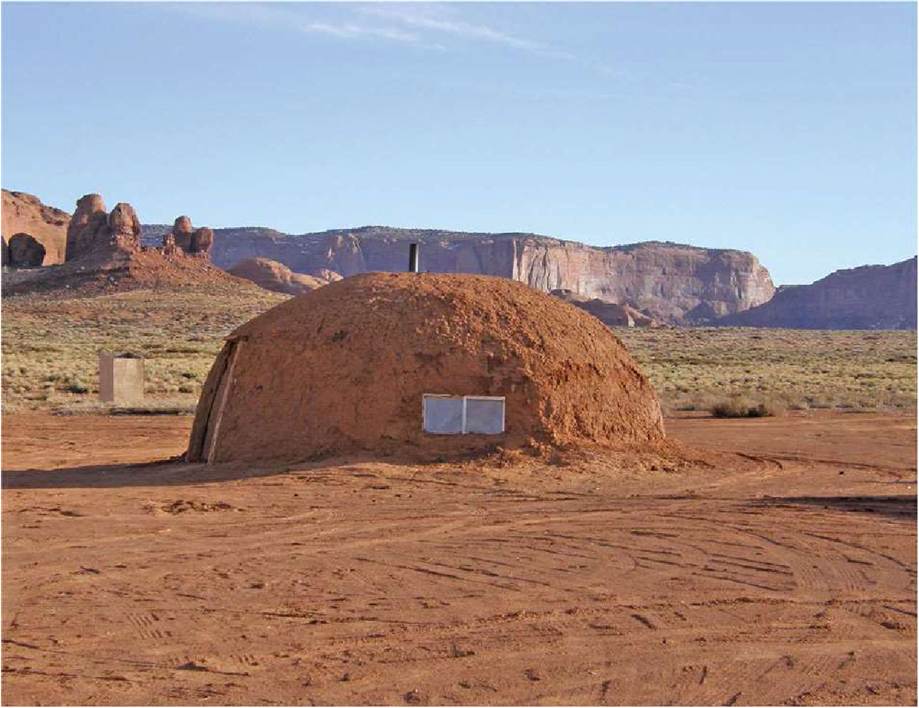
Navajo hogans are built to represent the Navajo lands and the cosmos.
The words of Black Elk illustrate the important relationship between the elderly and the very young. In many Native religions, elders teach youngsters about their religious heritage through myths.
Often, the telling of myths is regarded as sacred speech. Because of the cyclical nature of time, the events related in myths are not thought to be a part of a distant and irrecoverable past but rather are representative of another place on the circle of time. Recounting a myth re-creates the events of the myth, transporting listeners into mythic time.18In some Native cultures of California and the southwestern United States, deaths are marked by special cry ceremonies, which involve sacred mourning songs and tales, dances, and sharing stories about the deceased, all of which aid the spirit of the deceased in transition to the next world. In the nineteenth century, Native communities in Nevada and California held the cry annually as a collective mourning rite for all the deceased. Eventually, peoples in the region like the Southern Paiute began to hold cries for individuals.19 For the Southern Paiute today, the cry ceremony helps guide the spirit to the next world, and emotional talk about the deceased is thought to give strength to the spirit on a difficult journey.— In this chapter’s “Voices” interview with Brian Melendez, attending cry ceremonies with his community was one of the first spiritual practices he recalled as a child.
Earlier in this chapter, we learned how the ancestors of the Navajo sang and painted the world into existence. Thus, words and language were the building blocks of creation. The rituals of the ancestors provide the foundation for Navajo ceremonial practice, which is focused on maintaining order in the world. This is primarily done through practices known as chantways. Chantways involve ritualized singing and chants and may take place over several days. Like the cry ceremonies, the songs and chants retell the stories of creation and thus, through language, bring the power of the time of creation into the present. Chantways are used in many contexts, such as marriages, births, and puberty rites, and are thought to have the power to bring great benefit.
The chantways are used for healing by aiming to bring afflicted individuals into harmony with their surroundings. Normally, the ceremonies take place in hogans.VOICES:
An Interview with Brian Melendez
Brian Melendez is of Northern Paiute, Southern Paiute, and Western Shoshone descent. He is a member of the Reno-Sparks Indian Colony, in Nevada, and is from the Hungry Valley tribal community.
What is your background?
I am Northern-Southern Paiute, and Western Shoshone. I’m from three different Great Basin cultures. As a Great Basin person, I don’t just have one isolated tribal identity. Growing up in Hungry Valley [the Reno-Sparks Indian Colony], I was fortunate that my family fostered a mixture of different belief systems. We lived together in modest tribal housing and often shared space with extended families. Times were very difficult back then. There was never a shortage of dysfunction in my community. We had countless issues and collectively struggled. The Reno-Sparks Indian Colony is made up Paiute, Shoshone, and Washoe people. As a Tribe, we maintain three distinct languages and cultural mechanisms, happening all at the same time. Today, most young people, like me, are some combination of all three groups.
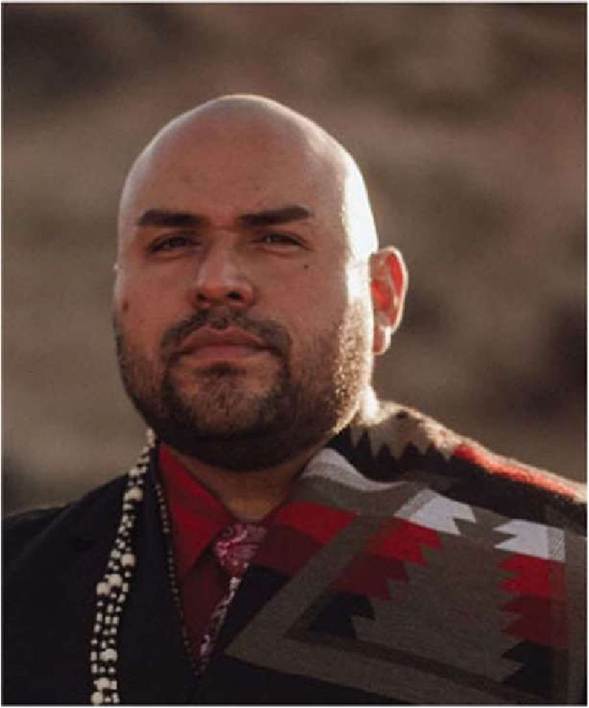
Brian Melendez.
In your view, what is the nature of the world? What is humanity’s place in it?
Tribal people embrace the art of storytelling and introspection, and much of our cultural identity is based on what is shared with us through stories. Our stories emphasize that we have a purpose to provide a certain balance within nature: I believe that our innate occupation is to protect family, community, and nature. In my opinion, nature is the greatest equalizer, to address imbalances of humanity. I think that there is a justice in nature. Spiritually, when we wanted to know something, to gain power, or to heal, we would go out into the world, and on our own merit we would stand before creation for those answers.
Our ancestors were impeccable in their understandings of these actions. Today, we are not as ingenious as they once were, or as resourceful... but I like to think we do our best to live as natural as possible. We understood that we would have to travel to where the food and water was—we had to move with nature, otherwise we wouldn’t exist. I think that modern people don’t look at nature that way. Modern people want nature to be convenient. For us, we feel that we owe something to our environment, as stewards of the land. Moreover, we feel that that there is a need to preserve the integrity of the planet. Protection of the planet may be the most agreed- upon platform among tribal peoples in this country. Our cultural identities, belief systems, and complex languages are derived from our relationship with nature: everything we are as indigenous people is connected to the environments we’ve existed in. The justice of nature, and our role in nature, keeps my culture in harmony.Could you describe your religious practice and your personal spirituality?
My spiritual identity began as a young child. I can recall participating in cry ceremonies associated with death. Putting someone to rest culturally is a substantial ritual. Even though some belief systems conflicted, almost everyone in my community would participate in burials: mourning is a universal part of our collective faith. As Great Basin people, our communal foundations and much of our spirituality are based on the cycles of life and death. Ideally, the respect we have for life should be equal to the respect we have for death.
In 2001, my little brother died tragically. He was preparing to participate in the Sun Dance that summer with our family, and never made it. Reluctantly, I attended in his place. Overpowered by grief, it was during the Sun Dance that I had the proverbial “coming to God” experience. It was at that moment I knew that I could not go back to living the way I had been. I said to myself, “I don’t know what this ceremony is, but I know that my brother is here, and whatever I have to do to be with him in this circle, I’ll do it.” My relatives were able to direct me to areas where I could learn: with an open mind and heart, I found various sweat lodges and Sun Dances.
I went to all types of ceremonies when I began my spiritual path, traveling the country for a couple of years figuring myself out. Over the years, I have become a practical-minimalist, I’m a pretty pragmatic guy. I contribute my time and energy for my community to sing, dance, and pray in our mountains, the way our people once did. The fruits of these labors have been beautiful.What opportunities and challenges do you face as a member of a Native community in the United States today?
The federal government definitely had a plan when they taught our people to be carpenters and housemaids. They weren’t giving us hard science and philosophy so that we could be equal to each other. Today, we understand the range of multiple educations and how to use them all. In terms of spiritual practices, parents are supposed to teach their children, but when they were separated during the boarding school era, they weren’t able to do this. Thus, our grandparents were forcefully removed from their cultural and tribal roles. This was especially devastating for my parents’ generation. For my parents... they were in a state of confusion and struggling with their own identities. They couldn’t teach what they didn’t know. It created direct trauma for them, and indirect trauma for us. My generation is currently working to heal this trauma.
The upside is that, today, tribal people in this country have never been more mobile. We have more access to technology, to academics, to economic capital, to larger communities. Tribes are able to stay up to speed with what other tribes are doing; this is forcing us to evolve. When it comes to spirituality, we are able to observe what neighboring tribes are doing to retain their cultures. Tribes are problem-solving to find something that works, for who they are today. This is helping tribal people adapt and adopt new practices, which assist communities as they self-regulate. We were at a spiritual ground zero—we were struggling to maintain customs and rituals, some more than others. Not all transitions are easy or even welcomed; sometimes these changes create tension with the older generation. Some people are wishing for a revival of old ways, some people are working towards a revolution of change: there’s no one right way or wrong way. This is all happening internally in Indian Country right now.
Self-Assessment 2.1
[Please note: You must be using an online, browser-based eReader in order to view this content.]
More on the topic Sacred Language and Sacred Time:
- Sacred Language and Sacred Time
- Women in the Sacred Landscape of Early Christian Narrative
- Other Sacred Practices
- Hindu Sacred Texts
- THE INNER CIRCLE OF THE DUAT
- Sacred Spaces and Objects
- The sacred from the Stone Age to the present and back again
- THE SCIENCE OF SACRED RITUAL
- PROLOGUE Introducing a Sacred Isle
- Church Interiors: Sacred Space