The Minor Festivals
In contrast to the major festivals, several “minor” festivals serve to fill out the Jewish religious year. Despite their historically subordinate status, they are beloved by the many Jews who observe them.
The observance of many of these minor festivals does not entail restrictions on labor, diet, or any other activities. In addition, while the agricultural cycle is clearly embedded within the calendar of major holidays, the minor festivals only indirectly reflect the season in which they appear.Hanukkah
Of all of Judaism’s minor holidays, Hanukkah is probably the best known throughout the Western world. Hanukkah commemorates the Maccabean rebellion that began in 167 bce against the tyrannical rule of the Syrian monarch, Antiochus IV, who sought to suppress the practice of Judaism within Palestine and who “defiled” the Temple in Jerusalem by rededicating it to the Greek gods. For the next two years an armed insurrection, led first by a priest named Mattathias and after his death by his eldest son, Judah the Maccabee, wrested control of the Temple from Antiochus’s army. Hanukkah celebrates the recovery and cleansing of the Jerusalem Temple and the miracle of the lights that Jewish tradition records. According to this legendary account, once the Temple was in Jewish hands it became necessary to rededicate the sanctuary—yet only one flask of the oil necessary to keep lamps lit could be found. Miraculously, however, this one flask continued to burn for eight days, thus attesting to the renewal of God’s presence within the Temple. In commemoration of that miracle, Jews light a candle each night for eight nights until a ceremonial lamp (known in Hebrew as either a menorah or a hanukkiah) is completely lit. This candle-lighting ceremony is accompanied by the chanting of prayers, the singing of songs, and, in more recent times, the giving of gifts.
In addition, a traditional game of chance is played with a four-sided top known as a dreidel, on whose sides are inscribed four Hebrew letters, which stand for the words meaning “a great miracle occurred there.” In contemporary Israel, however, dreidels bear a slightly altered message: “a great miracle occurred here,” referring to the establishment of the Jewish state in 1948.Purim
Another history-oriented festival is Purim, which occurs on the fourteenth day of the month Adar (February-March). Purim is a camival-like holiday whose origins can be found within the biblical book of Esther. Like Hanukkah, Purim celebrates a victory, this time over an antagonist named Haman, who appears in the book of Esther as a would-be destroyer of the Jewish people. However, unlike Hanukkah, the underlying festival narrative appears to have little or no historical basis. Still, Purim tells an interesting story of adaptation and survival against all odds, and it is a story that has gripped the Jewish imagination for centuries.
For Orthodox Jews, Purim begins with a fast on the thirteenth of the month of Adar. Once the fast is over, the festive aspects of Purim begin. These include a reading of the book of Esther. Congregants interrupt the narration with shouting and foot stamping every time Haman’s name is read aloud. In addition, the rabbis, many centuries ago, sanctioned the practice of drinking to excess on Purim, thereby contributing to an atmosphere of barely controlled anarchy, while children are dressed in costumes that suggest the principal characters in the Esther story.
Purim also has its more sedate customs: the sending of gifts to friends, or to the poor, and the eating of triangular-shaped cookies known as hamantaschen, variously thought to represent Haman’s ears, or hat, or pockets. Finally, although there is no prohibition against working on Purim, many Orthodox communities will devote the entire fourteenth of Adar to celebrating this festival.
Tu B’Shevat
The fifteenth day of the month of Shevat (Hebrew, Tu B’Shevat) is identified in rabbinic literature as the “New Year’s Day of Trees.” Typically, trees are planted on this day (especially in modem Israel), and monies are set aside for the poor.
In some communities Jews hold a special Seder on Tu B’Shevat consisting of recitations from the Bible and the Talmud, combined with the eating of certain fruits and nuts that are native to the land of Israel. Tu B’Shevat is celebrated near the end of January or the beginning of February.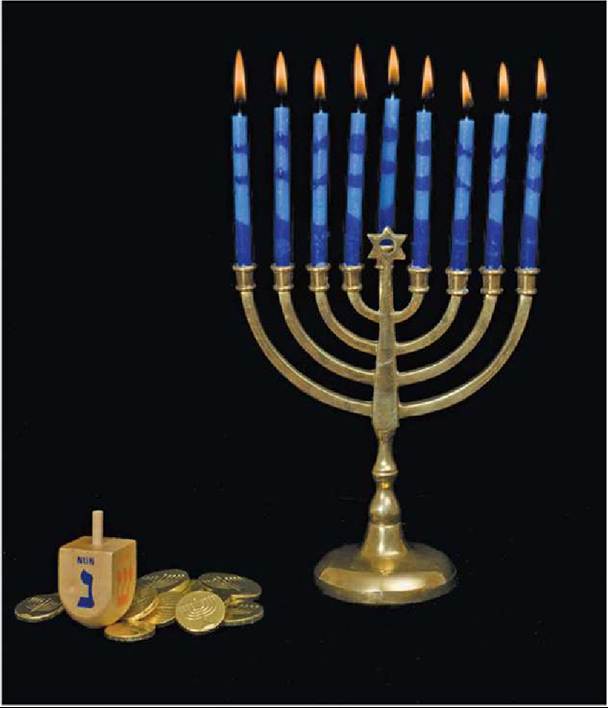
On the final night of Hanukkah, all the candles are lit while children play with the dreidel, a game with toy coins.
Tisha B’Av
The ninth day of the month of Av (Hebrew, Tisha B’Av) is, after Yom Kippur, the most solemn day in the Jewish calendar because it commemorates the destruction of both the First Temple by the Babylonians in 587 все and the Second Temple by the Romans in 70 ce. Each of these events was a tragic turning point in Jewish history, leading to the loss of national sovereignty and the subsequent exile of the Jewish masses from their homeland. On Tisha B’Av (commonly celebrated in July or August), Jews fast from sunset to sunset as they remember not only these tragedies but other terrible losses that they have suffered during their long history. Like Yom Kippur, Tisha B’Av is a day of collective contrition and virtual mourning, as
Jews gather in synagogues to read from the book of Lamentations and sing hymns that reflect on the double loss of Jerusalem and Jewish nationhood.
Yom HaShoah
Holocaust Memorial Day, or Yom HaShoah in Hebrew, is the most recent addition to the sacred calendar in Judaism. In 1951, the Israeli Parliament selected this date (the twentyseventh day of Nisan [March-April]) as a remembrance day for the millions of Jews who were victims of Nazi genocide during World War II. This date was chosen because it coincides with the beginning of the Warsaw Ghetto Uprising of 1943, and Jewish communities throughout the world observe this day of collective mourning and reflection. Yom HaShoah, however, is not a fast day, and unlike Tisha B’Av there are no prohibitions on work or other activities. Nevertheless, it has become customary in recent years for Jews to gather on the evening of the twenty-seventh of Nisan and to recite memorial prayers for the roughly one-third of the Jewish world population who lost their lives during the war.