The Sabbath
Although it is neither a major nor a minor festival, the weekly Sabbath (Hebrew, Shabbat) forms the core of the sacred calendar in Judaism. Like the major festivals, it is a day of prayer and rest, with its own liturgical tradition and pattern of observance; but, unlike any other sacred occasion in Judaism, its observance is explicitly mandated in the Ten Commandments.
The Torah provides two different rationales for Shabbat: in the book of Exodus (20:8-11), it is identified as the day on which God rested from his creative labors; in the book of Deuteronomy (5:12-15), however, it is associated with the Exodus from Egypt and liberation from slavery. Each of these explanations provides a distinctive interpretation of the meaning of Shabbat; the first rationale is supernatural, whereas the second, the Exodus, is historical. For both interpretations, however, the commanding lesson of the Sabbath remains the same: God’s actions, whether at the beginning of human time or at a turning point in the history of Israel, serve as a model for human behavior. The Creator/Liberator has separated sacred time from ordinary time, and so must we.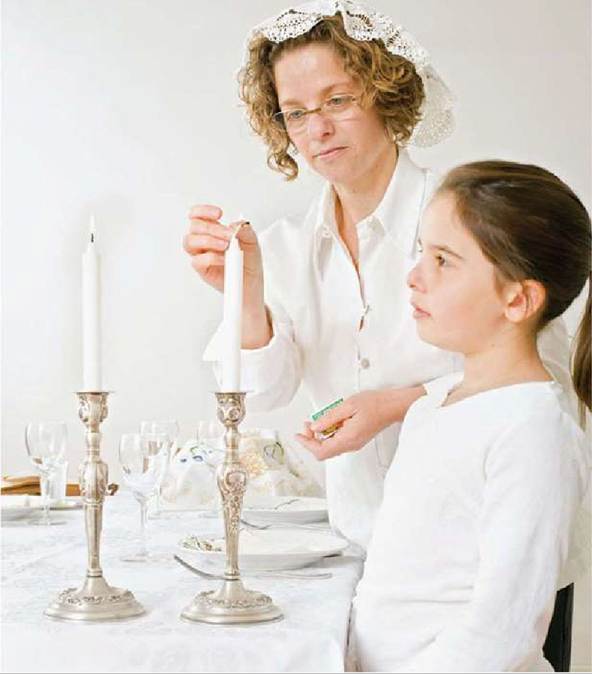
A Jewish mother and daughter light the Sabbath candles.
Shabbat begins at dusk on Friday and concludes at sundown on Saturday. This twenty-four- hour period is ushered in by the lighting of two candles in the home, reminiscent of the first act of creation. Customarily, it is the woman of the house who lights these candles. Once the Sabbath formally begins, observance shifts to the synagogue, where the Erev Shabbat (Sabbath evening) service is conducted. The liturgy for Sabbath evening identifies the Sabbath itself as a “bride,” and the feelings aroused by the “joy of the Sabbath” are similar to the emotions evoked by a wedding.
With the return of the family from prayer, the Sabbath meal begins with a prayer of sanctification recited over wine and a blessing said over two loaves of bread. Sabbath bread is called challah, and it is usually baked in a shape that suggests a woman’s braided hair (yet another allusion to the Sabbath “bride”).Sabbath morning observance shifts to the synagogue, where, in addition to the Shabbat liturgy, a weekly portion of the Torah is read, accompanied by a portion from the prophetic books. That service concluded, the remainder of the day is spent quietly until the evening, when the last two worship services of the day are celebrated, and a separation ceremony, known as Havdalah, is observed with a cup of wine, a braided candle, and a spice box—all reminiscent of the sweetness and calm of the Sabbath. The rabbis of the Talmud once observed that it was not just Israel that had kept the Sabbath but the Sabbath that had kept Israel. As the most direct link to the ancient past, Shabbat serves as one of Judaism’s primary symbols of historical and spiritual continuity.
VOICES:
An Interview with Ms. Avigayil Halpern
Ms. Halpern graduated from Yale University in 2019 with a degree in Judaic Studies. She is presently enrolled at the Hadar Institute—an egalitarian yeshiva located in New York City—with the goal of entering the rabbinate.
As a modem observant woman who is seeking semicha (rabbinic ordination), what future do you see for college-educated women within the Orthodox community? Will they be able to overcome obstacles to full religious participation in that community that have existed in the past?
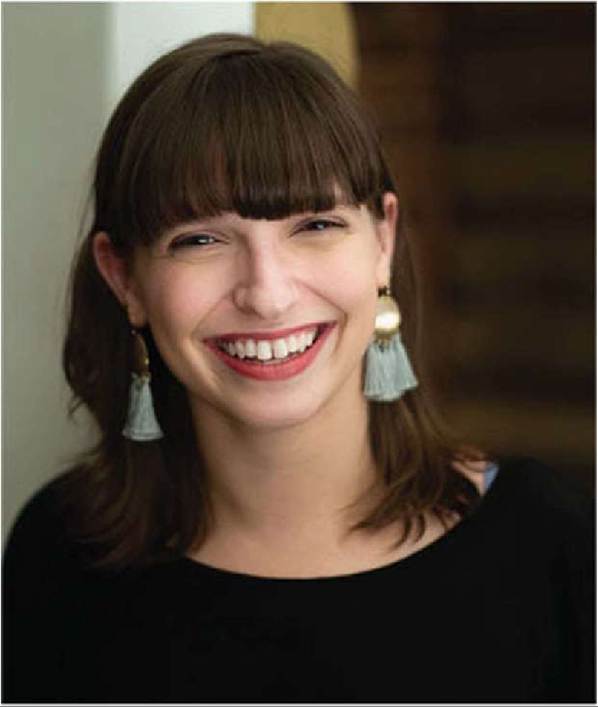
Avigayil Halpern.
I grew up in a more liberal Orthodox Judaism, and feel very connected to that community, but while I continue to practice in a way that is similar to Orthodoxy, I no longer identify as Orthodox myself. This is because in even the most liberal streams of Orthodox Judaism today, gender division in ritual roles is central, and I practice in a gender-egalitarian way, even as I observe ritual laws like Shabbat and Kashrut to the same standards as Orthodox people.
I believe that the strength of women’s education in liberal/Modern Orthodoxy is to its credit, the disjunction between the opportunity to study Torah at the highest levels and the inability to participate fully in synagogue life was too jarring for me, and I sought out communities where I could have a more integrated experience of Torah study and communal religious practice. I believe that different people will seek out different ways to maximize religious participation and increase women’s role in traditional forms of Judaism. For some of us, that means leaving Orthodoxy, and for others it means working within that community.Can you foresee a time when women in the rabbinate will seem commonplace to almost all Diaspora Jews?
I’ll start by noting that for most American Jews, women rabbis are so commonplace as to not even be a live question anymore. Even within my short lifetime, I have seen a dramatic shift in the acceptance of women rabbis within Orthodoxy, and there is even an entire school dedicated to the ordination of women. I believe as the numbers of women within the rabbinate grow, more men and women within the Orthodox community will become accustomed to the idea of a woman in the pulpit, and it will simply start to feel less foreign.