Life-Cycle Events
At each stage in the cycle of living and dying, Judaism offers a distinctive ceremony that marks the passage from birth to death. The ultimate object of these rites of passage is the sanctification of human life and the desire to deepen the covenant relationship between Israel and God.
Birth
The ritual process of entering the Jewish community begins, for male babies, on the eighth day of life with the rite of circumcision. Jews are not the only people today who circumcise male infants (nor were they in antiquity), but in Judaism circumcision is much more than a medical procedure. It is a mitzvah, a divine commandment imparted to the biblical patriarch Abraham and incumbent upon all of his male descendants from that time forward.
Historically, circumcision has been one of the distinctive physical marks of Jewish identity. Its importance for Jews can be gauged by the fact that the circumcision ritual takes precedence over the Sabbath or any other holy day in the sacred calendar. The only thing that would delay the performance of this mitzvah would be concern for the health of the child. During this ceremony, after the mohel (a ritual circumciser, who is usually a medically trained professional) has removed a portion of the infant’s foreskin, the newborn receives his Hebrew name, which traditionally consists of the child’s own name and that of the father (for example, Isaac son of Abraham). From this moment on, this is the name by which the child will be known in the Jewish community, particularly on ritual occasions. In many Conservative and Reform communities, it has become the custom to add the mother’s name to the father’s.
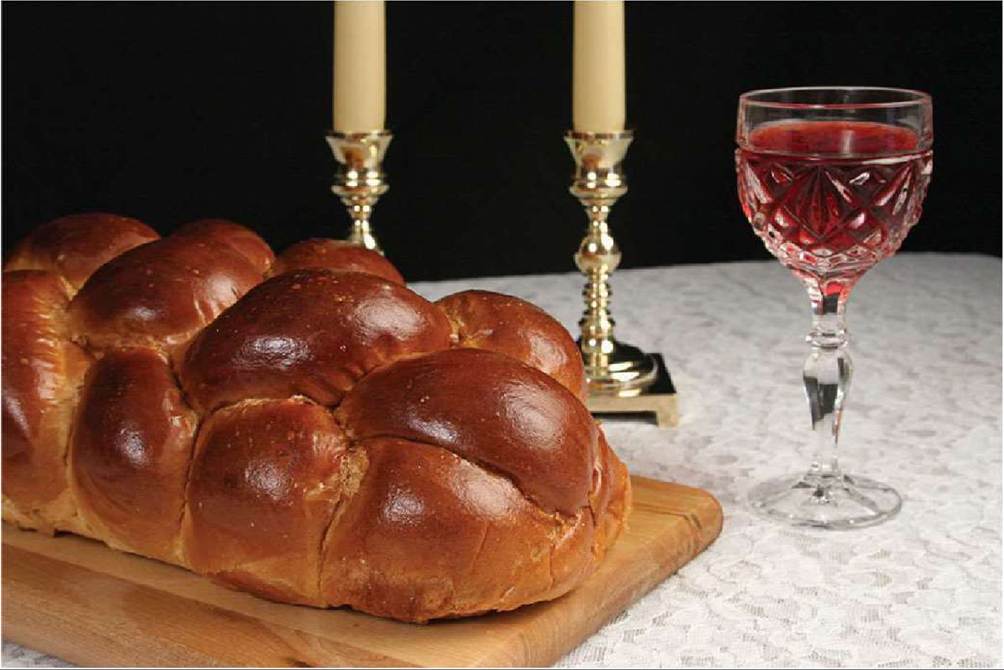
A table set for Shabbat: Challah, candlesticks, and wine.
Baby girls enter the Jewish community under slightly different circumstances.
There has never been any form of female circumcision in Judaism or any fixed naming ritual for the infant female. However, one popular custom today among Jews worldwide is the practice of bringing the newborn to the synagogue on the first (or, in some communities, the fourth) Sabbath after birth. On that occasion, either the child’s father or both parents are called up to the Torah and recite the customary blessings. Then the baby girl is given a Hebrew name, and, like her male counterpart’s, it is the name that she will use on all ritual occasions for the rest of her life.Bar/Bat Mitzvah and Confirmation Jewish males traditionally enter the stage of religious maturity at the age of thirteen, whether or not they have engaged in the Bar Mitzvah ceremony. There is no reference to such a ritual in the Hebrew Bible, nor do the rabbis of the Talmud make mention of any specific rite of passage that marks a young man’s assumption of responsibilities as an observant Jew. Nevertheless, by the later Middle Ages, something like the Bar Mitzvah ceremony practiced today had already begun to evolve, consisting of some demonstration of Hebrew literacy and an ability to read a weekly portion of the Torah. Of all the commonly practiced rituals of contemporary Judaism, the Bar Mitzvah is the one ritual that is likely to be familiar to nonJews.
Compare the Bar or Bat Mitzvah in Judaism with the confirmation ceremony in various forms of Christianity. How are they alike, and how do they differ?
After years of study, the young man who becomes a Bar Mitzvah is taught to see himself as a scholar-in-training whose entry into adult Jewish life is just the beginning of a lifelong program of study. Although the celebration that follows is often joyous, there is a serious underlying purpose: the preparation of a young person to assume what the rabbis have called the “yoke of Torah.” Thus, in addition to reading a portion from both the Torah and the prophetic literature, a Bar Mitzvah is expected to deliver a brief scholarly explanation of the portion he has just read, thereby demonstrating a mature comprehension of Jewish Scriptures.
The practice of requiring young women (between the ages of twelve and thirteen) to furnish similar proof of both literacy and religious commitment is of much more recent origin. The first Bat Mitzvah to be performed in the United States was conducted in 1922 for Judith Kaplan, daughter of Rabbi Mordecai Kaplan, the founder of the Reconstructionist movement. Beginning as a gesture designed to affirm gender equality in modern Judaism, the Bat Mitzvah soon evolved into an alternative form of the Bar Mitzvah ritual, and today the Bat Mitzvah ceremony is as common as the Bar Mitzvah in non-Orthodox communities.
Another innovative practice, known as a Confirmation, is almost as commonplace today in non-Orthodox communities as the Bar and Bat Mitzvah, and it, too, involves a process of study and ritual performance by both young men and young women. The Confirmation ceremony can be traced back to the early decades of the Reform movement in nineteenthcentury Germany, where some reform-minded rabbis attempted to find an alternative rite of passage for adolescents rather than the traditional Bar Mitzvah, believing that the latter had become little more than a ceremonial occasion. Their solution was to borrow a practice from the Christian church and to require sixteen-year-old males (and later females) to make a profession of faith during the Shavuot service, thus connecting their religious coming of age with the traditional celebration of the giving of the Torah at Mount Sinai. This practice was integrated into the traditional life cycle after World War II, as many Reform and several Conservative congregations added the Confirmation ceremony to the now-lengthened process of Jewish education. Thus, instead of supplanting the Bar Mitzvah, the Confirmation ceremony simply became a secondary stage of the passage to adulthood.
Marriage and Divorce
In Judaism, marriage is a contractual relationship between a man and a woman, rooted in mutual love and respect, and presumed to be both monogamous and enduring—a relationship on which divine blessings can be invoked.
However, like all contracts, the marriage contract can be dissolved.Over time, Jews have devised formal procedures for regulating and solemnizing the processes of marriage and divorce. Many centuries ago, the marriage ceremony consisted of two separate rites: the betrothal and the actual nuptials. According to this ancient custom, the future bride and groom became engaged to one another through the exchange of a ring. The couple then returned to the homes of their respective parents for a year, after which time the bride and groom gathered, along with their families, under a marriage canopy (known as the chuppah). A rabbi would recite seven blessings, praising God and sanctifying the union, and only at the conclusion of this ceremony would the marriage be consummated. Today, these two ceremonies have been combined and are accompanied by other, largely symbolic rituals: first, having the bride and groom drink from the same wine cup, and second, having the groom present the bride with her marriage contract (Hebrew, ketuvah). Finally, at the conclusion of the ceremony, the groom crushes a wine glass with his shoe—traditionally understood to symbolize the destruction of the two temples—whereupon the attending guests shout “Mazel Tov” (Hebrew, “good luck”).
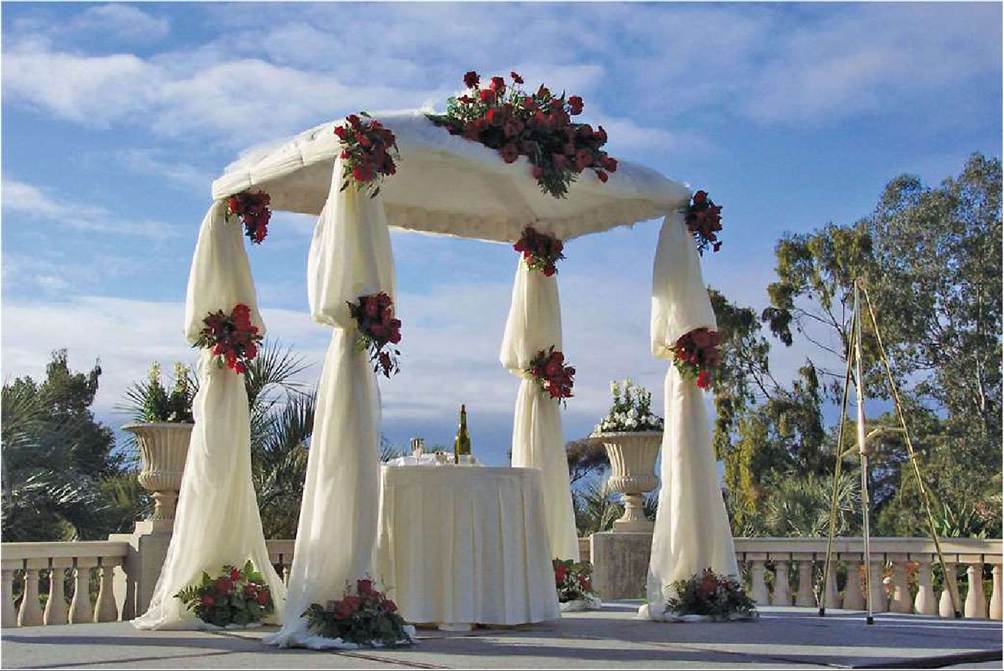
The bride and groom will stand under this chuppah during the wedding ceremony.
From a traditional point of view, the presentation of the ketuvah by the groom is the core of the marriage rite in Judaism because it states publicly the groom’s intention to provide for his bride’s well-being while he lives and her financial security after he dies, or after they divorce. Traditionally, the groom alone vows to set aside monies in escrow as “marriage insurance,” but many modem Jewish couples have opted for a very different kind of ketuvah, vowing mutual commitment and support, symbolized by an exchange of rings.
Jewish divorce proceedings are no less formal than the marriage ceremony.
After marital counseling has been tried and failed, the couple comes before a rabbinic court that hears the case. The divorce document is then drawn up, releasing both parties from any future obligation to one another. At that moment, the husband (or his representative) must hand the divorce document to his soon-to-be ex-wife. He is then declared to be free of their union and eligible to marry again—that very day, if he chooses. The wife, however, must wait three months to marry again, on the presumption that she maybe pregnant and therefore carrying the child of her former spouse. Moreover, if her husband refuses to grant her a divorce—or cannot do so because he is missing—traditional Jewish law leaves her few options for dissolving the marriage. She may find herself bound by religious law to a husband who has abandoned her or who may have died without witnesses to his death. Orthodox communities continue to struggle with this legal dilemma today.Death and Mourning
In Judaism the deceased are treated with as much dignity as the living, and the ceremonies associated with the burial of the dead and mourning are invested with sanctity and respect. Whenever possible, a Jewish burial will take place within twenty-four hours of death (unless the Sabbath or a festival intervenes). The body is prepared for burial by being bathed and wrapped in a shroud and then traditionally placed in a simple pine box, thus discouraging ostentation. During the burial service, mourners express their sorrow by a symbolic tearing of their clothes—often wearing a strip of torn black cloth, pinned to a garment—while reciting prayers of praise for God and comfort for the soul of the deceased in the afterlife.
Once burial occurs, those mourners who were closest to the deceased—parents, siblings, children, or spouse—enter into a week-long period of mourning known as shivah (Hebrew, “seven”), interrupted only by the Sabbath. During this period, mourners do not work, remain at home, and receive well-wishers who join with the mourning family in “sitting shivah.” Because mourners are not expected, during this week, to attend synagogue, it is customary for friends to join the family in the home to recite morning and evening prayers.
Once shivah is over, however, mourners are expected to return to the world and everyday obligations, with the understanding that for the remainder of that month mourners will abstain from entertainments and remain in a somber state of mind. Once this thirty-day period of diminished mourning is completed, restrictions on the mourner’s participation in celebratory events are lifted, though most Orthodox Jews continue a modified mourning protocol until the first anniversary of a parent’s death has passed. The erecting of a tombstone does not normally occur until eleven months have passed; thereafter, close relatives are expected to visit the grave at least once a year—usually on the anniversary of the death of that family member—as well as to recite prayers in memory of the dead during memorial services held during all the major festivals. Finally, it is customary to light candles in the home at the time of the yearly anniversaiy of a loved one’s death, and, whenever possible, to place small stones on the gravestone as a sign of one’s remembrance of the deceased.
More on the topic Life-Cycle Events:
- Way of Life
- Individuals within species differ in their life histories
- Life-Cycle Rituals
- Life tables can be based on age, size, or life cycle stage
- CONTENTS
- HONE YOUR PROBLEM-SOLVING SKILLS
- The diversity of life reflects both speciation and extinction rates
- Some species reproduce only once, while others reproduce multiple times
- CASH FLOW AND THE COMPANY LIFE CYCLE
- Rites of Passage