The diversity of life reflects both speciation and extinction rates
Speciation may increase the number of species through time, but this increase may be offset by species extinction. The balance between the rates of these two processes determines the net diversity of species within a group.
We can visualize the outcome of this balance with an evolutionary tree, a branching diagram that represents the evolutionary history of a group of organisms. FIGURE 6.17A shows an evolutionary tree for the pinnipeds, a group of aquatic mammals consisting of seals, sea lions, and the walrus. The pinniped common ancestor lived about 20 million years ago, and its descendants include the 34 species of living pinnipeds along with a diversity of extinct species. The walrus group, for example, contains only a single species today—the walrus—but it once contained Gomphotoria pugnax and as many as 18 other species, all of which are now extinct.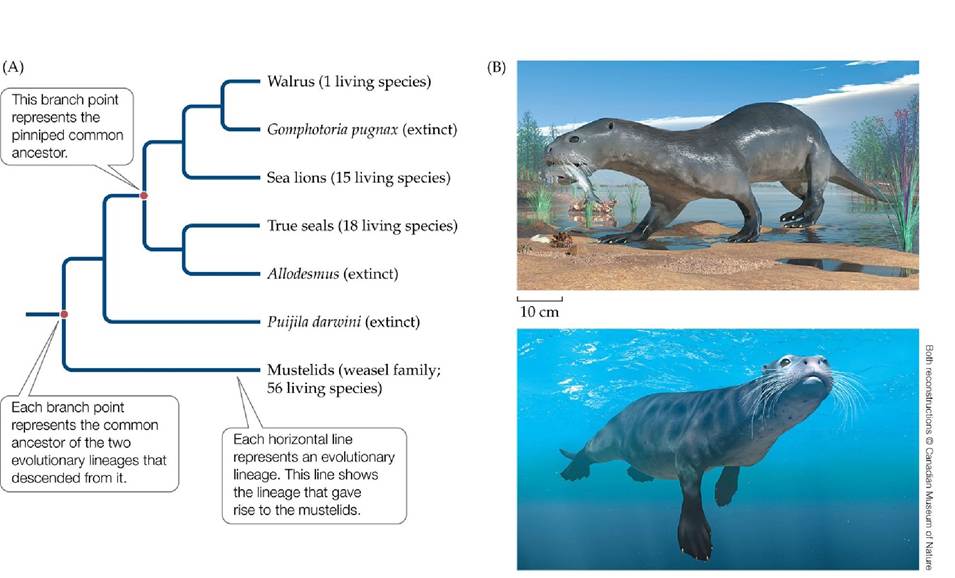
FIGURE 6.17 An Evolutionary Tree of the Pinnipeds (A)Thisbranchingtreeisa representation of the evolutionary history of modern seals and their close relatives that is based on recent fossil finds. This research indicates that the marine mammals known as pinnipeds probably share a common ancestor with modern weasels and their relatives. (B) Reconstructions of Puijila darwini based on fossils show that extinct close relatives of pinnipeds were similar morphologically to some living mustelids, such as otters. P. darwini appears to have foraged both on land (above) and in the water (below). (A after N. Rybczynski et al. 2009. Nature 458: 1021-1024.) View larger image
Extinction can also help us to understand the large morphological differences that occur between some closely related groups of organisms. Seals and other pinnipeds, for example, differ greatly from their closest living relatives, members of the weasel family (the mustelids). However, fossils of Puijila darwini (Rybczynski et al. 2009), an extinct close relative of the pinnipeds, show that extinct relatives of pinnipeds were similar morphologically to some living mustelids, such as otters (FIGURE 6.17B). Over time, repeated speciation events led to the origin of fully aquatic pinnipeds—but because P. darwini and other such species have become extinct, there are no living species that “fill the gap” between living pinnipeds and living mustelids.
Speciation and extinction events also have affected the rise and fall of different groups of organisms over long periods, as we'll see in the next section.