The genetic divergence of populations over time can lead to speciation
Each of the millions of species alive today originated by speciation, the process by which one species splits into two or more species. Speciation most commonly occurs when a barrier prevents gene flow between two or more populations of a species.
The barrier may be geographic, as when a new population becomes established far from the parental population, or when isolation is introduced by continental drift (see Concept 18.2). Barriers may also be ecological, as when some members of an insect population begin to feed on a different host plant. When a barrier to gene flow is established between populations, they diverge genetically over time (FIGURE 6.15).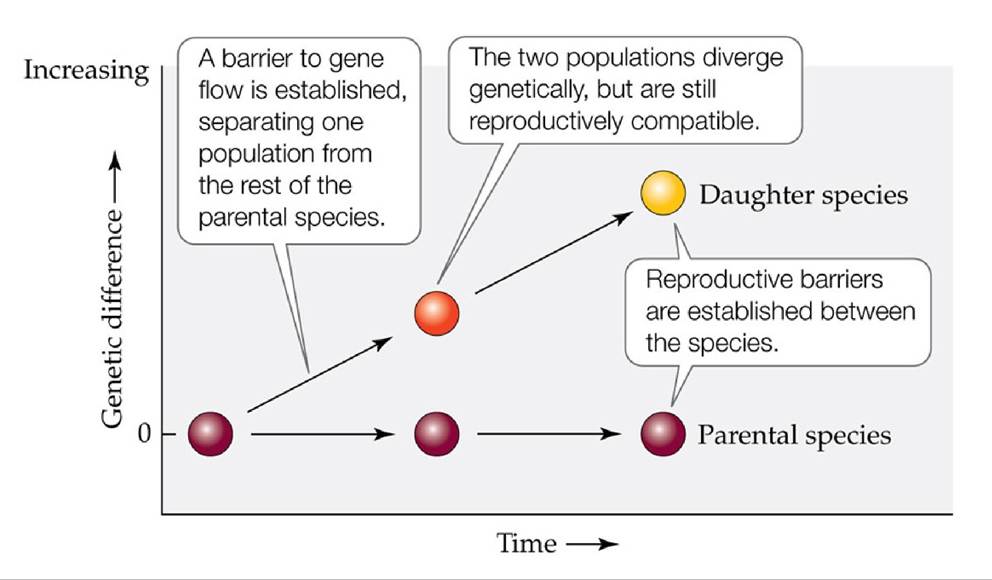
FIGURE 6.15 Speciation by Genetic Divergence Once genetic divergence begins, the time required for speciation varies tremendously, from a single generation (perhaps a single year), to a few thousand years, to millions of years in most cases. View larger image
New species can also form in several other ways, such as when members of two different species produce fertile hybrid offspring (see Figure 6.21 for an example in sunflowers). Whether it is produced by genetic divergence, hybridization, or other means, the key step in the creation of a new species is the formation of barriers that prevent its members from breeding freely with members of the parental species. Such reproductive barriers arise when a population accumulates so many genetic differences from the parental species that its members rarely produce viable, fertile offspring if they mate with members of the parental species.
The accumulation of genetic differences that lead to the formation of a new species can be an incidental by-product of selection. For example, an experiment with fruit flies demonstrated the beginnings of reproductive barriers between
populations selected for growth on different sources of food, but no such barriers were observed between control populations that had not been subjected to selection (FIGURE 6.16). Natural selection has produced similar changes in plant populations growing on soils with differing concentrations of heavy metals (Macnair and Christie 1983), in bird populations living in environments with different food resources (Smith and Benkman 2007), and in fish populations exposed to low or high levels of predation (Langerhans et al.
2007). In each of these cases, reproductive barriers arose as a by-product of selection in response to a feature of the environment, such as food source, heavy metal concentration, temperature, or presence of predators.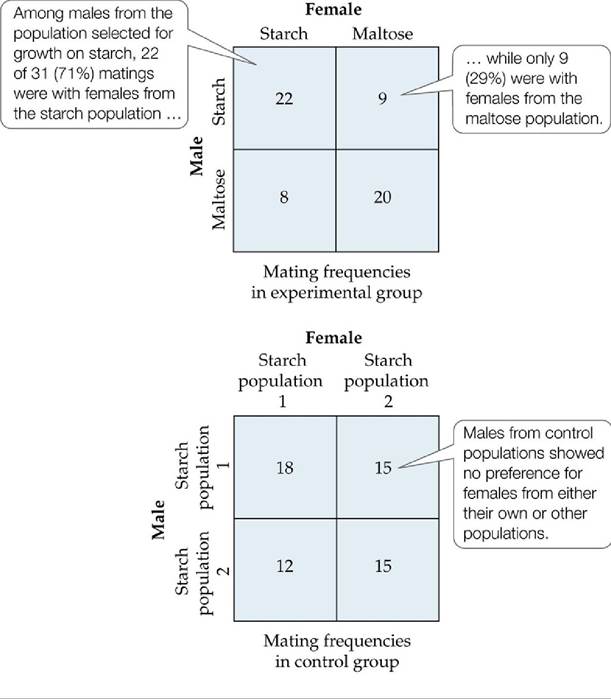
FIGURE 6.16 Reproductive Barriers Can Be a By-Product of Selection Afterlyear (about 40 generations) in which experimental populations of Drosophila pseudoobscura fruit flies were selected for growth on different sources of food, most matings occurred between flies
selected to feed on the same food source. No such mating preference was observed in control populations that were not subjected to selection, regardless of whether the control populations were reared on starch (shown here) or maltose (not shown). To reduce the chance that the food eaten by the larvae would produce a body odor in adults that influenced the results, all flies used in the mating preference tests were reared for one generation on a standard cornmeal medium. (After D. M. B. Dodd. 1989. Evolution 43: 1308-1311.) View larger image
Genetic drift can also promote the accumulation of genetic differences between populations (see Figures 6.7 and 6.8). As a result, like natural selection, genetic drift can ultimately lead to the evolution of reproductive barriers and hence to the formation of new species. Gene flow, on the other hand, typically acts to slow down or prevent speciation, because populations that exchange many alleles tend to remain genetically similar to one another, making it less likely that reproductive barriers will evolve.
More on the topic The genetic divergence of populations over time can lead to speciation:
- Populations grow geometrically when reproduction occurs at regular time intervals
- CONCEPT 6.1 Evolution can be viewed as genetic change over time or as a process of descent with modification.
- CONCEPT 10.1 Populations are dynamic entities that vary in size over time.
- CONCEPT 9.1 Populations are groups of individuals of the same species that vary in size over space and time.
- CONCEPT 6.2 Natural selection, genetic drift, and gene flow can cause allele frequencies in a population to change over time.
- Orthopedic problems in childhood deserve special attention for two reasons: (a) many of them are mere developmental aberrations which correct spontaneously over time and do not need any intervention, e.g. physiological bowing, and (b) even a minor defect of growing skeleton may lead to long-term adverse effects on childhood growth and development.
- Small populations are at much greater risk of extinction than large populations
- Differential takeoffs and the great divergence
- CONCEPT 12.3 Predator populations can cycle with their prey populations.
- The diversity of life reflects both speciation and extinction rates
- REFLECTIONS ON MULTICULTURALISM: CONVERGENCE AND DIVERGENCE IN AUSTRALIA AND SINGAPORE
- Despite growing Muslim minority populations in many Western countries, one area where there has traditionally been seen to be a legal disconnect between those populations and their new countries is the area of adoption, or the similar but distinct concept known in Islam as ‘kafala’.
- Connections in nature can lead to unanticipated impacts
- CONCEPT 6.4 Long-term patterns of evolution are shaped by large- scale processes such as speciation, mass extinction, and adaptive radiation.
- 17 Lead ingestion in a puppy
- There are many reasons or motives which may lead someone to study religion or particular religions.