The practice of religion
The most visible and common way in which religion is expressed on the subcontinent is in its practice, especially in the form of diverse and colorful rituals. There are many reasons why ritual is so popular in India today.
For one thing, from the beginning of Indian civilization, ritual has served to express one’s fundamental place in the social and cosmic order. Ritual acts out one’s relationship to family and kin, expresses one’s obligations consistent with dharma, and enacts “tradition” in such a way as to make that “tradition” accessible to the senses. One can see, hear, taste, even smell the “tradition”; one can experience “tradition” somatically. One expresses one’s identity as a member of a particular family or village/city or of a regional or linguistic matrix. Ritual also serves a pragmatic purpose in contemporary life as many see in it a strategy for changing the circumstances of their lives - the quest for betterjobs, educational opportunities, etc. are often expressed ritually. In a ritual one can negotiate or reflect the various passages and boundaries that modernity imposes - between global and sub-ethnic identities; between the past and the contemporary moment; between generations; between “us” and “them.”Pilgrimages and festivals
More people have been making religious pilgrimages in India today than has been true at any other point in history. While classical texts identify any number of places where a pilgrim may attain special grace, the building of roads and railway connections, vigorous advertising, and increased wealth all have made pilgrimage an enormously popular enterprise today throughout the subcontinent. Sacred places abound: riverbanks andjunctures, hill tops, geographically suggestive landscapes - many have been mythologically enhanced. One or another deity is said to have set up residence or to have performed a certain act in a specific place.
Siva, Visnu, or a goddess are said to have sacralized at least 108 places each throughout India. The subcontinent itself is said to be sacred land centered as it is by Kailasa, the mountain at the center of the world. A given state can be rendered mythologically sacred as when Tamil Nadu is said to have six cakras or sacred places - sacred, that is, to the Tamil’s favorite god Murukan. Tamil Nadu, as a whole, is thereby rendered congruent to the body of a yogin and to the cosmos and each holy stead of Murukan becomes a point of access to heaven itself. Geographer S. N. Bhardwaj has noted that there are several levels of pilgrimage in the Indian context ranging from the national to the local.6 There are the national or even international sites, such as Varanasi, Tirupati, Hardiwar, or Rameshwaram because of their geographical and mythological significance nationwide. Pilgrims to these centers are often more affluent or classically oriented than those who attend more local shrines. But there are also regional centers which usually serve pilgrims with distinctive ethnic or regional ties while local centers often celebrate ‘folk’ deities or sacred figures with strong local attachments. Some pilgrimage centers have roots a couple of millennia old - such as Varanasi, while others are the products of dynastic patronage in the late medieval period - such as Tirupati, the famed pilgrimage site of the Vijayanagara kings. Still others have mushroomed into popularity within the last century, despite claims to antiquity. Such is the case, for example, with Sabaramala, Kerala.The reasons for going on pilgrimage are manifold: because one has a vow to keep if a certain wish has been granted; to seek improvement in the very mundane aspects of life; to seek grace, immortality, or healing at the hands of the deity; to educate oneself or one’s family as to the story of the particular deity of the place; and many others. Serious religious activity is mixed with recreation and play.
It should be worthwhile to look more closely at one or two pilgrimage locales.Varanasi
Varanasi - or Kasi or Banaras, as it is also called - is one of the oldest pilgrimage centers in the world. It is a place where Buddhist and Jain sages visited in the sixth century bce and today it attracts millions of pilgrims in any given year. The sacrality of Varanasi is based on several factors in addition to its historical importance.7 For one thing, the Ganges river itself is said to be sacred, flowing, as it is believed, from the abode of the gods. But at Banaras the river takes a special turn: it assumes the form of a crescent and flows momentarily from south to north. It is here Siva is said to have caught the Gariga in his hair as it was plunging out of heaven; this is why his iconography often depicts him with a crescent in his hair. Moreover, the ideology of the trha or crossing place is focused on Varanasi. A tirtha is a place where one can “cross over,” where one can experience the expiation of sins. Here, saints and gods are said to have bathed so as to be purified preparatory to attaining enlightenment. There are over 300 propitious places or tirthas in Banaras alone and the riverbanks are jammed with bathers each morning at dawn. Varanasi, further, is a major cult center for Siva, known here as Visvanatha (Lord of all Directions). Virtually all visitors to Banaras will visit the temple to Visvanatha in hopes of attaining moksa or ultimate liberation. Finally, Varanasi is a place propitious for dying and performing the rituals associated with death. Hospices dot the landscape and funeral pyres can be seen along the river’s banks. To die here is to go straight to the land of the ancestors. The orthoprax come to Varanasi to perform sraddha or memorial rituals for their deceased ancestors.
Quite apart from the golden temple of Visvanatha, there are numerous other shrines, for example, to the goddesses Annapurna and Laksmi, believed able to bring wealth; to various manifestations of Visnu; and to any number of local folk deities, where priests are non-brahmans.
At many of these shrines the local deities are thought able to address specific problems, for example, removing of obstacles (Sankatamochan or Sankata Mai) or warding off evil spirits (Kal-bhaira or Pishamochan). Almost three-quarters of the shrines of Varanasi are of local significance, looked after by local inhabitants; another 5 percent or so of the shrines are maintained by particular ethnic groups - these include, for example, shrines to Amba and Gopal, attractive to Gujaratis, and Visalaksi, popular with Tamilians.8 Nonetheless, it is the classicized and pan-Hindu temples (about 6 percent of the total) that attract pilgrims from afar.Prof. L. P. Vidyarthi and his colleagues studied the makeup of the pilgrim population to Banaras in a recent year. They found that over 50 percent of all pilgrims came with their families (about 39 percent came alone); a third of Varanasi’s pilgrims were brahmans and 76 percent held a college or graduate degree (only 6 percent were illiterate); some 30 percent of these traveling pilgrims had come more than six times; about a half of the pilgrims did come from the nearest states - Bihar, Bengal, and Uttar Pradesh. Many would stay in facilities run by those who spoke their own language, or were members of their own sect.9 While in Varanasi, in addition to visiting the temple to Visvanatha and bathing in the Gahga, pilgrims would perform arati (the waving of lamps) and receive darsan (vision) of the deities of their choice and perform vows (vratas). Some pilgrims will perform the last rites of cremation and memorial (antyesti puja).
While pilgrims will go to Varanasi at virtually any time of the year, certain occasions are deemed especially important. These days of national significance include Sivarairi (the night of Siva), falling on the fourteenth day of the dark fortnight of February to March; this is said to be the day of Siva’s marriage to Parvati. Another such occasion is the full moon of Kartikkai (November to December) when the gods are said to descend to earth.
In addition, there will be special days associated with specific deities and local shrines. Ambitious pilgrims will also perform the pancakosi parikrama - the pilgrimage to the “five halting places.” These five centers are said to represent the entire cosmos as they are thought to represent all the major pilgrimage centers of India (e.g., Mathura, Hardiwar, Kancipuram, etc.). Vaisnavas who make this mini-pilgrimage believe the circumambulation to be in the form of a conch, Visnu’s special insignia.Palani, Tamil Nadu
Yet another pilgrimage center (of the many that could be described) is Palani in the state of Tamil Nadu. Now one of the wealthiest temple complexes in the south, Palani has been truly popular only in recent times. It is true that Tamil texts dating back to the sixth century refer to a site which this temple claims as its own, and the temple’s talapurana (story) claims that medieval kings came to worship here.10 The site was also associated with medicinal ascetics in the medieval period. Further, certain festivals (for example, the Tai Pucam in January-February) were known to have been held here in the seventeenth century. But it is only after the building of roads and railroads that the site, tucked into the shadow of the Palani Hills, became truly accessible. The favored deity at Palani is Murukan, Tamil Nadu’s favorite god. He is ensconced atop the local hill in the guise of an ascetic, where he is said to have come when angered by his parents, Siva and Parvati, who had offered a fruit symbolic of their favor to Murukan’s elder brother Ganesa. It is only after Siva came and told Murukan that he was the fruit (Palam ni), that is, the true embodiment of his father’s authority and attributes, that the young god was assuaged.
Since the 1950s as temple authorities aggressively advertised the virtues of worshiping at Palani, pilgrims have poured into the town, specially for four festival months - one each in October-November, January-February, March-April, and May-June.
The pilgrims are primarily Tamil; they often walk from their home villages, bearing water for the deity. They are encouraged to participate in various kinds of ritual activities at various subsidiary shrines. They may carry colorful kivatis on their shoulders (these are shoulder arches decorated with peacock feathers), and the pilgrims’ dance is said to emulate the dance of the peacock, Murukan’s mount. At the shrine of Karuppucami (the black servant god), pilgrims may enter into trance or watch the non-brahman priest smear the icon with boiling oil ladled from his bare palm. In short, while classical agamic ritual procedures are conducted in the main temple by brahman priests, various forms of folk worship are encouraged at subsidiary shrines, where non-brahman priests preside. Devotees have their heads shaved and bring gifts representing various economic strata. A poor man may give a live rooster; a millionaire or a corporation donates a silver or gold chariot. Different families and communities take turns sponsoring various ritual events. All the trappings of “modernity” are used by the temple authorities - from web pages to electronically enhanced chanting, even while attempts are made to evoke images of the past, which are thought to legitimate the proceedings. Most of the temple’s festivals, however, are not more than a few hundred years old; indeed, many of the activities and amenities are accretions of the twentieth century. The temple complex, as a result, is an amalgam of classical and folk, pan-Hindu and regional, relatively ancient and distinctly modern, national and local expressions - all in juxtaposition with one another. Pilgrims express many of their multiple identities at once when they come to Palani.Festivals
Just as there are many types of pilgrimage centers, there are many kinds of festivals that are popular in India today. Each classical temple, for example, generally celebrates a series of biah.motsavams or celebrations of the local deity’s exploits. Generally, these festivals come to their climax on the day of the month when full moon and lunar constellation (naksatra) coincide; thus, there may be as many as twelve major festivals in a classical temple, though more commonly there will be anywhere from two to six. The festival calendar in such temples or pilgrimage centers will generally follow the career of the presiding deity - his or her “birth,” marriage, conquests, etc. - in a manner that isjuxtaposed into the seasonal calendar. Many temple festivals, for example, fall between the winter and summer solstices - in the “light” half of the year and occur during the waxing half of a lunar cycle.
Festival activity, even of the classical kind, often combines ritual sequences with forms of entertainment and play. Crowds mill in bazaars and attend puppet shows, lectures, or concerts sponsored by the temple authorities. Yet, for most who attend there is a serious purpose - to celebrate the exploits of a deity and internalize his or her power, to fulfill vows and bring offerings that express gratitude for favors granted and ask the deity’s blessing for a variety of needs.
In addition to those festivals that are centered on temple premises, festivals can be celebrated in a home with local displays, home puja (worship), the visitation of guests, and the exchange of gifts. Moreover, fairs often spill over into the streets of a village or town and are characterized by street entertainment, shopping in open bazaars, and processions. Here again, for illustrative purposes we focus on two distinct festivals.
Makara Vilakku, Sabaramala, Kerala
Around mid-January every year, hundreds of thousands of men, dressed in black shirts and shouting “Ayyappa, Ayyappa” ascend to a small temple in the forests of Kerala.11 It is the culmination of a festival known as Makara Vilakku. For forty days, groups of men from a variety of cities, especially in South India (but increasingly in the north as well), have been gathering daily under the tutelage of a “guru.” They have sworn to refrain from sexual activity and the consumption of meat and alcohol. They wear black shirts and call each other by the name of their deity Ayyappan. They have formed these groups which transcend normal barriers of caste and socio-economic lines. They have become part of this annual event for a variety of reasons. The longing for community attracts some who have lost a sense of belonging to normal kinship systems. Most have heard that the deity is unusually powerful and can correct any of a host of problems. Some find the rigor and adventure of the experience challenging. As with most classical festival events, menstruating women are not permitted to participate, in this case, on the grounds that the “deity is a bachelor” and might be distracted. At the appropriate time, pilgrims set out for Sabaramala by car or train then walk the last few kilometers. They carry small bifurcated bags bearing their rations as the deity is said to have done in his days as a human. On the climax of the trek, pilgrims stand at one of eighteen steps leading to the temple, the step determined by the number of times one has made the pilgrimage. That night, as all pilgrims watch, the sky is lighted mysteriously as if to indicate the deity’s pleasure with those who have undergone this discipline.
While a century or two ago, a handful of tribal people and others made their way to this remote shrine, by the mid-1950s increasing numbers of Keralites, Tamilians, and others made their way to Sabaramala. Plays and poems had been written extolling the powers of the god. The deity’s devotees spread the word that Ayyappan transcended caste and social boundaries - that in this pilgrimage genuine community could be experienced and virtually any problem resolved. The light that flooded the skies (though artificially created by the resident tantris or priests) symbolized the start of the light half of the year and the beginning of new possibilities. Those who have made the trip believe it to have been one of the most compelling experiences of their lives and want to return. Shrines to Ayyappan have subsequently spread especially throughout South India and overseas where Keralites have gone.
Bonalu, Hyderabad, Andhra Pradesh
A very different phenomenon is the festival known in Andhra Pradesh as Bonalu (literally, “feeding [of the goddess”). Occurring in the months of June-July, the festival honors goddesses of neighborhoods and families and invokes their power for the days and months ahead.12 The roots of the festival lie in rural settings where goddesses are represented by trees or rocks smeared with red and yellow (vermilion and turmeric) stripes. The goddesses were protectors of a village or portion of land and were believed able to ward off diseases and other evils. Accordingly, the goddesses were offered sacrificed goats and rice boiled and processed in clay pots. When in 1869 a pestilence of the plague infected the Hyderabad area, the feeding of goddesses took on greater import.
As village people trickled into the city, they brought their local goddesses with them - Ellamma, Maiasamma, Peddamma, and others. They were established at small shrines near a tree or a smeared stone. Come June or July, at the first new moon after the summer solstice, the goddesses would be fed at each local shrine; women carried on their heads pots of rice smeared with vermilion and turmeric, and topped with a small fire (these are known as “gathams”) and bring their gifts to the shrine of the goddess. Often the goddess is thought to reside in the gatham itself. Accompanying the goddess will be men smeared in ash and carrying whips, calling themselves Potharaju, attendant, brother (and by some mythical accounts, husband) of the goddess. At the shrines where the folk goddess still presides goats are slaughtered and consumed in family picnics. Often women carrying the pots will go into a trance and are believed to become possessed by the goddess. At times a transvestite is employed by a particular family to represent the goddess and tell fortunes, once “possessed.”
In time some goddess shrines have become “classicized.” Goat sacrifices are replaced by the cutting of pumpkins or other vegetarian fare. She is given the name of the “high goddess” Kall or an entirely new name. This occurs as former villagers become more affluent in the city or rub shoulders with more affluent neighbors, and they seek to upgrade their shrines and even install a brahman priest.
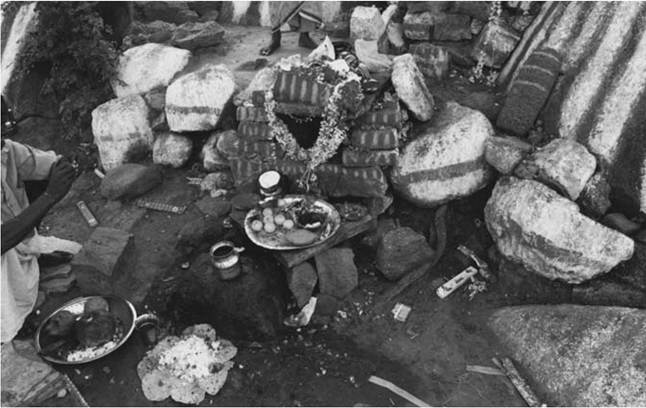
Figure 8 Bonalu Festival, Hyderabad, Andhra Pradesh: roadside shrine to "folk" goddess Maiasamma. Photograph by Rob F. Phillips.
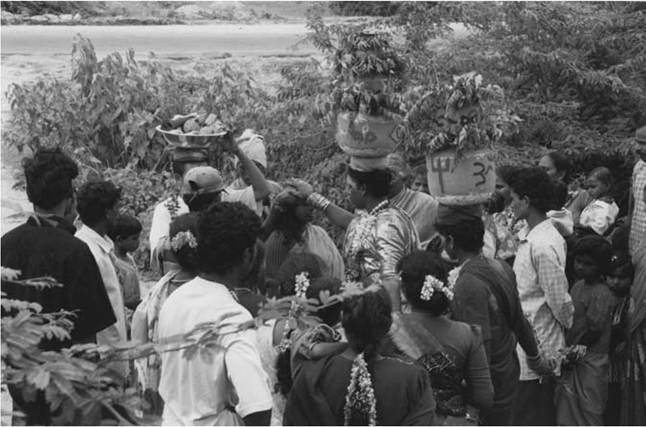
Figure 9 Bonalu Festival, Hyderabad, Andhra Pradesh: worshipers bearing gifts (gatham) for the goddess atop Golkonda Hill. Photograph by Rob F. Phillips.
Bonalu is like a garland of individual celebrations continuing over the space of several weeks. Families and neighborhoods come to be linked together in the festival. Non-Telugu speakers, villagers, and tribal peoples may be integrated into the city through their participation in the festival, even while they maintain their specific ‘identities’ through their worship of a particular goddess and maintenance of a particular shrine. The goddess is invoked, not so much any longer to assure good crops or a successful monsoon, so much as to assure prosperity in the time of any adversity and to provide a sense of safety in the face of external threat.
At another level the festival has also been used by such agencies as the Arya Samaj to attempt to homogenize the practice of Hinduism and to integrate “folk” and tribal people into the Hindu fold. In fact, processions of Bonalu have been used as rituals of confrontation as, in the mid-1980s, paraders made their way through Muslim neighborhoods, thereby instigating resentment, even skirmishes. The festival has now become, along with Ganesa Chathurthi, one of the most popular festivals of Hyderabad; planning committees have come to work with participants at specific shrines to co-ordinate the whole enterprise and provide a semblance of structure. Yet spontaneity persists as individuals and families participate and interpret their experience in their own terms.
Festivals in other religious communities
Muslims, Christians, Jains, and other religious communities similarly participate in festival life across the subcontinent. Muslims, for their part, observe at least two feast days (‘id). One, known as ‘id al fitr, is the feast that ends the fasting month of Ramadan. During Ramadan Muslims observe the fast (saum) and abstinence (imsak) from dawn to dusk each day. When the new month begins, families gather, sometimes in larger community settings, to celebrate in the sharing of foods that represent their cultural and ethnic heritage.
The other feast, ‘id al adhd, is the feast of sacrifice. This occurs on the tenth day of the month of pilgrimage or hajj: after the event known as jamrat (stoning of pillars) that occurs in the pilgrimage, pilgrims, and many Muslims in solidarity with them, commemorate Ibrahim’s act of sacrificing a ram rather than his son Ishmael. On this occasion, an unblemished sheep or goat is sacrificed halal (with its face toward the Ka ‘ba and with the incantation “in the name of Allah”). This becomes an opportunity to remember the goodness and mercy of Allah and human dominion over animals. The flesh of the sacrificed animal is distributed to the poor as well as to friends.
In addition, Muharram is observed by Shiites who mourn the assassination of Husain, son of ‘Ali. On this occasion, in some parts of Bombay, young men can be seen slashing themselves with knives as if to re-enact the tragedy Muharram commemorates. Various other feast days will be observed, especially by Shiites: these include the birthday of Muhammad and of other saints or pirs. Some Muslims will cluster at the tombs (darg^ah) of such saints and make pilgrimages to shrines deemed sacred. In many rural settings, especially, there will be the celebration (‘urs) of a saint’s birth, in which both Muslims and Hindus will participate. Occasionally, Hindus and Muslims will share a common pilgrimage center inasmuch as a Muslim saint is associated with that spot. Such is the case with Sabaramala, Kerala, where a shrine to Vavar, said to be a Muslim “friend” of Ayyappan, is honored. In recent years, however, militants of both camps have contested these shared spaces.
The festivals of Christians, especially of Catholics, have sometimes taken on the accretions of the Indian landscape. The days devoted to commemorating the lives of saints, for example, are often marked by the procession of palanquins bearing the icons of the honored saints. Further, some Christian shrines have become enormously popular for pilgrims of all communities. This is specially so, for example, with the shrine of Lady Velarikanni, the Virgin who is enshrined along the seashore of Tamil Nadu. Thousands of pilgrims, Christian or Hindu, pour into the small pilgrimage town on September 9 to seek healing or other favors at the shrine. For ten days prior to the ninth, starting with a flag raising, various rituals and novenas are performed in honor of the Virgin who was believed to have appeared at this spot.
Within Jainism, laypersons of all the sects will participate in certain annual holy days. These include a commemoration of the “first” giving of alms to a mendicant (one named Rsabha) in the month of May-June. This celebration honors the special relationship that exists between laity and the ascetic order. Also commonly observed are the anniversaries of Mahavira’s birth (April-May) and death (October-November). Yet the single most massive celebration for Jains is the mastabhisekam (head anointing) offered every twelve years at the gigantic image of Bahabuli in Karnataka. Bahabuli is considered an exemplary figure - one who renounced power and possessions to attain instant liberation (kevalajnana). For several weeks during this celebration the fifty-seven-foot image of Bahabuli is offered various libations from above, from water to sandalwood paste.13
The shrine or temple as the focus of religious expression
Millions of shrines of great diversity dot the Indian landscape. Many of these are very simply marked - a sacred tree, a snake hill, a smeared stone, a picture of a favored deity. A worshiper may stop at such a place, circumambulate, prostrate, or in other ways do obeisance to the sacred presence. If the shrine is that of a goddess, the worshiper, usually a woman, may shower vermilion or turmeric over the sacred object and themselves. In many cases such shrines will have a local non-brahman priest, male or female, usually representing the particular family or community for whom the shrine is important. On special occasions, at such non-brahmanized shrines, a goat or chicken may be sacrificed and family picnics are enjoyed.
For a variety of reasons, some of these “folk” shrines become classicized. Some of the patrons of a particular shrine may become more affluent; other neighboring groups may begin to use the shrine and increase its income; there may be an impetus to “brahmanize” the shrine for purposes of demonstrating increased status; other groups may even co-opt the shrine and use it for their own purposes. Classicization of such shrines usually entails hiring a brahman priest to do at least some rituals that are more nearly “agamic” and constructing a brick or stone shed over the shrine. An icon may be installed in a manner that reflects classical style. The name of the deity may even be changed to reflect how he or she is integrated into the mainstream Hindu pantheon. Occasionally such shrines are upgraded without benefit of brahman input inasmuch as the community wants to retain complete autonomy over the shrines.
A fully classical temple is rich with symbolism and ritual life. The inner sanctum (garbhagrha - literally, “womb house”) is below the central tower of
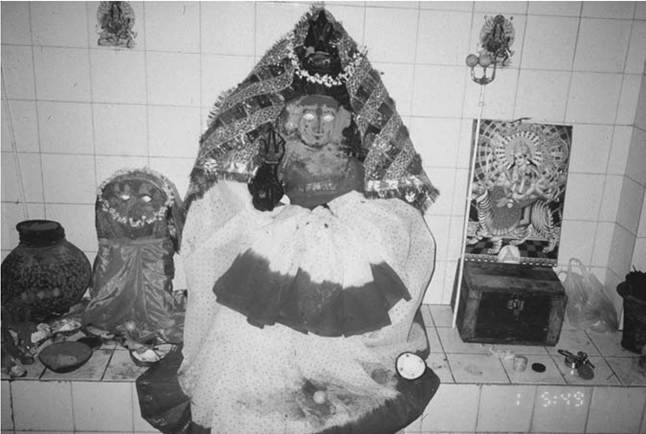
Figure 10 "Folk" religion is classicized: a shrine to goddess Mutalayamma, near Hyderabad, Andhra Pradesh. To the left: old stone icon. Center: new more classical icon with Siva's trident. To the right: artist's depiction of the "great" goddess, Durga. Photograph by Rob F. Phillips.
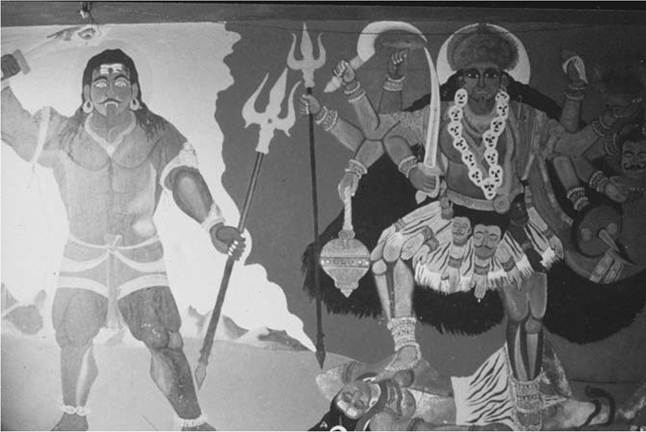
Figure 11 "Folk" religion is classicized: artist upgrades a shrine to the goddess Renuka near Hyderabad, AP, by linking her to KalT as well as folk hero Potturaja. Photograph by Rob F. Phillips.
the temple. The tower is known as a vimana in the south or sikhara in the north. The tower represents Mt. Meru, the center of the universe; the h.iranyagarbh.a (golden reed) from which the universe is said to have arisen; and a human torso. The inner sanctum is the womb in which the icon of the deity is implanted like an embryo. Inasmuch as temple-based worship and iconography were stimulated during the era of kingship, the representation of the deity is treated like a king. It is believed the essence of the cosmos (brahman) permeates the entire cosmos and can become manifest at any point in the created order, and, once the rituals of enlivening the icon (pranapratistha) are done, it is believed the icon is an authentic embodiment of the divine. Temple priests thus become servants of the god-sovereign, awakening him or her in the morning and putting him or her to rest at night. In theory, there are twelve sacred hours during the day appropriate for ritual, each congruent to a commensurate period of the solar year. Most of the ritual occurs before dawn, between dawn and noon, and after dusk. There are certain basic rituals, which will be done in most classical temples - these include the ritual libations (abhiseka) when the deity is bathed and libated with various offerings such as milk, curds, sandalwood paste, fruits, and honey. This ritual is generally done at least once a week, but during festivals or in large temples as often as once a day. The libation is followed by the dressing and adorning of the deity (vastra) when clothing and jewelry, once donned, represent the deity’s readiness to “hold court.” At this stage worshipers may watch the showing of lights in honor of the deity (anti), experience viewing (dan-san) of the deity, and receive foodstuffs, which have been offered to and blessed by the deity (prasada). Some devotees may patronize the recitation of 108 or 1,008 names of the deity and thereby invoke the deity’s blessings. Some devotees, especially couples, will ask that the deity be ritually married to the consort(s) as if to enhance their own marriage.
Worshipers will most commonly visit such temples with their families or friends and/or stop in briefly for dan-san before going to work or after working hours. Seldom is such worship congregational, though devotees may gather in the sanctuary to sing devotional songs (bhajans) and share a sense of community.
It is quite possible to be “religious” in the Hindu world without visiting a temple at all. It is not uncommon for families to have puja (worship) rooms in their homes. These are rooms set aside to display the icons representing the family’s favored deities. In the houses of the affluent, these rooms can be very elaborate indeed. More commonly, the puja room is a modest space set aside for family worship. Usually the eldest woman resident in the house will maintain the room and conduct the puja. In many families this will occur early in the morning after bathing and before the other chores of the day have started.
Ritual in other religious communities
Some Jains, especially the Murti Pujak Jains (of the Svetambara sect), have an active ritual life not unlike that of their Hindu counterparts. Whether in puja rooms at home, or in the often elaborate temples to which lay Jains contribute generously, any number of symbolic representatives can be found - icons of tirthankaras, representatives of living saints as well as of certain Hindu deities. LayJains will perform puja at any or all of the representations. Puja will usually start with libations of water, milk, and/or other substances; the icons may be dabbed with sandalwood paste and offered flowers. Prayers will be recited. Offerings, for example, of rice, fruit, or coins may be placed before the icon. Arati (the waving of an oil lamp before the icon) will occur; the ritual usually concludes with a period of prayer and meditation.
The performance of pujas in Jainism differs from that in Hinduism in several respects. The Jain worshiper does not expect the worshiped figures to help her - each Jain is obliged to work out her own liberation and think of the object of her devotion as a means of meditation, representative of a state of being worthy to be emulated. Further, eachJain layperson will perform the pUja on his/her own at one’s own speed and depend on temple “servants” (known as pujaris) merely for support or instruction, whereas, in Hindu worship, the pujari (priest) performs the rituals on behalf of the devotee who often expects the deity to respond to his requests.14
Devout Muslims also maintain an active ritual life. The high point of the week is Friday noon, when the faithful gather at a mosque for midday prayers. Prayers (namaz) will also be led by the elder at the local mosque five times a day as prescribed by the Qu‘ran. Women are not permitted into many mosques, but many engage in the namaz at home, often together with neighboring women. Unlike the Hindu temple, the mosque is barren of any representations of Allah, though quotations from the Qu‘ran are often inscribed on the inner and outer walls. The mosque is generally oriented in such a way that prayers can be done facing Mecca, the birthplace of Islam and the seat of the sacred Ka'ba stone.
Thus far we have noted a number of ways by which people express their religious orientations through ritual and performance. Ritual does many things at once. With their bodies and through their senses, people act out in ritual something of who they understand themselves to be. Sometimes the ritual is orthoprax, attempting to reconstruct a sense of rootedness and antiquity. Sometimes the ritual is a hybridization - mingling of folk and classical and of various regional and family “traditions.” Ritual selectively reappropriates and re-presents perceptions of the past even as it embodies elements of the present. Local spaces and shrines may be linked to pan-Hindu or classical ones. Festivals and pilgrimages often have a way of bringing together a diverse assortment of people, sometimes acting out distinct social identities, sometimes transcending them. Attempts to homogenize rituals within both Hinduism and Islam suggest how certain agencies such as the Arya Samaj want to “purify” practice so that it will conform to perceptions of a pristine past. Such groups seek to free the rituals of “folk” accretions and even want to use certain rituals such as processions as forms of confrontation with “outsiders.” Many of the conflicting dynamics of religion in contemporary India, in short, are expressed in its ritual life: selective appropriation from a perceived past, classicalization, and brahmanization; hybridizations and homogenizations; conciliations and confrontations between diverse groups. This performative landscape serves as a kaleidoscope of the nature of religion in the world today.
More on the topic The practice of religion:
- PRACTICE AND THEORY
- CONTENTS
- Bell Michael. City of the Good: Nature, Religion, and the Ancient Search for What is Right. Princeton University Press,2018. — 360 p., 2018
- The Rediscovery of Eastern Religious Thought
- Conclusion
- Jacob's Well (John 4:4-42)
- The Law of Marriage - BriefHistory
- Concluding comment