Background
September 1, 1939, marked the beginning of World War II. It also marked the beginning of a five-year holocaust during which society in Galicia was completely torn apart. The initial invasion of the Red Army resulted in the decimation of segments of the Ukrainian and Polish populations and the establishment of a radically new form of government; warring factions of the Organization of Ukrainian Nationalists (OUN) fought with each other, with the Germans, with the Poles, with Soviet partisans, and with the Red Army; Ukrainians sympathetic to Soviet rule were ousted by those who accepted German rule, who were in turn forced to flee in the face of the returning Red Army in 1944.
The local German populace was “voluntarily” relocated to the German fatherland while the large and vibrant Galician Jewish community was physically liquidated.[577] It seemed that during these five years, no matter what side an inhabitant chose, it would sooner or later be the wrong one. And if individuals tried to remain apolitical, they still would be hard pressed to avoid the raids, artillery, or bombing of one of the many competing factions.Galicia’s fate was decided on August 23, 1939, when the Ribbentrop-Molotov nonaggression pact was signed between Germany and the Soviet Union. Both countries agreed not to attack each other while they were engaging in the total destruction of Poland. Germany’s attack from the west on September 1 was followed by a Soviet attack from the east on September 17. By mutual agreement, the Red Army occupied L’viv and the rest of Galicia east of the San River. As a
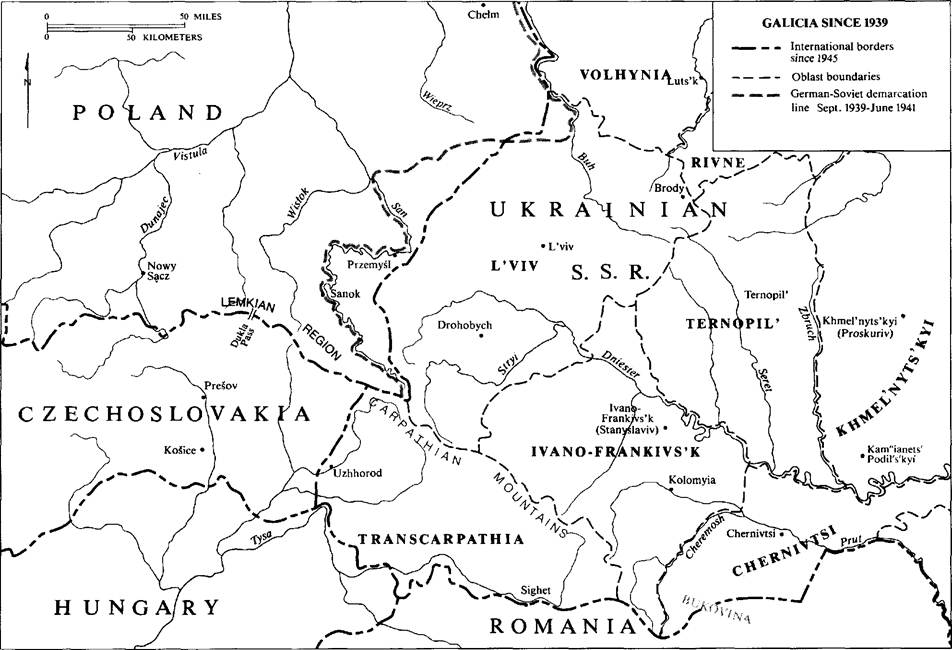
result, only Ukrainian-inhabited areas around Przemysl and the Lemkian region in the Carpathians remained under German control as part of a large area stretching as far as Warsaw and known as the Generalgouvernement.
In lands under the control of the Red Army, Soviet-style elections were organized on October 22 for a People’s Assembly of the Western Ukraine. Four days later, this body, which in large part was composed of local communists and their sympathizers as well as delegates sent from the Soviet Ukraine, requested to be incorporated into the Ukrainian SSR. The request was granted on November 1, and immediately a Soviet administration was set up throughout eastern Galicia. Soviet rule lasted until June 22, 1941, when the Germans broke their nonaggression pact and invaded the Soviet Union. Within a few days, eastern Galicia was overrun by German troops and on August 1, it was made the fifth province of the Generalgouvernement.
For almost three years, the area was ruled by the Germans. Ukrainians were employed only at the lowest levels of the administration and a few organizations were permitted: a branch of the Cracow-based Ukrainian Central Committee, some schools, a publishing house, and a theater. None of the older political parties abolished by the Soviets were permitted to be revived, and both factions of the OUN, which before 1941 had reached an accommodation with the Germans, were banned. A military force was allowed, however; in April 1943, the Galician Division was formed from Ukrainian volunteers and it fought within the ranks of the German Waffen SS. But as the Germans began their retreat from Soviet territory, Galicia again became a theater of military operations. By mid-1943, Ukrainian nationalist and some Soviet partisans were operating in the region, and by March 1944, the Red Army controlled all territory east of Kolomyia and Ternopil’. On July 27, the Soviets took L’viv and by early August controlled all of eastern Galicia. The area was once again a part of the Ukrainian Soviet Socialist Republic and a Soviet administration and government were installed.
More on the topic Background:
- Background Context
- BACKGROUND AND DEFINITIONS
- The Iconoclastic Controversy
- Alsharari Nizar Mohammad (ed.). Banking and Accounting Issues. ITexLi,2022. — 175 p., 2022
- Bano Samia (ed.). The Sharia Inquiry, Religious Practice and Muslim Family Law in Britain. Routledge,2023. — 143 p., 2023
- North Korea: the last Stalinist state
- Hare C., Neo D. (eds.). Trade Finance: Technology, Innovation and Documentary Credit. Oxford University Press,2021. — 417 p., 2021
- Nigeria: mission ahead of empire
- Solomon Islands
- Statement—Courses of Action