CHAPTER XV. OLVlA.
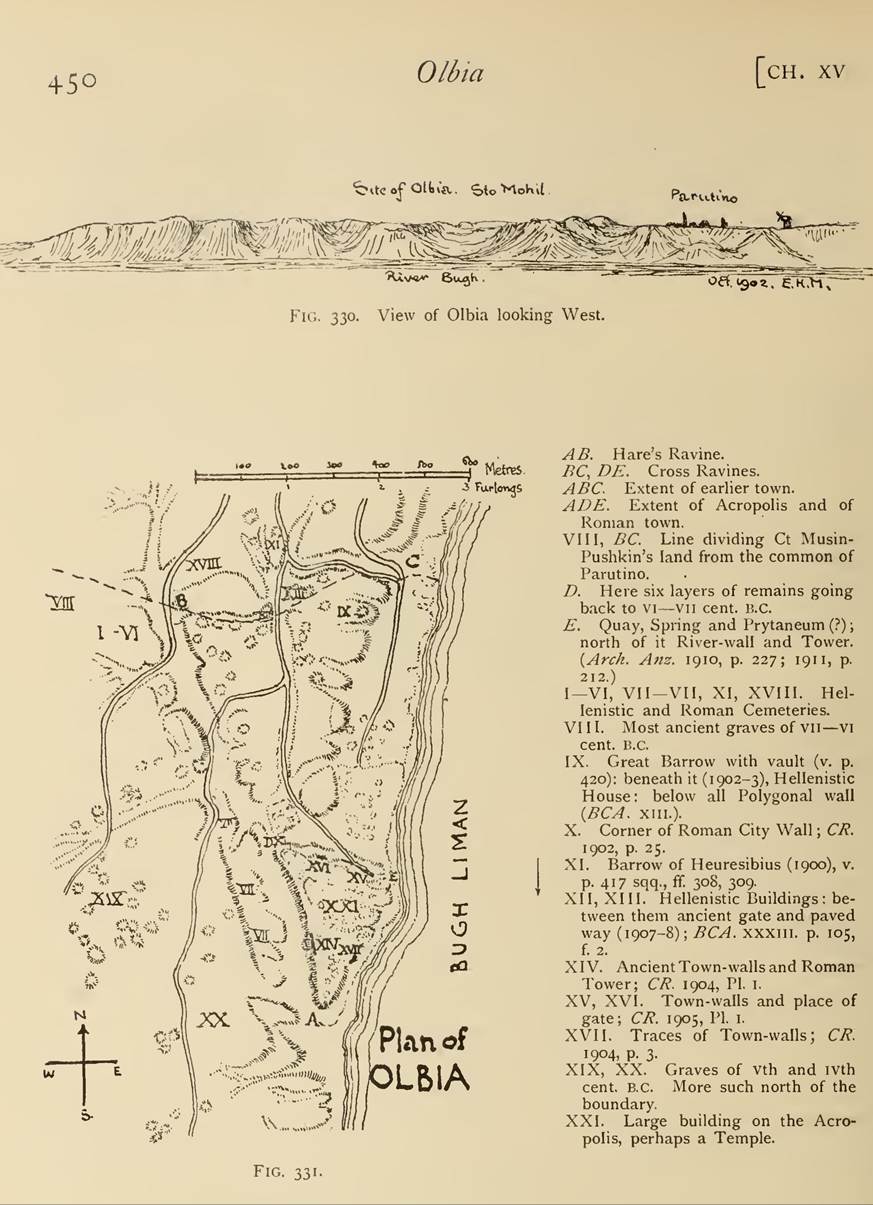
In the following sketch of Olbia its history and constitution I have been well content to follow Latyshev’s “Olbia,” of which von Stern says that it is the best of modern books dealing with our region.
Therefore I have not given references every time I am indebted to him, but have rather indicated the few cases in which I have presumed to differ. I have accordingly paid less attention to older writers whose views were strangely fanciful, founded upon few inscriptions and very subjective judgements of coins. These vagaries have led our author to undervalue the style of coins as an evidence of date, and in the question of Scythian kings I have preferred to be guided by an experienced numismatist, A. V. Oreshnikov. New inscriptions found since the publication of Latyshev’s work have thrown comparatively little fresh light on the history and constitution of Olbia, epigraphic material has been more important on the other sites, but it has added to our knowledge of the cults of Olbia even since the appearance of Miss G. M. Hirst’s excellent papers. It is especially upon the purely archaeological side that most progress has been made, and our ideas of the first stages of the city’s existence are decidedly more definite.Olbia[1008] is the clearest example of a Milesian colony which seems to have come into being gradually, having developed out of a trading factory.
Berezan.
At least there is a presumption that the early Greek settlement on the island Berezan was the factory surviving on its original site down to the vth century. Not that anything has been found there that can be definitely placed before the earliest finds on the mainland[1009], for on both sites Ionian pottery (v. supra, p. 338), archaic terra-cottas and examples of the early Olbian aes grave have occurred.
Nor indeed arc we quite justified in calling Berezan an island, there is every probability that when first settled by the Greeks it wasof free entrance [Et’y Bojpvo-o-^ei^ ” which Latyshev says must mean the town, but it might well apply to the whole liman—to the port of Borysthenes in the wider sense.
Pliny, N//. iv. 82 (26) gives the forms Olbiopolis and Miletopolis which occur nowhere else (for the real Miletopolis near Cyzicus v. Hasluck, Cyzicus, p. 74), the former must have existed to account for Olbiopolitae : of the latter we can say nothing. In Anon. Periplus (86 (6oi) we find ’oX3miles across. If we follow this common estuary eastwards about nine miles from the mouth of the Bugh it is narrowed by a sharp promontory Cape Stanislav, and beyond begins the Dnepr liman proper. 'Phis Cape Stanislav must be the Cape of Hippolaus mentioned by Herodotus (iv. 53) and Dio as running out between the Hypanis and Borysthenes rivers. From the mouth of the Bugh to the narrow entrance by Ochakov is about twenty miles (32 km.), but as was said before the wide estuaries with shifting channels make it hard to give exact distances from point to point in any less summary way than measuring them upon the map (v. supra, p. 15).
Upon the Cape of Hippolaus Herodotus says there was a temple of
Trans. Od. Soc. XXIX. Minutes, p. 88. Demeter (v.l. M->?Tp6s), and Bruun thought that he had found its site a mile to the north of the actual headland[1018], but no certain remains have been investigated. At other points in the environs (e.g. Hadzhi Gdl, Kisljakovka and Kotseruba and at Bejkush on the Berezan liman) coins and traces of habitation have been reported but no such.site has been thoroughly explored; at Nicolaevka a little below Berislav on the Dnepr was a town of Roman date[1019].
2 BCA. xxiii. p. 66.
The ground covered by the city itself is triangular in shape, the apex pointing to the south. On the west side is a considerable ravine (Hare’s Dell, Zfijachia Balka, BDA on the plan).
To the east was the Bugh liman. The northern boundary varied according to the prosperity of the city.The triangle ADE always remained populated. In Greek times it may have formed an acropolis, but only one of its surrounding walls (at xiv on f. 331) can be certainly referred to an early date: in Roman times it contained the whole city and was duly fortified with massive walls (xiv, xv, xvn), in places reaching the enormous thickness of 13 ft. 5 in. (4'70 m.); at xiv they were strengthened by a great tower, 82 x 33 ft. (25 x 10 m.), in the nnd or mrd century a.d. ; near xvi was a gate of which nothing is left. The work was of three periods; good masonry with a face of massive headers and stretchers having been repaired with poorer work and again patched up very roughly[1020].
In Greek times the city stretched as far as the line BC. Along the Hare’s Dell north of D so far no walls have been found, but to the north of E are foundations of a piece of river-wall with a tower[1021] and along the south side of the ravine BC the early settlers seem to have dug a trench which no doubt had a palisade on its inside. Later on a splendid wall was built on the very edge of the ravine north of the trench and the latter was filled up and its site built over. This wall has lost all its facing and almost all its material but has been traced by its foundations 16 ft. (5 m.) thick, built in layers of clay and of charcoal with cinders alternately, a combination which hardens into rocklike consistency. Such foundations were found in the oldest deposits of Berezan and continued in use in Hellenistic Olbia, inasmuch as its natural soil the loess is very friable. For this technique Pharmacovskij quotes the accounts of charcoal under the foundations of the temple at Ephesus[1022]. Between xn and xiii were the traces of an early tower and the remains of another with great facing stones: between them was the site of the main gates and a patch of pavement.
Cut into the foundations of one tower was a tomb with Attic pots of the ivth century b.c. shewing that the tower must be yet older. In its position the tomb is just comparable to that in the wall at Chersonese (v. inf., p. 499). Another interesting thing about it is that it is covered with a true vault6. H ere then were the walls and towers that Protogenes repaired (v. inf., p. 461) and of which Dio Chrysostom saw the remains far out in the country. The upper part of the walls was of sun-dried brick and nearly all the solid material went to build the Roman Olbia, and so they lay hid till quite lately.6 Pharmacovskij has only given a general account of the trench and walls found in 1907 in Hermes, 1907, pp. 45-49, 68-70; CR. 1907, p. 7 sqq.; Arch. Anz. 1908, p. 180; 1909, p. 162; plan, BCA. xxxm. p. 105, f. 2. In the trench was a terra-cotta mould for a woman’s face perhaps taken from a work of Calamis, BCA. XL. pp. 121—129.
Near E is a spring and a considerable space of low ground suitable for beaching ancient ships: under water are the remainsofa mole: roundabout most of the coins are picked up and this was presumably the site of the commercial district. Here two streets met, one along the back of the riverwall, the other running inland. Six layers of debris have been distinguished : the sixth or lowest only goes back to the mid century n.c. and stands in marshy soil. To the fifth layer belong buildings round a peristyle court (p. 457): on the analogy of the Prytaneum at Priene1 Pharmacovskij has suggested that they served the same purpose, but he prefers to speak of them as a house: the big supporting wall to the south might be the boundary of the Ecclesiasterium2. ·
The city was thickly inhabited right up to the Greek wall. Excavations on the spots marked ix, xn and xni shewed foundations of Hellenistic buildings and under those at ix (p. 456) Pharmacovskij unearthed a wall of polygonal masonry that he refers to the archaic period3.
In Roman times on this very spot was reared a great barrow (v. p. 420), proof positive that by then this area was without the city boundary. At that time it seems to have been waste land.Some idea of the changes the city’s area underwent may be gleaned from the positions of the burying places of different ages. It is remarkable that the older the graves the farther they are from the town. This points to the greatest period of the town having been in the vnth and vith centuries b.c. when people went as far afield as vin to bury and even across to the next ravine parallel to Hare’s Dell. Less remote arc the graves of the vth and ivth centuries about xix and xx and to the north on the site of Parutino. Still closer in were the Hellenistic graves 1—vi, vn, and xvin, whereas Roman interments trespassed on the Hellenistic city. The time of greatest expansion in Olbia would accordingly coincide with the time of close and often very friendly relations with the Scythic power to which Herodotus and the spoils of Scythic graves with their strong Ionian influence alike bear witness. This supposes an extremely rapid growth at the very first, which is just what we do see in successful colonies. Uvarov was not wrong in the main, BC really was the line of the old walls although the towers that he found along it have proved to be but barrows ix and xi with retaining walls of masonry. The many other barrows all about have given the place its name of the Hundred Barrows.
The advantages of the site do not seem very obvious; the chief attraction seems to have been the low-lying space of shore upon which ships could be drawn up, commanded as it was by higher ground itself defended by the ravine on the further side. Probably too the channel of the Bugh was in ancient times favourable to Olbia : of the alternative sites which suggest themselves, Nicolaev was too far up country, Kherson channel has never been good and there must have been some special reason against Ochakov, which when in hostile hands was undoubtedly a thorn in the side of Olbia.
ITio Chrysostom4 says that in his time it belonged to the queen of the Sauromatae. Be this as it may it was Olbia that the Milesians chose as the point which could control the trade routes of the Hypanis and Borysthenes and become the chief emporium of the North Western Euxine.1 Wiegand-Schrader, p. 231 sqq. 3 CR. 1903, p. 17, f. 15.
2 Arch. Anz. 1910, pp. 227—234, ff. 28, 29, 32. 4 Or. xxxvi. p. 49.
Until this century the site of Olbia, though ascertained in the time of Pallas, has not been fortunate archaeologically. The northern necropolis was part of the communal property of the village of Parutino, and was exposed to every kind of predatory digging. To the south of the line vm BC the main area belongs to Count Musin-Pushkin whose predecessors refused to allow scientific digging while taking insufficient steps to prevent the raids of the Parutino peasants. Hence the bulk of the inscriptions and objects discovered have lost half their value through their exact place of finding not being known. Even the occasional attempts of archaeologists were unsystematic and ill recorded. But a new era opened with the advent of Mr Pharmacovskij in 1901 and the conclusion of an agreement between the Archaeological Commission and the owners of the soil. The opening up of the walls described above gives us the position of the acropolis and the limits of the Roman town. In the middle of the triangle have been found the remains of a considerable building apparently a temple, and further work may tell us where were the temples of Zeus Olbios and the chapel of Achilles Pontarches. Several inscriptions found to the north of the inner walls indicate the probable position of the temple of Apollo Prostates.
The point whose exploration has been of most interest is that marked ix. This was rendered conspicuous by the great barrow with its chamber and plinth of masonry described above. Below three layers which had to do with the barrow and so were dated in the nnd century a.d., Pharmacovskij found four others. The lowest is only represented by a fragment of polygonal masonry referred to the archaic period. The two layers above this were Hellenistic but the buildings in them were too fragmentary to tell us much except that they were dwelling houses[1023].
From the fourth layer, though much disturbed by the heaping up of the barrow, still could be made out the plan of a Hellenistic house. A comparison of its arrangements with those of other Greek houses shews that it comes between the earlier houses at Priene of the mrd century b.c. and that described by Vitruvius which seems to lead on to the Delian type of the 1st century b.c. It is specially close to that called by Vitruvius (vi. 7 (10)) Rhodian. This as well as the details of style point to the middle of the nnd century b.c.[1024]
The house consisted of two systems of chambers each surrounding its court. Of one not very much is left but of the other a most attractive restoration has been made. It is just the moment in evolution of the Greek house before the peristyle becomes the same on all four sides. In our example whereas three sides of the square have each four ordinary Ionic columns, making five spaces, the west has a facade of two stories; the upper is Corinthian having antae with two columns between, while below are two Ionic columns flanked by antae forming what Vitruvius calls the prostas, and again antae at the corners of the court. The court was paved with cobbles, the centre having a square panel of primitive mosaic made of unshaped pebbles. The design consisted of a circle whose content has perished inscribed in a square, the spandrels being filled with palmettes, the frame outside has a frieze
storations Pl. Xi, ХП, and CR. 1903, pp. 8 sqq. Cf. Arch. Anz. 1904, p. 103 with pictures of the mosaic.
of animals arranged in pairs each looking towards a palmetto, on each side two winged lions, a lion and a boar and two panthers. The outermost member of the frame is a wave-pattern, broken in the middle of the north and south sides by paths leading out of the centre across the plain pavement to the colonnade. East of the court was a long chamber with a fine view over the Bugh, perhaps a spring and autumn dining room. To the south were large spaces which have not been fully explored owing to the desirability of leaving some part of the barrow untouched. One of them, however, yielded the three precious heads of Asclepius, Hygiea (p. 292, f. 208) and Eros (?). Beyond the north wall of the court was apparently a blank wall.
The entrance was from the ne. An alley ended in a vestibule which led by a narrow passage into the north walk of the peristyle. The narrowing of the passage gave space for a porter’s niche between the corner pier and the north anta of the prostas or east face of the house which made the west side of the court. This prostas led into two considerable rooms which with those above them made the chief part of this division of the house. These reception rooms were plastered and painted in the first Pompeian style to imitate marble panelling. To the south were three rooms of one story only ; one of them, which came at the se. corner of the court, had a great cistern beneath it, fed from the converging roofs of the whole complex of buildings. Further to the west was a store room with seven great pithoi.
The orientation of the house is interesting. In Greece the prostas w'ould have looked south as Vitruvius recommends. But in Olbia that would have made it unbearably hot in summer without there being much gain of warmth in winter. A western aspect is exposed to bad winds off the steppe whereas the breezes from the Bugh are pleasant. Hence the eastern aspect of the prostas. Vitruvius mentions that special arrangements were necessary in the Pontus.· What appliances they had for artificial heat does not appear. The winter snow determined the steep pitch of the roof, about 20, as we know’ from a ridge tile[1025].
This house w'as built upon banded foundations of clay and ashes carried right down to virgin earth : hence its erection meant great disturbance of all lower layers. The duration of its existence, about a century, is marked by the lettering of the astynomus stamps on its tiles. It perished by fire towards 50 b.c. ; evidently it succumbed to the Getic storm.
The heaping up of the barrow' again disturbed the soil, hence in its mass and in the layers below it arc found pottery fragments of all possible periods, beginning with Ionian, through black- and red-figured Attic of various styles to Hellenistic and Roman products, also terra-cottas of corresponding dates. This confusion makes it hard to place particular strata but gives us the right to infer that the site was continuous!)· inhabited from the viith century b.c.[1026]
The house at E, the prytaneum (?), is a little later in date, the peristyle, an irregular oblong with five and four columns a side, being without a prostas; in the middle was an altar once surmounted by a tripod. The entrance was through a vestibule from the street behind the river-wall, and into this the peristyle drained. Between the street and the court was a handsome room partly paved with pebble-mosaic like the former in technique, but with simpler patterns—wave, maeander and guilloche : on it was another little altar and terra-cottas of Cybele and a priestess1. Destroyed in the Getan sack this house was patched up immediately and again burnt.
History.
The date assigned by Eusebius to the foundation of Olbia (Ol. 33. 2, b.c. 647-6) thus quite agrees with the archaeological evidence2. But regard being had to what has been said above about the gradual growth of the factory definite dates are clearly out of place (v. supra, p. 453).
The history of Olbia is divided into two parts at the destruction of the city by the Getae in the middle of the 1st century b.c. During the first part it is that of a typical Greek town, at first prosperous, later on hard pressed by the surrounding tribes, probably more or less tributary to barbarian chieftains, but essentially Greek. During the later period its population had accepted a strong barbarian element and the town existed at first on sufferance, later by the support of Rome, but there was some connexion with the former inhabitants, it was not an entirely new community upon the old site, for the old personal names lived on though mixed with foreign ones, the Greek language survived in some form, and the institutions (e.g. the names of the months) still shew a resemblance to those of Miletus and her colonies.
During the vith and vth centuries в c. we cannot say that we know any definite events of Olbian history. Herodotus gives us stories of the relations between the Scythian kings and the Olbiopolites from which we may gather that the princes were attracted by the higher civilization, its conveniences and its pleasures, and established friendly and even intimate relations with the Greeks, whereas the mass of the nation having less chance of enjoying all this was less well-disposed. But to make the most of every detail of these stories and argue as to the state of architecture in Olbia because the house of Scyles was adorned with sphinxes and griffins, as to its fortifications and sallyports because from a tower a citizen shewed the Scyths their king making one of a Bacchic thiasus, or judge of the size of the town because Scyles could leave his “army ” in the проаатєїог, is to take too literally the stories of Tymnes. But we can conclude that the Borysthenites had friendly dealings with a fairly powerful nation which proved a very good customer for all their Greek wares.
How the expedition of Darius affected Olbia we do not hear. Presumably it was a source of anxiety and nothing more. More serious was the expedition of Pericles into the Pontus. Its main effects were probably to strengthen Athenian commerce in this region, from the middle of the vth century the Attic pots come in again (v. p. 339), whether Olbia were enrolled in the Delian confederation we cannot say. In the new list set out in 424 b.c. there is a town beginning with O (App. 2, cf. pp. 447, 561) but it only paid a talent which is no more than Nymphaeum and perhaps Tyras paid. From this period we have three epitaphs, the earliest was found beyond the Hares’ Dell3, and also the coins EMIAAkO (v. p. 487) who may have been a foreign ruler.
1 Arch. Anz. 1910, pp. 228—234, ff. 28—30; against it; perhaps 33.3 of F is right: Scaligergave
1911, pp. 207—220, ff. 18—23. 01. 31. 3, B.C. 654 ; cf. Latyshev, Olbia, p. 38, n. 2.
2 Schoene following В gives 01. 33. 4 but the 3 App.y-=IosPE. I. 120(facs. IV. p. 275 = Roehl, Oxford MS. seems with A and P to turn the scale /. Gr. Antiquissimae\ No. 48, perhaps the oldest
From the ivth century a few inscriptions have survived, mostly epitaphs and grants of proxeny1 to foreigners, Chaerigenes of Mesembria, I lellanicus of Rhodes (?), Nautimus of Callatis and a Dionysius whose city cannot be read. This last stone was found at Chersonese. All this points to lively intercourse with other trading cities.
A decree found at the temple of Zeus Uriusat the entrance of the Thracian Bosporus gives regulations for the treatment of foreign money at Olbia2, directing that all copper and silver and gold other than that of Cyzicus should be exchanged against Olbian currency according to the market and that such transactions should take place “ upon the stone in the ecclesiasterium ” upon pain of confiscation of the amount in question : but Cyzicene gold (or rather electrum) staters were fixed at io£ staters (Olbian silver like Pl. in. 2)3.
Cyzicene staters have been found in Olbia and in later times their place was taken by those of the Macedonian kings. So far only one autonomous Olbian gold stater (just like Pl. 111. 2) has been discovered4. It seems clear that the Olbiopolites mostly used foreign gold such as the Alexanders and Lysimachi, at least a thousand of which were found at Anadol in Bessarabia’, and that this is meant by the gold pieces mentioned in the decrees thanking Callinicus and later Protogenes (v. inf. pp. 460—462 and 485).
This decree in honour of Callinicus son of Euxenus" in the ivth century records the bestowal by the grateful people of praise and a wreath worth a thousand gold pieces to be presented in the theatre at the Dionysia and the setting up of a statue. But what Callinicus had done to deserve this is lost.
The one event in this century for which we have a literary source is a siege of Olbia by Zopyrion recorded by Macrobius7, for the sake of the extreme measures taken by the citizens to rally to themselves all possible defenders. They set slaves free, gave foreigners the citizenship and cancelled all debts. This means that they must have been reduced to great straits, either that the city was not in a position to resist an attack or that the forces of the invader were overwhelming ; in any case the shock to the city’s prosperity must have been serious. Almost certainly this Zopyrion was the governor left by Alexander in Thrace after his reduction of that country and his demonstration against the Getae across the Danube. Zopyrion wishing to distinguish himself went farther whether against Getae or Scythians (v. p. 123) and was destroyed with 30,000 men. But what the mutual relations of Olbia, the Scythians, the Getae and Zopyrion may have been we cannot make clear. Also the date of the occurrence is doubtful, Justin says Alexander heard the news just after Arbela, Q. Curtius, when he had returned from India to Persia: and Curtius says that Zopyrion perished in a storm, presumably on shipboard : but a governor of Thrace would not want ships to attack the Getae, whereas they would be invaluable against Olbia of which the river side was not fully defended until the time of Protogenes. Bertier-de-La-Garde[1027] refuses to believe in the siege of Zopyrion saying that you cannot besiege an unwalled town, but part of the circuit had been completed in stone and the rest was no doubt defended by walls of crude brick or a palisade and ditch for which very likely Protogenes substituted stone. Grote (xn. p. 299) regards Zopyrion as an unknown person and declines to fix any date for his attack upon Olbia,
N. of the Euxine, cf. pp. 447, 560, 618), losPE. iv. 28 and Trans. Od. Soc. xxiv. Minutes, p. 39.
1 losPE. 1. 8—10, 14, 15. BCA. x. p. 1, No. 1.
2 App. $ = IosPE. 1. 11.
3 Latyshev, Olbia, p. 48 n. quotes Dittenberger, Hermes, XVI. p. 189, cf. Sylloge1, II. 546. Bertier-de- La-Garde, “ Comparative Values,” p. 54 sqq. after considering the amount of gold in a Cyzicene and of silver in an Olbian stater declares that this decree put a premium of about 2| per cent on Cyzicenes
in order to attract gold in its then most general form to the Olbian market.
4 Burachkov, p. 64, No. 167, Pl. VIII. 201, Pick, IX. 1, now at Brussels: a dozen 4 staters are known, v. p. 485, Pl. III. I
6 BCA. in. p. 58. 0 losPE. 1. 12.
7 Saturnalia, 1. xi. 33. Borysthenitae, obpug- nante Zopyrione, servis liberatis dataque civitate peregrinis et factis tabulis novis hostem sustinere potuerunt.
To the end of the ivth century belongs a tantalizing inscription[1028], in praise of a man who appears to have brought the citizens to one mind by arranging an impartial compromise. Presumably there had been a faction fight. Perhaps when the danger from Zopyrion had passed there were difficulties between the old and the newly enfranchised citizens. But this discord may have to do with the subsequent decadence.
Protogenes.
After the attack by Zopyrion, Olbia appears to have begun to decay. Circumstances were no longer favourable. Her customers in European and Asiatic Greece had mostly fallen on evil times, mixed up in the rivalries of various dynasts, or had diverted their attention to the richer regions of Asia laid open to them by the conquests of Alexander. For instance the steady corn production of Egypt must have competed fatally with the fluctuating exports of South Russia. Worse than this, changes in the population of the interior interrupted the trade routes, ruined the Scyth power with which Olbia had established tolerable relations, so that the remnants were driven to encroach upon Olbian territory, and brought new foes from East and West.
This decadence is fully illustrated by the decree in honour of Protogenes to which reference has already been made. It is perhaps the most important epigraphic document from the Scythian region[1029].
Its interest may be grouped under two heads, the information it affords as to the tribes surrounding Olbia and her relations with them and the internal economic questions of providing money to buy off these tribes, to fortify the town against them, and to relieve the distress of the citizens due to these exactions and to bad harvests.
The tribes mentioned in the inscription have been already dealt with (p. 118 sqq.[1030]). Towards them Olbia stands in no pleasant relation. We hear most of a King Saitapharnes to whom one year the Olbiopolites give four hundred gold pieces (for the question as to what coins are meant, v. p. 459), provided by Protogenes, another year he paid other four hundred pieces to the Saii, perhaps the tribe of which Saitapharnes was king, soon after some part of 1500 gold pieces was spent on “douceurs” (e^epaTrevibycrai') to lesser chiefs (o-KayTTTovxot) and the advantageous preparation of gifts for the king.
4 Braun, Investigations, I. pp. 89, 102 sqq,, 117, 129, v. supra, pp. 125, 126, puts the inscription in the Ilnd cent, to suit his theory that the Galatae were the Kelts afterwards known as the Britolagae on the Danube, but originally from further north. Niederle, Slav. Ant. I. pp. 303—311, after stating all views comes to no conclusion.

This phrase suggests that the gifts were not merely money (as was said by some in discussing the famous tiara) but money’s worth which could be got cheap or dear according to circumstances. Saitapharnes would have been much pleased with Rachumowski’s work had it been executed in time. Fitting out an embassy to the king cost 300 gold pieces and could hardly be done for that. Later Protogenes himself went on an embassy to the king and offered him 900 gold pieces—Latvshev suggests that this was two years’ tribute with an extra hundred to make up—but he was not satisfied, found fault with the gifts and prepared for war : here the narrative breaks off; but Protogenes had spent 2000 gold pieces on embassies and gifts, besides the 1500 for general purposes most of which went the same way.
On the other side of the stone we find that worse foes have appeared, Galatae and Sciri, and that in fear of them the Thisamatae, Scythae and Saudaratae try to take shelter in the city walls, driving its inhabitants to despair and to the desertion of the city. Also their allies the Mixhellenes to the number of 1500 and all their slaves turn against them. We do not quite see where Saitapharnes and the Saii come in. It is likely that they were on the eastern side of the Hypanis and even of the Borysthenes and so more or less safe. We have no means of saying where Cancytus may have been and to Trepan might conceivably be the Hylaeaand the parts beyond, where Herodotus puts the Scythae Nomades, whereas the other tribes were probably to the west and north exposed to the new comers. In any case the danger seems to have passed away after rousing the town to complete its fortifications along the river bank.
The most pressing need was the want of two stretches of wall along the river, that by the harbour’and that by the old fish-market. All this Protogenes had to undertake at a cost of 1500 gold pieces; next we are told of five towers restored by him, two by the great gate (v. p. 454), Cathegetor Tower, Waggon-way Tower and Epidaurius Tower, he also built up the three curtain walls (cr^oifiaia) between them and he completed another piece of wall from the Tower of Posis to the upper place (this cost a hundred gold pieces), besides building the grain store and the bazaar gateway1. All this in the face of difficulties with the contractors so that he had to take the work over himself and repair at a cost of 200 gold pieces the barges kept by the city for the transport of stone. That makes a total of 1800 gold pieces spent upon buildings.
Still larger amounts went to the meeting of other calls on the treasury mostly in times of famine. To begin with Protogenes redeemed for too gold pieces the sacred plate of the city which the foreign creditor was just taking to be melted down : next year he paid 300 for a cheap lot of wine bought by the archons under Democon : the following year he sacrificed 200 by selling 2000 medimni of corn at half price. When elected one of the Nine he offered 1500, much of which went in gifts to chiefs. The following harvest was again bad, Protogenes advanced 1000, 300 without interest for a year: he was repaid at the rate of 400 coppers evidently at a loss (v. p. 483). The same year he sold 2500 medimni of corn making an abatement of about
See Bertier-de-La-Garde on these walls, Comparative Values, p. 86, n. 2. 2270 gold pieces[1031]. That amounts to about 4400 making no allowance for loss of interest or on copper repayments. In some of these transactions it is not clear whether the town intended repayment or took as a gift the sum provided. But this does not make much difference as the inscription represents Protogenes as cancelling the debts due to himself from the city by the singular process of crediting it with non-existent surpluses and applying these to the extinction of its debts to himself. All this he did during three years as “ financial director of the city’s affairs,” in the course of which time he used no harsh measures against the tax-farmers, but let them pay at their own convenience, while he submitted to the people at due seasons accounts falsified for the city’s benefit. Yet the city proceeds to ask him to sacrifice private debts due to him and to his father amounting to 6000 gold pieces and to remit interest due upon them. In all, then, he spent about 9200 gold pieces on the town of which we seem to hear of 2500 being paid back, though with loss of interest and at a lower rate of exchange : that makes 6700 in public benefactions and the 6000 of private debts brings the total up to 12,700 gold pieces, a colossal sum. The question that rouses most wonder is how Protogenes and his forbears amassed a fortune from which they could make such sacrifices ; whereas no one else in the town is represented as ready or able to help at all[1032]. Yet we have another inscription of about the same date, the peculiar lettering is almost identical, saying3 “ Cleombrotus son of Pantacles saw to the building of the Gate and Curtain wall,” and the same Cleombrotus4 dedicates a tower to Heracles with six bombastic elegiac couplets. This man, his converse Pantacles son of Cleombrotus (if this is his father we have the base of his statue dedicated by the people to Heracles, the lettering is a good deal older)5, Heroson son of Protogenes converse to the hero of the great inscription, two Aristocrates (the name of Protogenes’s colleague as envoy to Saitapharnes) and several sons of Aristocrates, several sons of Herodorus, the name of an eponymous priest during his activity, further Heuresibius son of Demetrius, who on losPE. 1. 105 made a dedication to Zeus the King, and Agrotas who with his brother Posideus set up a statue to their father Dionysius priest of Apollo Delphinius6, are all mentioned on a list of citizens’. Further Posideus son of Dionysius an Olbiopolite receives proxeny in an inscription at Delos dated about 180 a.d.8
This means that unless we have been misled by the customary repetition of ancestral names all these men belong to the first half of the nnd century b.c. Latyshev, who believes that the Galatae mentioned are the forces of the
suggest that Protogenes was really a tyrant who had come into power on the shoulders of the democracy after a rising against an oligarchy devoted to Heracles, dedications to whom by Cleombrotus and Nicodromus, losPE. iv. 459, had been defaced by the people : if not a political tyrant P. must have been a commercial monopolist for he had evidently concentrated into his hands all the money in the town. No doubt he ruled through democratic forms.
3 losPE. I. 100. 4 ib. 1. 99.
5 BCA. xxxiii. p. 41, No. 1.
6 losPE. 1. 106.
7 losPE. 1. 114, cf. iv. p. 273.
8 Latyshev in Journal of Min. Public Instr. St P. Feb. i8go = TlovTiKa, p. 55; also losPE. iv. p. 264 quoting Foug&res, BCH. xm. (1889), p. 236.
kingdom of Tyle which fell in 213 b.c., prefers to see grandsons where it is just as possible to sec grandfathers. Thereby he puts back Protogenes into the mrd century. Protogenes himself is represented in the decree as comparatively young, at least the debts due to his father arc remembered apart from those due to him : that is in the list he is maybe a survival from the mrd century and
Clcombrotus too ; but the lettering of the decree is placed by Mommsen at
the end of the mid century, by Bocckh in the 1st or mid, by I )ittenberger in
the mid century, Latyshev shews that it might be mrd, but he is driven
thereto by the date of the fall of Tyle. The list of citizens looks if anything later still[1033]. Braun’s arguments in favour of bringing the Galatae from the Carpathians rather than from Thrace agree with the prinia facie date of the writing and a fair view of its relation to the document at Lelos as dated by Fougeres. Altogether I should put the decree in the first half of the mid century b.c. Some other points in it will be touched on in the review of the institutions of Olbia (p. 474).
A further illustration of financial affairs in the mid century b.c. is afforded by an inscription[1034] giving the fees for sacrificing various beasts. They are fixed by the Seven, apparently the commission that managed the finances of the Gods, twelve hundred coppers, that would be three gold pieces, for a bull, three hundred for a sheep or goat, sixty for some other animal or according· to Jcrnstedt’s conjecture for the skin. The fees went to the sacred treasury but that was no doubt used as a reserve for the public needs.
Soon after this we would put the period of vassaldom to Scythian kings (v. p. 119); the danger from that quarter had become more and more threatening and it is conceivable that the suzerainty of a strong ruler like Scilurus was rather a relief, if he protected the city against other barbarians and allowed her merchants to trade in his extensive territories. That this was probably so we judge from the occurrence in his capital Kermenchik (Neapolis?), besides a stone bearing the king’s name[1035], of three inscriptions recording dedications made by Posideus the son of Posideus to Zeus Atabyrius, Athena Lindia and Achilles, lord of the island (of Leuce)[1036] [1037], the last in celebration of a victory over the Satarchaci pirates. The same name occurs on a dedication to Aphrodite Euploea found at Qlbia’, and there is good reason to supply it in No. 49, a decree of the men of Cos, and perhaps in No. 48, a decree of the men of Tenedos in honour of an Olbiopolite. There is no call to make Posideus a Rhodian as is usually done because of his dedications to Rhodian deities; he was evidently a seaman by the victory over the pirates, with close connexions with the islands of Asia Minor, and there was special reason for his having to do with Rhodes, just then the chief commercial state of the Aegean and carrying on a great wine trade with Olbia, as we know by the amphora stamps. Whether the Olbiopolites liked their connexion with Scilurus or not, it came to an end at the defeat of his son Palacus by Diophantus with the forces of Mithridates and Chersonese[1038]. That Olbia submitted to Mithridates seems 2 App. Z = IosPE. I. 46. 3 p. 119, n. = losPE. I. 241. 4 losPE. I. 242—244. 5 I os PE. I. 94. 6 App. 18= losPE. I. 185, iv. 67, Strabo, vn. iv. 3, v. inf. p. 520. implied in the fragmentary decree1 in honour of...son of Philocrates a master mariner of Amisus thanking him for services in transporting supplies to certain Armenians in Sinope, also in facing a storm to bring home an embassy of the city’s and reinforcements granted to it by the king. Rostovtsev2 refers the former service to a running of the blockade of Sinope in 70 b.c., when Machares had deserted his father ; the Armenians being the Cilician troops borrowed from Tigranes, who were holding the city for Mithridates. The second transaction he assigns to the king’s last moment of power in 64 b.c. when Olbia wanted support against the threatening Getae and he himself would be glad to secure a. pied-a-terre with a view to his intended Western campaign. After his death it again became a prey to the indiscriminate attacks of the surrounding tribes. Of this time we have a glimpse in the decree in honour of Niceratus son of Papias3. He is praised as a peacemaker among the citizens and a defender of the city against the attacks of outside foes, whose name is not given, but they were probably not the Getae as the scene of his death is laid in the Hylaea. The honours he receives are interesting, a public funeral, on the day of which the workshops were to be closed and the citizens to wear black and attend in order, a gold wreath, an equestrian statue, a yearly rehearsing of his merits at the ecclesia for electing magistrates and at the horseraces in honour of Achilles established by oracle, and the setting forth of the complimentary decree upon a fair white stone to rouse the emulation of others. Sack by the Getae. The next event in the history of Olbia is its sack by the Getae. Our authority for it is Dio Chrysostom, who says that the Getae took this and the other Greek cities on the west of the Pontus as far as Apollonia, which happened a hundred and fifty years before. The speech was delivered about 100 a.d. ; but we may have to reckon back from the time of Dio’s stay at Olbia, which may have been about 83 a.d. So the sack must be put between 67 and 50 b.c. This corresponds exactly with the time when Byrebista had raised the Getae or Daci to greater power (v. p. 123) and no doubt the destruction may be laid at his door. It is borne out by the burnt layer found by Pharmacovskij (v. p. 457), by such expressions as that of the decree in honour of Callisthenes4 c. 200 a.d. which speaks of his descent from the founders of the city, hardly the first founders of eight hundred years before, and by hints from the other towns affected®. Indeed the inscriptions of such towns as Istropolis and Odessus, and the description, maybe exaggerated, of Ovid’s life at Tomi present close parallels to the state of things we have found at Olbia. Dio speaks of this sack as the last and greatest capture, and says that the city had often been taken before: that it had been on the verge we know from several inscriptions, after a capture there would be no decree set up, so we cannot say whether it were actually taken : but there is so far no trace of any such break; when he says “often” Dio is almost certainly exaggerating. Scilurus may well have entered the city and done comparatively little harm. 1 App. g = BCA. xvm. p. 97, No. 2. 4 losPE. I. 24. 2 “Mithridates of Pontus and Olbia,” BCA. 5 Latyshev, Olbia, p. 147, quotes an article of xxiii. p. 21. his own in Ath. Mitt. xi. (1886), p. 200, citing in- 3 losPE. 1. 17. Latyshev, Olbia, p. 139. scriptions from Odessus and Istropolis. Olbian Life. Reviewing the history of Olbia as far as we have gone we must confess that it is a sufficiently depressing record. The citizens’ main occupation was commerce with the natives, a commerce in which the civilized man usually makes unrighteous profits, and one branch of which was no doubt the slave trade ; this was varied by internal disputes of which we have hints from time to time, constant petty wars with ever fresh tribes of barbarians, struggles against bad harvests once exhaustion came to the lands which had at first been so fertile, and ever growing financial difficulties. Yet in spite of these disadvantages, in spite of their severe winter, the Olbiopolites strove to live the life of Hellenes. They must have concentrated into the summer the activities of the whole year, for they endeavoured to keep up the due festivals and games. We read of Dionysia held in the theatre' and horseraces in honour of Achilles. Dionysius son of Nicodromus the gymnasiarch seems to have gained some prize abroad perhaps in Athens2 from which Panathenaic vases were brought back in triumph (supra, p. 347). A special point is the archery contest in which Anaxagoras son of Demagoras made the record shot of 282 fathoms3, a contest most natural in Scythia. To anticipate, the very archons and strategi in the later period record their victories in running, leaping and throwing the lance and discus (v. p. 473). Of special interest is an inscription recording a statue by Praxiteles4, so that the statues of which we hear so often were not all specimens of mere municipal art, and the Hellenistic houses are better than we might expect. Some of the earlier coins also attest a fairly high standard of taste and execution though degeneracy soon sets in. As regards literature Olbia gave birth to a well-known philosopher Pion5, but the stories we hear of him suggest not so much a serious thinker as a sophist with keen mother-wit and unstable intellectual interests—he first attended the Academy, then joined the Cynics, passed on to the Cyrenaic school and finally became a pupil of the Peripatetic Theophrastus before setting up for himself at Rhodes. When rivals hinted at his lowly origin, he turned on them and said that his father was a freedman dealing in salt fish and was sold up'for cheating the customs, his mother no better than she should be, and he himself, having been the favourite slave of a rhetor who left him all his possessions, began his free life by burning his old master’s writings: this was merely inverted boasting, we cannot learn from it anything about life in Olbia: Bion flourished in the mrd century b.c. Sphaerus, his younger contemporary, though called a Borysthenite by Plutarch, is more usually stated to have been a Bosporan6. Lastly Suidas7 speaks of a historian Poseidonius the Olbiopolite who wrote about the phenomena of the ocean and the land of Tyras, also, if it be the same man, Attic and Libyan histories, and a Scholiast on Apollonius Rhodius (11. 660) says that Dionysius Olbianus (v.l. ’AXyStapos) terropet ras eupetas ipdi'as Xeyecr^at ’A^iXXccjs Spo/zoiA 1 losPE. 1. 12. 2 ib. iv. 459. 3 p. 66, n. 10 and App. 6 = Cos PE. iv. 460. 4 v. p. 295, nn. 10, 11. 5 Cf. Diog. Laert. IV. vii. 6 Plutarch, Cleomeaes, 11. Diog. Laert. vn. vi. " Lexicon ap. Latyshev, Olbia, p. 144. Bekker, p. 877. Müller, FHG. in. p. 172. 3 This is not a confusion with Dionysius Perie- getes as he emphasizes the narrowness of the Tendra. So Latyshev reads: Articon to the housefolk greeting ; if Myllion from Ataces turn you out of the house (go) into the chamber if he offer it; if not to Agatharcus into the [other ?] : let him take the share of the wool from Cerdon[MXXXIX]. Fig. 332. Letter on lead. Olbia. BCA. X. p. 11, No. 7. V. V. SkorpiP has published three more lead tablets from Olbia, two are merely defixiones, lists of names of people cursed, one of about the same date as Articon’s letter, the other of about the und century b.c., the date also of the third, apparently an anonymous letter to a judge (?) offering him a bribe (σε τειμησω καί Greek that nearly all had collected round him. So they adjourn to the temple of Zeus where was their place of council and plenty of space and there they range themselves in order about him. Dio is delighted at their old-fashioned look with their long hair and beards. Two citizens had shaved but this was regarded as disgraceful imitation of the Romans. Yet these old-time Greeks could no longer speak Greek clearly (σαφώς). Dio goes on with his speech about the well-administered city, but is interrupted by one Hieroson (one would like to read Heroson a name so typical of earlier Olbia) and asked to speak in the Platonic style about the government of the universe, inasmuch as Plato is the favourite author next to Homer : and so with great applause he discourses of the government of the universe. 1 The excavations shew a very short interruption, Arch. Anz. 1911, p. 217; ПСА. хххіп. p. 113. The whole picture is quite unique, it reminds one of a French litterateur giving his experiences of Canadian habitants, but actuality underlies its idyllic surface and much is borne out by the inscriptions: Ovid supplies the other side of the picture. The truth lies among the three. The stage and main situation are the same in all, but Ovid insists on the barbarism and discomfort, whereas Dio makes us have a kindly feeling for the Borysthenites, he shews them simple, brave, independent yet courteous, keeping in all their barbarism touches of true Hellenism that had died out elsewhere, and feeling in all their ignorance and narrowness aspirations after higher things. But this is not borne out by the inscriptions, a whole series of which consists of complimentary decrees couched in a turgid style equally full of showy bombast and inextricable anacolutha. We might yet think that they represented the inarticulate strivings of real gratitude had not chance preserved us one precious document1, telling us that the Senate and People crown Dadus the son of Tumbagus in recognition of the services he might have rendered had he lived, seeing that he was a well-educated young man of great promise. That the people should sympathize with a bereaved father is all very well, but such an example shews what a farce the complimentary decrees had become. It was only necessary to b.elong to the inner ring of the leading families and you might have any number of lines of ungrammatical rhetoric dedicated to your memory. From the restored Olbia we have a very considerable number of inscriptions, naturally far more than from the ancient time. They tell us much of the organization of the city and give us the names of many magistrates and citizens, but very few refer to anything which can be called an event; and very few can be dated. The chief criterion of date is the assumption of Roman praenomina and nomina in accordance with a fashion which changed with each change of Emperor. It would seem that for some two hundred and fifty years there was no alteration in the internal economy of Olbia. All that happened was that the magistrates succeeded each other duly, performed their duties, made some dedication or restoration in their own honour and handed on their offices to other members of the aristocratic families. Magistrates and citizens alike strove to adorn their city, but rather in a spirit of ostentatious emulation than of civic virtue, and the place must have been full of bad statues and fulsome eulogies. Dio says the good statues of former times had all been mutilated by the Getae. Now we read of the building of a gymnasium2, a portico in the time of Tiberius3 and another in the time of Severus Alexander4, a tower5, an exedra6 and baths7 under Septimius Severus, also of restorations, of the theatre8, a praetorium (orpariyyiov)9, the temple of Apollo Prostates10 and the chapel (Trpocrevyiy) of Achilles Pontarches11 ; evidently the look of the city was improved during the hundred years following Dio’s visit, 1 losPE. I. 26. 7 losPE. 1. 97. 2 App. io = IosPE. 1. 22. 8 ib. 1. 104. 3 losPE. 1. 102. 9 ib. iv. 26. 1 ib. 1. add. 97'. 10 ib. I. 58, 61. 5 ib. 1. 101. 11 ib. 1. 98, at least it was roofed by the archons, 6 ib. I. 103. who mostly made their offerings to him. XV ] Restored Olbia. Buildins's. Rome o and it is hard to believe that in the preceding century the statues had been left without any attempt to make good the damage[1040]. Externally the restored Olbia had dealings with the natives, with the other Pontic cities and with Rome. Refounded by the permission of the Scythians after the Gctan power had collapsed, her relations with the natives soon became uncertain. We may believe that Rome helped her to throw off the yoke of Pharzoeus and Inismeus, for in the early years of Tiberius Ababus the son of Callisthcnes had already dedicated a portico to Augustus, Tiberius and the People. Such a dedication means gratitude or expectation on the part of Olbia. He is very likely the father of Orontes, son of an Ababus described by the Byzantines as having attained the honour of being presented at the Imperial court[1041]. Again in 62 a.d. Ti. Plautius Silvanus[1042], legate of Moesia, boasts of having made a Scythian king raise the siege of “ Cherro- nensus which is beyond the Borustenes.” To this display of Roman activity is usually ascribed the annexation of Tyras, but this was probably in 56 a.d. However, it must have meant something for Olbia. When Dio says that two citizens were held in contempt for having shaved in imitation of the Romans, we must remember that he had been exiled by the Roman government. The steady attraction of Rome is shewn by the increasing frequency of Roman names, such as Ulpius and Aclius : it must have been much increased by the conquests of Trajan. Antoninus Pius granted help against the Tauroscythae and made them give hostages to the Olbiopolites, so from his time there can have been left but the shadow of independence[1043]. However the Olbiopolites themselves did their best in their own way, we hear of generals gaining triumphant victories and making dedications accordingly[1044], and of citizens thanked for going out to meet barbarian chiefs, and we may be sure they did not meet them empty handed6. Finally the inevitable happened. We find Olbian coins with the image and superscription of Septimius Severus, baths dedicated to Severus and Caracalla while Cosconius Gentianus was legate of Moesia7, statues of Caracalla and Geta set up by Senate and People and all signs of full Roman sovranty. Possibly the difficulty experienced in the reduction of Byzantium moved Septimius Severus to get all the Pontic towns more in hand. We have coins of Severus, Caracalla and Geta, then an interval and then again those of Severus Alexander. Meanwhile the Olbiopolites kept up a lively intercourse with other Greek cities, especially those on the Pontus and Propontis. Reference has already been made to a decree of the Byzantines in honour of Orontes son of Ababus 2. It is written in elaborate Doric and praises Orontes for hospitality to strangers at Olbia and dignity when himself staying at Byzantium. son of Attalus in the nnd century «ivSvvovr pixpdied in his year of office as chief archon. Not only did Olbia give him the usual honours decreeing that he should wear a gold wreath at his funeral, his virtues be rehearsed by a herald and a medallion with his bust put upon the gymnasium in whose building he had been concerned, but the foreigners resident in the town had the names of their cities added as joining in the honour paid him *. Regular hospitality to foreigners is one of the virtues credited in complimentary decrees. On the other hand one of Dio’s hosts draws a most unfavourable picture of the Greeks that came to Olbia, saying that they are mere merchants and bagmen bringing poor rags and bad wine, more barbarous than the Olbiopolites themselves. Let us hope that the architect from Nicomedia and Tomi[1045] [1046] who built their baths was a little better than this. Further evidence of such intercourse may be seen in the foreign coins that found their way to Olbia, from Amisus, Callatis, Odessus, Tomi, Istrus, Tyras, Cercinitis, Chersonese, Panticapaeum, Phaselis, Thasos, Athens, Locri, Panormus and others, besides the staters of Cyzicus and later of various dynasts, which supplied the lack of local gold, and the Imperial currency. Three gravestones[1047] witness to Bosporans living and dying at Olbia and the grave described on p. 420 seems to be that of a woman of Chersonese. Finally to these citizens of many states was added an entirely fresh element in the Roman soldier and his Thracian auxiliaries[1048]. Perhaps from the time of Antoninus Pius there must have been a cohort or ala of such regularly stationed for the defence of Olbia and of Bosporus and Chersonese : from the time of Trajan or Hadrian a detachment was supplied by Legio XI Claudia, part of the garrison of Lower Moesia. This continued till at any rate 248 a.d. when two of the soldiers dedicated an altar to Mercury in honour of the consulship of Philip Augustus and Philip the Emperor[1049]. Coins give the latest dates, one of Otacilia Philip’s wife was found long ago, more recently one of Valerian[1050] and even one of Constantins7. After this date we can say no more. Only Ammianus Marcellinus (xxn. vii. 40) speaks of Olbia as existing in his time: but that -is little to go by. Subsequently someone must have lived on the site, for this very altar was found built into a wall and a few Byzantine coins have been picked up8. But of this which may be called the third Olbia we know nothing. Presumably the Goths destroyed the second but it may have been the Carpi or some Sarmatian tribe. The date must have been about the year in which Decius was defeated, rather later than Mommsen puts it9. No author found the event worth mentioning, not even Jordanes10, who knew of the city’s existence and even speaks of Borysthenis and Olbia separately ; he might well have attributed this exploit to the Goths had they performed it, but they were not very successful against walled cities such as Tomi, Marcianopolis and Cyzicus11, and the end may not have been an instantaneous catastrophe. 5 App. 14 = BCA. x. p. 5, No. 4. 6 BCA. xxvn. p. 65; CR. 1907, p. 24. 7 Arch. Anz. 1911, p. 221. 8 ibid.; Uvarov, Recherches, I. p. 103, Justin II. 9 R.G. v. pp. 216,28 5 =/Vow. 1. pp. 237, 310—312. 10 Getica, V. 32. 11 Zosimus, 1. xlii. xliii. 1. Institutions. In the following review of Olbian institutions no attempt is made to trace any development. For the earlier Olbia hints in the Protogencs decree borne- out by one or two other inscriptions are all we have to go upon. Probably the forms of the old order survived into the new city though impregnated with an aristocratic spirit. The Nine and Seven do not occur in the later Olbia. The population of Olbia consisted of citizens, free aliens, and slaves. We hear nothing of metoeci. Only the citizens formed the body politic. Apparently the constitution was at any rate in theory a pure democracy : we do not know of any class of citizens having any special rights, nor of any division into tribes or (fiparipaL. But at any rate in the restored Olbia this democracy had become something very like an oligarchy. I'or one reason or another the responsible offices of the state are concentrated in the hands of a small number of families and the same names occur again and again’shewing that these families held their own for generations. This was in a manner recognized in the formula for complimentary decrees. The rehearsal of a man’s merits usually begins by mentioning that his ancestors had benefited the city and held high office[1051]. It is interesting that barbarian names are as common as Greek among these Olbian nobiles. Olbia never adopted election by lot, the Attic remedy against undue influence, also unlimited reelection was apparently allowed, so the inner ring had the means to maintain its supremacy[1052]. The legislative bodies were the Boule and the Ecclesia or Demos. The former seems merely to have had probouleutic functions, propositions being first considered by it and then brought before the ecclesia. The formula for decrees generally mentions both. This formula when fully expressed gives the name of the proposer (6 eicr^y^cra/zepos) and says that the proposal was stated (ei7rap) by the archons or in some cases by the archons and the Seven, this was probably because finance, the province of the Seven, was nearly touched by the activity of the citizens honoured[1053]. In one complimentary decree the proposal comes from the Synhedri[1054], whom Latyshev regards as a permanent committee of the boule like the prytaneis in many cities. Latyshev analyses the full preambles of the later decrees to extract therefrom some account of the procedure5. Apparently the proposer laid his scheme before the boule, and if the boule approved it it was brought before the ecclesia by the archons who probably presided over it. If the proposal is made by several men, e.g. by the synhedri, the statement stands in one name alone unqualified by any magistrate’s title. Occasionally instead of the archons we only find the chief or eponymous archon6. Quite exceptional is a preamble7 in which it appears that a resolution (ypojp.77) voted by the demos on the proposal of the archons was the following year ratified by demos and boule. The preamble sometimes[1055] adds that the ecclesia was crowded or universal (ewK’X'^crias avvY)0poLap.evT]^ irav8ijp.ov). This gave its decisions no more legal force but added lustre to a complimentary decree. A decree was then inscribed upon a fair white stone and set up in a conspicuous place. This was probably done under the direction of a secretary, such a ypap.p.aTeva medallion or a statue, plain or gilded, afoot or equestrian, and lastly the honour of a funeral at the public expense, the shops being closed and the citizens clothed in black. In case of sudden necessity the archons had the power to summon the ecclesia[1058], but in the face of such miscellaneous responsibilities it must have had regular days for meeting, but we know nothing of them. The dates are sometimes given in the preambles of decrees, but we can deduce nothing from them except that the names of the months, Panaemos, [Metageitjnion, Boedromion, Cyanepsion, [Apajtureon, Leneon, Anthester[ion], Tha[rgelion], Calamaefon], were such as we meet· at Cyzicus and other Milesian colonies®. Olbia seems never to have had an era and a simple manner of reckoning dates such as we find in Roman times at Tyras, Chersonese and in the Bosporan kingdom. Years were denoted in earlier times by the name of some priest, probably that of Achilles, in later times by that of the chief archon. Magistrates. Executive power in Olbia belonged to colleges of magistrates. The only solitary officials were the king and the director of finances, which office Protogenes, probably appointed for the special need of the time, held for three years: 4 App. 7 = IosPE. i. 16. 5 Latyshev, “On the Kalendars of Olbia, Tyras, and Chersonesus Taurica” in Trans, of Vlth (1884) Russian Arch. Congr. Odessa, 1888, Vol. 11. p. 56 = Ποΐ'τίκnot seem to be used anywhere in this sense. It is better to keep to Boeckh’s dilationemper menses dare debitoribus by in some way pacifying the creditors. Before we leave the question of finances we may remark that our authorities give us the usual sources for the revenue, duties on imports, direct taxes on places of business8, fines and confiscations and contributions from rich men, whether forced or voluntary ; the only rather unusual source is spear throwing); BCA. xxvn. p. 35, No. 32; Trans. Od. Soc. xxix. Minutes, p. 61. 8 οί άρχοντες καϊ οί επτά είπαν, losPE. I. 13, 16, IV. 456. 6 App. 8 = losPE. i. 46. 7 Pl. in. 7; Burachkov, v. 88, 91; Pick, ix. 32(?),x. 5,6. ( '. 8 I os PE. I. 20 ε'ργαστ]ηρίων /ζίσ#ω[σΐΓ], the tax on sacrifices, but this did not go strictly speaking to the state[1066]. The expenses too were the usual ones, the cost of war, or presents and embassies to stave off war, the keeping up of the fortifications and public buildings and ships, the helping of poor citizens in time of scarcity and the support of dramatic representations, athletic contests and religious ceremony in general. These objects were mostly undertaken by contractors unless, as we have seen, some patriotic citizen came forward ; the taxes and even judicial fines were collected by companies of contractors[1067]. Minor Magistrates. The internal order and decency of the town and the conduct of trades and manufactures were the care of a college of five Agoranomi: they suitably made dedications to Hermes Agoraeus[1068]: but their choice of a Nike was rather bombastic unless they had very serious disorders to contend with. Their names sometimes occur on amphorae and we have a bronze label off a vessel marked ΑΓΟΡΑΝΟ MOYNTOC | ΑΓΑΘΟ KAGOYCB AGITPA[1069]. The Astynomi cannot be shewn to belong to Olbia but certain amphorae and tiles marked with the name of the maker and of an astynomus designated as such have been generally referred to Olbia (v. supra, p. 360). Of the Gymnasiarch[1070] we know no more than his existence which implies that of Ephebi : it is curious to notice that it was his son that won the race. The survival of the title King[1071], a rex sacrificulus, is interesting, but so common in various Greek states that we might expect it. Certain sacrifices could not be offered but by a man clothed in the dignity and name if not the power of the ancient king whose duties as priest were hardly less important to his people than his duties as ruler. Cults. The Cults of Olbia have been very fully treated by Miss Hirst and her articles are easily accessible to English readers7. There will be therefore no need for me to quote parallels from the other cities of the Euxine coast; perhaps their mutual resemblance has been exaggerated by investigators who have approached them from the standpoint of Greece. I should certainly agree with the conclusion that at Olbia no native deity such as the Tauric Virgin at Chersonese has penetrated into the Greek city. In making the following summary, though I am much indebted to Miss Hirst by whom the material has been so clearly marshalled, I have been compelled to differ from her conclusions in details. Also I have been enabled to add one or two facts from the latest excavations. Leipzig, 1909, p. 538, 92, A*. 0 losPE. 1. 53. Its bearer is one of the strategi, so it can hardly have been a real office. 7 JUS. xxii. (1902), p. 245; xxiii. (1903), p. 24 : Russian translation by P. V. Latyshev, brought up to date by V. V. Latyshev in BCA. xxvii. (1908), p. 75. 60—2 Evidence as to cults of Olbia is derived from the statements of Herodotus and Dio Chrysostom, inscriptions, one or two works of art and coins. These last must be used with caution as often other than religious considerations dictated the choice of types even when these are actually heads or emblems of gods. Achilles Pontarches had perhaps the most interesting and important cult but as in duty bound let us begin with Zeus. Zeus and Poseidon. Zeus is mentioned in the inscriptions with various epithets. As Soter he receives the dedication of the decree in honour of Callinicus son of Euxenus[1072] and another made by some private citizen on behalf of the peace and safety of the city[1073]. With the name Zeus Eleutherius there is a ivth century fragment[1074]. In the next century we have Zeus Basileus[1075]. As was fitting to Zeus Poliarches was dedicated a tower built by Anaximenes and his brethren, sons of Posideus in the und century a.d.[1076] Most interesting is the title Zeus Olbios. Callisthenes son of Callisthenes is praised for “ having been priest of the god who defends our city Zeus Olbios and having [vac.] the god in holy fashion and making petition for good blending of the airs and so obtaining a favourable season[1077].” Evidently Zeus Olbios was the god of Olbia and the giver of Olbos : especially in the form of a good harvest. The two ideas were inextricable. Surely it was in the temple of this Zeus that the council met and before it the open space into which Dio’s hearers crowded. A priest of his in Roman times made a dedication to Achilles Pontarches[1078]. There is a certain number of coins[1079] with a head of Zeus and a sceptre or an eagle on the reverse. The Rhodian Zeus Atabyrius like Athena Lindia has nothing but the personal reverence of Posideus an Olbiopolite living at Neapolis9. Considering that it was an Ionian town depending upon maritime commerce it seems strange that there should be no trace of Poseidon, but his office was taken by Achilles Pontarches and he had no jurisdiction in the Western Euxine. Some writers call the well known head of the River god on the coins (Pl. in. 4, 5) Poseidon without sufficient reason. The only doubt could be when the head looks right instead of left10 or the reverse bears a dolphin, but this is a usual type on the smaller coins of Olbia (B. m. 24) and not a special symbol of the god on the obverse. Apollo and Helios. If Zeus appears with most names, by the number of inscriptions Apollo received most honour. As Apollo Prostates11 the defender he was as we have seen the object of special devotion on the part of the strategi. Their dedications ιπίτυχιν evenjpiai κ.τ.λ. Could the missing verb be a compound of λούω, a natural rain charm ? 7 Trans. Od. Soc. xxvn. Minutes, p. u. 8 Pl. in. 12, 13; Burachkov, p. 61, Nos. 147— 159, Pl. Vi. 105—115. 9 losPE. 1. 242. 10 B. in. 23; Pick, ix. 32 inscribed ΟΙ ΕΠΤΑ(?). 11 Called Phoebus, losPE. 1. 58 (in verse), 74. have been found just to the north of the Roman walls and this probably was the site of the temple1. Miss Hirst would see on a coin (Pl. in. i6)a late copy of his cult image apparently wearing a calathos as town deity and thinks that this image, archaic as it is, was preceded by a mere pillar which survives as an accessory on another coin (Pl. in. 17) but was originally the representation of Apollo Hiatros. But for this latter epithet actually at Olbia the only authority is a conjecture2. However the epithet occurs at Panticapaeum and Phanagoria and at Apollonia and Istropolis ; moreover there is the cylix of the careless red-figured style that Count Bobrinskoj found at Zhurovka near Chigirin, inscribed AeX^ipio(v) ^vPTj(i) bjTpo(v), and this may have come from Olbia3. This is rendered probable by the occurrence of the epithet Delphinius which spread from Athens and Miletus4 to most Ionian cities. In a fuller discussion of the cylix5 Tolstoi maintains that the Healer and Delphinius arc originally independent deities merged in Apollo. Delphinius he derives from 8eXus matrix. Granted that the myth in the Homeric hymn is actiological should not the explanation be sought in the resemblance of AeXot and 8eXi$ ? Apollo’s head occurs on a great number of coins both early and late8. The monogram might conceivably stand for Attoaaconoc npocr&Toy or perhaps A^iAAewc TIont&pxoy just as at Chersonese it is for FiAPoeNoy (v. p. 549). On the ground of certain coins it has been suggested that Helios was worshipped at Olbia ; one might say that it would be the last place in the Greek world where he would be worshipped : a big double countermark with a rayed head on one side and oA with two horses’ heads on the other stamps them as a temporary issue referred to about the 1st century n.c. The rayed head recalls some Asiatic types, Rhodes, Sinope or Amisus. Pick (p. 150, n. 1) thinks the horses emblems of a wind-god (Pl. in. 11)7. Hermes, Dionysiis, Ares and Asclepius. Hermes Agoraeus was patron of the agoranomi8. To Hermes too in conjunction with Heracles did Nicodromus the gymnasiarch dedicate a statue of his son Dionysius9.' To Hermes *Ap/cios “the reliable” Apaturius10 inscribed a Panathenaic scyphus, the addition ’AvdeaippLos suggests the Attic rite χύτροι on the third day of the Anthesteria. To Mercury is inscribed the last epigraphic monument of Olbia, the altar set up by Pyrrus and Bithus for the safety of the Emperor Philip a.d. 248*. Hennes also occurs on a few coins[1080] [1081]. 1 losPE. I. 50—74; iv. 15, 16; ПСА. x. p. 4, No. 5; xviii. p. 101, Nos. 4, 5 ( = App. 11), 6—12 ; xxiii. p. 30, Nos. 5—7; xxxvii. p. 65, Nos. 1, 2. See also Ct I. 1. Tolstoi, “ Cult of Apollo on the Bosporus and at Olbia,” Journ. Min. Pub. Instr., St P., 1904, Jan. Farnell, Cults of the Greek States, IV. p. 372, quotee Soph. Tradl. 200 for προστάτης. 2 r nc·, ΚΗΙΟΣΟ/...,. 2 losPE. I. 93. ПОЧЧОХ1І Latyshev supplies ...κηίος υλίβιοπολίτης ?, „... i. ,г 5 but one is tempted to suggest Α7Γ]οΛΛωι*ι ι^ητρωι: г Ιιρησάμίνον, cf. IV. 27, V. p. 478, П. 12 ; ПСА. X. p. 8, Nos. 5, 6, v. p. 479, n. 8. 3 Arch. Anz. 1904, p. 102; BCA. xiv. p. io, v. supra, pp. 176, 361. 4 Diog. Laert. Thales, i. i. 7, so Tolstoi reads ; Farnell, Cults, iv. p. 147 would bring it from Crete. 6 PC A. xiv. p. 44. 0 1’1. in. 6, 7, 15—17, cf. B. p. 45, Nos. 39—50, Pl. in. 25 31, p. 70, Nos. 204—228, Pl. vii. 164— vili. 178 ; Pick, ix. 30, X. 6, 25—30, XI. 7—20. 7 Orèshnikov, Materials touching the ancient Numismatics of the Black Sea coast, p. 29, Pl. 11. 25—27, published a coin of a King Aelis to whom he shews good reason for attributing the suzerainty of Tomi and suggests that he is responsible for the same rayed head on the coins of Olbia, if for a short time he had gained power there, v. Pl. in. 22. 8 losPE. 1. 75 ( = App. 12), 76. 9 losPE. iv. 459. 10 Trans. Od. Soc. xxiii. p. 19: so ib. p. 21 (Berezan), IEPHEIMITOPMEÌÌ ; ib. p. 23 (Olbia), EPMHC, dotted letters en barbatine, Vogell, Samuil. No. 441, Pl. VII. 8. Of Dionysus Herodotus (iv. 78) tells us in the story of Scyles ; also there was a theatre and Dionysia[1082]. A cylix (p. 351, n. 1) marked ΔΙΟΝΥΣΟΥ hardly counts. Recently a vith or vth century graffito from Berezan[1083] [1084] and part of a stone table with the inscription in ivth century letters Μτ/^ΡΟΒΙΟΔΙΟΝ ΥΣΖ-Μ have given clear material evidence® and another fragment of the latter date was set up by his priest Thrasybulus[1085]. Ares may have been worshipped at Olbia by the Thracian element perhaps, but there is no evidence. There are coins of Geta (Pl. in. 18) with a standing warrior on the reverse but even if it is Ares it is quite Roman: about as likely to be a real object of a Greek cult as the abstractions on Roman coins. Asclepius may have had something to do with the tower restored by Protogenes that they called τον Έπ[ι]δαυρίου. A relief regarded by Uvarov[1086] (v. supra, p. 304) as a sacrifice to him seems nothing more than an ordinary funeral feast but these do run into reliefs in honour of Asclepius[1087]. There do not seem to be any coins with the head of Asclepius. The marble head found by Pharmacovskij in 1902[1088] though undoubtedly Asclepius is no evidence for a real cult of the god. Dioscuri, Cabiri, Rider God, Good Genius, River God. The Dioscuri were mentioned in an inscription which has lost their names but the stone shews their caps and stars on a bas-relief above10. Also these appear on coins11 in a way usual throughout the Northern Euxine (e.g. Pl. vi. 1, ix. 28) but differentiated by a dolphin; the other side with a tripod also much resembles Panticapaean coins (Pl. vi. 3, 4). It looks as if the dolphin were the only Olbian element ; the issue may be Mithridatic. For the worship of the Cabiri we have only one piece of evidence: Epicrates son of Niceratus dedicates a statue of his uncle Eubiotus son of Ariston who had served as priest to “the gods in Samothrace12”. To ’Αγαθός Δαί/χωρ is inscribed a black-glazed cylix of the early ivth century b.c. and what may be a boundary-stone of the nird13. Votive reliefs to their own “Rider-god” were set up by Thracian auxiliaries in Roman service14. The commonest coins of Olbia, coins which were issued for many generations to judge by the varieties of style, bore on their obverse a horned head with long rough hair and sometimes ox ears (Pl. in. 4, 5). There has been some doubt whom this might represent: the Russian peasants recognise the 10 losPE. 1. 18, description of the stone. 11 B. vi. 100, 101 ; Pick, x. 31. 12 losPE. iv. 27 corrected according to BCA. x. p. 7, No. 5 in the discussion of the latter, see p. 479, n. 8 : Eu/SioTor’Apitrnapor./’ErriKpaTi/r NiKrjpdrov/ tov Selov / Seals Tais ev 2apo#pdKi;[i]/leprjadpevov. 13 BCA. XLii. pp. 134—140, if. i—5: losPE. 1. 10. 14 Now in Historical Museum, Moscow, Rostovtsev, BCA. XL. Pl. vi. 17—19, 21, 22, Arch. Anz. 1911, p. 237, cf. 1904, pp. 11 —17, v. inf. p. 546. Devil and call the place where they are mostly picked up the Devil’s Dell ; others find him, as they put it, like a Scythian or a Russian peasant; to others he is Poseidon. But no doubt he is really a river god Hypanis or Borysthenes[1089]. It is a less crude version of such an idea as the god Gelas on the coins of that city. We can assume some cult of the bountiful river. Goddesses. Demeter ranks almost as the city-goddess, wearing as she does on some coins (Pl. in. 3) a mural crown adorned with cars of wheat and on others (Pl. in. 2, 8) wheat-ears alone and so more directly reminding us of the corn trade. Curiously enough her name has not yet appeared upon inscriptions[1090], and unluckily an uncertainty of reading in Herodotus (iv. 53, v. p. 454) makes us unable to determine whether she or Cybele had the temple by Cape Hippolaus. It is a question whether she do not appear on the latest As from Olbia as Burachkov supposes (v. p. 484). For Cybele and her cult we have the evidence of an inscription of Roman date recording the erection of a statue to her priestess[1091]. Her head appears on a rare coin (Pl. m. 14). Terra-cottas of goddess and priestess were found on the mosaic in the Prytaneum (?). Aphrodite does not occur on the coins, and the inscription which names her[1092] [1093] [1094] was set up by the Posideus whose taste for exotic deities has been mentioned already (v. p. 463) ; in any case the epithet EuTrXota is interesting: but there is a graffito 'loriaio? 'A(f>po3t,T7)L dtvov*. On Berezan G. L. Skadovskij dug up a cylix with the word AnATOPH^“. Artemis occurs on several coins[1095] and on one inscription[1096], also round the neck of a vase in the shape of a woman’s head stands APTEM1S OTI[1097]. There was probably some cult of Hecate at her grove on Kinburn Spit (v. p. 16), though the only inscription from by there is a dedication to Achilles[1098]. Thetis is naturally associated with Achilles11. A statue of Athena Parthenos was found in 190312. The dedication to Athena Lindia at Neapolis was made by Posideus an Olbiopolite, but that does not prove that this Rhodian cult was established in his own city13. It is on the coins that we have most evidence of Athena. Even here it is a question whether Pallas were a native type or had some Athenian connexion. However the Acs grave at Olbia seems thoroughly native and some of the earliest examples of it bear Athena helmeted and a fish14. Other coppers have a gorgoneion, perhaps still keeping some connexion with Athena, others a beautiful head in which Burachkov may not be wrong in seeing Demeter, though the type also recalls nymphs like Arethusa. Athena may also occur on ordinary coins and is quite common as a countermark (Pl. in. 6, io)ls. ifprjaap.fvrji’, V. p. 482. 9 Trans. Od. Sac. XX111. p. 19. 10 las PE. iv. 63, v. p. 481 n. 6. 11 v. p. 481, lasPE. 1. 82. 12 Arch. Ans. 1904, p. 106; BCA. xiv. p. 69, v. supra, p. 296. 13 losPE. 1. 243. 14 Pl. 11. 2; B. n. 9, 10, 12; CR. 1902, p. 24, f. 37. 15B. vi. 116—121, 125 is not very clear; Pick X. 15—17, 36, 37, v. inf. pp. 485, 486. Heracles and Achilles. Among heroes Heracles who had left a footprint on the Tyras and sons in the Hylaea[1099], undoubtedly received honour at Olbia. A statue of Pantacles son of Cleombrotus was dedicated to him by the people'[1100], and his son Cleombrotus, a contemporary of Protogenes, dedicated to him a tower glorifying himself in an epigram set out on what seems to have been a ready-shaped Attic grave stele[1101]. He is coupled with Hermes on another inscription also poetical, that beneath the statue set up by Nicodromus the gymnasiarch after his son’s victory[1102]. Latyshev has drawn attention to the curious fact that these last two inscriptions have been purposely effaced: this may be a coincidence or may point to a definite destruction of monuments dedicated to Heracles: which could best be explained by his being regarded as the symbol of some party, presumably aristocratic, and that party and all its works having been overturned by opponents. The coins with the head of Heracles are rather rude but are assigned to the same period, the nnd century b.c. They look however like poor imitations of Asiatic types rather than the independent expression of Olbiopolitan worship[1103]. The case of Achilles Pontarches allows us to judge for how little in the matter of worship the coin-types go. Dio says expressly that the Olbiopolites honour him extraordinarily, and shews them very jealous of his honour when he ventured to speak lightly of him. Further he says that they had built him a temple in the city and another in the island called Achilles’ Isle. And yet we cannot point to any coin with his image[1104]. On the other hand the inscriptions bear Dio out fully and are just enough to shew that this was not merely a matter of the later Olbia. Mention has already been made of his cult at Leuce and we know that in the ivth century b.c. Olbiopolites took part in it[1105]. But the complimentary decree8 expressing thanks for benefits conferred upon citizens visiting the island suggests that at some time early in the mrd century b.c. someone was living there, presumably a priest, and that he was not under the direct control of the Olbiopolites : that would not prevent their setting up a decree in honour of a man who had driven pirates from the island and afterwards came to Olbia and was useful to the city. That other Greeks made dedications we know from the graffiti; rol tol (tvvvuvtul is surely not Ionic9. In later times the authors all agree that the island was really deserted. Although Leuce is the most famous Isle of Achilles it is not quite clear that Dio means it, as in his time the Olbian power could hardly have gone so far afield. It has therefore been suggested that by this time Berezan had taken its place, in as much as two dedications10 have lately been found upon it and from the reign of Caracalla. 7 losPE. 1. 171, 172. 8 ib. 1. 13. 9 See supra, p. 361 and Trans. Od. Soc. xx. p. 169, Pl. I., for that and two other dedications to Achilles. 10 BCA. xviii. p. 109, No. 14, xxvii. p. 35, No. 32. two of the first discovered are said to have come thence1. But it is clear that these dedications have nothing to do with any temple, for they are scattered along the coast from Koblevka and the Tiligul2 past Bejkush3 to Ochakov'and again several upon the Tcndra or Cursus Achillis’, one set up by a sailor from Bosporus. Achilles seems even to have invaded the “Grove of Hecate,’’ for an altar to him was dredged up off Kinburn Spit". It is not unlikely that with the changes of these uncertain sandbanks islands may be formed, and afterwards washed away by a new set of the currents or extended to join some existing spit’. Such an island in these parts would naturally be sacred to Achilles: but the only permanent ones arc Bcrezan and Leuce, being of such stuff as the mainland is made of. But though most of the dedications to Achilles are scattered, enough fragments have been found at Olbia to bear out Dio’s statement that he had a sanctuary there8. We cannot locate the actual site of the temple or as it seems to have been called the chapel (TTpoo-eu^-ij)9: of course it may have been near the shore and handy for people to take the stones away as ballast or building material, but except in the case of a stone found at Odessa10 this is not a likely explanation of their dispersion in spite of the analogies of the two Tyras inscriptions and the wonderful case at Chersonese11. The dedications wherever set up were mostly made by the archons12, Some by the strategi13, several, as was natural, by priests of Achilles14, one strangely enough by a priest of Zeus Olbios16. It is curious that we do not have Helen, Medea or Iphigenia mentioned though literature always gives Achilles a companion on Leuce16. The oldest mention of Achilles17 except that from Kinburn Spit tells us that there were horse-races in his honour apparently instituted by order of the Pythian prophetess. Achilles is a very common name at Olbia and we also get Brisais18 from the same associations. Of the hero Sosias we know but that his place was by the old fish-market19. Priests. Such being the cults of Olbia a word must be said as to the Priests that served them. A priesthood seems to have been an honourable position involving expense and accepted as one of the services to the state expected of an ()lbio- polite politician. In the praises of Thcocles the son of Satyrus20 it is mentioned that besides being strategus and archon he had served as priest. So too Callisthenes son of Callisthenes had been priest of Zeus Olbios[1106]. Tryphon son of Tryphon the strategus[1107] may not be the same person as the priest of Zeus Olbios[1108]. In the time of Protogenes some priest was eponymous but whether that of Apollo Prostates, Achilles Pontarches or possibly Zeus Olbios we cannot say[1109]. 1 losPE. I. 77, 78. 2 losPE. I. 80, 82, 83. 3 losPE. IV. 17; Trans. Od. Soc. XXVII. Minutes, pp. 7, cf. 63 ; 11. 4 losPE. I. 79. 5 losPE. i. 179—183. 6 losPE. IV. 63. ’Αχιλλίΐ τό/J βωμόν καί τό κέδρον : this latter perhaps the model of a pine-cone serving as a sea mark; lettering ivth century B.c. 7 v. p. 16 and Latyshev, “The Island of St Aetherius,” Journ. Min. Pub. Instr., St P., May, 1899 = Ποντικά, p. 284. s losPE. iv. 18; BCA. X. p. 2, No. 2 and some fragments. y losPE. I. 98, v. p. 468, n. 11. 1U Trans. Od. Soc. xxix. Minutes, p. 59. 11 losPE. iv. 72, v. inf. p. 524, n. 7. M. 12 losPE. 1. 77 (App. 13), 78, 98 ' ?); iv. 17, 19(F); BCA. X. p. 2, No. 2 ; xviii. p. 110, No. 14. 13 losPE. 1. 79, 80; BCA. xxvii. p. 35, No. 32; Trans. Od. Soc. xxix. Minutes, p. 60. 14 losPE. 1. 81, 82, wherein Thetis is associated with her son, 83; IV. 18, 19(F); Trans. Od. Soc. xxix. Minutes, p. 59. 15 Trans. Od. Soc. xxvii. Minutes, p. 12. 10 v. p. 14. Ct I. I. Tolstoi, Journ. Min. Pub. Instr. St P., june, 1908, pp. 245—259, “The Myth of the Marriage of Achilles on Leuce,” thinks Helen the original mate supplanted by the local heroines. 17 losPE. 1. 17, 1 st century B.C. ls BCA. X. p. 13, No. 8. 19 App. 7 = losPE. I. 16. 30 App. \o = IosPE. 1. 22. 6l We have the names of six priests of Achilles Pontarches of whom one served four times and two twice. Hence the office was probably annual. Four of the names are barbarous. This suggests that the priesthood was open to all; not, as might be, closed to the descendants of some priestly house surviving from the old city[1110]. Besides these priesthoods of the great patrons of the city we have mention of less important priesthoods probably held for some time. These afford a good excuse for ostentatious folk to set up statues to their relations and glorify themselves. A clear case of this kind of thing is seen in the three statues set up by Epicrates son of Niceratus, one to his uncle Eubiotus son of Ariston priest of the Cabiri[1111], one to his wife Timo daughter of klypsicreon priestess of Artemis and one to his daughter whose name is lost and who does not seem to have held any sacred position[1112]. Something the same is the setting up by Agrotas and Posideus of a statue to their father Dionysius priest of Apollo Delphinius8 and by Socratides son of Philinus to his wife the priestess of Cybele9. Of the cult of the Roman Emperors we can only say that it is hard to distinguish evidence for it from the expression of extravagant loyalty. No doubt it existed for the last half century of the city’s being10. Although religious societies similar to those in the Bosporan kingdom (v. p. 620) existed at Odessus, they have not left any memorials at Olbia. Coins. Plate II. The most original Olbian pieces are those of cast bronze: Plate II gives nearly all the types and its letterpress the varieties. Coins they were no doubt, at any rate the round ones, but quite unlike any others in the Greek world: the large pieces must have had intrinsic value like the early Italian aes grave, taking the place of silver which was probably too scarce for coinage. Coins with intrinsic value ought to shew their mutual relations by their weights, but their extraordinary variability prevents our arriving at an evident conclusion. General Bertier-de-La-Garde (Comparative Values, p. 72) gives the weights of 186 specimens and I use his figures founded upon the rejection of pieces in really bad condition. Clearly Nos. 3 and 4, the most modern in style, are on a reduced standard. Taking the A which sometimes occurs on No. 4, average weight 112 grm., to mean that it contains 10 units, I have been inclined to take No. 3, average weight 22 grm., to contain 2 units. If we divide the biggest of the old issues into 10, the smaller denominations fall fairly into place. 6 losPE. iv. 27, v. supra, p. 478 n. 12. 7 BCA. x. p. 7, No. 5, v. supra, p. 479 n. 8. 8 losPE. 1. 106. 9 ib. 1. 107. 10 losPE. 1. 97,97*, 102,109 ; BCA. x. p. 6, No. 4 ( = App. 14). Units Types, Nos. Weight (Average in grains. (Maximum ' 2 3 I b I a 2 12 28 38 '6 34 43 Early Issue. (4) 5 (6) 2 b and 6 a 6 71 76 7· '°3 7 (8) (9) 10 Late Issue. 2 IO 2 a and I 3 4 117 116 22 I 12 127 138 27 120 Bcrticr-de-La-Garde takes the A to be a magistrate’s name and thinks that the big coins were bronze obols and the units chalci, eight to the obol Attic fashion in place of Aeginetic twelve. His table would be: can be made up with two dichalci. He regards the big dolphins as weights not coins, but did not know of No. 6 here published for the first time by the kindness of the British Museum authorities. Any number of different tables could be drawn up according to different ways of looking at these variable coins but none yet carry conviction. However Bcrtier-de-La-Garde’s further hypotheses deserve stating. He supposes his chalci to have weighed 2^ Aeginetic drachmae of 6’064 grams, and the obol 20 drachmae, so that silver was worth 120 times bronze. Next, just as in the Italian copper we find the as reduced to in the mrd century b.c., he takes the “ Devil” coins (in. 4, 5) to be a token currency of -g the old weight; transitional is one stamped APIX in a wheel like the reverse of No. 1 b[1113]. Olbia asses circulated in the mrd century, for 108 of them were found in piles upon a dish of that date. Copper being then of silver and silver from Alexander’s time of gold, gold would be worth 1200 times as much as copper or 400 times as much as the new copper at par. This is just the value at which Protogenes (v. p. 461) accepted the latter, and we can scarcely doubt that it had fallen below par especially if he belonged to the nnd century when the “ Devils” are inferior, that is where his service to the city came in, δού$ χρυσίον παν, χαλκόν έκομίσατο ίκ τετρακοσίων. It seems however simpler to believe that by his time copper was counted not weighed and that four hundred copper pieces were taken by him for one of gold: this may have been an Attic stater which would be equal to 480 dichalci: the whole drift of the decree is that he was taking less than his due. The smaller dolphins, mostly so much perished that we cannot establish their true weight, may very likely have been mere tokens: Bcrticr-de-La-Garde will not see in them coins at all, but from the way that they arc held in the hands of the dead on Berezan they seem to correspond to the coins for Charon found elsewhere. On this site two were found shaped like flat-fish instead of dolphins. According to von Sallet[1114] the middle sized dolphins with APIXO such as Nos. 7 and 8 betokened άρριχος a basket of fish, a single fish being reckoned equal to a smaller dolphin marked OY[ppos] No. 9. But against this it must be urged that the letters PAYS which alternate with APIX on the coins are almost certainly short for Pausies or Pausanies[1115]; that is that we here have magistrates’ names. Considering the large number of Iranian names beginning with API and the known fact that Scyles had a commanding position in the city the question arises whether even at this early period we have not to do with a native name. But this does not explain the : which divides up the word on No. 8. With its 0Y No. 9 tempts us to see in it a tunny, but why is it in the shape of a dolphin, which is a natural improvement of a ingot, as if one should put eyes and a snout to a pig of lead ? Further the fishy wealth of Olbia was not in tunnies but in sturgeon. Lastly how should Nos. 1 and 7 bear the same word for a basket ? Mr J. R. McClean has given ten large coppers Nos. 1 and 4 and four smaller Nos. 2 and 3 to the Fitz william Museum. The APIXO fish make his reading XAPI[S impossible—besides four ounces of bronze make a weighty symbol for a favour. So APIX on the round coins disposes of Koehler’s T]APIX[02 ; he vainly seeks to distinguish between tunnies and dolphins, but the back fin of the latter is always characteristic[1116]. 6l — 2 As to the types, the Pallas is copied from the early coins of Athens. The Medusa is a current archaic motive, the sea-eagle and dolphin present the first example of a type which rings the Euxihe and is better represented at Istrus and Sinope[1117] than at Olbia. Nos. 1 and 2 must belong to the vith century b.c. The full face Medusa has nothing to do with the fashion for full faces that prevailed in the ivth century following the wonderful models from Sicily. Coins of these types are found not only at Olbia especially on the edge of the Liman but also on the island Berezan which ceased to be inhabited soon after the beginning of the vth century, and are associated with vith century potsherds. The full face on No. 4 with the more artistic presentment of the eagle and dolphin would appear to belong to the ivth century. It has a reminiscence of Arethusa, but the way was prepared by the Medusa, and it has been doubted whether we have not the beautiful Medusa, on the way to the Rondanini type, others have seen in her a local nymph, but she is certainly the same head as is seen in profile on the large silver coins Pl. m. 2 and there the evident ears of corn point to Demeter. No. 3 presents a less archaic Medusa and the sea-eagle shews that it is not much older than No. 4. The little coins with l£T are a puzzle—the casting technique and place of finding point to Olbia—v. Sallet (l.c.) thought I SIT meant 1STION, Pick (p. 180) takes it to be iSTPIHNilN comparing a coin found by Murzakiewicz on Leuce.[1118] bearing a wheel and I2TP1 but struck not cast. He would refer them to Istrianorum Portus. No satisfactory explanation has yet been suggested. Pharmacovskij5 puts them down to Istrus itself: Bertier-de-La-Garde (p. 77) thinks them Olbian small-change tokens6. It is hard to distinguish coins of such strange size and shape from the weights for use in scales. Bertier-de-La-Garde (p. 78) thinks the large dolphins 6 BCA. xm. p. 232, n. 1. 6 The Schubin coins (Sadowski, op. c., p. 72, Pl. III. 1,2, Wheel; 3, Gorgoneion. | Incuse square), though rather like some of these, are probably not Olbian, v. supra, p. 440. like No. 6 and also square blocks with dolphins in relief and magistrates’ names (Burachkov 111. 16 KPIT0B0Y, vi. 136 APIEToH) all equally weights, deducing therefrom the use at Olbia of a light Phoenician mina of 360 grm. = 555Ogrns. divided into 60 Aeginetic drachmae. _ Plate III. 1 —19. As for its aes grave so for its silver, but not for gold, Olbia at first used the Aeginetic standard ; later on it took to the Attic. Aeginetic are the EMINAKO coins (v. p. 487), and the fairly common silver staters, No. 2 weighing about 190 grn. = 12’3 grm. Gold is very rare, the Olbiopolites having evidently used the Cyzicene staters = ioinscriptions have been erased (v. supra p. 462), his coins have been stamped with a head of Pallas, cf. /E. Head of Pallas helmeted rt. | Owl, SBE, 0ABI0. Pick, x. 15 ; B. vi. 119. The only remaining important type is that of Apollo. With the eagle and dolphin reverse he is somewhat uncertain (cf. Pick, ix. 9, but x. 13) ; on No. 6, the lyre makes him quite clear ; two coins with his head are inscribed OlETTA (cf. p. 474, 476), No. 7 with the archer and N. Head of Apollo laur. r. I Bowcase as No. 8 (perhaps the same coin), o A B I o, above, o I E P T A below. Pick, X. 6 ; B. V. 88. Miscellaneous types of interest are, yR. 25'8 grn. = 1’67 grm. (Medusa (prob. Demeter I Dolphin, above o A B I o, below K P I. ZR. 94-5 gm. =6’i2 grm. ( as Pl. n. 4) full face. | As No. 2. The first, Pick, x. 10 ; B. III. 21 ; the second, Brit. Mus., Num. Chroii. 1912, Pl. VI. 4. N. Head of Hermes in petasus r. | Winged caduceus, 0 A B I 0. Pick, x. 32 ; B. vn. 150. This is like coins of Tyras (v. p. 448), KAY- and Scilurus, Nos. 23, 24; a similar coin (Pick, x. 33) substitutes O AB IO FIOAEI TilN as on No. 14 and ?R. 94'3 grn. = 6’i 1 grm. Head of Pallas in I Spear and shield, 0 A B I 0 TT 0 A E I T R N. helmet r. cf. p. 485. Brit. Mus. cf. N. Pick, X. 36 ; B. VI. 116. All these coins have the same countermark, a leaf, as on Nos. 13, 14; on No. 12 this has been surcharged with a caduceus suggesting the Hermes coins. Very Mithridatic (cf. Panticapaeum, Pl. vi. 1—4) is N. Winged tripod, above o A. | Dolphin, star and caps of Dioscuri. Pick, x. 31 ; B. vi. 101. The reverse of No. 13 and the eagle of No. 12 recall coins of Mithridates, and may be traces of his power in Olbia. But the reverse of No. 12 is in the BM. specimen practically identical with that of Pharzoeus’s gold coin No. 26 ; on the Odessa specimen the eagle looks the other way. The various types seem to have succeeded more or less in the order named from the ivth to the 1st century b.c. In the imd century a.d. we have more coins of Olbia, all of them with the heads or types of Apollo Prostates, to whom so many inscriptions were set up. Probably the monogram stands here for his name just as at Chersonese it stands for Hapdevos. As Miss Hirst says, No. 16 preserves for us the pose of one cult statue and No. 17 another. But the barbarism of the execution prevents our taking any pleasure in the composition. These coins have the further interest of bearing the names of two archons whom we find mentioned in inscriptions, Adoes Delphi and Dadus Satyri (v. supra p. 473), clearly = vAp-^ovrocontents have been summarized in general works are mostly not included. It is impossible fully to separate the historical from the numismatic books. Blaramberg, J. de, Choix de Medailles Antiques d’Olbiopolis ou d’Olbia avec une notice sur Olbia. Paris, 1822. This I do not seem to have seen. As the first attempt at a view of Olbia and its Coinage it has a historical value. Koehler, H. K. E, “TAPIXOS ou Recherches sur l’histoire et les antiquites des Pecheries de la Russie Meridionale,” Mem. de l'Acad. Imp. des Sciences de St. Petersbourg, vime Sèrie, T. I., 1832. Schmidt, W. A. S., “Das olbische Psephisma zu Ehren des Protogenes,” Rhein. Mus. iv. (1836), PP· 357 sqq·, 571 sqq. Boeckh, A., CIG., Vol. II. Sarmatia. Berlin, 1843. Uvarov, Ct A. S., Recherches sur les Antiquites de la Russie Meridionale. Paris, 1855. Koehne, B. de, Description du Musee Kotschoubey (MK), 1. pp. 1—103, Pl. I. St P. 1857. Latyshev, V. V., losPE. I. (1885), Nos. 8—172; iv. (1901), 9—63, 456—463, recapitulating Inscrr. published in various periodicals esp. Trans. Od. Soc.·, BCA. (yearly from 1904), x. p. 1, Nos. 1 —12; xiv. p. 94, Nos. i—7; xvili. p. 95, Nos. 1—22 ; xxm. p. 28, Nos. 1—12; xxvn. p. 35, No. 32; xxxiii. p. 40, Nos. i, 2; xxxvii. p. 65, Nos. 1—6. ----- Investigations into the History and Constitution of the City of Olbia. St P., 1887. ----- TTontika, St P. 1909, contains several small articles touching Olbia. von Stern, E. R., has published in Trans. Od. Soc. many Inscrr. some not yet gathered up by Latyshev, e.g. l.c. xxvn. Minutes, pp. 7, 12, 64, xxix. Minutes, p. 59. Hirst, G. Μ., “The Cults of Olbia,” JHS. xxii. (1902), p. 245; xxm. (1903), p. 24. Russian translation with extra notes by Latyshev, BCA. XXVII. p. 75. Rostovtsev, Μ. L, “Mithridates of Pontus and Olbia,” BCA. XXIII. p. 21. ----- “Latin Inscription from Olbia,” BCA. xxvn. p. 64, No. 4. Skorpil, V. V., “Three Inscribed leaden Tablets from Olbia,” BCA. xxvn. pp. 68—74. The regular histories devote few pages to Olbia, e.g. Grote, XII. p. 641 (296—300); Mommsen, R.G. v. p. 285 = Provinces 1. pp. 310—312. Excavations. Jastrebov, V. N., “Excavations at Olbia,” CR. 1894, p. 98. Kulakovskij, J. A., “Excavations at Olbia,” CR. 1900, p. 3. Pharmacovskij, B. V., “Excavations on the site of Olbia,” CR. 1896, p. 200; cf. JHS. xvi. (1896), P- 344· ----- “The Vault of Heuresibus and Arete at Olbia,” RCA. in. p. 1. ----- “Excavations of the Necropolis of Olbia in 1901,” ib. vm. ----- “Excavations at Olbia in 1902-3,” ib. xm. Accounts of his excavations from 1902 —1909 have appeared year by year in Arch. Anz. 1904, p. 103; 1905, p. 63; 1906, p. 118; 1907, p. 145; 1908, p. 180; 1909, p. 162; 1910, p. 227; 1911, p. 207 respectively and in CR. for the years reported as far as published. ----- Article “Olbia” in Brockhaus-Jefron’s Russian Encyclopaedia, Suppl. Vol. ill. ----- Articles summarizing the work up to 1907 inclusive in Hermes (I’epMCC'i,, a New Russian Classical Magazine). St P., 1907. ----- “Olbia 1901 —1908, Fouilles et Trouvailles,” Communication faite au 2"1C Congr&s International d’Arch^ologie Classique du Caire, 1909, BCA. xxxm. p. 103. ----- “ Olbian Antiquities in the collection of N. Ph. Romanchenko, St P.” RCA. XLH. pp. 134—143. Mr Pharmacovskij has very kindly sent me off-prints of most of his articles. For pots and small antiquities from Olbia see references in Chapter xn. especially to Boehlau, J., Sammlung A. Vogell, Cassel, 1908, and to many articles by von Stern and to notices by him in the minutes of nearly every meeting in Trans. Oil. Soc. 1 have not enumerated the many Olbian articles in its earlier numbers, those dealing with Inscriptions and History are quite superseded by Latyshev; those concerned with the site and excavations unsystematic, the numismatic ones quite fantastic. Plans of Olbia. Koppen, P. J., Trans. Oil. Soc. vm. Pl. ix. made in 1821, reprinted by Blaramberg, op. cit. and by Pharmacovskij, JHS. (1896), p. 344 and often in CR. Uvarov, A. S., op. cit., Pl. vm. a, b, very fanciful. The Plan, p. 450, f. 331 is that in JHS. supplemented by Pharmacovskij in a personal letter for which I am very grateful. Map of Liman and surrounding country, Ph. Bruun, Trans. Oil. Soc. v. Pl. 5. A Bibliography of Berezan has been given on p. 452, n. 1. Coins. Besides Blaramberg, Uvarov, Koehne, and casual references in other works enumerated above BMC. Thrace U^c., p. 11. London, 1877. von Sallet, A., Zt. für Numismatik, X. (1883), p. 144. ----- Beschreibung d. Münzen d. K. Museen zu Berlin (1888), 1. pp. 15—30. Burachkov, P. O. (B.), General Catalogue of Coins of Greek Colonies on the N. Coast of the Euxine, PP· 37—81, Pl. 1—ix. Odessa, 1884. Giel, Ch. (G.), Kl.B. p. 1; TRAS. v. (1892), p. 344, Pl. iv. 1—4: vn. (1895), p. 217, Pl. xvm. 1 —11. Head, B. V., H. Num.2· p. 272. Oreshnikov, A. V., Catalogue of Antiquities belonging to Ct A. S. Uvarov, Pt vn. pp. 3—41. Moscow, 1887. ----- “Coins of Scythian Kings with the name Olbia? TRAS. iv. (1890) 14—24. ----- Description of Ancient Greek Coins of Moscow University. Moscow, 1891. ----- Materials touching the Ancient Numismatics of the Black Sea Coast, p. 29. Moscow, 1892. Antonovich, V. B., Description of Coins in Kiev University, pp. 106—112. Kiev, 1896. Pick, B., Die antiken Münzen von Dacien und Moesien, Bd I. Pl. vm—xu., no text but v. p. 919. Berlin, 1898. Bertier-de-La-Garde, A. L., Corrections to Burachkov. Moscow, 1907. ----- “ Comparative values of monetary metals on the Bosporus and Borysthenes, c. 350 B.C.” Moscow, 1909. (Extract from Numismatic Miscellany, Vol. I. Moscow, 1911.) Pharmacovskij, B. V., “Coins found in 1901,” BCA. vm. p. 63, Pl. vi. ----- “Coins found in 1902-3,” BCA. xm. p. 233. Goszkewicz, V. 1., Town Museum, Kherson: Pt I. Coins, pp. 2—10. Kherson, 1910. Μ. 62
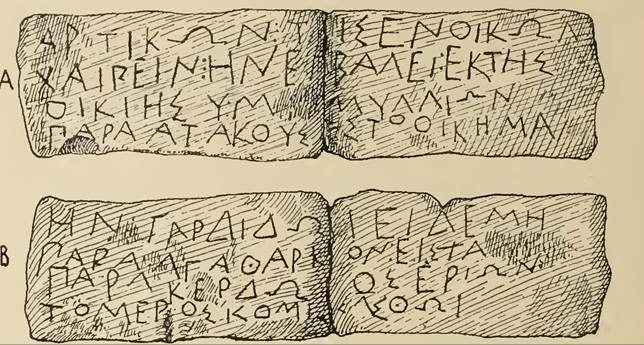
Early Issue. Lati ■ Issue. Chalci 1 2 3 (4) 5 (6) (7) 8 2 8 Types, Nos. I b I a 2 2b 2 a and i 3 4 Average weight (grni.) 12 28 38 71 117 116 i 22 I 12 The absence from this of 4 the half-obol is remarkable, though of course it
More on the topic CHAPTER XV. OLVlA.:
- Minns E.H.. Scythians and Greeks. A survey of ancient history and archaeology on the north coast of the Euxine from the Danube to the Caucasus. Cambridge: University Press,1913. — 720 p., 1913
- Follow-Up
- Scythian Customs
- DEALING WITH POISONS