CHAPTER XIV. TYRAS.
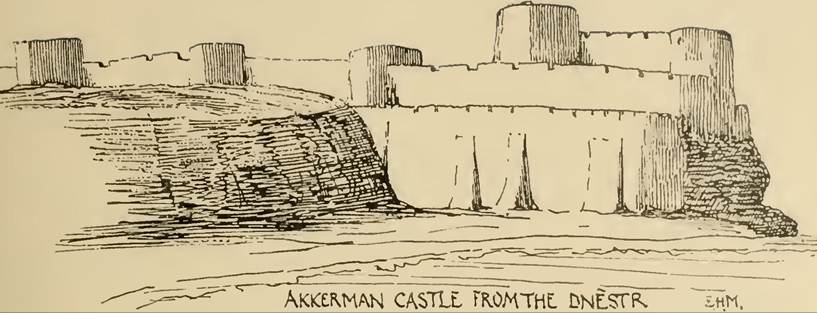
Fig. 329.
North of the Danube the first Greek colony was Tyras. It has already been shewn (p.
14) that Tyras was at Akkerman, on the right side of the Dnestr liman, about ten miles from its mouth, and that the statements of Strabo (vu. iii. 16) agree thereto. Ptolemy (m. x. 8) is troubled by conflicting data, the other authorities[999] are perfectly vague. Some confusion was caused by the existence of a second name for the city: Ophiussa. This was probably the real name superseded by that derived from the river and current in the mouths of strangers. Herodotus (iv. 51) mentions the Tyritae, but not the city, yet it was probably founded about the same time as Istrus and Olbia, in the middle of the vnth century b.c. Its position at the mouth of a great river corresponds to that of the other Milesian colonies. But it never seems to have attained any distinction. It is mentioned rather as a geographical point than as a political entity. It must have had a certain amount of trade ; what inscriptions we have deal with trade rather than politics, but that is all. Under certain conditions its position might have strategical importance, but those conditions were not present in ancient or in modern times ; formerly it was overshadowed by Olbia, now by Odessa. The Romans may have had some regard for it during the period when it was under their sway, while Olbia still maintained a precarious independence. For that interval it was the last outpost of the power holding the upper Balkan peninsula. This was again its position in its time of greatness in the later Middle Ages, when there was no Olbia, and it was on the north-eastern frontier of Moldavia, fortified to resist Russians and nomads alike. At that time it was the great port and fortress of the north-western Euxine, and its buildings were worthy of its greatness. It is still one of the most complete of mediaeval fortresses with its keep, inner and outer bailey standing deserted but intact, and now transferred to the care of the Odessa Archaeological Society. It remains a monument to Genoese, Wallachs and Turks, who strengthened it in turn. The present name due to the latter means White Fortress, in old Russian Belgorod : the Genoese called it Moncastro. General Bertier-de-La-Garde says that it never was Genoese, that the inner and outer baileys were built by Moldavians under Greek direction, and the keep constructed by the Turks when they took the place in 1484[1000].This great fortress has been the destruction of the Greek town, most of whose site it must cover. In von Stern’s excavations Greek potsherds were found mixed up with Chinese porcelain and Venetian glass in a way which shewed that the area had been dug over again and again. Hence the two most important Tyras inscriptions were found far from the town at Korotnoe and Chobruchi, sixty and seventy miles up the river; and this led to doubt as to the true site of the city.
The earlier of these[1001] is the end of a decree conferring public honours on one Cocceius, who had approached the Emperor on behalf of the town. It is “sealed” by the Chief Archon (πρώτος αρ^ωρ), four others, the proposer (εισηγητές) and the leading citizens, passed by the Senate and People, executed and enrolled by the Secretary in the third consulship of Commodus and that of Antistius Burrus (181 a.d.), year 125 by the Era of Tyras, giving 56 a.d. as the starting-point for the latter. The later inscription[1002] gives a letter from Ovinius Tertullus, legate of Lower Moesia, covering a letter to him from the Emperors Severus and Caracalla and another to Heraclitus, probably the procurator of the province. The tenor of the correspondence is that the citizens of Tyras have confirmed to them an immunity from customs of which they could not prove the origin, but which was supported by letters of M.
Aurelius and Antonius Hiberus, a predecessor of Tertullus. But before future citizens whom they may elect can enjoy the privilege their names must be submitted to the legate ; that is a distinct encroachment on the freedom of the city. The inscription is dated in the consulship of Mucianus and Fabianus (a.d. 201), in the 145th year of the Era of Tyras, in the archonship of P. Aelius Calpurnius. A very fragmentary inscription4 mentions freights, and stamps, and bankers (?), so it also deals with trade. Fragments of dedications we have, one in Latin for the preservation of Septimius Severus, Caracalla and Geta (his name erased as usual)5, and one6 giving the name of Priscus the arch]on. Another,...ς Κρατίνου ^αράπιδι,, Τσιδι,/... θεοΐς συν(ν)άοι,50 B.C., for Dio Chrysostom[1006] says they took all the Greek cities on the left of the Pontus as far as Apollonia. During all this period it owed its existence to fishing in the liman, to corn growing on the lowlands by the river and to cattle raising on the steppes ; perhaps also to viticulture such as now produces the excellent Bessarabian wine. Accordingly the most common head upon the autonomous coins is that of Demeter (Pl. 1. 1—4), crowned with ears of corn, with a bull or a horse on the reverse. Other deities are Apollo (8—10) with a lyre, Athena (11) helmed with the bull, a river god with a fish (13, 14), Dionysus with cornucopia and a bunch of grapes (5—7), Asclepius with the snake upon an altar (12), and Hermes with his petasus and caduceus (Burachkov x. 25).After the destruction by the Getae we cannot say what came to Tyras. It is tempting to think that it lay waste until 56 a.d., the year of its new era, and that then Ti. Plautius Silvanus, legate of Moesia, who later (about 62) extended his province and made Roman influence reach beyond the Borysthenes, raised the city from its ashes as a frontier defence to Moesia[1007].
The retention of its old kalendar argues autonomy.
Mommsen quotes many examples of town eras dating back to the year in which a city came definitely under the Roman suzerainty and was at once granted autonomy6. But there is a coin ascribed to Augustus (No. 15), and if the ascription be right the town must have been under Roman sway long before. Yet the account of Tomi given by Ovid would make us think that Tyras must have been untenable during the first decades of our era.In any case we find the town under Roman protection, governed by its
1869, pp. 74 and 164 sqq. V. App. z — CIAtt. I. 37, fr. He has also supplied NiKpuwa].
4 Or. xxxvi. p. 49.
5 App. \ = CIL. xiv. No. 3608; cf. A. v. Domas- zewski, “Die Dislocation des romischen Heeres ini J. 66 n. Chr.”, Rhein. Afus. 1892, p. 207.
6 R. Staatsrecht, III. i. p. 707.
44-8 Tyras [ch.
five archons, a senate and a popular assembly. Probably its constitution was much like that of Olbia. From the time of Domitian we have a regular series of Roman coins (Pl. i. 16—27) as far as Alexander Severus (d. 235). It can hardly be a coincidence that in his reign the Goths drew near to the Danube, which they crossed in 238 a.d., and began to cut short the coasts of the Roman Empire. The Tyrani enjoyed the confirmation of their free port not much more than thirty years. Zosimus (1. xlii. 1) expressly names their river as the base of a Gothic raid under Gallienus.
Coins. Plate I.
Tyras did not begin to coin until the latter part of the ivth century b.c., the earliest coin known seems to be No. 1 (86 grn. = 5'57 grm. Aeginetic drachma HN? p. 273), later silver coins are lighter, No. 2 weighs 8o’i grn. = 5'2 grm., and the didrachm, always rudely restruck, 144 grn. = 9-34 grm.
/R. Head of Demeter r., wheatears in hair. | Horse-protome r. TYPA.
Giel, Kl.B., No. 3, B. X. 27 ; Oreshnikov, Cat. Uvarov, No. i.
Later it even essayed a gold issue, a stater on the Lysimachean pattern.
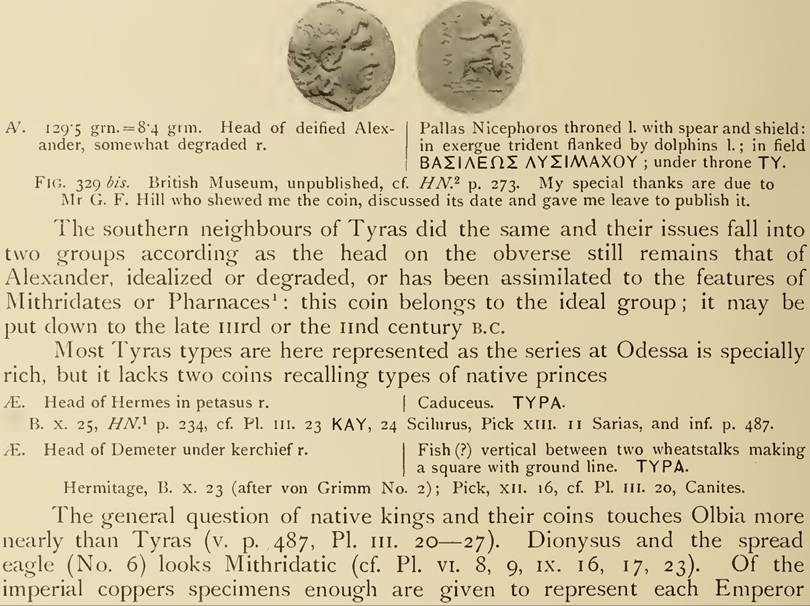
[1] Pick, op.
cit. pp. 64 n. 2, 91, 154, 170, Regling, ib. pp. 591, 606: to the first group belong No. 255, Callatis; Nos. 2471—-2473, fl· v· 6, Tomi: to the latter, Nos. 256—266, Callatis; No. 482, Pl. 11. 27,Istrus; Nos. 2474—2486, Pl. XXI. 6, Tomi: cf. Panti- capaean staters on this model inf. p. 583, Pl. vi. 19—21. The cities are distinguished by letters under the throne: KAA, IX, TO.
whose coins are known, the series extending· from Domitian to Alexander Severus, and to shew that the types are thoroughly imperial. The coin assigned to Augustus (No. 15) might very well belong to some other town; Pick docs not seem to recognize it. Of the coins put down to Trajan by Jurgiewicz, J. 39 seems to be a poor specimen of No. 17, Hadrian; J. 40 one of the later ones with Heracles reverse.
BIBLIOGRAPHY.
History and Geography.
Becker, P. “Tyras and the Tyritae.” Trans. Od. Soo. II. p. 416. I have not seen his Civil Life of the Tyritae. Odessa, 1849.
Bruun, Ph. “On the Site of Tyras.” Trans. Od. Soc. III. p. 47: Chernomorje, 1. p. 3.
von Stern, E. R. “The Latest Excavations at Akkerman.” Trans. Od. Soc. xxm. p. 33.
Inscriptions.
App. 1—4. Becker and Bruun as above.
Jurgiewicz, W. N. “On the Inscription from Chobruchi.” Trans. Od. Soc. XIII. p. 7.
losBE. 1. 2—7 (with summing up of previous literature), IV. 1—8, 452—455.
von Stern, E. R. “New Epigraphic Material from S. Russia.” Trans. Od. Soc. xxm. pp. 1—5, Nos. 1 4. Latyshev, V. V. “ On the Kalendars of Olbia, Tyras and Chersonesus Taurica.” Trans. Vlth Russ.
Archaeological Congress. Odessa, 1888, 11. p. 56 = 1101-74««, p. 37.
Coins.
von Grimm, A. “Die Münzen von Tyras.” Berliner Blatter f. Münz- Siegel- u. Wappenkunde, vi. (1868), p. 27.
Gardner, P. British Museum Catalogue of Greek Coins, Thrace, &-x, p. 13. London, 1877.
Burachkov, P. O. (B.). General Catalogue of Coins belonging to the Greek Colonies on the N. Coast of the Euxine. Pl. x.—xii. Odessa, 1884.
Giel, Ch. Ch. (G.). Kleine Beiträge (Kl. B.) zur Antiken Numismatik Süd-Russlands, p. 2. Moscow, 1886.
----- “New Additions to my Collection.” TRAS. v. (1892), PI. iv. 4, 5.
----- “Coins acquired in 1892, 1893.” TRAS. vn. (1895), PI. xvm. 12—14.
Oreshnikov, A. V. Catalogue of Antiquities belonging to Ct A. S. Uvarov. Pt VII. “Coins of Greek Cities N. of the Euxine,” pp. 1, 2, Nos. 1—7. Moscow, 1887.
von Sallet, A. Beschr. d. ant. Münzen d. k. Museen zu Berlin, I. pp. 31, 32. 1888.
Jurgiewicz, W. (J.). “The Coins of Tyras City.” Trans. Od. Soc. xv. (1889), pp. 1 12, Pl. I. Bruun, L. “Lieber die Münzen von T. unter Hadrian.” Zt. f. Numismatik, xvi. (1888), p. 182.
Pick, B. (P.). Die Antiken Münzen von Dacien und Moesicn I. Berlin, 1898. PI. XII. 1—28, xm.
1 —12, p. 919. (Most complete but without the corresponding text.)
Head, B. V. Historia Numorum {HN.} 1 p. 234, 2 p. 273. Oxford, 1887, 1911.
Tyras is not included in Koehne’s Description du Muse’e Kotsclioubey (MK).
Akkerman.
Kochubinskij, A. A. “XV Century Stone Inscriptions from Belgorod now Akkerman.” Trans. Od. Soc. xv. p. 506.
----- “Tura (Tyras)—Belgorod-Akkerman and its stone Inscription of 1454·” ib. xxiii· p. 79·
----- “On the state of the Fortress of Akkerman.” ib. XX. Minutes, p. 5.
von Stern, E. R. “An Expedition to Akkerman.” ib. XIX. Minutes, p. 13.
----- “ Latest Excavations at Akkerman,” with Plan of Fortress, ib. XXIII. p. 33·
Also short articles on various details in Trans. Od. Soc.
Bertier-de-La-Garde, A. L. “Report on the condition of the Fortress.” ib. x.xii. Minutes, p. 75.
More on the topic CHAPTER XIV. TYRAS.:
- Chapter XIV Fortunes of War: From Primitive Warfare to Nuclear Policy in Anthropological Thought
- Bhayro Siam, Rider Catherine (eds.). Demons and Illness from Antiquity to the Early-Modern Period. Leiden, Boston: Brill,2017. — xiv, 434 p., 2017
- Chapter 2 Refraining from Seeking Clarification: A Chapter from al-Wafl fl sharh al-Wafiya of al-Acraji (d. 1227/1812)
- Chapter 8 Why Early Muslims Divided into Sects? A Chapter from the Mukhtasar al-usul of cAli b. Muhammad b. al-Walid (d. 612/1215)1
- Chapter 7 The Role of Consensus in Legal Hermeneutics: A Chapter from the
- Chapter 1 Are Rulings of the Prophet Due to Ijtihad and Are all Mujtahids Always Correct? A Chapter from the Sharh. Zubdat al-usul of al-Mazandarani (d. 1081/1670)
- Chapter 6 The Chapter on Analogy (Qiyas) from the Hashiyat al-Fusul al-lulu’iyya of Ahmad b. cAbdalläh Ibn al-Wazir (d. 985/1577)
- Moving from the revelation of San‘ah to the tradition offiqh, our voyage has proceeded by means of strategies of translation (Chapter 2) and comparison (Chapter 3) to discover the ‘aqd in the acoustic space of Islam.
- Chapter 5 Debating the Epistemic Value of Hadith: A Chapter from the Fath al-bab ila. l-haqq wa-l-sawab of Mirzä Muhammad al-Akhbäri (d. 1232/1817)
- We argued in Chapter 0 that credit constraints are an important part of life, especially in the developing world. In this chapter we argue, based on Aghion-Angeletos-Banerjee-Manova (AABM), that the presence of credit constraints can help us understand why volatility is so costly for growth.
- Chapter 15 Appendix VII: Comments from the Department of Homeland Security
- Chapter Summary
- Chapter Summary
- Chapter Summary
- Military legitimacy was defined at the beginning of Chapter 2.
- Chapter 6 Pandemics and Financial Assets
- MAIN FOCUS OF THE CHAPTER
- Chapter Summary