Cossack Society and Beliefs
The population of Ukraine was Slowlyincreasing and Cossack towns such as Cherkassy, Kaniv, and Bratslav were experiencing economic growth, due in large part to exports of game, fish and produce such as wood, potash, tar, hemp, flax, wax and grain.
With plenty of fertile and free land, homesteads, ranches and entire farming communities appeared during the first half of the 16th century. They were largely self-administered and provided their own self-defense, and the state with its dominating class structure played a minimal role. Few members of the aristocracy chose to reside in the rough and unstable frontier regions, and those who did usually identified with the warlike Cossack culture. The influence of the local “starostas” and the power they were able to exercise declined noticeably as more armed town burghers and farmer-peasants acquired Cossack identity and status. Not surprisingly, the Ukrainian region began to witness a spontaneous growth of a much different society than those surrounding it, or indeed those elsewhere in Europe.Women also found themselves less restricted and more equal to men. Theywere usually outnumbered by the menfolk and at times found themselves taking part in armed defense of home and community. Marriages were rarely arranged, if at all, romantic love was common and Cossack women became famous for their freedom and pride. Although the greater gender equality was no doubt mainly due to the particular conditions of the Sparselypopulated frontier it could also have been influenced by the steppe traditions of the Sarmatian tribes. Strangers who visited the free Cossack communities were surprised by the local customs, and left us with their observations and impressions. Aparticularlyreliable source is Guillaume LeVasseur, the Siuer de Beauplana, a French mathematician from Normandy who worked as an architect and engineer.
He was initially hired by the Polish Hetman Stanislaw Koniecpolski in 1630 to build an Italian-Style palace near Brody, Galicia. He spent 17 years in Ukraine and is considered to be one of the most reliable witnesses of the Cossacks and their society. He was astonished to see young women take the initiative in choosing their husbands.As I had promised, let us say a few things about their customs which [the Cossack communities] observe, amongst them of marriage and how they sometimes go about making love (i.e., conduct romantic affairs) which to many people will seem new and unbelievable (“incredible”). Hence contrary to the usual practice of all nations, we see there girls making (professing) love to the young men who please them.... They go about it following a custom which is never broken. A girl who is in love goes to the house of the young man s father when he and the mother are at home, and with the words “may God be with you...” she asks the mother and the father to consent to the marriage.... If given an excuse (as to why they don’t consent) the girl states that she will not leave unless the parents agree. After a few weeks the parents are convinced and talk their (no doubt already willing) son into marriage.37
The whole procedure followed a set ritual which was always observed. The chastity of the bride, however, had to be preserved and if virginity was in doubt a conflict arose between the parents, and the groom was free to abandon his wife as if the marriage never occurred.
Weddings were elaborate affairs lasting several days and were celebrated by the whole Communitywith feasting, dancing and song. The rich harvests and self-governance without taxes and corvee labor duty gave Cossack settlements leisure time to not only train young men for war but also to socialize in family and communal entertainment, with much drink.
The custom in the villages of this country (Ukraine) is that on all Sundays and holidays after dinner the peasants (i.e., villagers) assemble in the tavern (inn) with their wives and children where they spend the rest of the day having drinks with each other.
Only the men and women have drinks while the young people amuse themselves dancing to the sounds of a “duda,” which is a kind of a bagpipe. I do not think that there is a nation in the world which is more free in drink... but when they go to war or embark on another enterprise they are extremely sober... they are pleasant and tactful, ingenious and liberal without design or ambition to become very rich, but they greatly love their freedom without which they would not wish to live.38Life did not seem to trouble the inhabitants of the Ukrainian prairies to any great extent and was often spent in revelry. “There is also no one amongst them/’ Beauplan continues, “no matter of what sex or age, who does not try to outdo his companions in drink or carousing (‘hulianka’) and there are no other Christians who trouble themselves less for tomorrow as they... never worry what the next day brings.”39
Separated and isolated from the other regions of Rus by distance and political environment the Cossack settlements were developing a distinct culture, with their own customs and artistic expressions. The unique Cossack male dances with their lively rhythms such as the “hopak,” the “kozachok” or the “trepak” were based on martial arts exercises and saber-fighting techniques whose energetic styles have been preserved to this day although as was Customaryin some dances, real sabers are no longer used. The fetching combinations of rhythm and melody were widely used and copied by various composers such as Khachatourian, inspired others and were directly incorporated into the ballets, opera and compositions ofTchaikovsky, himself a descendant of Ukrainian Cossacks. The rich tradition of Ukrainian folk music also owes much, if not most, of its origin and development to the Cossack movement and lifestyle. Many of the stirring campaign songs were used in Russian and Soviet military marches, and melodies of romantic songs have even been adopted by American folk musicians such as Woody Guthrie.
Less well known to the outside world are the sad love songs and ballads, the laments composed in memory of famous Cossack officers and leaders who lost their lives in the fight for freedom.Cossack communities produced their own skilled artisans and craftsmen and were Iargelyself-Sufficient, as ObservedbyBeauplan. Although some specialized in a particular craft or trade there was a general tendency to diversify, and most knew some carpentry, construction, wagon making, tanning leather, barrel making, and so forth. Women largely spent their time in weaving linen, wool and other cloths, while all knew how to cultivate the land, make bread, cook, brew beer and mead, and distill alcohol—the Ukrainian “horilka,” or “vudka” in Polish. As pointed out by Beauplan, while the people of the prairie Erontierwere “spiritual” enough, they mainly limited themselves to what was useful and necessary to a rural life.40 Most weapons were also made locally, with the exception of those requiring an “industrial” capacity, such as firearms and cannons, which had to be captured from the enemy. Turkish inlaid silver pistols and Damascus steel sabers and daggers were especially prized and highly sought after, as were Turkish and Persian rugs, which were usually hung on walls together with the weapons. Beauplan was impressed by the fine gunpowder, which was milled in large quantities, thanks to the rich deposits of saltpeter found in the Ukrainian prairies.
Besides their egalitarian and anti-state culture, which differed so much from their neighbors’, the Cossacks were nevertheless not entirely free from traditional influences such as religion. Weddings and funerals took place in a church, where the main holidays such as Easter and Christmas were also celebrated. Referred to as the “Faith of Rus,” the Greek Orthodox Church provided a sense of a wider cultural or “national” identity in an age before the birth of nationalism or other forms of “national” consciousness. The Church itself, however, had very little political or ideological influence on Cossack armed action such as choice of military target or who to serve in time of war.
By the second half of the century the Greek Orthodox Church in the Polish-Lithuanian Commonwealth had gone into a deep decline in the OfficiallyRoman Catholic State which was increasingly showing signs of intolerance towards Greek Orthodoxy and Protestantism. Moral and educational levels of the Orthodox clergy had also sunk to an all time low, as witnessed for example by the "certificates of absolution/’ which continued to be sold years after Rome had abandoned the sale of its “indulgences.” Orthodoxbishops were appointed by Catholic Polish kings, without too much attention being paid to suitability such as educational background so long as the candidates were deemed to be loyal to the Crown. Manywealthy and influential members of the Orthodox nobility found it more advantageous and reputable to convert to Roman Catholicism, which resulted in a further decline in the official influence of the Orthodox Church.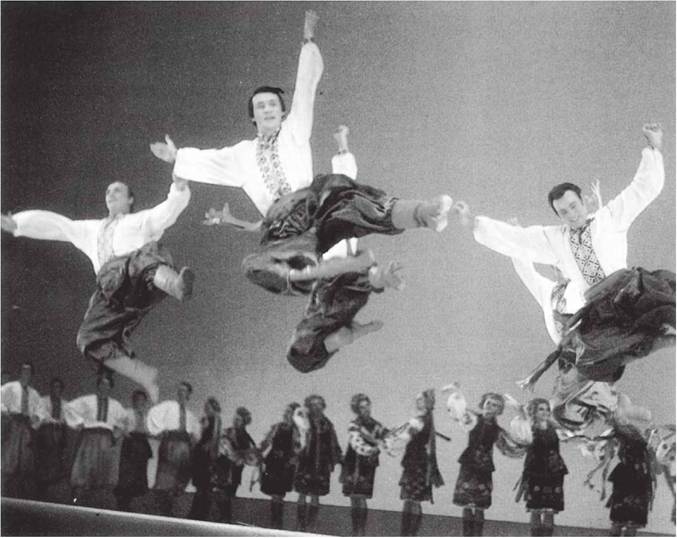
Traditional Ukrainian folk dances, by which the boys get to show off their stuff. Set to fast music, the dances were based on Cossack martial arts saber fighting techniques.
The decline in the Church may have had a limited effect on the town Cossacks but it Certainlywas of little importance to the steppe Cossacks, and those in the male-only strongholds in the lower Dnipro region. No churches were built there nor were there any ecclesiastical observances, as was pointed out humorously in a Ukrainian folk song:
The renowned lads, the Zaporozhians,
For ages saw no priest.
When they spied, in the field, a goat
The Otaman declared: “this, brothers, be a priest!”
The Osaul says: “so that I can confess.”
The renowned lads, the Zaporozhians,
For ages saw no church.
When they spied, in the field, a haystack The Otaman declared: “that, brothers, be a church!” The Osaul says: “in it I shall confess.”41
The lack of an ecclesiastical presence on the steppe was certainly intentional and could have represented a Muslim influence.
Although sworn foes of Islam, which was the faith of the Crimean Tatars, it does not follow that the Cossacks were opposed to all Muslim beliefs and practices. Without an ecclesiastic bureaucracy, such as that found in the Greek Orthodox and Roman Catholic Churches, Islam placed a stress on personal conscience and prayers could be said anywhere, not only in a mosque. God, after all, was everywhere.There is no record ofnon-Orthodox Christian settlements in the frontier palatinates (provinces) of Volin, Podilia, Bratslav and Kyiv although some individual Cossacks must have come from Catholic or Protestant backgrounds. Some adventurous Jews, however, did leave the relative security of the towns to venture into the Ukrainian border provinces, and by about the middle of the 16th Centuryprobablynumbered some 4,000 individuals.42 These were farmers and artisans rather than money lenders, managers, or lease holders of aristocratic estates, and once in the frontier they were also required to carry and learn the use of arms. Some took part in raids on Tatar lands and enjoyed the Cossack “rights and privileges” although they were forbidden by the Jewish Council of the Four Lands to do so, or to take part (in the later) Zaporozhian Black Sea raids.43 A Jewish presence amongst the Cossacks is known from several records. Before the Holy Roman Emperor Rudolph II sent his emissary Eric Lossota to Zaporozhia, he was visited by a Cossack officer Stanislav Khlopytsky, who was in the company of a Jew called Moses, both of whom took an oath of loyalty to Rudolph indicating Moses had Cossack status.44 Another record dealt with the 1610 Moscow campaign on the occasion of the death of a member of a Jewish Cossack squad of 11 men: “and many Cossacks said, "O God, how sad that the knight, the Jew Berakha died so painfully/ lamented his comrades in arms: he was chopped and stabbed by halberts.”45
He had apparently died under heroic circumstances and was talked about by the Cossacks for the next several weeks. Most records, however, dealt with Jewish burghers, merchants and businessmen rather than the artisans and farmers who lived in frontier Ukraine.
An underlying reason for the decline of the Greek Orthodox Church was the fall of the Roman Empire when the Turks began to invade the Balkan Peninsula. To seek aid from the Catholic world the emperor and the patriarch of Constantinople agreed to merge with Rome, and in 1439 by the Union of Florence the OrthodoxPatriarch agreed to accept Roman Catholic dogma and Papal jurisdiction, in return for maintaining the Eastern rites—no doubt to mask the negative public impact of the union. In 1452 Emperor Constantine XI accepted Cardinal Isidore into the city, and on 12 December Roman Catholic mass was said in the great Cathedral of St. Sophia. The great city fell to the Turks in the following year and the Union of Florence became a dead letter when Sultan Mehmet II declared himself the protector of the Greek Orthodox Church and oversaw the installation of a new Patriarch.
By the middle of the 16th century the Roman Catholic Church itself entered into a crisis, losing much of its jurisdiction to the Protestant Reformation. With the new Order of Jesus Christ—known better as the Jesuits—leading the way, the papacy embarked on the Counter Reformation. The Greek Orthodoxpopulation ofEastern Europe came to the Popes attention and it was decided to revive the Union of Florence with the publication of “On the Unity of Gods Church” in 1577 by the Jesuit Piotr Skarga. After Severalpolemical interchanges the OrthodoxMetropolitan of Kyiv and his bishops signed an “Article of Union” which they sent to the King and the Pope. Kos- tiantin Ostrohsky, the most powerful Orthodox magnate of the Commonwealth, reacted by threatening military action unless a Sobor council of the Orthodox Church of Rus were held to decide on the union.
Disregarding the opposition of the anti-union faction, on 24 September 1595, King Zygmunt III had announced the union of the Church of Rus with Rome, but the following year in May heeding the volatile situation in Ukraine and Prince Ostrohsky s warning, the King authorized the pro-union Metropolitan of Kyiv to convoke a Sobor of the Church. The prounion delegates and their Catholic supporters gathered for a congress which was opened with a mass in the Brest Cathedral to which union opponents were not invited. In fact all Orthodox churches were ordered to be closed, and the opposition reacted by gathering in the private Protestant prayer hall of Lord Raisky to condemn the union. Thus two separate Orthodox Church of Rus councils were held, one pro and the other anti-union. The latter had invited prominent Greek Orthodox Patriarchal hierarchs from Constantinople and Alexandria, such as the Pa- triarchs exarch Nicephorus, whose attendance of the council meetings was barred by the King s order, forbidding foreigners from attending.
The ban decided the final outcome and on 9 October 1596 the pro-Uniate Councilproclaimed the union of the Orthodox Church of Rus with Rome. All bishops and priests who opposed the decision were excommunicated, and on the same day the Patriarchs exarch announced the Metropolitan of Kyiv and all bishops who had accepted the union were divested of their offices and the right to conduct Orthodox church service. The King proclaimed the Uniate Church to be the only legal church in Rus and most Orthodox churches and monasteries not protected by Prince Kostiantin Ostrohsky were occupied by the Uniates.46 Nicephorus was accused of being a Turkish spy and on Zygmunt III s orders was imprisoned in Marienburg castle where he was starved to death. Three years later in 1599 the Orthodox Church, such as it was, concluded an agreement with the Protestants for a joint defense of religious dissent against Catholic persecution. Henceforth religion would become yet another source of conflict between the growing strength of the Cossack Brotherhood and the Catholic Polish state.
Not all folk customs in Ukraine were guided by Orthodox Christianity and many pagan practices and beliefs survived the christening of Rus. This was especially true of Cossack communities where ecclesiastic influence was not very strong to begin with. One custom which survived and has spread to other parts of the world is the practice of a friendly, semi-magical being known as “Did Moroz” or “Old Man Frost” (Hoar Frost) who brings children gifts on Christmas Day. This was very different from Catholic and Protestant practice of northern or western Europe where gift-giving had nothing to do with a jolly “St. Nick.” The origins of Santa Claus are unknown but are at times considered to lie in North European cultures, such as Holland or Germany. Nothing could be further from the truth. In Holland a household would be visited by St. Nicholas dressed in a bishop s attire, a stern judgmental figure who gave out sweets and tested childrens’ knowledge of the scriptures and other Christian beliefs. He also carried a rod and was accompanied by Black Pete, a scary black-faced devilish figure.
In Germany, Christmas was also accompanied by a blackfaced being carrying a whip, known as Pelznichol (Bellsnickle) or “Fury Nikolas.” Pelznicholuttered strange sounds to imitate a foreign tongue, and by the time he reached Pennsylvania in America he was sliding down chimneys at midnight to leave presents in the hanging stockings. Another German Christmas figure was a wild man called Ruprecht who was later replaced by “Christkind” (“Christman”), a teenaged girl dressed in white accompanied by men with blackened faces, and wearing tattered womens clothes known as the “Fein.” “Christkind” made the children recite passages from the scriptures or religious hymns, and if they passed they would be rewarded with gingerbread; otherwise they would be beaten with an ash-filled bundle. When “Christkind” left, the Fein would enter the house, jump around and frighten the children. In Catholic Austria the children would be visited by Saint Nickolas, a grey-haired figure with a flowing beard, cape and a staff. He, too, was accompanied by a black-faced creature dressed in a hairy hide with horns and carrying a clanking chain.
In the north and eastern regions of the Baltic, Christmas was also symbolically not a joyous affair. An exception seems to be Finland, Wherejoulupuckli goes from house to house enquiring whether there are good children, and when reassured (by the children) that this is the case he proceeds to distribute gifts, helped by little elves. In Sweden, on the other hand, Christmas was accompanied by a young woman in white robes known as Lussi, who wore a crown with attached candles and went about accompanied by a rider on a horse and men with blackened faces and hairy costumes. These were the demons and trolls who were being conquered by the reviving sun, symbolized by Lussi. Other sinister figures also made their appearance in the Scandinavian and Baltic region, but none were as terrifying as the one-eyed cannibalistic monster called Stallo in Lapland, who brought no presents but went around scooping up children into his bag.47
What was the apparently abrupt transformation that changed the German Pelznickol or the Lap cannibal Stallo and the other unkind pagan winter beings into a jolly, children- friendly gift giver, whom we have come to know as Santa Claus? Clearly a different tradition was at work, a clue to which lies in Santas costume and appearance—that of a Ukrainian Cossack, probably an officer from around the middle or the second half of the 18th century. Ukrainian Cossackunits fought in the Baltic region, and were often stationed there as a part of the Russian occupying forces, and on Christmas Day individual Cossacks simply did what was Customarybackhome. They masqueraded as “Did Moroz,” with his great white beard and eyebrows symbolizing winter as Old Man Frost, who traveled in his sled delivering gifts to the local children. Orthodoxy had never introduced the concept of original sin, and children were highly valued in Eastern Europe as completely innocent beings free of sin. Physical punishment of children in Cossack society was also not generally practiced.
Frightening children was not the Cossack way, and the presents no doubt went some way to alleviate the fear children felt during the darkest days of the year. The distribution of gifts was also possible during hostilities since Norwegians, Swedes, Finns and Estonians publicly announced a Christmas truce in wartime. Several Cossacks would deliver the presents which they had prepared ahead of time which would have been given to their own children had they been back home. Surely, whoever it was bringing the presents was magical for on Christmas Day he could be at different places at the same time; certainly St. Nickolas, as explained by the local Catholic and Protestant ecclesiastical authorities. Santa Claus, as he became known in German, wore very distinctive clothes which could not but be noticed by the local population, clothes which today give him away as a Ukrainian Cossack: black riding boots, baggy red trousers or aSharovarif a red sheepskin coat or the “kozhuch” girded by the leather saber belt which would also hold pistol holsters, and above all the fur cap with the long hanging “shlick.” This was the image of Santa Claus which was brought by Scandinavian and northeastern German settlers in Wisconsin during the 19th century. It was first published by the White Rock Natural Mineral Spring Company of Waukesha, Wisconsin, in its advertising of mineral water and ginger ale in Life magazine in 1923 and 1924. Santas costume was further popularized by H.H. Sunblom, a commercial artist who drew the familiar, red- suited Santa Claus in 1959 for a Coca-Cola ad.48