The Cossacksfrom “Down Under”
Then as now, the mighty Dnipro River begins its flow in the forest region of the Pripiat Marsh. Proceeding southeast past Kyiy it broadens into a prairie river, flowing past the old Cossack towns of Kaniv and Cherkassy for some 400 kilometers until it reaches the Samara Tributary.
Today, the river is harnessed and flooded by dams, but 500 years ago a dramatic change could be seen here. Turning sharply south, the Dnipro began to descend for 90 kilometers over a great system of 3 groups of rapids, 12 individual rocky barriers blocking all free access to the “Wild Prairie” below. The last cataract, known as the “Vilny” (“Free”), consisted of 7 surfaces of granite rock with12 sets ofjutting “dragons teeth” before the river dropped some
13 meters into quiet water. Once beyond the rapids or in the “Zaporozhia” region, the Dnipro and the surrounding territory once again underwent a drastic transformation, as it began to flow southwest for its final 200 kilometer journey to the Black Sea. Here it became once again a prairie river subject to spring flooding over a wide area resulting in a virtually impenetrable water system. Almost the entire eastern shore was covered by a flat grassy terrain alongside reed beds called “plavny,” which were dotted with lakes and lagoons and crossed by tributary streams and rivers. The largest “plavnia” was called “Veliky Luh” (Great Plain), which began on the left bank of the Dnipro at first about 25 kilometers wide in its northern reaches and tapering off over 100 kilometers along the river bank. This was the Dnipro s floodplain and during spring and early summer it was difficult to penetrate from land. In the west, steep banks prevented easy access to the river. Rich in fish and game, the entire region was a favorite Cossack hunting ground, where they could camp and seek safety on the hundreds of islands dotting the river.
The winters were cold, and the hot summers prone to drought, which would turn the steppe into a brown sea of dried vegetation. Locust infestations arrived periodically, and thick swarms of mosquitoes were everywhere. This was also a dangerous land Controlledbythe steppe nomads such as the Tatar tribes, and beyond the traditional reach of Kyiv Rus. As the name “Zaporozhia” implies this was the territory beyond the “porohi” or thresholds of Slavic settlements, marked by the series of rapids and cataracts.1The second half of the 16th century saw a growth in the Cossack way of life here and the birth of a new self-reliance, based on individual freedom and independence from the monarchies and feudal societies which surrounded them. More town Cossacks began to push south along the Dnipro River to join the “burlaky” or steppe Cossacks in search of richer fishing and hunting grounds beyond the rapids, or “down under” as the region became known: as went a rhymed Cossack saying, “the steppe and freedom, that is the Cossack destiny.” Defensive wooden blockhouses were established and soon more Cossacks began to camp over winter on the river islands, as described in a Ukrainian folk song:
Brother Dnipro, with what are you renowned, With what beauty, with what brightness; Whether by your steep shores, Whether by your yellow sands, Or with your Cossacks?
Oi, I am renowned with the burlaky, The Cossacks from Down Under.2
A description is also provided by the Polish chronicler Marcin Bielskiwho recorded in 1574:
The people in the “Nyz” (Down Under) live from their fishing. They dry the fish without salting it and then subsist on it during the summer. In the winter they disperse among the neighboring
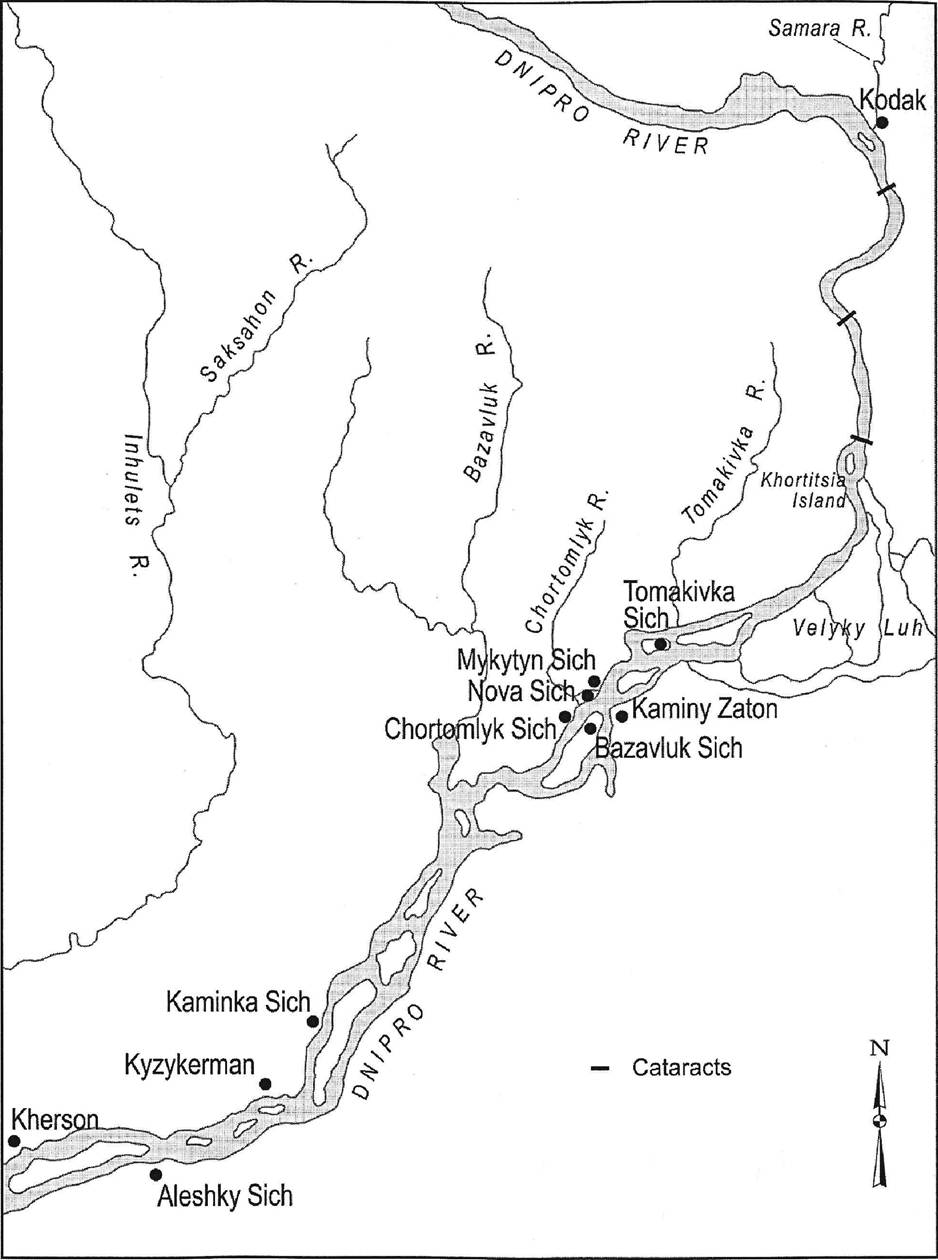
The main Zaporozhian Sich strongholds on the Dnipro River. To the north were the cataracts which protected the “Down Under” territory from naval invasions.
towns such as Kyiv, Cherkassy, and others.
They leave their boats in some safe place on one of the islands of the Dnipro. In addition they leave several hundred armed men there, in the “kurines” (barracks) as they say, and with artillery. They have their own small cannons, some of which were taken from the Tatars. Previously there were not so many of them but now they number several thousand. Especially in recent times they have rapidly grown in numbers.3Giant catfish and sturgeon were plentiful, and together with millet were the main staple of the Dnipro Cossacks. The size of the sturgeon could be enormous, as noted by the British ambassador the Earl of Carlisle in 1669 in his “A Relation of Three Embassies”; he wrote that Zaporozhian Cossacks fishing in the Dnipro caught beluga “three fathoms long, one of which can hardly be carried by thirty men.”
An idea of establishing a fortification on the lower Dnipro region began to be entertained by government officials from southern Rus, including King Zygmunt I himself. Garrisoned by Cossacks, it could serve a double purpose: provide the first line of defense against Tatar raids and invasions, and put to good use the energy of Cossack “trouble makers.” The first step was taken again by a Rusian nobleman from southern Volin, Prince DmytroVyshnevetsky, who was appointed as “starosta” of Kyiv and Kaniv in 1550. He had spent several years in the company of Cossacks fighting Tatars where he earned the nickname “Baida.” Nowwith several hundred Cossacks he landed on Khortitsia Island just below the rapids in 1556 and began to erect a palisade fort or a “sich,” well supplied with provisions and munitions to withstand a siege. Taking the fight to the Tatars would force the enemy into a defensive position and rob him of the ability to launch invasions into Christian territory. That, at least, was the plan. The Zaporozhian Sich, as it became known, would be the main headquarters and the heart and mind of the Cossack movement. It would also establish the most unusual military organization in Europe, perhaps in the world.4
Establishing the Sich on Khortitsia Island also brought the Cossacks closer to Muscovy, as well as to the Putyvl town Cossacks.
In March 1556 Ivan IV (“The Terrible”) of Muscovy attacked Tatar Astrakhan on the Caspian delta of the Volga River, and a diversionary force of Muscovite troops from Putyvl Cossacks under Ivans commander Rzhevsky was sent down the Dnipro to attack the Crimea. Muscovy s territory extended to the outpost of Lubny only several dozen miles to the east of the Dnipro and bordered the lands of Kyiv Ukraine and those of the Crimean Tatars. Baida Vyshnevetsky also joined the expedition with 300 Cossacks from Cherkassy and Kanivunder their atamans Mlynsky and Jakovich. This was the first time a Cossack force would fight alongside a foreign power which moreover was hostile to Lithuania-Rus and Poland. Unable to take the Tatar stronghold of Islam Kerman some 200 kilometers down the Dnipro River from the Sich and defended with heavy artillery, they headed towards the Dnipro estuary and attacked Ochakov Capturing the outskirts of the fortress they took much booty and prisoners but were obliged to retreat at the approach of a large Turkish force, which began to pursue them back to the Dnipro River. The Turks were ambushed in the thick reeds of the river,s “plavni” and suffering heavy casualties from the withering musket fire were forced to withdraw. The Turks were replaced by Tatar troops, which forced the Cossacks to take refuge on a Dnipro island, but after six days of attempts to dislodge the defenders the Tatars laid siege to the island. In a surprise move the Cossacks rowed their boats to shore under cover of darkness, hijacked the Tatar horses and rode off into the steppe, leaving the Tatars stranded in their camp.In October of the same year the Cossacks from Khortitsia Island again attacked Islam Kerman but with a larger force, and this time the fortress fell into their hands, with much military materiel and the prized cannons. The Zaporozhian Sich was becoming a thorn in the side of the Tatars, and waiting until the Dnipro froze, Khan Devlet Giray decided to deal with the upstarts once and for all.
InJanuary 1557 at the head of a large force the Khan laid siege to the Khortitsia Sich, and during the next 24 days the Tatars launched assault after assault on the Cossack positions but without avail. Having lost many of his best men, the Khan decided to withdraw. Baida Vyshnevetsky promptly informed Prince Zygmunt II of the Victorywith a request for men and firearms to make up for his losses, but to no avail. All he received was a modest monetary stipend and a reminder that the Crimean Khan was the Grand Prince s ally, and was not to be molested. Once again the Grand Prince refused to take responsibility for the defense of the Ukrainian lands, and henceforth the Sich would be manned only by Cossacks.The Khan was intent on destroying the Cossacks’ foothold below the rapids, territory which he viewed as his own, and in the summer of that same year he returned with a much larger force which included the elite OttomanJanissaries. A massive initial attack was repulsed by deadly musket fire, as were further assaults, but with supplies and men running low it became a question of time until the Cossack defenses would be overrun. Under the cover of darkness the remaining Cossacks boarded their swift “tchaika” riverboats which were hidden in the reeds and abandoned the Sich, leaving the settlement in the hands of the enemy, who proceeded to destroy all traces of a Cossack presence.
Grand Prince Zygmunt II was held responsible for Vysh- nevetsky s actions and a large Tatar army of 20,000 men was launched on the Ukraina, Volin, and Podilia, resulting in great devastation and loss of lives, including captives destined for the Crimean slave markets. The main reason for the invasion, however, was probably a drought in the southern steppe and the famine that followed among the Tatar population. Disillusioned with Zygmunt s lack of support, Vyshnevetsky approached Ivan the Terrible of Muscovy, and in 1557 took an oath of service to the Tsar, in return receiving the town of Belev with the surrounding villages, as well as others near Moscow and a 10,000 ruble stipend.
The following year with Muscovite troops and his own Cossacks Vyshnevetskymarched on Perekop, the fortress which guarded the narrow isthmus of land joining the Crimean Peninsula to the mainland. His advance was blocked by the Khan, who had taken his entire horde to guard the strategic narrow stretch of land. The following year a large Muscovite force sailed down the Dnipro and landed in the Crimea, while Vyshnevetsky was sent to the Don River to attack the Tatars from the opposite direction. After devastating a part of the western Crimean peninsula the Muscovites withdrew in preparation for the Livonian War with Lithuania-Rus which broke out in 1561. Faced with conflicting loyalties, Vyshnevetsky returned to Grand Prince Zygmunt s service. He was well received at a meeting of the nobles’ Sejm, as well as at the Royal court, and when he became ill—from poison he thought—Baida was treated by Zygmunt s own physician.
Barely recuperated, Vyshnevetsky once again turned his energies to the anti-Muslim struggle. Without Moscow’s support, he was powerless against the combined might of the Tatars and the Ottoman Empire, and he turned his attention to Moldavia where a power struggle had broken out for the crown of “Hospodar.” In 1563 Baida intervened on behalf of the antiOttoman candidate with disastrous results. An uprising led by the usurper Tomsha had succeeded in putting him in power, and as he was being crowned a group of dissident Moldavian nobles convinced Prince Vyshnevetsky that it was he who should be the “Hospodar.” Tomsha had the larger army, and when Vyshnevetsky s Moldavian allies deserted the field the Cossacks were easily routed. Vyshnevetskywas taken prisoner and promptly handed over to the Turkish Sultan Suleyman I (“The Magnificent”). Baidawas executed, and the Cossack prisoners condemned to the slavery of the Ottoman war galleys.
Vyshnevetsky s legacy survived his death and grew with time as the renowned founder of the Zaporozhian Cossack Brotherhood with their fortified Sich “Down Under.” Ballads were composed in his memory, one of which has come down to us in typically jocular Cossack style.
In Tsargrad (Constantinople) at the bazaar, Hey, there Baida drinks mead and whiskey; Hey, there Baida drinks not for a day Nor for two, no one night.
The Turkish Tsar (Sultan) sends for Baida,
“O Baida of renown,
Be my loyal knight, take my daughter, You shall be lord of all Ukraine!”
Vyshnevetsky shows his disdain for Islam and the Sultan, bringing upon himself the “Tsar’s” wrath.
Your faith, O Tsar, is cursed,
Your daughter is ugly, too!
“Oi,” shouts the Tsar to his haiduks,
“Take Baida into your hands,
Take him, hang him by the rib on a hook.” the island is a mighty fortification.”7 A rare description of the “Down Under” Cossacks is provided by the Polish author Bar- tolomiej Paprocki, who visited the area in 1599:
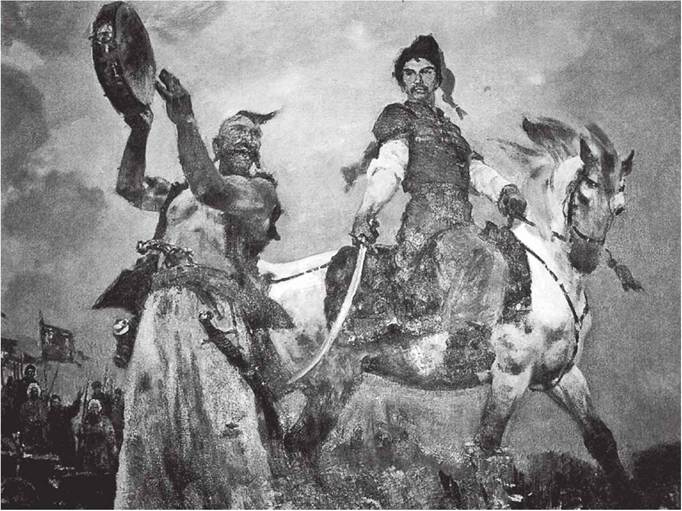
V.V. Poltavets, “A Call to Arms.” The Cossack is sporting the “oseledets” hairlock indicating that he is a member of the Brotherhood (The CherkasyMuseum of Fine Arts).
In proper Cossackfashion, however, Baida refuses to give up and resists to the very last.
Oi, Baida, he swings from the hook, Not for a day, nor for two, not one night.
“O young guard, pass me a taut bow,
For I spy three pigeons
To shoot for the Tsar’s daughter.”
As he aims he shoots the Tsar,
And he shoots the Tsar s wife, Nor does he spare the daughter’s life.5
A more humorous version has the Sultan wounded such that he would never enjoy his harem again. The Ukrainian Cossacks could have paraphrased the motto of the British Royal Marines, “good humor in the face of adversity,” as their operating motto.6
The destruction of the Khortitsia Sich did not put an end to the Cossack presence below the Dnipro rapids. We know from the Polish chronicler Marcin Bielski that by 1574 the Sich had been rebuilt, with better fortifications: “here (on an island called Tomakivka) the Zaporozhian Cossacks usually live. Ofitself
There are several places or broad islands on the Dnipro River that are in the Tatar rather than the Podilian regions.... In times almost within our memory military men began to go there to try their luck against the Tatar pagans. Then people who had done something wrong or caused mischief... began to join them.... Initially there were several hundred of them, which seemed a large number. Now several thousand of them can be found. But many blameless, though not rich young men also go there to learn the martial arts. Also quite a few young gentlemen from Rus, Podilia and Poland (Galicia, Volin?) go there, for among them (the Cossacks) one can get good training in military discipline and readiness. The Rusins call them Zaporozhian Cossacks... from the word “porohy” (rapids). Others call them the Cossacks of the “Down Under”.... They have many firearms on these islands.... Sometimes their army abounds in everything because peasants bring articles to them... and they pay them with whatever the peasants want—horses, wagons, or other property, as well as money.... Once the army’s debts are paid they divide the rest of the booty evenly, and each uses his share as he wishes.8
The frontier towns in Ukraine were also growing with new strongholds established at Bar, Bila Tserkva, Vinnitsia, Chihirin, Korsun, Uman, and Pereiaslav, which were rapidly becoming Cossack centers. Besides the Cossacks in the Sich more frontiersmen were traveling south to the rich grounds of the lower Dnipro region to take part in the fishing, hunting and gathering. Small bands or “vatahas,” usually up to a dozen individuals protected by wooden blockhouses, formed a single co-operative unit independent of any outside authority. Another Polish nobleman, Samuel Zbarowski, who visited the region “Down Under” was surprised to observe that the Cossack huntergatherers “did not care for the king, their (nominal) lord, or for the fatherland in which they were born, but pinned all their hopes on the place where they lived, according to the proverb, one lives as long as one has a livelihood.’”9
Hunting and fishing, however, did not constitute the Cossacks’ sole means of “livelihood” and raids on Tatar and Ottoman territory were increasing. The attacks brought new threats from the Crimean khans and more seriously from the mighty Ottoman sultans who pointed out with some logic that since the Cossack Sich was on the Grand Prince’s (claimed) territory he, Zygmunt II, was responsible for the damage caused by the Cossacks. We can gauge the scope of the raids and the increasing Cossack presence from the letter in which for the first time Zygmunt II addressed the Cossacks directly. They were to vacate the steppe, the lower Dnipro region, and their hunting and fishing grounds. They were to remain in the Ukrainian towns and forts and no longer go on “willful expeditions” against the Tatars; in return they were promised paid service as frontier guards. If the Cossacks continued their “willfulness,” however, they would invite severe punishment from the authorities.
Lithuania-Rus was being hard-pressed by Muscovy in the Livonian war, and in 1565-66 the Polish and Lithuanian “sejms” met in Vilnius to discuss future arrangements. After giving themselves even more privileges and political rights, the nobility moved to the question of a union of Poland-Galicia and Lithuania-Rus. The Polish “sejm” was in favor of a complete union, but the Lithuanians were opposed to anything which would lead to loss of independence. The nobility of the Rus provinces of Pidliashia and Volin were also in favor of union, and Zygmunt II proceeded to remove the two provinces from Lithuania and incorporate them into the Polish Crown. Three days later, putting on his crown, Zygmunt II ordered the nobility of the two provinces to swear allegiance to him as King of Poland. The Ukrainian territory was transferred next, and on 1 July 1569 the changes were formalized by the Treaty of Union signed in Lublin and ratified by Zygmunt II three days later, giving rise to what became known as the Commonwealth.
The Union of Lublin had a major impact on the Cossack movement as well as on the future development of Eastern Europe. Besides dividing Rus into what would become Belarus and Ukraine, the Union opened the door to a sharp antagonism between the Cossacks and the Orthodox population, on the one hand, and the land owning oligarchy on the other. The power and its abuse by the aristocracy was sharply increased when the nobility gave itself the legal right to elect the kings of Poland as well as the power of life and death over a peasant serf, who could be killed by his lord without penalty. While under the rule of the Grand Princes of Lithuania-Rus the palatinates (provinces) of Volin, Podilia, Bratslav and Kyivhad retained the legal code and customs of medieval Rus as well as Church Slavonic as the official language. Both were now replaced by Polish law and the Polish tongue, as had been done in Galicia some two centuries before although Latin still played a major role. The guarantees and independence of the Greek Orthodox Church (“The Faith of Rus”) were canceled, with Orthodox bishops being appointed by the king, followed by its complete ban several decades later. With the steep decline in prestige of the Orthodox Church and the growing influence of Polish Catholic culture, the Orthodox nobility of Rus began to convert to Roman Catholicism. The notable exception was of the boyars (knights), whose traditional noble status was not recognized by the Union of Lublin and who remained adherents of the Greek Orthodox Church. Many of these professional men-at-arms began to hire themselves out to Orthodox magnates such as the Ostrohsky family, while others gravitated towards the Cossacks which strengthened their military capability. No doubt it was due to the boyar influence that Cossacks began to refer to themselves as “litsiars,” or knightly men-at- arms. Abandoned by both the ecclesiastic and secular pillars of traditional Rus society and state, the peasant serfs and town burghers Increasinglybegan to look to the Cossacks for selfdefense and leadership. It would not be long in coming.
Following the Union of Lublin, King Zygmunt II entrusted a Polish nobleman, the Crown Hetman (commander) JerzyJa- zlowiecky, with the task of recruiting a limited number of Cossacks from “Down Under” for royal duty. He was also to define the political and legal basis on which this would be done. The Hetman knew the Cossacks well, spoke the common Rusian language and had fought with them against the Tatars on a number of occasions. He knew that the Cossacks’ main complaint was about the “major injustices and oppressions by the border palatines and starostas, and other government officials.” As long as the Cossacks were being harassed and taxed on their proceeds from hunting and gathering and other trade there could be no resolution to the “Cossack problem.” Jazlowiecky hit on a simple solution, one which changed the very official nature of the Cossacks’ status. Theywere to be removed from the usual Crown jurisdiction and placed under the Hetman’s direct authority, with a special judge to oversee legal aspects. This was to make all Cossacks exempt from the administration and implementation of justice by any civil government offices and officials, and complaints could only be lodged with the Crown Hetman. The King accepted Jazlowiecky s recommendations and, by the Royal Charter of 1572, it was announced that
Jan Badowski, departing in no way from the decision of the Lord Palatine is to administer justice without delay to everyone of the Cossacks of the Lower Dnipro Region according to the general law, and to do so justly and promptly... he is obliged to the end of his life to be responsible not to the palatines, starostas, our offices or anyone else (except for violence and bloodshed) but only to Us the Sovereign, or to the Rusian Lord Palatine and to the (future) Hetmans.10
The charter created overnight an independent and unique social category, a new social class not seen anywhere before. Being freed to a large extent from the Polish Kingdom’s legal and political institutions, the Zaporozhian Cossacks had become a virtually untouchable and semi-privileged military body, with their aCossackliberties and privileges” officially recognized; and all Cossacks, even those of the towns, began to consider themselves as Zaporozhians from “Down Under.” Most had spent time in the Sich and took part in Zaporozhian expeditions, but the Royal Charter of 1572 established the Sich as the undisputed Cossack center.
Three hundred Cossacks from the lower Dnipro region were also recruited by Jazlowiecky, with a quarterly payment of two and a half gold zlotys, and woolen cloth. The draft of the “registered Cossacks” as they became known was intended both to put an end to the raids on Tatar territory and to provide future border guards against Tatar raids. The number accepted on the royal payroll was negligible, and attacks by the nonregistered Cossacks on Muslim territory continued. The strength of the Zaporozhian Cossacks had increased to several thousand, particularly in the summer months when many came to hunt, gather honey, and dry fish. The Sich was now protected with artillery and a permanent garrison of several hundred Cossacks, but larger forces would gather periodically to “inflict considerable damage to the Turks and Tatars. Several times already they have destroyed Ochakov, Tehin (Bendery) and other fortresses.”11
The Cossacks in the Sich had elected a Hetman who became known for the scale of his campaigns, a minor prince from Volin by the name of Ruzhinsky. “Bohdan Ruzhinsky, Hetman of the Cossacks of the Lower Dnipro Region... who abandoned the luxuries of the world (and) stands as a valiant lion with his right hand raised to engage the pagans in a bloody banquet,” we are told by a contemporary Polish writer.12 When the Tatars launched a devastating attack on Ukraine, Volin and Galicia in 1575 Ruzhinsky followed the horde, as it was returning to the Crimea loaded with booty. Entering the peninsula he proceeded to destroy all which lay in his path, killing Muslims who fell into his hands. This was the largest attack on the Crimea to date, involving 3,000 Cossacks as later claimed by the Khan. The following year at the request of Tsar Ivan IV (“The Terrible”) and provided with ample supplies, Ruzhinsky again attacked Tatar forces in the lower Dnipro region, obliging them to turn back from an intended invasion of Muscovy. Laying siege to the Tatar stronghold of Aslan Kerman, Ruzhin- sky was accidentally killed by a mine which the Cossacks had laid under the walls of the fortress which had exploded prematurely. InJanuary of the following year a Zaporozhian ataman, Jakiv Shach, attacked a Tatar envoy from Moscow who was stripped of the rich gifts he was bringing to the Khan. Outraged at the attack the Khan again invaded Kyiv and Bila Tserka, destroying Bar and other smaller outposts; but in October his men were defeated by a force led by PrinceJanush Zbarazhsky the Crown Voivoda of Bratslav.
As Zaporozhian numbers grew their attacks against the Tatars and Turks increased. The nobility continued to fail in its duty to protect the realm against Tatar attacks, particularly in the Orthodox frontier provinces of Volin, Podilia, Bratslav and Kyiv, a task that was increasingly falling to the Cossacks. Indeed, the Commonwealth continued the policy of appeasing the Ottoman Empire and the Tatars with peace treaties and annual payments, which were thought to be cheaper and less troublesome than outright confrontation. The Tatars, however, had become dependent on the valuable slave trade, and the raids went on. The relationship between the nobility and their Cossack status rivals continued to worsen with the aristocracy losing much respect for being able to enjoy the unearned wealth and privileges which were not available to the rest of the population. Many nobles were unable (or unwilling) to handle money matters or to manage their own estates and instead hired Jews as professional estate agents, tax collectors and leaseholders of their properties.13 Khazar and (later) TatarJews had been common in Eastern Europe as traders and fighting men, but these were German-speaking newcomers who had been encouraged to settle in the Polish Kingdom beginning in the 14th century to help stimulate economic activity.
The Cossacks in turn were viewed in a negative light by the Catholic nobility being not Onlyinconvenient but also dangerous troublemakers who claimed rights and privileges, and moreover invited Tatar attacks. Theywere frequently compared to bandits only intent on looting and pillaging who were to be controlled as much as possible. Most of the Polish aristocracy had a dim knowledge of the Cossacks and their activities, although some realized the importance of their contribution. One such noble was Bartosz Paprocki who in 1572 published a singularbookin Cracowwith the simple title aPanoszaw (“My Lords”), based on his impressions after visiting the Lower Dnipro region. Its unusual admissions are worth quoting in full:
I lived but a short time among them (the Cossacks) and have not as yet conspired with them; but I have recognized their glorious deeds and am certain that their glory will not die but will go down into posterity. Like brave lions they defend all Christianity. Almost yearly these serious people hunt down the Tatars... because of them do you live in peace.... Who in our time could in anything ever surpass a Rusin? Send him as a legate, he will perform his task better than you can show him (how to). You should seek among the Rusins both the Hetman (Commander) and your soldier.... Your spoiled brat becomes a soldier (in the Za- porozhian Sich); your gentleman-son becomes the captain and the brave knight.... Please heed me: it is not proper for a wise man to enrich himself with things which belong to others, nor is it manly for a rich man to deride those who are poor. Among the Podolians (frontiersmen) there is none to say who is master and who is serf, they have not a penny’s worth of conceit. They do not wear expensive clothes yet they are covered with a glory far more precious.... The fame of the people (the Cossacks) is spread over the world and it will stay with them eternally although Poland may die.... When Turkey rushed upon Poland with a mighty army it was stopped by the Rusin forces. The Rusins (Cossacks) hurl themselves off the precipice of war, forgetting all else, and if they attain victory we all shall be covered with glory. Be grateful for the glory they bring you, although you are not with them in the military expeditions; do not cast a jealous eye upon their wealth (spoils of war), as every time they fight you are sitting somewhere (comfortably) in your gardens.”14
The Sieur de Beauplan was even less flattering towards the Catholic Polish (and Polanized) aristocracy:
the Polish nobility is humble enough and agreeable to their superiors... is courteous with their compatriot equals, but is arrogant and insupportable to their (social) inferiors... and have no wish to converse (with foreigners) such as Muscovites, Swedes or Germans (non-Catholics), towards whom they hold a great aversion.15
For most Cossacks life “Down Under,” whether in the steppe or in the Sich, was a temporary affair. All were born and raised in the towns or other frontier settlements where they acquired their initial martial arts skills, and their Staywith the Za- porozhians was temporary. Of those who survived very few stayed to old age, and the common practice was to head north to the settlements after several years of campaigning.