A HISTORICAL LANDSCAPE
Reading Yiddish literature as a child, I used to imagine the shtetl as a Smurf village, an oasis fantasyland populated with peaceful, joyous, and simple Jews, singing Yiddish songs and humming Hasidic tunes.
This blissful flow of life would only be interrupted sporadically by the marauding Cossacks, who, I imagined, lived in the outskirts of the village, plotting like the Smurf's nemesis Gargamel against the Jews. My images were probably influenced by the likes of Maurice Samuel, who did much to bring the idea of the shtetl to American audiences in the 1960s, although I only encountered his writings much later. In 1963, he described the shtetl as an “impregnable citadel of Jewishness.” “The Shtetlach!” he continued, “Those forlorn little settlements in a vast and hostile wilderness, isolated alike from Jewish and non-Jewish centers of civilization, their tenure precarious, their structure ramshackle, their spirit squalid.”1 In one of the first academic articles published on the shtetl as a sociological phenomenon, Natalie Joffe referred to the shtetl as “a culture island.”2 To Elie Wiesel, the Shtetl (spelled occasionally in his rendition with a capital S) is a “small colorful Jewish kingdom so rich in memories.”3 In Wiesel's imagination, “No matter where it is located on1
the map, the shtetl has few geographical frontiers.... In its broad outlines, the shtetl is one and same everywhere.”4 It has become customary to write about the shtetl as an ur-space located outside of any particular time or place. Countless “composite-collective” portraits of “the Shtetl” have emerged in the Jewish imagination, as though no further geographic distinction is necessary. Some refrain from naming individual shtetls and instead write of an imagined “Shtetlland.”5 Wiesel's portrait purposefully exemplifies the duality of this tragic and nostalgic image:
Such was the fate of hundreds of communities.
The enemy would suddenly emerge with sword in hand, and in a frenzy of hatred, he would behead men, women, and children in the streets, in poorly barricaded homes, caves, and attics. The murderers would leave only when they thought the last Jew was dead. Then as if out of nowhere, a man, a woman, or adolescent would appear... life would once again begin flowing, binding the abandoned survivors into a community. They would rebuild their homes, open schools, arrange weddings and circumcisions, celebrate holidays, fast on Tisha b’Av and Yom Kippur, dance on Simhat Torah, and make their children study Talmud: all that, while waiting for the next catastrophe. That was life in the shtetl.6In Wiesel's colorful rendition, the shtetl lurches from tranquility to catastrophe.
Today when most people think of a shtetl they think of Sholem Aleichem's Tevye the Dairyman, or, more accurately, of Norman Jewison's adaptation of that story cycle as Fiddler on the Roof. Sholem Aleichem's Tevye, though, lives not in a shtetl, but in a dorf, a village. It was the non-Jewish Jewison who relocated him to a shtetl, as the small town had become by the 1960s a synecdoche for Eastern European Jewish life. For American audiences in the 1960s, it was difficult to conceive of Eastern European Jews living anywhere other than a shtetl.
The emotional impact that the Yiddish language and the shtetl continue to have on American Jewish culture is remarkable. Nowhere has this impact been more evident than in the literary marketplace: modern novelists and nonfiction writers have continued to play with the sentimentality of the shtetl, reworking these worn nostalgic themes toward new ends. They often portray the shtetl in epic terms as the focus of a journey, a quest that will forever remain unfulfilled. In his debut novel, Everything Is Illuminated, Jonathan Safran Foer imagines a fictional character aptly named Jonathan Safran Foer, who travels through Ukraine in search of the elusive Trachimbrod, a shtetl that turns out to exist only in memory and ephemera.
Similarly, Nicole Kraus—the spouse of the real Jonathan Safran Foer—writes, in her History of Love, of longing for an Eastern European past that can no longer be recovered. Daniel Mendelsohn's The Lost: A Search for Six of Six Million is, in many ways, a real-life version of Safran-Foer's novel. Like Safran-Foer's protagonist, the real Daniel Mendelsohn travels to Ukraine in search of his grandfather's world, to uncover the lost life of his great uncle known to the family only as “Shmiel. Killed by the Nazis.” In the midst of all this searching for the lost, vanished, and erased, the real-life experiences of Jews who remained are often forgotten.The Shtetl as an imagined space has trumped shtetls as real lived spaces.7 Part of the blame can go to Mark Zborowski, a one-time Soviet spy and native of the city of Uman, who co-wrote the book Life Is With People in 1952, a pseudo-sociological study of “the Shtetl” that was produced in conjunction with a Columbia University Research in Contemporary Cultures project headed by Margaret Mead and Ruth Benedict. As Steven Zipperstein puts it, “Life Is with People examines shtetls not in their considerable variety but as instances of a single ideal type presented in the present tense, as if it still existed.”8 Zborowski and his co-author Elizabeth Herzog imagined a lost home in the midst of the Diaspora: “The small-town Jewish community of Eastern Europe—the shtetl—traces its line of march directly back to Creation,” they wrote in the prologue, before speaking of “the road from Mount Sinai to the shtetl.”9 The shtetl for Zborowski and Herzog was one big happy family: “For the shtetl, the community is an extended family,” they crooned.10
The shtetl also loomed large in the Soviet Jewish imagination, but with less bombast than in the West. For Soviet writers, the shtetl landscape was more than an imagined past; it was a sociological reality, rife with economic and political challenges.
The Soviet passion for the industrial factory left the shtetl a spurned bride; small-town life was portrayed as exploitative, superstitious, and backwards. Although most Jews with roots in the shtetls of Ukraine had abandoned the region by the postwar period, and lived in the larger metropolitan cities—Kiev, Moscow, St. Petersburg—tens of thousands of others continued to reside in the shtetls of Ukraine. Soviet writers, as well, could still, on occasion, visit the shtetl and write about their travels through the region. Others used fictional and autobiographical genres to imagine their hometowns, sometimes doing so from abroad. Among them, Shire Gorshman, Fridrikh Goren- shtein, Shmuel Gordon, Itsik Kipnis, Hershl Polyanker and Elye Shekht- man all turned their gaze toward the shtetl, nostalgically lamenting the destruction of Jewish life.11 Gordon, for instance, began publishing his story cycle Shtetlekh: rayze bilder (Shtetls: Travel Portraits) in 1966 in the Soviet Yiddish journal Sovetish heymland (Soviet Homeland). Like many American and Israeli writers, he grounded the shtetl in the literary imagination, associating the names of the Podolian towns with the writers who made them famous: Sholem Aleichem, Mendele Moykher Sforim, Dovid Hofshteyn, Avrom Goldfadn and Nahman of Bratslav. He wrote apologetically of traveling by bus instead of by horse-drawn carriage, as in the old days when travel was so slow that “you could count the branches on the trees.”12Most scholars now recognize that the shtetl has entered public consciousness not as a historical or sociological entity, but rather, in Arnold Band's terms, as “an imagined construct based on literary descriptions.’43 Historian Israel Bartal agrees, noting that “the literary image of the shtetl obliterated the historical facts and distorted the geographical maps.’44 Bartal notes the exclusion of non-Jews from the literary landscape of the shtetl, which, he argues, eviscerated the “complex ethnic mosaic” from the historical shtetl.
Ben-Cion Pinchuk largely concurs, writing that the shtetl “became in the narrative of the Jewish people one of the more lasting symbols of life in the Diaspora,’45 and that “the place of the shtetl in the dominant Jewish narrative was determined principally by those who left it, and frequently turned the small town into clichd stereotype, and symbol.”16 But Pinchuk is unwilling to see the shtetl solely as an invented landscape: “the shtetl was a real Jewish town, not a mythical Jewish world. There was nothing mythical about its portrayal as such in literature and in Jewish cultural and political discourse.’47In reality, a shtetl is simply the Yiddish word for town. It is a diminutive for shtot, or city. In other words, it is a little city. A town. A shtetl is sometimes defined as a market town, and indeed it was the presence of a market that most often distinguished a shtetl from its smaller cousin, a dorf, or a village. The definition of a shtetl, though, was always in the eyes of the beholder.18 Historian Samuel D. Kassow defines it as a settlement “big enough to support the basic network of institutions that was essential to Jewish communal life” and yet small enough to be “a face- to-face community.’49 Historian Adam Teller, looking for a definition of the eighteenth-century shtetl, settled upon “a small settlement of less than 300 houses, which dealt mostly in agricultural produce, and at least 40 per cent of whose total urban population was Jewish.”20 Neither the tsarist government nor the Soviet government ever defined a shtetl, or a mestechko, to use the Russian-language equivalent. The 1926 Soviet census, for instance, distinguished between urban cities and rural villages, but invented no terminology to account for the difference between a major metropolis like Kiev and a small town like Teplyk, both of which were deemed to be urban. The shtetl did not exist as an administrative category in the Soviet Union, even though mestechko became a common Russian equivalent for the Eastern European shtetl.
Nevertheless, official reports and publications discussed the shtetl extensively, even obsessively, and always recognized it as a distinct entity. They knew it when they saw it. The leading Party intellectual, Motl Kiper (1869-1938), for instance, after whom the Jewish colony Kiperovke was named before Kiper fell out of favor and was himself arrested, had estimated that in 1926 there were about 525,000 Ukrainian Jews living in shtetls, constituting about a third of the Jewish population of Ukraine.21 The defining elements of a shtetl remained a small urban settlement with a large Jewish population, with both “large” and “small” to be determined by the expediency of the moment.A shtetl is sometimes described as a Jewish town, and, in fact, many towns in Eastern Europe during the late nineteenth and early twentieth centuries were largely Jewish. Using data from the 1897 census of the Russian Empire, Ben-Cion Pinchuk identifies 462 shtetls with Jewish majorities, and 116 in which Jews constituted more than 80 percent of the total population.22 “The single most important feature or characteristic of that settlement, the one that made it distinctive and unique,” he argues, “was its being a Jewish town, a Jewish island and enclave, a world of its own. This basic fact, true for hundreds of towns, has to be emphasized, because while obvious to contemporaries who were familiar with life in the shtetl, it was treated as a literary concoction by later generations.’^3 The fact of Jewish majorities in many shtetls was a significant attribute of the town. Gershon Hundert has even questioned whether Jews of eighteenth-century Poland should be considered a minority, since they tended to constitute a majority within their own communities and lived primarily among other Jews.24 But despite the genuinely Jewish character of these towns, it would be an overstatement to insist that they constituted a world of their own. When he writes that the Jews were living in a “sheltered environment” or that they were “living in isolation from the surrounding societies,’^5 Pinchuk neglects the constant interaction with the outside Jewish and non-Jewish world that characterized most Jewish communities in small towns. In fact, there was constant interaction between the Jewish community of the shtetl and Christian peasants as well as Christian officials. The church that lurks in the background of most photographs and paintings of the shtetl has a purpose beyond providing linear perspective to frame the central scene. In recognition of the complex networks linking Jewish and non- Jewish communities around the shtetl, John Klier proposed that “the shtetl might better be envisioned as the centre of an economic-cultural zone, linking Jews to Christians and Jews to Jews.,^β
Shtetls, therefore, have too often been studied as abstract entities— either as historical places or literary myths—rather than as individual urban units. In the aftermath of the Second World War, survivors and emigres published hundreds of memorial books, yizker-bikher, to memorialize their individual towns. These books, although containing valuable data and otherwise unobtainable reminisces of daily life in the shtetl, were often published haphazardly and usually lack a structured argument or scholarly direction. Because of the small number of dmigrds from shtetls that fell within the prewar Soviet Union, there are also precious few memorial books for towns within Vinnytsya Province. Only a few studies have looked at individual towns or discrete regions during specific periods of time in order to help more clearly understand the nature of the shtetl.27 While there are certainly commonalities within the shtetl experience across geographic borders, shtetl life also differed across regional expanses. Shtetls were profoundly impacted by their relationship to neighboring urban centers and rural settlements, their geographic setting, the political sovereignty under which they functioned, and a host of other factors. Sometimes, two shtetls across the river from each other would develop in radically different ways simply because political borders cut across the river. Never was this more true than during the Second World War, where one side of the Southern Bug River fell under Romanian control and the other under direct German control.
- 1V-
The socialist writer Moyshe Olgin (Moyshe-Yoysef Novomiski), who left his native shtetl, near Sokolvika, just north of Uman, in the first decade of the twentieth century, described his hometown as follows:
After a hill on the other side of the river you can see the shtetl in the valley. It seems as though someone playfully scattered around blue, red, green, white, and gray boxes. They are arranged in a beautiful pattern. They spread out from the river all the way to the edge of the hill. Perhaps they extend further still, but can't be seen because the sky begins. The boxes are the roofs of the houses. In my shtetl people cover their roofs with tin and they paint them, if they so desire. The shtetl shines with all types of colors.28
Olgin's description of the town's haphazard layout echoes the image of the shtetl portrayed by the Yiddish writer Mendele Moykher Sforim (Sholem Yankev Abramovitsh), who wrote, “The builders' art is despised there and its rules are never followed. Its houses do not stand upright, arrogantly challenging heaven, but are low. Some of them tilt precariously and their roofs are buried in the ground.” Sholem Aleichem (Shalom Rabinovitz) described his fictional Kasrilevke similarly: “The houses themselves are small mud huts, low and rickety, and look like ancient gravestones in an ancient cemetery,” and the streets, he continued, “are twisting and curving and wind about, running up hill and down dale, full of trenches and pits, cellars and caves, back lots and courtyards.’^9 The Argentinean Yiddish writer Valentin (Velvl) Tshernovetski wrote of the houses in his native Teplyk: “There are three types of houses in Teplyk: the majority are orderly. That is, they are made of clay brick and are covered with a roof of tin or slate. Another group of houses, mostly in the backstreets, were built of earth and mud and the roof is covered with straw. A third group very few in number, are actually called palaces and are soundly built, have many rooms, several trees in front of the door, and are surrounded by a fence and a garden with flowers.”30 The same shtetl image persists across media: whenever the director of the Moscow State Yiddish Theater, Aleskandr Granovsky, put the shtetl on stage it was always portrayed with a Constructivist set of ladders and platforms protruding at odd angles. In his 1925 film Yidishe glikn (Jewish Luck), the shtetl houses dissolved into cemeteries, with gravestones lackadaisically strewn about. Similarly, Marc Chagall's famous images of slanted houses in colorful panoramas provide pictorial reinforcements of Olgin's description.
The market, Olgin continued, consists of:
two lines of stores that stand in the middle of the market. Opposite them are a few houses—Avrom Koretsky's inn, two other inns, and the big dry goods store. On the other side in a corner is the besmedresh [study house], surrounded by a picket fence. A little further is the church with its green spires. The non-Jews live on the mountain. There, past the pharmacy, one goes to the fields and vineyards. Along the way, on both sides, stand old high poplars.31
Shtetls of the Podolian region are typically nestled in valleys or alongside rivers. Established on the private lands of the Polish nobility, many also include a Polish noble palace and a Catholic church in the highlands on the outskirts of the town. Usually, the synagogue is on the opposite side of the town from the church, two bookends holding up the town. Sometimes, as in Sharhorod, a sixteenth-century synagogue was built as a fortress, outside the confines of the original town fortifications. These old stone “fortress synagogues” were built in part to protect the Jewish community from Tatar and Cossack invaders. The Sharhorod synagogue is located in the extreme southeast of the town—exactly opposite the church that dominates the upper northwest quadrant. Since Jews were usually forbidden from building their synagogues higher than the church spire, these original stone synagogues often had sunken sanctuaries beneath ground level, designed to allow for a spacious interior without violating restrictions on the height of the building.
The Jewish cemetery was usually separated from the town itself; the dead were put to rest on the other side of the river or in the hills above the town. In Bratslav, where the Jewish cemetery lies on a plateau overlooking a bend in the Southern Bug River, the dead have a stunning view of the meandering water as it flows past the mill. The Jewish cemetery was separated not only physically from its Christian counterpart,
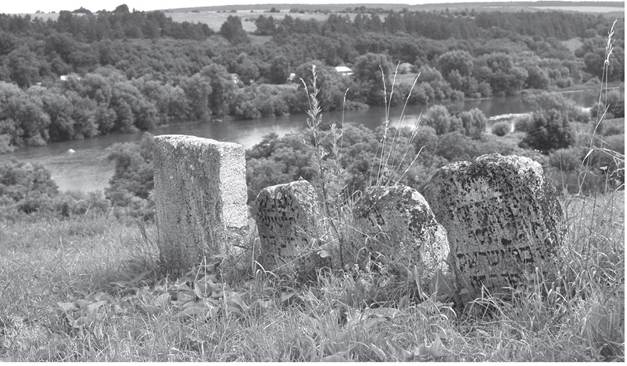
View of the Southern Bug River from the old Jewish cemetery of Bratslav.
Only a few gravestones remain standing. Photo by Artur Fraczak.
but also semantically. A Jewish cemetery, in Yiddish, is a feld (literally, a field) or a besoylem (eternal house), whereas a Ukrainian Christian cemetery is a tsvinter, a Yiddishized variant of the Ukrainian tsvyntar.
Today, large parts of these cemeteries have been destroyed, the stones carried away and used for pavement. Some cemeteries, though, like the eighteenth-century Jewish cemetery of Sharhorod, remain relatively well preserved, with hundreds of gravestones still visible. The above-ground stone grave markers, shaped like sarcophagi and often carved from a single piece of limestone, are distinct among Jewish gravestones in Po- dolian cemeteries.
The more densely populated urban streets of the shtetl were usually located near the synagogue, around the market square and commercial hub of the town. The dense distribution of houses along a central street served well for protection as well as for religious purposes. Underground passages connecting many houses were ideal hiding spots in times of distress. The eruv, or border in which it is permissible to carry goods on the Sabbath, could also be more easily constructed around the densely populated town center. The Jewish houses that filled these streets were distinguished from typical peasant huts by their distinctive blue-and- white colors. Jewish artisans commonly painted their houses in order to attract customers into their home workshops. Porches or galleries in front of Jewish homes created a boundary between the domestic sphere and the street, and served as storefronts from which the artisans could sell their wares. When we visited, small businesses were still being run out of some of these houses—Abram Vaisman in Sharhorod had a photographer's sign in front of his house, and Alexei Futiran in Tomashpil still sold caps out of his home workshop, equipped with an antique Singer sewing machine.
When we began visiting the region, many turn-of-the-century shtetl houses still flanked the old market square. The entrance to these typical Podolian shtetl houses usually leads into one large room, off of which several smaller rooms cascade. This central living room serves as dining room, living room, and bedroom. Its centerpiece is a wooden table, surrounded by wooden stools. At one end of the room is a wooden divan, usually covered with a colorful, patterned rug and another similar rug hanging over the divan. During the day, the divan serves as a sitting area and at night is used as a bed. When large families lived in the house, the bed would be used for the children. Another bedroom or two could be found off the main room, along with the kitchen. In some smaller towns, like Shpykiv, homeowners were still carrying water into the house from a well, located in the center of town, when we visited. Some houses still have a wood-burning oven that heats the home and is stoked with wood or buckwheat hulls. Others have small electric or propane stoves. A veranda on the outside of the house was a central point of socialization with neighbors during the summer.32
I came to appreciate the kaleidoscopic position that Jews have held in the Podolian landscape only after years of traveling through the villages and towns of the region, each of which has its unique local traditions and customs, and interviewing local residents. Some of the towns we have visited on multiple occasions and interviewed numerous residents include Bratslav, Bershad, Tomashpil, Tulchyn, and Sharhorod, each of which has its distinct history and traditions, still reflected in the contemporary city.
The Shtetl
її
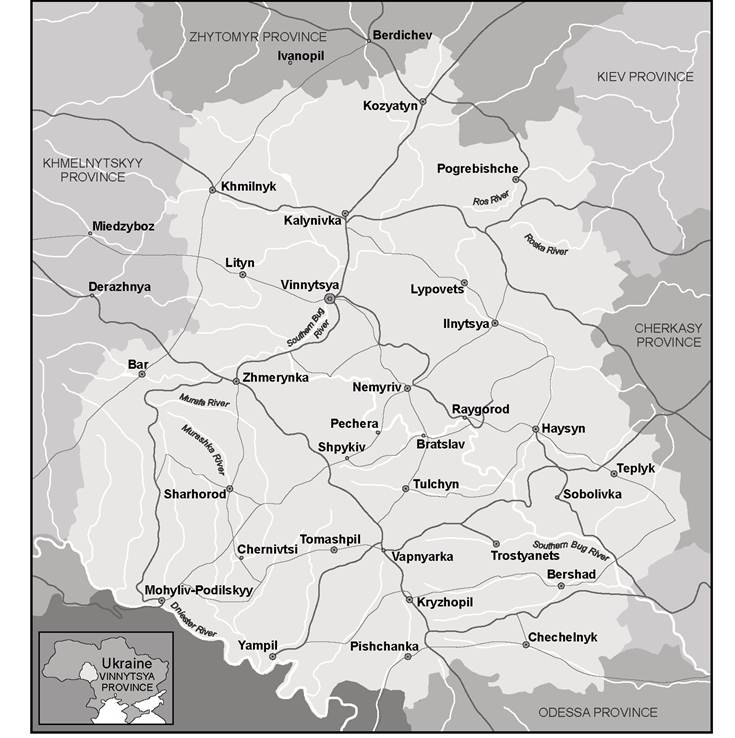
Vinnystsya Province
Bratslav
We first drove into Bratslav, a scenic town overlooking the Southern Bug River, on a scorching hot July afternoon in 2002. It was in Bratslav that Rebbe Nahman arrived in 1802 and “captured the city by clapping hands and dancing.” Israel ben Eliezer, an itinerant faith healer and Nahman's
great-grandfather, was known throughout the region as the Baal Shem Tov (Master of the Good Name), or the Besht, and was credited with establishing the pietist movement of Hasidism. As the Besht's direct descendant, Nahman had a credible claim to leadership of the rapidly growing Hasidic movement. To this day, the name Bratslav conjures to mind the Breslov Hasidim, a sect of Jewish mystics, who continue today to flock to Uman, where Rebbe Nahman, their tsadik, their righteous leader, was buried in 1810, to pay homage to his memory and spirit. The grave of Nahman's chief disciple, Nosn Sternhartz, ensures that Brat- slav itself remains on the itinerary of many Hasidic pilgrims. We had already had a busy day, conducting interviews elsewhere in the region, and resisted the temptation to call it a day and head back to the regional capital of Vynnytsya, where we were looking forward to relaxing in the pub across the street from our hotel. As we approached the crystal-clear waters of the Southern Bug River, which meanders just north of the town in a southeasterly direction from the Podolian uplands toward the Black Sea, and watched a handful of children and Speedo-clad local men bathe in the cool waters next to the picturesque stone mill, we decided that we would search for Yiddish-speakers in Bratslav before rewarding ourselves with a swim in the river. We stopped an elderly passer-by on what seemed to be the main street, and asked if he knew of any Jews in town. “Not so many,” he muttered, and pointed us in the direction of a small dirt road, where we found Moyshe Kupershmidt.
The first Jewish settlement in Bratslav dates back to the early years of the sixteenth century, when a Jew acquired a lease to collect taxes from the nobleman who owned the town, a common practice among Jews in early-modern Poland. Because of its strategic location on the river bend, Bratslav became a regional trading center that attracted Jewish merchants and artisans, who lived alongside the Polish nobility in the town. According to the 1765 census, there were thirty-five Jewish households in the town, comprising 101 individuals. The next decade saw a fire destroy forty houses in the town and a Haidamak pogrom that resulted in the deaths of several Jews. As a result, the Jewish population had declined modestly by 1776, the next year for which figures are available. By the early nineteenth century, the Jewish population had increased to 352 Jews, who now constituted more than 40 percent of the town's population. There were two synagogues in Bratslav by the early nineteenth century.33 The town's fame today rests largely from the brief period between 1802 and 1811, when Nahman settled there. His arrival in Bratslav led one of his admirers, Natan Sternhartz, the son of a prosperous merchant from Nemyriv, to move to Bratslav in order to be near the great tsadik. Natan recorded Nahman's sayings and published them in his Sefer hamidot, and later edited Nahman's teachings, which he published as Likutei Moharan. After his teacher's death in 1810, Natan published Nahman's fairytale-like stories in a bilingual Hebrew-Yiddish edition. These stories, with titles like, “The Lost Princess,” “The Humble King,” and “The Burgher and the Pauper” were not only instrumental to the spread of Nahman's teachings, but also to the development of Yiddish and Hebrew literature. They are even said to have influenced Franz KaikaA1 By 1907, the Jewish population of Bratslav had reached 5,903, representing just over half of the total population. Jews continued to play integral roles in the economic life of the city, particularly in the mill and honey factory, which were owned by Jews?5
When we first met him outside his home on a small cobblestone road heading down toward the river in 2002, Moyshe Kupershmidt was in his eighties. His frame showed wear, but he had clearly been a muscular man in his youth. His intense eyes lit up at the sound of Yiddish as he greeted us wearing a tank top and beige ivy cap. Our driver, Petr, was waiting in his white Mercedes minivan on the cobblestone lane outside. The sounds of ABBA could be heard coming out of Petr's open window as we sat down with Moyshe: “You can dance, you can jive, having the time of your life / See that girl, watch that scene, diggin' the Dancing Queen.” Moyshe inspected our van like a prospective buyer at a used- car depot before asking, “Did you bring the car with you from Israel?” assuming immediately that we were a group of Hasidic pilgrims from the Holy Land. We later learned that Moyshe was a professional driver and so his interest in our vehicle was more than just casual chit chat. When we told him it had been driven from Lithuania, he nodded and then, still assuming we were Israelis, asked if we knew of any news about Yasser Arafat.
He invited us in. We had to bend down to get into the front door, which led immediately into a tiny cramped kitchen. Glass jars of homemade compote sat on a rickety wooden table, next to a sink and tiny refrigerator. The living room, which doubled as a bedroom, was decorated with colorful rugs hanging on the wall. Souvenir American, Ukrainian, and Israeli flags were taped to the wall above his bed. Mezuzahs were clearly visible on every doorpost. The wide wooden floorboards looked about a century old, a reasonable estimate for the age of the house. The only running water in the house dripped through a spigot in the kitchen sink; an outhouse was accessible through the garden in the back. When we asked if he had been born in this house, he told us that he had actually been born two houses over, toward the river, but he had been living here for over half a century. When he returned to Bratslav after the war, he found that his house had been occupied by Christian residents who had assumed he was dead. The new occupants never imagined that the Jews who fled so suddenly in the summer of 1941 would find their way back. In the vast majority of cases, this assumption proved correct: the Yiddish speech that had echoed through market squares for generations was silenced overnight. When sound returned, it was overwhelmingly in Ukrainian, forever transforming the aural landscape. Rather than take his real estate claim to the courts, Kupershmidt had simply settled into a neighboring house whose owners really would never return.
As he led us into his living room, Kupershmidt inquired about our families and shared with us that his son and two grandchildren had left for Israel three years ago. His grandson, he proudly told us, was serving in the Israeli army. No sooner had we sat down in his living room than he boasted of his ability to write in Yiddish. Like a magician performing a card trick, he took out a pen and paper and began scribbling. A few seconds later he held up the paper: “This is Yiddish writing, not Hebrew,” he asserted, as though he were showing us that our Six of Diamonds had turned into the Ace of Spades. As we set up our technical equipment, Kupershmidt continued his performance. He knows how to pray, he explained. His father had taught him when he was a child. And with that he launched into a list of the Judaic subjects he recalled from his childhood. “It’s been seventy years since I learned to pray,” he apologized. “I have forgotten so much.”
More on the topic A HISTORICAL LANDSCAPE:
- Reviewers
- Background Context
- Preface
- On Warfare Origins
- References
- THE THEORY AND PRACTICE OF EMPIRE-BUILDING
- Chapter 23 Bovine Tuberculosis in Zambia
- Pre-independence India
- CHAPTER FOUR Town and Country Urban devotions and rural rituals
- Hare C., Neo D. (eds.). Trade Finance: Technology, Innovation and Documentary Credit. Oxford University Press,2021. — 417 p., 2021