PREFACE
THIS book offers a summary of what is known as to the archaeology, ethnology and history of the region between the Carpathians and the Caucasus.
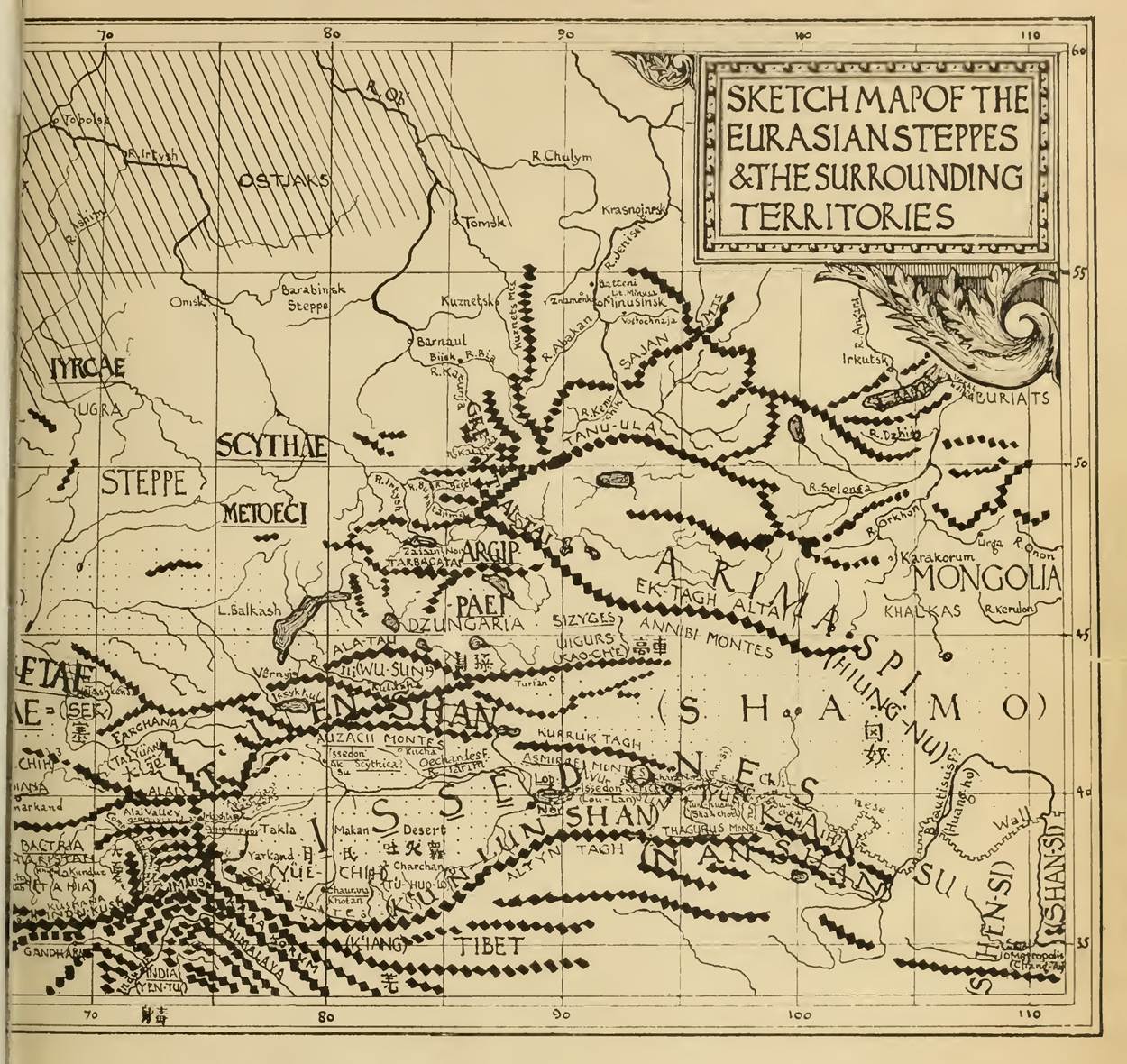
The region is of varied importance for different branches of knowledge touching the ancient world, yet about it the scholars of Western Europe have had a certain difficulty in obtaining recent information, because each found it unprofitable to master Russian for the sake of pursuing his subject into an outlying corner. The language difficulty, therefore, first suggested this work, and my original intention was merely to supply a key to what has been written by Russian scholars, since they have been insisting upon the right of their language to scientific use. But such a fragmentary account of things would have been most unsatisfactory, and, though the time has not really come for a complete synthesis, enough advance has been made since the last attempt to review the subject, to justify a provisional summary.Though the geographical limits to which I have confined myself have confessedly been dictated by considerations of language—i.e. I have, in principle, kept to the area within the Russian Empire which has naturally attracted the attention of- scholars writing in Russian—yet the frontier of Russia towards the Carpathians and the Danube answers nearly to a real historico-geographical boundary, the western limit of the true steppe. The Caucasus, again, is a world in itself, having little in common with the steppe, nor has the time-yet come to bring any sort of system into its archaeology ; so I have reason enough for leaving it alone. On the other hand, the unity of the Asiatic and European steppe has led me on occasion right across to Siberia, Turkestan and China without any feeling that I was trespassing beyond my borders.
My limits in time are, I hope, equally intelligible : an attempt to begin at the beginning has resulted in Chapter vn, which, I trust, will not be useless: since it was printed off, more material has accumulated than I was able to cope with in the Addenda. The Great Migrations form a good lower limit, as they made a radical change in the population of the steppe and interrupted the continuous life of the Greek cities on the Euxine coast. In the case of Chersonese alone there was no such break and I have therefore followed its history to the end.
Just these same limits were contemplated by K. Neumann in his Die Hellenen ini Skythcnlande (Berlin, 1855), but he only lived to publish the first volume and that is nearly sixty years ago. In the first three parts of Kondakov and Tolstoi’s Russian Antiquities in the Monuments of Art (St P. 1889- ) reissued by Reinach as Antiquitts de la Russie Mdridionale (Paris 1892, henceforward cited as KTR.} is provided a more recent summary. This, intended as an introduction to a more or less popular account of Christian art in Russia, leaves something to be desired in arrangement and in bibliographical indications of the sources for the facts presented, but I have no idea of superseding it, as its limits in time and space are much wider than mine, and, though I have been allowed to reproduce a great many of its illustrations, it remains the most accessible book in which to find many more.
When the above work was compiled, the policy of publishing in Russian had just become dominant (from about 1889, v. p. xxv) and it was difficult for Europe to know of discoveries in Russia from then until 1904, when Pharmacovskij began contributing year by year to the Archäologischer Anzeiger his very full and well illustrated reports. It is just from the period before 1904 that the main bulk of my unfamiliar matter is taken, as the greater part of the illustrations (e.g. those borrowed from the Archaeological Commission) had been selected by then and the earlier part of the book drafted.
Other obligations and work having nothing in common with this have made the writing, and also the printing, of the book a very slow business, further delayed by the continual flow of fresh material, the incorporation of which, especially at the later stages, has presented some difficulty : there have also resulted certain unavoidable inconsistencies. Important facts which I have learnt since the earlier sheets were printed off are briefly indicated in the Addenda, to which 1 would ask the reader’s attention, but these supplements, necessarily, have been kept down rather jealously.
A great cause of delay has been the miscellaneous content of the work : its unity being merely geographical, the composition of the different chapters has meant incursions into different branches of knowledge, in each of which the specialist will find me wanting. He also may say that what interests him has not received sufficient space, but there is no denying that the book is big enough already. The notes give him chapter and verse for every fact mentioned and indications as to where further information may be found on any particular point: I believe that even Russians may find these convenient. For readers requiring less detail, 1 have endeavoured to make such a representative selection of material as to supply a general account of each subject treated and thus to make the book intelligible without the necessity of looking up any references. Accordingly I have shewn enough coins to give an idea of the whole series and have even taken up space with an Appendix of Inscriptions, though Latyshev’s 1nscriptiones Orae Septentrionalis Ponti Etixini is fairly accessible.
With regard to illustrations, I have deliberately sacrificed quality to quantity : I could not afford to reproduce photographically the hundreds of objects of which I have made rough and ready tracings for Chapters viii—xii ; the source of each being given, those who want finer detail will know where to find it. Illustrations of objects from a tomb will be found where the tomb is described.
Critics may point out books and articles that I have overlooked, and such indications will always be welcome. Omissions are inevitable in view of the wide survey necessary. I fear I have not extracted all I might have done from Serbian, Bulgarian, Polish, Rumanian and Hungarian authorities, but these lie somewhat on one side ; even in Russian I have found it impossible to hope for completeness, while in the archaeological literature of Western Europe I must have missed endless articles which would have enriched my work ; but had I waited to read them all, the book would never have been published.
I am very anxious to direct the attention of the reader to the table for transliterating Russian on p. xxi, in order that he may have all possible help in grasping the many unfamiliar names he will meet with in the text, and also to the Preliminary Bibliography and List of Abbreviations (pp. xxiv —xxxv) which explain such references in the notes as may not be clear at first sight.
A book like this is not written without incurring many obligations which can only be repaid by sincere thanks and a readiness to render service for service if opportunity arise.
Most of all· I am indebted to the Imperial Archaeological Commission at St Petersburg : during my stay there, I was given a place of my own in its library and was presented with a complete set of its more recent publications, and these have been sent me regularly year by year ever since ; full leave was granted me to reproduce any of its illustrations and over 130 blocks were sent to England for my use. Its individual Members have done all that could be done for me, especially the President, Count A. A. Bobrinskoj, who gave me his magnificent volumes on Smela and his History of Chersonese, the Vice-President, Academician V. V. Latyshev, who by a long series of letters and articles has kept me informed of epigraphic progress; the Senior Member, Professor N. I. Veselovskij, Mr A. A. Spitsyn and Mr B. V.
Pharmacovskij who by sending me his articles has kept me up to date in his own special studies.M. b
At the Imperial Hermitage, I have pleasant recollections of the courtesy of the late Dr G. von Kieseritzky ; Mr E. M. Pridik and Mr O. F. Retowski have rendered me valuable help and so has Mr J. I. Smirnov, whose most generous offer to read my proofs unfortunately came too late. Count I. I. Tolstoi and Academician N. P. Kondakov graciously agreed to my reproducing illustrations from KTR., and from the latter I have received kindnesses more than I can recount. I should also like to mention the names of Professor M. I. Rostovtsev and especially of the late Baron Victor R. Rosen, without whose kindness my stay in Petersburg would have been far less profitable.
In the Historical Museum at Moscow, Mr A. V. Oreshnikov made me very much at home, and ever since by most valuable letters, articles and casts of coins has been my chief help in numismatics ; Mr V. A. Gorodtsov has supplied me with unpublished material for Chapters vn and vm. Professor Vs. Th. Miller, Director of the Lazarev Institute, has earned my gratitude both personally and by his books.
At Kazan, the late Professor I. N. Smirnov first made me acquainted with Volga-Kama antiquities.
From Kiev, Mr N. Th. Belashevskij of the Town Museum and especially Mr V. V. Chvojka have sent me books, letters and photographs of which I have made full use, and Professor J. A. Kulakovskij has been constant in help and encouragement.
At Odessa, the Imperial Historical and Antiquarian Society did me the honour to elect me a member: its Director, Dr E. R. von Stern, now Professor at Halle, put its coin collection at my disposal and its Secretary, Professor A. A. Pavlovskij, has supplied me with its Transactions. These two scholars have besides rendered me important private services.
At Nicolaev, Mr A. Vogell entertained me and shewed me his beautiful collection, now, alas, dispersed. At Kherson, Mr V. I. Goszkewicz has kept me abreast of the progress of archaeology in his district.
At Chersonese, the late Director of the Excavations, Mr K. K. Kosciuszko- Waluzynicz, shewed me round the site and sent me photographs and reports from time to time : I am also under very definite obligations to his successor, Dr R. Ch. Loper, and his draughtsman Mr M. I. Skubetov. From General A. L. Bertier-de-La-Garde at Jalta, I have received books, articles, letters and other help on many points archaeological and numismatic : my constant references to his work are a measure of what I owe him. Dr K. E. Duhmberg, Director at Kerch, assisted me while I was there, and his successor, Mr V. V. Skorpil, has answered questions and sent me valuable articles, while Dr I. A. Terlecki gave me my first real introduction to Bosporan coins.
Outside Russia, I have found similar assistance : from Mr A. M. Tallgren at Helsingfors, from Professor A. von Lecoq and the authorities of the Antiquarium at Berlin, from Professor P. Bieiikowski at Cracow, Dr Vasid at Belgrad, and Professor M. Rosenberg at Karlsruhe. In Paris, my special gratitude is due to Professor Paul Boyer, Director of the School of Living Oriental Languages, my first guide in Russian studies, also to Mr E. Babeion at the Cabinet des Mddailles, and to Mr S. Reinach, who helped me at the St Germain Museum, joined in allowing me to copy figures from KTR. and encouraged me in other ways.
In the British Museum, Mr 0. M. Dalton of the Medieval Department, who has traversed much of the same ground in his Treasure of the Oxus, has been to me a constant moral support and has besides helped me in many ways ; in the Coin Department, I have always been sure of assistance from the late Mr Warwick Wroth, from Mr G. F. Hill and from Mr H. Mattingly ; I have been also specially beholden to Sir Cecil Smith and Mr F. H. Marshall, both formerly of the Greek and Roman Department. To Professor W. M. Flinders Petrie I am indebted for one of my most valuable illustrations. At Oxford, I have received help and encouragement from Sir A. J. Evans, Sir M. A. Stein and Professor J. L. Myres.
In Cambridge, my thanks are first due to the Managers of the Craven Fund, who enabled me to make my-original archaeological visit to Russia, and to my College, which allowed my work upon this book to qualify me for holding my Fellowship. I cannot say how much I owe to my masters, the late Mr R. A. Neil who encouraged me at the beginning—I had hoped to talk over many a point with him—and Professor Ridgeway, who has ever been urging me forward. My thanks are also due to the Masters of St Catharine’s and Emmanuel Colleges, to Sir Charles Waldstein, Professor J. B. Bury, Professor H. A. Giles, Professor A. A. Bevan, Professor E. J. Rapson, Miss Jane E. Harrison, Mr A. B. Cook, Mr S. A. Cook, Professor C. H. Hawes, now-of Dartmouth College, U.S.A., and other scholars to whom I have had occasion to turn for information.
Much of the photographic work was done by the late Mr H. A. Chapman of the Fitzwilliam Museum, the staff of which has aided me in the matter of coins. The trouble that I have given to the staff of the University Library has amounted to something that deserves special recognition from me.
My very deepest gratitude is due to Mr A. J. B. Wace, who has read the proofs right through, successive batches coming to him at the most widely different places, and to Mr F. W. Green, who has made assurance more sure for the second half of the book by eliminating errors which had crept in after Mr Wace’s reading.
If I have omitted to acknowledge either here or in the text any b 2 obligations incurred within these thirteen years, may the lapse of time be some excuse for me.
The Syndics of the University Press I can but thank for undertaking a book by nature unremunerative and ask their pardon for having expanded it beyond reasonable convenience and delayed it almost beyond endurance : from the staff, especially from Mr Norman Mason, whom I have troubled with an endless series of petty details, I have received invaluable help given with unfailing patience, while the press-readers have saved me from many slips.
The work is dedicated to my Father, who has enabled me to devote myself to it, has very largely supplemented the liberal allowance for illustrations made by the Syndics, and has contributed to the expenses incidental to making the scale of the book less inadequate to its subject.
E. H. M.
24 April, 1913.
More on the topic PREFACE:
- Publisher’s Preface
- Preface
- Preface: Ray Offenheiser
- PREFACE
- PREFACE
- Preface
- PREFACE
- Preface to the First Edition
- Preface
- Preface