A Society Transformed
During the last six years between the great battles the Ukrainian provinces of Bratslay Kyiy and Chernihiv had undergone a radical transformation. The peasants were farming their own land either by individual or communal ownership without the nobility or any other class to oppress them.
Most Greek Orthodox nobles had joined Cossack ranks, Polish and other landlords were expelled, and serfdom and slavery had been abolished. Ordinary Cossacks were also beginning to farm family homesteads and ranches in return for small payments levied for the army’s treasury and the Hetmans office or the obligation to serve in the regiment without pay and provide their own supplies and weapons. Ukraine also began to be administered by the Cossack officer corps, which had replaced the main functions of the Polish state institutions with the officers elected by the rank-and-file subject to the hetmans confirmation. The system was explained in a direct (and somewhat sarcastic) manner by a Cossack captain called Pilip Umanets in a letter to the Muscovite “voevoda” (governor) of SevskAndrei Buturlin following his reproach that the Cossack captain—“a simple man”—had dared to address a Tsar s noble voevoda by letter!Concerning what Your Grace wrote to us recently in your letter—that it was improper for us, simple people, to write to vo- evodas. We are now, with God’s grace, not simple (but) are knights of the Zaporozhian Army. It is true that the grand envoy of the Kingdom of Poland, the late Adam Kisil, had decided with the righteous Sovereign and with great boyars, that only palatines (Polish governors), Starostas (sheriffs), judges, and land and castle court secretaries were allowed to write letters to (Muscovite) voevodas. But now, with God’s grace, for as long as His Sacred Will prevails, there are neither palatines nor Starostas nor judges, nor secretaries in the entire Siverian (Chernihiv) land.
God grant that Sir Bohdan Khmelnitsky, Hetman of the entire Zaporozhian Army, remain in good health. For here, Lord Colonel now serves as palatine, Lord Captain as starosta, and the town otaman as judge.20The Ukraine had become a military, stateless Societywith virtually all links to medieval princely Kyiv Rus severed, to the extent that Kyiv was not even chosen as the Cossack capital. Instead, Kyiv remained as the seat of the Metropolitan of the Orthodox Church of Rus, the only state institution that had survived from the Middle Ages. There was very little, if any, Cossack presence in Kyiv, which maintained resident nobles and was controlled by wealthy burghers who carried on a lucrative trade with the Ottoman Empire. Indeed, in the larger towns and cities such as Pereiaslav, they at times viewed Cossack authority with suspicion.
Khmelnitsky himself continued to keep his official residence in Chihirin simply furnished in Cossack style, with “kilims” (Turkish carpets) and weapons decorating the living room walls and icons in the corners. With visitors, however, no expense was spared to provide Ukrainian hospitality, as described by the Venetian envoy Alberto Vimina:
As I had occasion to experience myself, at tables and at drinking, festivity and humor are not lacking... in order to be briefl will mention but one. Once one of my officials boasted of the greatness and marvels of Venice, and the Cossacks drank in his words. After he had talked at length of the position, structures and wealth of the city and its size, he added that the streets are so wide that the citizens, not infrequently, are lost in them. “Why no!” interrupted one of the Cossacks. “Don’t pride yourself in your Venice, the same may happen to me in this crowded room. IfI continue to sit a little longer behind this table, I will not be able to find the door to get back home!”21
With freedom from exploitation by the nobility, Ukraine was developing economically without the extremes of wealth and poverty as observed by Vimina: “...generally they (the Cossacks) do not care about being rich but are satisfied with little, freedom being treasured above all.”
Another visitor to Ukraine was the Syrian Archdeacon Paul of Aleppo, who was traveling to Moscow with his father Patriarch Makarios III of Antioch, and passed through Ukraine in 1654 and again in 1656.
During the summer of 1654 he spent forty days in Ukraine, and recorded many of his observations and local accounts, including the bloody events which were transpiring in the Ukraine, Podilia, and SouthernVolin.We wept greatly over the thousands of martyrs (the Orthodox Rusins) killed by these godless and treacherous ones (the Catholic Poles and the Tatars) in these 40 or 50 small towns, some 70 or 80 thousand souls. Behold those faithless and impure people! Behold the merciless hearts! Of what were women, girls, children and infants guilty that they should have been killed? If you are so brave, go and fight their leader, who made a mockery of you before the whole world, having trounced your lords and princes, destroyed your heroes and brave warriors, and exposed you to disgrace and derision. His name is Khmel!22
The bloody religious-ethnic cleansing and slaughter carried out by the Greek Orthodox peasants and Cossacks is also described by the archdeacon with approval, displaying a somewhat double standard—at the time it was the prevailing attitude of “us” and “them.”
What a blessed people they are! What a blessed land this is! Its great merit lies in the fact that it has no infidels at all but only pure Orthodoxbelievers, steadfast and pious. Having once been in bondage these Kozaks now live in joy, pleasure and freedom... and they are deserving, for in life they content themselves with very little: they eat whatever comes to hand, and dress in whatever they come across.... So many thousands of them have been killed, so many thousands have been taken captive by the Tatars—and still they have a multitude of troops.
But how many Liakhs have the Kozaks also killed!—hundreds of thousands, with their wives and children, leaving not a single one alive. From a distance we saw the palaces of their lords and rulers—so high they were.... Now these palaces stand in ruins, as uninhabited refuges for dogs and pigs. And the Jewish and Armenian peoples have been completely destroyed.
Their fine homes, shops, and inns have become shelters for wild animals, for Khmel (God grant him long life!) having taken control of these populous towns, has completely destroyed all foreign inhabitants, and now this country is populated by Orthodox Kozaks alone.23Religion was evidently not the only motive for the widespread massacres and ethnic cleansing since Armenians were also Eastern Orthodox Christians.24
The fighting had taken a heavy toll on Ukrainian men of fighting age, leaving many orphans and widows, as was observed by Paul of Aleppo:
In this country, that is among the Kozaks, we remarked an untold number of widows and orphans.... Throughout the year, in the evening when the sun goes down, orphans make their way from house to house. In unison they sing hymns to the Most Blessed Mother of God, in pleasant voices that captivate the soul.... When they finish their singing, from house to house they receive a present of money, bread, or other food, and generally all they need for sustenance for their studies. Hence most of the orphans are literate and in general the number of literate people has greatly increased since Khmel... Iiberatedthisland....
The Archdeacon continues to describe the fate of orphans and homeless beggars many of them war invalids.
Know you that in the Kozak land, in every town and every village, homes have been built to house the poor and orphans.... Whoever enters makes a contribution for God’s work, unlike in the land of the Moldavians and Wallachians, where they go from church to church and their throngs prevent people from praying.25
Evidently this was an overstatement, since Paul of Aleppo also describes poor villages with many homeless orphans begging for food. Other settlements, however, exhibited great prosperity.
Know you that in the homes of this country we saw great numbers of people, livestock and fowl and were greatly amazed at how much of everything they have. Reader, in every house we saw ten and more children with fair hair on their heads, so that on account of this we call them old men.
They are one year apart in age.... In recent years they (the villagers) have been killed in campaigns by the hundreds of thousands. The Tatars have taken thousands of them into captivity. Earlier, they knew no epidemic but in recent years it has also broken out among them, carrying Offhundreds of thousands to the gardens of Paradise... in this country there is not a single barren woman. This fact is obvious....”26The large families were probably also due to adoptions, particularly of godchildren and family relatives. Of interest is Paul of Aleppo s assertion that epidemics were of recent origin, which indicates a likely purposeful introduction of the plague into Ukraine, probably by agents of the Polish government. We know that at the time infected corpses were used as instruments of war.
Following the revolutionary uprising the economy of the Ukrainian region underwent a noticeable shift, from large noble-owned estates, towns, and cities to rural villages and homesteads. The opulent residences of the nobility were gone—their ruins still dotting the countryside five years later. Some towns such as Tripillia, which was a major Jewish center, were totally abandoned, with resident burghers either killed or driven out. Visitors commented that in most towns Polish, Jewish and Armenian homes, shops, and fine inns often stood empty. Some of the Jews and Armenians were highly skilled craftsmen and artisans who manufactured goods and products of great value, but destined mainly for the aristocratic market of which the serfs could only dream.
The rural economy, on the other hand, experienced an explosive growth, fueled mainly by the family farms and homesteads in the fertile prairie region. The seed crops consisted of wheat, rye, oats, millet, buckwheat, hemp, flax, and others. The buckwheat (“kasha”) which was eaten like rice (or a porridge) also helped to support a thriving honey industry, which together with rye found its way into the production of alcoholic beverages.
Hemp and Aaxprovided oil, animal feed, and a particularly durable cloth, with hemp being used in crop rotation as a herbicide—its great height and density deprived any other growth of sunlight. Potatoes and tomatoes, on the other hand, were generally not grown. There was a great abundance of domestic fowl such as geese, ducks, and chicken, as well as large herds of horses, cows, sheep, goats, and pigs which were tended by shepherds and swineherds, Usuallyyoung boys. The mixed agriculture and the rich Ukrainian black earth very quickly produced abundant food surpluses of great variety. Land surrounding the family home was also planted with cherry plum and other fruit trees, and a fenced-in garden provided onions, cabbage, carrots, cucumbers, garlic, watermelons, melons, pumpkins and other produce. Bumper wheat crops were usually guaranteed by winter wheat, which was planted in July and germinated early in the spring when moisture was abundant, just before the hot and dry steppe summer set in. Grain was milled in watermills built along running streams, which would be dammed in several locations to provide ponds for aquaculture—usually carp which was considered a great delicacy. It is little wonder that the nobility did not renounce the reconquest of the Ukrainian prairies, the steppe where land was so much more fertile than in Galicia and the rest of Poland and when Europe was experiencing poor harvests due to the Little Ice Age.The ownership of land and freedom from an oppressive nobility and state in Ukraine was beginning to give rise to a rich folk culture, very different from that of its neighbors or what had existed before, a culture that would produce a Hohol (Gogol), Tchaikovsky, and others. Around this time the “kobza” followed by the “bandura” made their appearance, the latter instrument displaying a wide range of notes with 56 strings. Both were popularized by traveling minstrels composing and reciting the “dumas” of great deeds and Cossackheroes. Choral singing also become popular outside of church services, as recalled by Paul of Aleppo who recorded in his notes that “the singing of the Cossacks gladdens the soul and frees it from troubles; for their tone is pleasing and comes from the heart, and is produced as if with one voice. Theypassionatelylove tender singing, tender and sweet melodies, while the Muscovites sing without training of any kind, haphazardly.” These were often sad songs describing unsuccessful love affairs and other unhappy events about which Ukrainians sing to this very day. Other choral forms besides those of the Church which have come down to us (and which were been adopted by the Russian and then the Soviet Red Army) are the stirring Cossack campaign songs that provided much of the regimental marching music. The music also accompanied the athletic Cossack dances, which were based on martial arts and saber fighting techniques— both music and dance exhibiting exuberance and energy.27
Paul of Aleppo was also favorably impressed by painters, “who know how to paint portraits from life. Cossack painters learned to render the beauty of the face and clothing from Frankish and Liakh artists,” and were painting church icons and decorations in a unique style. The visiting archdeacon also noticed other local artistic improvisations such as church candelabra consisting of large deer antlers hung from the Ceilingwith candles fitted at the tips.
The tight-knit rural communities did not leave any room for antisocial activities and there were “no robbers or thieves,” perhaps due to severe punishment.28 Preventive measures were also taken by means of education and social care:
Starting with this town (the Boh River region in the Bratslav province) and throughout the land of Rus, that is, the Kozak land, we noticed a most wonderful trait that aroused our amazement. All of them, with few exceptions—even most of their wives and daughters—know how to read. They know the order of church services and church singing. The priests teach the orphans, and do not abandon them to roam the streets as ignoramuses.29
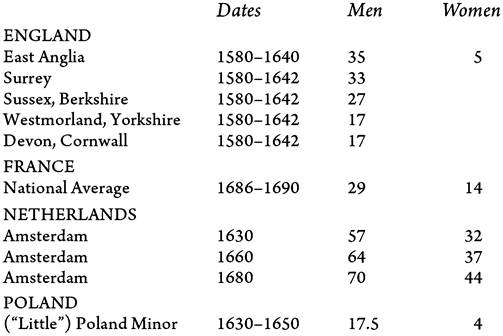
It was of some importance that the children could read the Bible as they were growing up, a requirement in Greek Orthodox Christianity. Also the written word in Slavic was made phonetic using the Cyrillic script, which made reading and writing easy to master. The entire community was involved with orphans and with homelessness; “in every town and every village, homes have been built to house the poor and the orphans...” Most of the poor (“beggars”) were war invalids and were respected by their communities. To appreciate the high literacy level found by Paul of Aleppo, we can compare it to western Europe, as indicated by Table 15.1, where Bible-reading Protestant regions indicate a much higher literacy rate.
Table 15.1 LiteracyScores in 17th CenturyEurope
As the estimated percentage of population able to sign their names (Parker, 1979)
The Archdeacon, on the other hand, was not very impressed with Moscow, where he stayed for almost two years with the Patriarch, who was seeking financial aid from the Tsar. According to Paul of Aleppo the Muscovites “are all of them, from the highest to the lowest, of a silent disposition, suspicious... they will not tell anything to a foreigner... either good or bad, of their own affairs. Mirth and Iaughterbecame completely alien to us because the suspicious Muscovites Constantlyspied on us and reported all. May God save us and liberate us from them!”30 On their waybackto Syria they re-entered Ukraine in the early summer of 1656, “thankful to be in the country of the Kozaks,” where they found cheerfulness and a friendly population. Theyvisited Hetman Khmelnitskywho “lives in Chihirin, a frontier town facing towards the Tatar between whom and the Kozaks is a distance of uninhabited wilds (‘the wild steppe) of five or six days’ journey.” After arriving in the regimental city of Uman some 150 kilometers to the west they found Cossacks setting up a defensive “tabor” in expectation of a Tatar raid. The Patriarch blessed the men and prayed for them, after which the Cossack regiment “fired all their muskets and reared their horses three times.” Moving on, they passed frontier towns “which the Poles and Tatars had burned and depopulated the year before.”
The free Ukrainian communities were also compared to Poland by Ulrich Werdum, who traveled widely in those countries during 1670-72.
The Poles are not lacking in politeness and intelligence but they are light-hearted and fickle. When... on the weaker side they act veryhumbly and peacefully, but when they meet a weaker party and master the situation they immediately become proud, conceited and cruel. They either serve merrily or rule proudly.... In everyday life and in social conversation they use more compliments and flatteries than any other people....
Typical behavior and mannerisms of the nobility, as was also remarked by Beauplan several decades before; Werdum offers the general observation that: “As a whole, however, Polish people are neglectful and lazy, they till only the most necessary parcels of land, while the rest lie fallow....” Serfdom was clearly not conducive to efficient agriculture. UlrichWerdum was more favorably impressed by the free inhabitants of Ukraine: “One can find much kindness in both words and gestures in Ukraina, particularly in the women, to which contributes also the Rusian language, for its pronunciation is not as hard as that of the Polish.”31
Yet a third person left his memoirs of Ukraine during this period—K.J. Hildebrandt, a member of the Swedish delegation to Khmelnitsky, which was seeking a treaty against the Roman Catholic Polish Commonwealth. Nothing came of the visit since the Swedish King, himself claiming the Polish throne, could not agree to Khmelnitsky’s claim to “the right to the whole of old Roxolania (Rus) where the Greek religion and their (Rusian) language was and still is used—up to the Vistula (River).”32 Hildebrandt noted that Ukraine was an armed camp, where even “small and insignificant” settlements provided a Cossack company with high morale—“brave and clever soldiers.” The Swede also commented in length on the women whose dress he noted consisted of a woolen apron, high boots and tight skirts with embroidered blouses. In the summertime young girls wore green wreaths adorned with flowers, and the women were decorated with rings, big earrings, and beads made of crystal, glass, or copper. “They danced well,” he observed, “gracefully and with a gay heart. Kozakwomen are brave, drink well, attend to serving (at the table), and often order their men to work.” Hildebrandt also perceived the Cossacks’ bitterness towards the Commonwealth: “Their sternness has expressed itself in war with the Poles over the faith. Constantly pressing against the enemy, they burned and mercilessly destroyed them, saying that the Poles behave in their country far more cruelly, not sparing even the small children.”33