The Mongols and. the Transformation of Rus' Political Life
The year 1240 is traditionally viewed as a crucial turning point in the history of eastern Europe. It is the year in which the Mongols captured and razed the city of Kiev and in which Kievan Rus’ is considered to have ceased to exist.
In its stead, Mongol rule - described prosaically by latter-day historians as the “Tatar yoke” - had begun. On closer examination, however, it seems that the Mongol presence did not radically change Kievan Rus’ society. Rather, it hastened and completed changes in Kievan political and socioeconomic life that had begun nearly a century before the arrival of the Mongols. This process was marked by three trends: (1) the gradual disintegration of Kievan Rus’ as a unitary entity; (2) the diffusion of political and economic power away from the center; and (3) the rise of three powerful and independent states from within the former Kievan federation: Gali- cia-Volhynia, Vladimir-Suzdal’, and Novgorod.The completion of these trends took place during the century following the “fall” of Kiev. During this “Mongol era” of Kievan history, the social and administrative structure of Rus’ society remained the same, and local princes, if they recognized the ultimate authority of the Mongols in eastern Europe, were essentially left to rule undisturbed in their local patrimonies as they had done before. This last era of Kievan Rus’ history saw a different evolution in each of the three regional successor states. On western Ukrainian territory, the principality, later the Kingdom, of Galicia-Volhynia was to lead an independent existence until 1349. But before examining the specific evolution of Galicia-Volhynia, it is necessary to review the beginnings of the Mongol presence and to examine its general impact on eastern Europe.
The rise of the Mongols
As their name suggests, the Mongols were a nomadic people who originated in Mongolia.
In 1206, a local tribal leader named Temujin succeeded in having all the Mongol and Turkic tribes of Mongolia submit to his authority and swear allegiance to him as the new emperor or khan. In his new role, he adopted the name Chinggis (in some English-language writings Genghis, or Chingiz), and he was to become known in history as the Great or Chinggis Khan.During the next two decades, until his death in 1227, the armies of Chinggis Khan conquered a vast territory stretching from northern China and Manchuria on the Pacific coast in the east, through Mongolia and southern Siberia, to Central Asia and northern Persia as far as the Caspian Sea in the west. The ability to conquer and control this vast expanse of land is attributable to the highly disciplined nature of the Mongol army and administration. In terms of administrative and cultural experience, the Mongols borrowed heavily from the peoples they conquered, in particular the Chinese. Their large armies were led by Mongol generals but composed primarily of soldiers from the lands they subjugated, especially Tatars (originally from the Mongolo-Chinese borderland) and Turkic peoples of Central Asia.
The Mongol armies quickly developed a reputation for invincibility and ferocity. Tales of the massacres of whole cities and regions became widespread in some of the conquered regions, and it became common for western sources to describe Chinggis Khan as the “scourge of humanity.”1 In reality, Chinggis Khan and his successors were not much different from other empire builders in history, and if his Mongol armies carried out brutal destruction, they did so not as an end in itself but as a means of inspiring fear and convincing their enemies that they must submit to Mongol rule or perish. Those rulers who submitted immediately and recognized Mongol rule were usually left to reign over their respective territories, which more often than not even flourished under the new order. The creation of a world empire from China to Europe, therefore, was the goal of Chinggis Khan, not wanton and indiscriminate destruction.
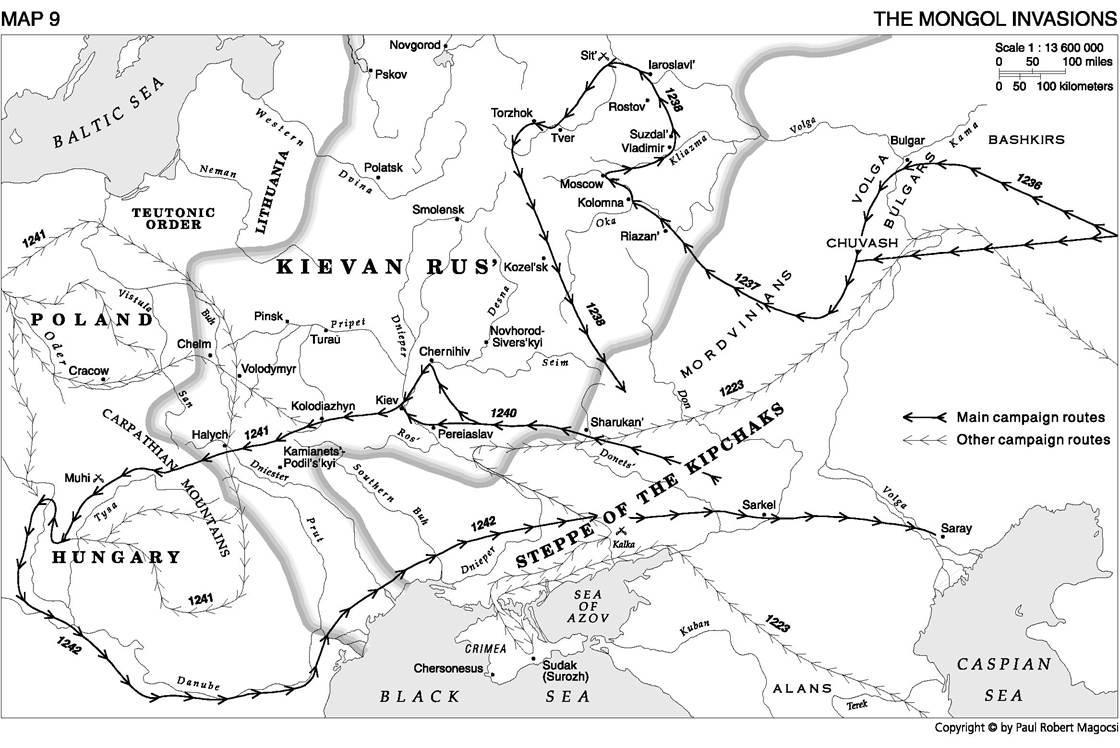
Working from the basis of the Mongol power already established, the successors of Chinggis Khan in the mid-thirteenth century were able to expand Mongol rule even farther, southward throughout China and westward toward the Middle East and eastern Europe. Within the vast territory from the Pacific Ocean to Europe, a new era of stability and economic prosperity was created - the Pax Mongolica.It was not Chinggis Khan but rather his generals and descendants who were to conquer eastern Europe and make large parts of Kievan Rus’ subject to the Mongol Empire. Already during the last years of Chinggis’s life, a Mongol expeditionary force on its way into northern Persia swung northward across the Caucasus Mountains into the Kuban steppe region. In 1222, the Mongols defeated first the Alans and then the Polovtsians/Kipyaks, continuing their route north of the Sea of Azov into the Crimea, where early in the next year they captured the coastal city of Sudak. In the meantime, the frightened Polovtsians turned to the Rus’ princes. Three senior princes (from Kiev, Chernihiv, and Halych) and severaljunior princes joined the Polovtsians in an offensive attack against the invaders. When, in the spring of 1223, a joint Rus’-Polovtsian army met the Mongol expeditionary force on the Kalka River near the Sea of Azov, after three days of battle it was totally routed.
This disaster on the Kalka for the southern Rus’ princes and the Polovtsians had no immediate consequences, however, because the Mongol expeditionary force returned home across the eastern steppe. To contemporary Rus’ commentators, the Mongols were just another in the long line of steppe invaders who seemed to vanish as quickly as they appeared. In the words of the chronicles, “We know nei-
ther from whence they came nor whither they have gone. Only God knows that, because He brought them upon us for our sins.”2
The experience on the Kalka River seemed to be an isolated tragedy, and life in Kievan Rus’ went on as usual.
The unsuspecting Rus’ princes even increased their internecine conflict, with the consequence that between 1235 and 1240 alone the city of Kiev changed hands no fewer than seven times. Meanwhile, the Mongols had decided to return, this time with a massive army of between 120,000 and 140,000 troops under the command of Batu, the grandson of Chinggis Khan and ruler of the western part of the Mongol Empire. The first step was to eliminate all possible centers of resistance on the eastern borders of Kievan Rus’. To accomplish this, the Mongols destroyed the Volga Bulgar state in 1236, then sent a force southward to eliminate the Alans in the Kuban Region and the Polovtsians in the Ukrainian steppe. By the end of 1237, the Mongols were ready to turn to the Rus’.The Mongol invasion of Kievan Rus’
The Mongols began their invasion of Kievan Rus’ with a systematic attack on its northern cities. First came Riazan’, in December 1237, and it was followed in rapid succession by Kolomna, Moscow, Vladimir, Suzdal’, laroslavl’, and Tver’ during the first three months of 1238. Although the way to Novgorod was open, the Mongols decided not to continue westward but instead to turn southward, where they spent nearly the next two and a half years in the steppe region between the Donets’ and the Don Rivers. There, in the traditional homeland of the Polovtsians - the Steppe of the Kipyaks - the Mongols prepared for the next stage of their assault on eastern Europe. Of the Polovtsians in their midst, some surrendered and were allowed to become Mongol subjects, some joined the Karakalpaks and other Turkic allies of Kievan Rus’ who had settled the frontier district along the Ros’ River, and others fled farther westward across the Carpathian Mountains into Hungary, where they were favorably received and Christianized.
Besides eliminating the Polovtsians, during the summer of 1239 the Mongols undertook expeditionary strikes against the southern Rus’ principalities of Pereiaslav, Novhorod-Sivers’kyi, and Chernihiv.
In October 1239, Chernihiv fell, and during the next year, from their base in the steppes, the Mongols kept close watch over the principality of Kiev and its southern defense system along the Ros’ River. Finally, in late 1240, the Mongol army as a whole was ready to resume its march.After a siege lasting several weeks, Kiev fell on 6 December 1240. The Mongols then moved farther west. Their armies divided: one group proceeded toward Volodymyr, in western Volhynia, and the other southward toward Halych, in Galicia. Both cities fell in 1241 after short sieges. The Mongols then moved farther south and west. The main force in Halych, under Batu, crossed the Carpathian Mountains and entered Hungary. The force in Volodymyr split, moving northward toward the Teutonic Order and westward into Poland. It finally turned southward across Moravia in order to join Batu’s main army already in Hungary. The Mongols remained in Hungary until the spring of 1242, when, upon learning of the death of the great khan in Mongolia, Batu decided to return eastward. The Mongol armies started back hurriedly along a route that passed along the southern bank of the Danube, across the Ukrainian steppe north of the Black Sea and Sea of Azov, and, finally, to the lower Volga region. There, Batu established his headquarters near the mouth of the Volga River, in Saray, which before long was to develop into a powerful administrative and commercial center from which the Mongols ruled their eastern European conquests.
The Golden Horde
The political entity created by Batu represented one of four regions or hordes into which the Mongol Empire was divided. The Mongols referred to their farthest western region as the Kipyak/Qipyaq Khanate, a name taken from the Kipyaks, or Polovtsians, some of whom remained after 1238-1239 as subjects of the Mongols. In Slavic and western European sources, the Mongol-led Kipyak Khanate came to be known as the Golden Horde. The Mongols themselves were a small minority, descendants of the 4,000 Mongol troops assigned to the region by Chinggis Khan.
Most of the Kipyak Khanate’s population consisted of Turkic peoples - descendants of the Polovtsians and, later, the Tatars, who were to form a large portion of the Mongol armies in the west. The original leaders of the Golden Horde, who were Mongol descendants of Chinggis Khan, were eventually replaced by Tatars, who for the next two centuries were able to keep the principalities of Kievan Rus’ in direct or indirect subjugation. Each Rus’ prince, no matter how strong his principality had become, until 1480 had to submit to the Golden Horde and pay an annual tribute. If a prince rebelled, his lands were likely to be invaded, and his army, at least in the early decades, to be destroyed by the Mongol forces.If the Rus’ princes paid their tribute to the Mongols, however, they were left alone. It is certainly true that during the era of Mongol expansion its generals showed little mercy toward those enemies who resisted and then suffered defeat. But it was not in the Mongols’ interest to transform Kievan Rus’ into an uninhabited and unproductive wasteland. Even during the Mongol invasions between 1237 and 1241, the actual physical destruction of Rus’ towns and cities was probably less than what writers recorded in contemporary and later chronicles. Moreover, when the alarm of imminent attack was sounded, the inhabitants of many towns and cities fled to the countryside, where they remained in safety until returning home after the Mongol armies had passed through on their relatively quick campaigns through the north (December 1237 to March 1238) and south (November 1240 to February 1241).
In essence, life in Kievan Rus’ returned to what it had been before the appearance of the Mongols. Those few centers on Ukrainian lands that had been hit directly (Chernihiv, Pereiaslav, Kiev, Kolodiazhyn, Kam’ianets’-Podil’s’kyi, Halych, Volodymyr) had to be rebuilt, and the population which had fled to the countryside was temporarily dislocated, but as the English medievalist J.H. Fennell has written: “The same princes ruled the same districts; the same chronicles were kept in the same centers..and the same enemies harassed the same segments of the western frontiers.”3
The fundamental reason for the absence of any profound change was the Mongols’ lack of interest in ruling over the lands of Kievan Rus’ directly. After all, from their perspective, Kievan Rus’ was a peripheral territory not located directly along the lucrative trade routes emanating from Central Asia and terminating along the northern shores of the Black Sea. It seemed best, therefore, simply to hold the Rus’ lands in vassalage. The easiest way to do that was to cooperate with the existing ruling elites, who would be expected to render political obeisance and, of course, pay tribute. Initially, the Mongols were particularly successful in co-opting some of the most powerful Rus’ princes, such as Aleksander Nevskii of Novgorod and Vladimir-Suzdal’ in the north and Danylo of Galicia in the south.
Whereas the Mongols subsequently had mixed success in controlling the Rus’ princes (Mykhailo of Chernihiv, the grand prince of Kiev, for instance, was among those who remained recalcitrant in the early days, until his torture and assassination by the Horde in 1245), they seemed to be consistently able to work with the hierarchy of the Orthodox Church. Manifesting their well-known tolerance of foreign religions, the Mongols guaranteed all existing rights held by the church and even extended further privileges. Church lands and individual priests (and eventually their families as well) were exempted from taxes, and church authorities were given the right to judge in civil as well as criminal cases their own clergy and all church people. As a result, the Mongol era in Kievan history witnessed a marked improvement in the status of Orthodoxy. Not only did the church increase its wealth, it also was finally able to complete the process of Christianization, begun “officially” in the late tenth century but made effective in the far-flung countryside only as Orthodoxy expanded its influence under Mongol rule in the late thirteenth century. The new role of Orthodoxy was all the more enhanced, since the Mongols favored the further diffusion of power among the Rus’ princes, which left the Orthodox Church as the only real unifying force in an otherwise politically fragmented Kievan realm. It is also interesting to note that in the southern (Ukrainian) as well as in the northern Rus’ lands, many peasants and small artisans in the cities willingly subjected themselves to the new Mongol order. After all, the Mongols promised peace and stability in return for an annual payment in grain or other goods. Because at least initially they delivered on their promise, the new order of peaceful stability, the Pax Mongolica, may have seemed for many peasants and artisans, as well as for the Orthodox Church, a welcome change from the interprincely wars and frequent nomadic raids that had marked the previous era of disintegration in Kievan Rus’.
For their part, the Mongols and Tatars of the Golden Horde continued the traditions followed by many of their nomadic predecessors, who had settled on the steppe between the Caspian and Black Seas and had derived their wealth from control of the great international trade routes that passed through the region. The Golden Horde’s first capital of Saray, known later as Old Saray (Saray-Batu), and its successor New Saray (Saray-Berke), farther upstream near the bend where the Volga almost meets the Don, served not only as the administrative and cultural center of the Golden Horde, but also as the nexus for trade routes spreading out in all directions. The famous Silk Road from China and passing through Cen-
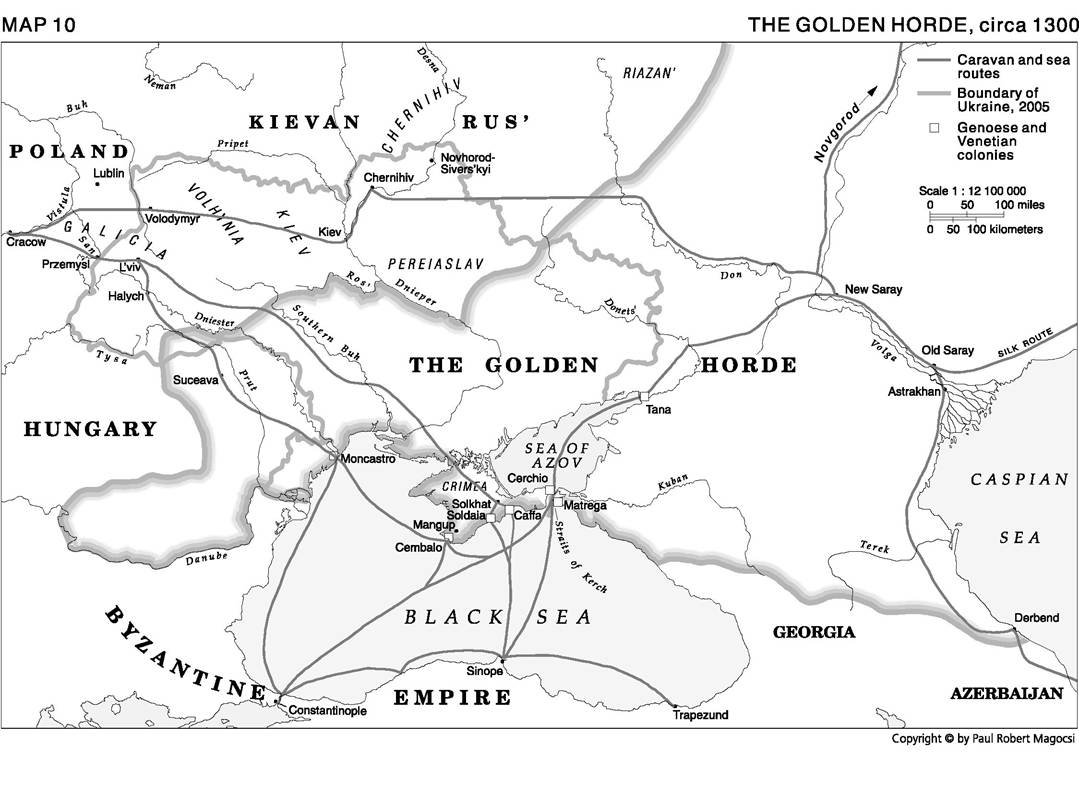
tral Asia converged on both Old and New Saray, and from there merchants moved southward along the western Caspian coast to Azerbaijan and Persia; northward up the Volga to the northern Rus’ lands of Vladimir-Suzdal’ (later Muscovy), Tver,’ and Novgorod; and westward to the Crimea, via Tana at the mouth of the Don River and from there across the Sea of Azov to the coastal cities along the Straits of Kerch and Black Sea. Subordinate routes went north from the Crimea across the steppe to Chernihiv, Kiev, and Galicia and from there westward to central Europe.
The Pax Mongolica and Italian merchants
Under the protection of the Pax Mongolica, the old Khazar trade pattern from the Far East to the Byzantine Empire, which had been disrupted for several centuries by Kievan Rus’, was now restored. The Crimea was part of the Mongolo- Tatar Golden Horde, and its coastal cities were to be once again revived, this time under the leadership of Italian merchants from Venice and, especially, Genoa. In 1266, the Mongols allowed the Genoese to build some warehouses at the former Bosporan Kingdom port of Theodosia, which soon came to be known as Caffa. Within a few decades, Genoese and, to a lesser degree, Venetian influence spread throughout the region, with the result that among the old centers of the Bosporan Kingdom, Panticapeum/Bospor became Vosporo/Cerchio, Tanais became Tana, Hermonassa became Matrega, and Sugdeia became Soldaia. The Genoese also controlled Cembalo, on the southern coast of the Crimea, and farther west they revived the Rus’ port of Bilhorod, at the mouth of the Dniester River, under the name Moncastro. All these cities became not only markets for international trade, but also centers of local manufacturing and crafts.
The main center for the Caspian-Black-Mediterranean Sea trading network was Genoese-controlled Caffa (today Feodosiia). Caffa grew rapidly and by the last decades of Genoese rule in the second half of the fifteenth century it had over 70,000 inhabitants. Like the other cities in the region, Caffa was inhabited by a heterogeneous mix of Armenians, Greeks, Slavs, Vlachs, Karaites, and Tatars, although its administration was in the hands of about a thousand Genoese, whose trading companies (factories) and bankers maintained good relations with the Byzantine Empire and were directly linked to the economy of their homeland city of Genoa. The Genoese domination in Caffa was symbolically enhanced by the establishment of a Roman Catholic bishopric as early as 1311. The main local industry was shipbuilding, but Caffa’s greatest wealth came from its control of the international trade in silks and spices from Central Asia and, later, the more local trade in fish, grains, hides, and slaves, which came from the Mongol-controlled lands of eastern Europe and then were brought on Genoese or Venetian ships to the Byzantine Empire and further on across the Mediterranean Sea to the ports of southern Europe.
Whereas the Genoese were able to reconcile their differences with the Mongol rulers of the Golden Horde and were also able to remove their Venetian rivals from the Crimea, Genoese control of the coastal regions and its dominance over
ITALIANATE CRIMEA AND THE BLACK DEATH
Crimea's port city of Caffa was an economic success story. But international trade requires the movement of all kinds of people and products, some of which turn out to be more dangerous than others.
In the Genoese sea-wall at Caffa, there is a tall gateway.... Six hundred years ago, columns of slaves in irons would enter this gate, and gangs of men carrying bales of Chinese silk shipped across the Sea of Azov from Tana. But one day in 1347, an invisible immigrant made its way under the arch and began to explore Caffa.
The Black Death came to Europe through this gate, the pandemic of pneumonic plague which within a few years had reduced the European population by one-third or more.. The disease must have taken hold among the nomad inhabitants of the Pontic Steppe before it infected the ‘Latin’ cities of the Black Sea coast. And it had traveled a long way across Eurasia from Manchuria or Korea, carried down the Silk Route by traders, porters, and soldiers to the fringes of Europe and the Black Sea.
The Silk Routes brought wealth, but then death.... Between December 1347 and September 1348, the Black Death had killed three-quarters of the European population in Crimea and the other Black Sea colonies. But it also killed half the population of Venice, the slaves and journeymen as well as the grandees, and suddenly there was a labour shortage. All over Europe... there was a famine of manpower.
Good businessmen do not miss an opportunity. The impact on the slave market was enormous. Everywhere on the Mediterranean littoral, from Egypt to Crete and Spain, the price of foreign slaves rose steeply. Most of Venetian slavers at Tana had died horribly in 1348, but the survivors were rewarded by a boom in demand and prices which roared on for half a century. By 1408, no less than 78 per cent of Tana’s export earning came from slaves. Out of their misery, and out of the profit born of the Black Death, one palace after another was raised along [Venice’s most prestigious thoroughfare], the Rialto.
source: Neal Ascherson, Black Sea (New York, 1995), pp. 95-96.
maritime trade was to be challenged by another force. Already in the late thirteenth century, a Christian principality called Theodoro arose in the mountainous highlands behind the coastal region. It was based in the region that from the fifth to tenth centuries had been controlled by Crimean Goths and that formed the territory of the Orthodox Archeparchy, and later Metropolitanate of Gothia. Hence, Theodoro is also known in some sources as the Principality of Gothia. From the 1360s the principality’s capital was Mangup, the largely inaccessible mountain-top town and former Gothic center of Doros located about halfway between Bakhchysarai and the Black Sea coast. At the time the Theodoro principality was inhabited by a heterogeneous mix of peoples, including Crimean Goths, Byzantine Greeks, Hellenized Alans, Tatars, Kipyaks/Polovtsians, and Karaites.
From their fortified center at Mangup, the princes of Theodoro, who were mostly Byzantine Greeks, in the course of the fifteenth century expanded their realm down to the Crimean coast, where in the far southwest they developed the port of Avlita and immediately above it on the cliffs constructed the fortress of Kalamita (today Inkerman). During the reign of Prince Aleksei (ca. 1405-1455), the Theodorites captured several port cities from the Genoese, thereby expanding their rule along the Black Sea coast from Cembalo (today Balaklava, an eastern suburb of Sevastopol’) eastward to Alushta. In essence, from the late thirteenth to the late fifteenth centuries, the classic symbiotic relationship between the steppe hinterland and the coastal cities was reestablished, and an era of stability was accordingly brought to eastern and southern Ukraine under the hegemony of the Golden Horde, the Genoese, and the principality of Theodoro-Mangup.
While the Pax Mongolica restored a degree of stability and economic prosperity in large parts of eastern Europe, often with the active or passive assistance of Rus’ princes and clergy, the elite of Kievan society could not help but be ideologically opposed to Mongol rule. The ideological gulf between the Christian Rus’ and their Mongolo-Tatar overlords further widened after 1313, when the Golden Horde officially adopted Islam. On account of that gulf, contemporary and subsequent chroniclers describe the Mongols in negative terms, with the result that the image of the “Tatar yoke” still prevails in most histories of Ukraine and other countries of eastern Europe. Furthermore, the decline of Kiev, already well under way before 1240, together with the opposition of some to the new Mongol order, encouraged the departure from Kiev and other southern Rus’ cities of certain members of the political, economic, and intellectual elite, who moved either northward to Vladimir-Suzdal’ or westward to Galicia-Volhynia. This migration northward and westward was undertaken by only a small proportion of Ukraine’s inhabitants, however. It was not a large-scale exodus resulting in the depopulation of the middle Dnieper region, as suggested in the nineteenth-century writings of Mikhail Pogodin and subsequent Russian historians (see chapter 2).
It was, nonetheless, during this last era of Kievan Rus’ history that under the watchful eye of the Mongol rulers the gradual realignment of political power among the Rus’ lands was completed. In the north, Novgorod continued its separate existence, while within Vladimir-Suzdal’ the new city of Moscow soon would become the dominant political force. In the south, Galicia-Volhynia was the only Rus’ principality on Ukrainian territory to survive as an independent state.
More on the topic The Mongols and. the Transformation of Rus' Political Life:
- The Mongols and. the Transformation of Rus' Political Life
- Contents
- Transformation (Specification)
- CHAPTER THREE KIEVAN RUS’
- The Decline of Kiev
- Muscovy and the Agreement of Pereiaslav
- The Unification of Eurasia
- Order, Religion, and Nation
- Socioeconomic Developments
- Basilevsky Alexander. Early Ukraine: A Military and Social History to the Mid-19th Century. Jefferson, North Carolina: McFarland & Company, Inc., Publishers,2016. — 397 p., 2016