5 The Rise of Kievan Rus’
Our knowledge of the earliest developments on Ukrainian lands is based on scanty historical evidence and is riddled with uncertainties. There is no question, however, that a political entity known as Kievan Rus’ began its existence sometime in the late ninth century and lasted until the mid-fourteenth century on the lands inhabited by the East Slavs.
The political and cultural center of Kievan Rus’ was in the middle Dnieper region of Ukraine, although the sphere of Kievan rule eventually extended far north of Ukrainian lands. This and the next four chapters will survey the rise, consolidation, decline, and transformation of Kievan Rus’ during four periods: (i) the 870s to 972, the era of growth and expansion; (2) 972 to 1132, the era of consolidation; (3) 1132 to 1240, the era of disintegration; and (4) 1240 to 1340, the era of political transformation.The origin of Rus’
While it is true that in comparison with the Khazar and early Slavic eras there is more historical data available about Kievan Rus’, its first century is still shrouded in uncertainty and controversy. Among several problematic issues is the question of the origin of Rus’. Who were the Rus’, and what were the beginnings of the state structure known as Kievan Rus’? These are among the most disputed and certainly most written about questions in the history of eastern Europe. Admittedly, the ongoing and often passionate debate that these questions have provoked among scholars and publicists frequently reflects less the actual issues of early medieval eastern European historical development than the needs of subsequent generations to find in their past an appropriate “foundation myth” that will both explain the origin of their people and provide for an appropriate degree of national pride. Did the East Slavs create their own state, or did they need outsiders to do it for them? In other words, was Kievan Rus’ the first state on East Slavic territory, or was it just a successor to earlier ones? Finally, who were the Rus’: Scandinavian outsiders, indigenous East Slavs, or both?
The controversy surrounding these questions derives from the different interpretations given to certain passages in the opening pages of one of the oldest and best-known written sources for the early history of the East Slavs, the Rus’ Primary
The Great Debate: The Origin of Rus’
The invitation to the Varangians and the problem of the origin of Rus’ have provoked a controversy that has been raging for over two centuries.
The principal schools of thought on these questions have come to be known as the Normanist and anti-Normanist.It could be said that the Normanist position was first presented in the oldest historical chronicles from Kievan times, the Novgorod First Chronicle and the Rus’ Primary Chronicle (also known by its opening phrase as the Poviest’ vremen- nykh liet, “Tale of Bygone Years”). The Novgorod First Chronicle dates from 1071, and despite subsequent modifications it is the earliest historical compilation available. The Primary Chronicle was begun even earlier, in the mid-eleventh century. Although it was subsequently copied and revised several times, its present form reflects a version prepared by the Kievan monk Nestor at the beginning of the twelfth century and subsequently reworked twice by his monastic colleagues (ca. 1118 and 1123). Both the Novgorod First Chronicle and the Primary Chronicle relate the story of the invitation to the Varangians and in various places associate them with the Rus’. Consequently, the Varangians are considered to have played a determining role in the establishment of Kievan Rus’.
With the advent of critical historical writing about eastern Europe in the eighteenth century, two German historians in the service of the Russian Empire, Gottlieb Bayer and Gerhard F Müller, set the Normanist tone. They and their nineteenth-century successors (A. L. Schlozer, E. Kunik, V. Thomsen) claimed that most features of early Kievan Rus’ civilization - its political and legal structure, religion, and art - owed their origin and subsequent development to Scandinavian influences. Although later research undermined many of these original Normanist assertions, one seemed irrefutable: the chronicle’s “invitation to the Varangians” and the association of them with the Rus’.
A revised Normanist understanding of early Rus’ history was adopted by the leading nineteenth- and twentieth-century historians of Russia (N. Karamzin, M. Pogodin, S.
Solov’ev, V. Kliuchevskii, P. Miliukov, M. Pokrovskii) and their successors in the West (M. Florinsky, F. Dvornik, D. Obolensky), as well as by some Ukrainian historians (M. Kostomarov, P. Kulish, V. Antonovych, S. Tomashivs’kyi). The chronicle’s association of the Varangians with the Rus’ having been accepted, a quest using linguistic evidence was undertaken to find the original Rus’ homeland. The hypothesis of Ernst Kunik and Vilhelm Thomsen that the original homeland was the Swedish maritime district of Uppland, along the Baltic Sea north of present-day Stockholm, was a view accepted by many leading Slavic philologists (F Miklosic, I. Sreznevskii, V. Jagic, A. Shakhmatov, A. Brückner). According to linguistic criteria, the name Rus’ reflects the Finnic tribes’ description of these “newcomers from overseas.” Consequently, Rus’ derives either (1) from Ruotsi, the Finnish designation for Sweden, especially the coastal region just north of Stockholm known as Roslagen, inhabited by the rospiggar (pronounced ruspiggar), or (2) from ropsmenn or ropskarlar, old Nordic designations meaning seafarers or rowers, a group the Finns thought to be a nationality and whose name they preserved in the first syllable of their terms for Sweden (Ruotsi) and Swedish (ruotsalaiset).An anti-Normanist reaction had already been expressed by the eighteenthcentury Russian author Mikhail Lomonosov, but his defense of the “Russian nation” and of the East Slavs in general was not really developed until the nineteenth century. Since then, the first serious anti-Normanists, Dmitrii Ilovaiskii and Stepan Gedeonov, have been joined by a host of other scholars (I. Filevich, M. Hrushevs’kyi, P. Golubovskii, G. Vernadsky, H. Paszkiewicz, M. Tikhomirov, B. Grekov, B. Rybakov), who have either criticized particular aspects of the Normanist position or, often with the use of archaeological evidence, constructed new schema to explain the early development of East Slavic state structures in which the Varangian invitation is treated as a mere episode.
According to the anti-Normanists, the name Rus’ was originally associated not with Varangians in the Novgorod and other northern regions around Lake Ladoga, but rather with a tribe much farther south, either along the middle Dnieper region just below Kiev or, in the opinion of one author (Vernadsky), east of the Sea of Azov. In the middle Dnieper region, a Slavic tribe known as the Ros (rosy/rodi) lived in the valley of the Ros’ River, a tributary of the Dnieper south of Kiev. From their center at Roden’, the Ros united the surrounding Slavic peoples into a tribal alliance in the sixth century. That union was subsequently enlarged and strengthened when the Ros merged with the Polianians of the Kiev region as well as with the Siverians of the Chernihiv region to form a new tribal union along the middle Dnieper valley that was called Rus ’.
Making use of such - some would say hypothetical - information, Soviet historians (B. Grekov, B. Rybakov) became especially adamant anti-Normanists. They based their position in particular on twentieth-century archaeological discoveries which supposedly proved the existence of East Slavic state structures well before the Varangians appeared in eastern Europe. These “states” included a Dulibian tribal alliance based in Volhynia and a Rus’ alliance based in the middle Dnieper region (made up of the Polianians, Siverians, and Ulichi- ans). Both alliances are considered continuations of the earlier Antean “Slavic state.” It was the expansion of the Rus’ northward from Kiev and their increasing control over other East Slavic tribes (and not the arrival of Varangians) that in the late ninth and early tenth centuries led to the formation of Kievan Rus’.
The anti-Normanists argue further that no people known as Rus’ or any variant thereof was ever mentioned in old Scandinavian sources. They point out that some ninth-century Islamic writers, furthermore, speak of the Rus as a tribe of Slavs and even make reference to three East Slavic states: Kuyaba, Slava, and Arta.
The anti-Normanists argue, moreover, that the traditional association of Slava (Slavia) with Novgorod is incorrect, and that the names refer simply to Kiev (Kuyaba) and two of its satellite towns, Pereiaslav (Slavia) and Roden’ (Arta). As for the supposedly indisputable evidence of the invitation to the Varangians and their identification with the Rus’ found in the chronicles, the anti-Normanists dismiss it as a latter-day interpolation. The story of the “invitation” was added by copyists who, as loyal monarchists, hoped to legitimize the Riuryk dynasty (a fourteenth-century concept) by arguing for its descent from Riuryk, the eldest of the Varangian warriors invited to the Novgorod region and the supposed first ruler of the Rus’ state. The anti-Normanists also dismiss the supporting evidence that the Rus’ envoys to Byzantium clearly had Scandinavian names, arguing that they were simply hirelings of Slavic Rus’ princes sent on their missions because they were specialists in commercial and diplomatic matters.An attempt to break the Normanist-anti-Normanist controversy was put forth in 1929 by the lawyer and Ukrainian civic activist Serhii Shelukhyn, living at the time as an emigre in Prague. Shelukhyn developed what he called “the theory of the Celtic origin of Kievan Rus’ from France.” Among the Celtic tribes of Gaul conquered by Rome under Julius Caesar in 58-51 bce were the Rutheni, who lived west of the Rhone River in, and just to the north of Narbonne, that is, the first Roman colony west of the Alps encompassing the regions of Languedoc and Auvergne in present-day southern France. Half a millennium later, during the fifth-century ce dispersal of populations in Europe caused by the Hunnic invasions, the Rutheni moved eastward and settled in the Roman provinces of Rhaetia, Noricum, and Pannonia (present-day Austria and western Hungary). It was not long, however, before the Rutheni rebelled against Roman rule. Among their leaders was Odoacer, described in sources as “king of the Ruthenians” (Rex Ruthenorum).
Odoacer was the very same military leader of Germanic origin who brought about the fall of Rome in 476 ce.As for the Celtic Rutheni, Shelukhyn argues, they continued to live in Rha- etia, Noricum, Pannonia, and coastal Illyria (present-day Croatia and Slovenia), where they mixed with the local population, including Slavs. Sometime in the seventh century ce, the Rutheni again moved eastward. A small number went northeastward to the Carpathian region in far western Ukraine, where they left their names of alleged Celtic origin: Rutheni (Slavic: Rus’/Rusyn) and Galicia (Slavic: Galich/Halych). A larger number traveled southeastward, along the Danube River to its delta, and then across the steppes of Ukraine until settling along the eastern shores of the Sea of Azov, in particular in the Taman Peninsula on the eastern banks of the Straits of Kerch. There they established a Ruthe- nian/Rus’ center at Tamarcha/Tmutorokan’. From Tmutorokan’ some of the Rus’ went north to Kiev where they mixed with the local East Slavic Polianians to whom they bequeathed the name Rus’. Eventually, the Rus’ spread from Kiev northward to Novgorod.
Another explanation that keeps the Celtic (“French”) factor in mind has been made by the Ukrainian-American historian Omeljan Pritsak. He agrees with the Normanists that the Varangian Rus’ came from abroad and that they were instrumental in organizing the first lasting East Slavic state. The Rus’, moreover, were already established among the Finnic and East Slavic tribes in the north at the beginning of the ninth century, their power base being the region around Rostov. Nonetheless, these early Varangian Rus’, as well those who responded to the later famous “invitation,” according to Pritsak represented no particular ethnic group - neither Scandinavian, nor Slavic, nor Celtic, nor Iranian (as Vernadsky asserts). Rather, they were an international trading company made up of peoples of various origins who plied the North Sea and the Baltic (or Varangian) Sea. As for the mid-ninth-century invitation to the Varangian Riuryk and his brothers, Pritsak agrees with the anti-Normanists that the emphasis on this episode is a latter-day interpolation by copiers of the chronicles. He also agrees with their rejection of the theory that the Rus’ were ethnically Scandinavian, although he denies that the origin of the term has anything to do with the Ros tribe, the Ros’ River, or any Slavic state on Ukrainian lands before the ninth century. Instead, he proposes that the word Rus’ is derived from Ruti/ Ruzzi, the Middle German equivalent of Middle French Rusi, which in turn refers to Ruteni/Rutena - the old Celtic polity in south-central France, where in the town of Rodez (whose inhabitants to this very day call themselves rutenois) an international Ruteno-Frisian trading company was based.
Despite the seemingly persuasive arguments of proponents of the various theories, there still is no definitive answer to the question of the origin of Rus’, and the debate goes on.
Chronicle. After the typical descriptions of the biblical flood and the dispersion of Noah’s descendants throughout the earth, the Primary Chronicle provides a list of East Slavic tribes and places special emphasis on the Polianians. The Polianians are presented as a “gentle and peaceful” people whose chief, Kii, not only was cofounder of Kiev but also was strong enough to visit and be received with “great honor” by the Byzantine emperor. The clear implication in the Primary Chronicle is that well before the ninth century there were several powerful East Slavic tribes or tribal leagues with their own chiefs or princes. By the ninth century, however, the Polianians and other East Slavic tribes in the middle Dnieper region had become vassals of the Khazars, while the Slavic and neighboring Finnic tribes farther north, inward from the Gulf of Finland, had become vassals of the Varangians, or Varangian Rus’, “from overseas.”
Sometime in the mid-ninth century (the Primary Chronicle says 862; the older First Novgorod Chronicle indicates 854), the Slavs (Slovenians and Krivichians) and the Finnic Chud, Vepsians, and Merians, all of whom were vassals of the Varangians, “drove [them] away overseas and did not give them tribute. And they themselves began to rule among themselves.”1 The Slavs and Finnic peoples in the north, it seems, were incapable of ruling themselves, with the result that “kin rose against kin” and they “began to raid against one another.” In such circumstances, says the Primary Chronicle, the former Slavic and Finnic vassals “said to each other, ‘Let us seek out a prince for ourselves, one who might rule us and keep order according to law.’ And they went overseas to the Varangians, to the Rus’.... The Chud, Slavs, and Krivichians, and the Vepsians said to the Rus’: ‘Our land is big and fertile, but there is no order in it. Come to be prince and rule us’.”2 In response, the Varangian Rus’ sent three brothers, Hroerkr/Riuryk, Sineus, and Truvor, who settled respectively in Staraia Ladoga (the First Novgorod Chronicle says Novgorod), Belo- ozero, and Izborsk. It is because of “these Varangians” in the Novgorod region “that the land of Rus’ was named,” even though previous to their arrival the inhabitants were Slavs. The Primary Chronicle seems, therefore, to distinguish the Varangian Rus’ newcomers and the indigenous Slavs as two different groups.
Soon after, the story goes, two of the Varangian brothers died, leaving Hroer- kr/Riuryk in control of the Novgorodian land of Rus’. Two of Hroerkr/Riuryk’s military servitors, Askol’d and Dir, were permitted to go to Constantinople, but on their way down the Dnieper River, which was to become part of the famed great waterway “from the Varangians to the [Byzantine] Greeks,” they stopped at Kiev, which at the time, together with the surrounding Polianian countryside, was in vassalage to the Khazars. While it is not clear whether or not they were asked to do so by the people of Kiev, Askol’d and Dir “remained in this town, and they collected many Varangians and began to rule the land of the Polianians, while Riuryk was ruling as a prince in Novgorod.”3
Seemingly entrenched in Kiev, the emboldened Askol’d and Dir continued their journey to Constantinople, and in 866, with 200 ships, they attacked the capital of the Byzantine Empire. Although Askol’d and Dir were able to defeat the powerful Byzantines, they proved less successful against their fellow Varangians. In 882, the new Varangian ruler of Novgorod, Helgi/Oleh, came to Kiev from the north with a large army, killed Askol’d and Dir, and “settled as prince in Kiev.” Pleased with his achievement, Helgi/Oleh declared that Kiev should “be the mother of towns of Rus’.”4 He then proceeded to force the other East Slavic and Finnic tribes to recognize his authority.
Thus, according to the Primary Chronicle, the various East Slavic tribes, in particular the Polianians, had from earliest times strong military forces and princely leaders. By the mid-ninth century, however, they were in vassalage to either the Varangians or the Khazars. A brief attempt at self-rule proved abortive, and therefore an invitation was sent to the foreigners known as the Varangians or Rus’ from Scandinavia to rule over them in the region of Novgorod. Not long after, the new Varangian sphere of influence had spread southward to Kiev and its immediate environs. At first, there were two separate Varangian spheres, one under Riuryk in the Novgorod region, the other under Askol’d and Dir in the Kiev region. By the 880s, these had been brought under the hegemony of one ruler, Helgi/Oleh, who proceeded to unite the other East Slavic tribes. With Helgi/Oleh, the rise of Kievan Rus’ had begun. In order to reconstruct the historical record from the sketchy and at times contradictory information of the Primary Chronicle, it is first necessary to examine the situation in Europe as a whole during the ninth century and to see how events at seemingly far distances had a direct and indirect impact on developments among the East Slavs and on Ukraine in particular.
Europe in the ninth century
The ninth century witnessed profound changes throughout Europe, from the Scandinavian north to the Mediterranean south, and from the far eastern steppes of the Khazar Kaganate to the heart of the Continent, which was experiencing the disintegration of Charlemagne’s empire and the destructive multidirectional invasions of the Norsemen, Arabs, and Magyars. The result of these changes was the rise of new political alignments not only in the east but also throughout Europe.
In the Scandinavian north, political and demographic changes led to a steady outward migration of warriors, traders, and adventurers, who, beginning in the last decade of the eighth century, invaded and pillaged large parts of Europe. To the inhabitants of northern Germany, Britain, and Ireland, they were known as Vikings; to the inhabitants of France, Spain, and Italy, as Norsemen or Normans; and to the Slavs and Finns in eastern Europe, as Varangians (from the Old Norse name Vaeringjar, “one who has taken an oath”). Throughout the ninth century, the Vikings/Norsemen/Varangians descended from the Scandinavian north in relentless attacks upon the cities and countryside of large portions of the Continent and the British Isles.
The causes of the Scandinavian expansion were complex, but the most important cause seems to have been political. In Denmark, and to a lesser degree in Norway and Sweden, kings were beginning to consolidate larger territories under their rule and to maintain firmer control over a traditionally freebooting population of subsistence farmers and fishermen. During this period of transition to more centralized authority, petty tribal leaders and rebellious subjects were forced into exile. One result of political consolidation was greater security and stability, which in turn promoted a prosperity and population increase that soon grew beyond what the meager natural resources of the mountainous Scandinavian landscape could support. It was this combination of population pressure and internal political consolidation that provided the manpower and leaders for the Viking raids. The result is a classic example of what may be called the safety-valve theory in history. Had the Vikings had nowhere to go, civil war between a centralizing power and discontented elements in the population might have become widespread. During the ninth century, however, the European continent was itself passing through a series of crises, and it became a kind of safety valve through which Scandinavian pressure could be released.
In the heart of the Continent, the empire of Charlemagne (reigned 768-814) restored a measure of stability to large parts of central and western Europe both north and south of the Alps, a stability which had been unknown since the days of the Roman Empire. Soon after Charlemagne’s death in 814, however, dissension among his successors led to the breakup of his empire and to internecine war between various Christian kings and princes. Farther south, the Mediterranean sphere had come to be dominated by the Islamic Arabs. From its base in the Middle East, the Arab Caliphate had brought all of northern Africa and most of the Iberian Peninsula (Spain and Portugal) under its control by the second half of the eighth century. Then, during the ninth century, the Arabs (or Saracens, as they were known) moved from their bases in northern Africa to acquire Sicily, Sardinia, Corsica, and southern Italy. Most of the Mediterranean and its trade routes were in Arab hands.
At the far southeastern end of the European continent, the Khazar Kaganate and the stability it had created within its large sphere of influence began to break down. A violent civil war took place during the 820s, and although the kaganate’s strength was restored a decade later, certain results of the conflict would have serious implications in the future. The losers in the internal political struggle, known as Kabars, fled northward to the Varangian Rus’ in the upper Volga region, near Rostov, and southward to the Magyars, who formerly had been loyal vassals of the Khazars. The presence of Kabar political refugees from Khazaria among the Varangian traders in Rostov helped to raise the latter’s prestige, with the consequence that by the 830s a new power center known as the Rus’ Kaganate had come into existence. The acceptance of the Kabar rebels by the Magyars, however, turned the latter into enemies of the new rulers of Khazaria.
Finally, a fierce warrior nomadic people, the Pechenegs (Patzinaks), began to move out of their abode north of the Caspian Sea in Khazaria. The Pechenegs displaced the Magyars from their homeland (Levedia) between the Don and Donets’ Rivers. This forced the Magyars to move westward and, in about 840-850, to settle in the Ukrainian steppe between the Dnieper and Prut Rivers. From their new homeland (Etelkoz) in Ukraine, the Magyars came into direct contact with the East Slavic Polianians living in the middle Dnieper region just to the north of them. The Magyars also began the first of their raids farther westward into the Balkans and central Europe. All these political changes and tribal displacements led to military clashes and disruption in trade, which had the overall effect of producing instability within the Khazar Kaganate and the Ukrainian steppe.
In fact, during the troubled ninth century, the only European power to maintain and even to increase its influence was the Byzantine Empire. That empire had itself just survived a profound internal cultural and political upheaval known as the iconoclast controversy, which lasted through most of the eighth and first half of the ninth centuries. Beginning in 843, Byzantium entered a golden age that continued until the first quarter of the eleventh century and witnessed the greatest extension of its territory and expansion of its commercial and cultural influence it was ever to achieve. Nonetheless, though the empire survived onslaughts from the Arab-dominated Middle East, its access to western Europe was cut off by Arab control of the Mediterranean during the ninth and much of the tenth centuries. In temporary isolation from the west and the south, therefore, Europe’s greatest trade and commercial emporium was forced to strengthen further its relations with the Khazar Kaganate and with the regions north and east of the Black Sea. The traditional close relations between the Byzantines and the Khazars were threatened, however, by the arrival of a new element in the eastern European world, the Varangians of Scandinavia.
The Varangians in the east
Whereas initially the Scandinavian marauders were content with hit-and-run raids on undefended coastal ports or with attacks on towns and monasteries along rivers navigable from the sea, they soon began to realize the advantages of settling down and establishing rudimentary administrations to control and exploit for longer periods the population in regions under their authority. In this way, they took over and developed entities such as Normandy in France, the Norman Kingdom of Two Sicilies in southern Italy, and Kievan Rus’ in the east.
In the east, the Scandinavians already had a long though interrupted tradition of contact going back to the beginning of the first millennium bce, especially along the eastern shores of the Baltic Sea (modern Estonia and Latvia). The earliest Scandinavians along those shores had been absorbed by the indigenous Baltic and Finnic populations within a few centuries.
By the sixth and seventh centuries ce, traders from Scandinavia, who had come to be known as Varangians, were back again along the eastern shores of the Baltic Sea. As they gradually pushed farther inland, they heard stories from the local Baltic and Finnic peoples about the riches of Khazaria on the lower Volga and the lucrative commerce of the kaganate with the Arab Caliphate and Byzantine Empire farther south and southwest. Spurred on by such tales, the Varangian traders and marauders grew anxious to tap the Khazarian market. By the eighth century, they had established the so-called Saracen route, which brought them from Birka along Sweden’s east coast, across the Baltic Sea and on through the Gulf of Finland, and then over land, rivers, and lakes (Ladoga, Onega, and White) to the upper Volga, whose course brought them southward to the heart of Khazaria. Along this route, the Varangians set up trading outposts and, eventually, centers of settlement. Three became especially important during the eighth century: Staraia Ladoga (called Aldeigjuborg in Icelandic sagas), on the southern shore of Lake Ladoga; Beloozero, on the southern shore of the White Lake; and Rostov, in the triangle between the upper Volga and Kliazma Rivers. From these trading posts in the north, the Varangians carried furs and other valuable skins, which they exchanged for spices, metalwares, cloth, and silver from the Arabic and Central Asian trade routes that converged in Khazaria.
Products from Central Asia and the Far East were still in demand in Byzantium and western Europe, but access to them via Baghdad and the ports of the eastern Mediterranean was closed off in the eighth century as a result of the Byzantine- Islamic wars and subsequent Arab control of the Mediterranean. The Khazar Kaganate accordingly became the new intermediary for Byzantium’s eastern commercial interests. The Varangians initially seemed content to join the Khazarian trade nexus, transferring products from Khazarian markets along the Volga River to the Baltic Sea and eventually to northern and western Europe. This mutually beneficial relationship was upset, however, after the 820s, in consequence of the internal disturbances in and external threats to the Khazar Kaganate discussed above. In conjunction with the disruption of the Pax Chazarica, the restless Pecheneg and Magyar tribes hampered trade along the Volga and forced the Varangians to look for alternative routes. Moreover, if the Khazars could not serve as effective intermediaries between the Orient, Byzantium, and northern Europe, perhaps the Varangians themselves could replace them in that role.
These are the factors which soon after the mid-ninth century led the Varangians to develop an alternative trade route that began at the eastern Swedish ports of Birka and Sigtuna. After crossing the Baltic (Varangian) Sea, they traveled up
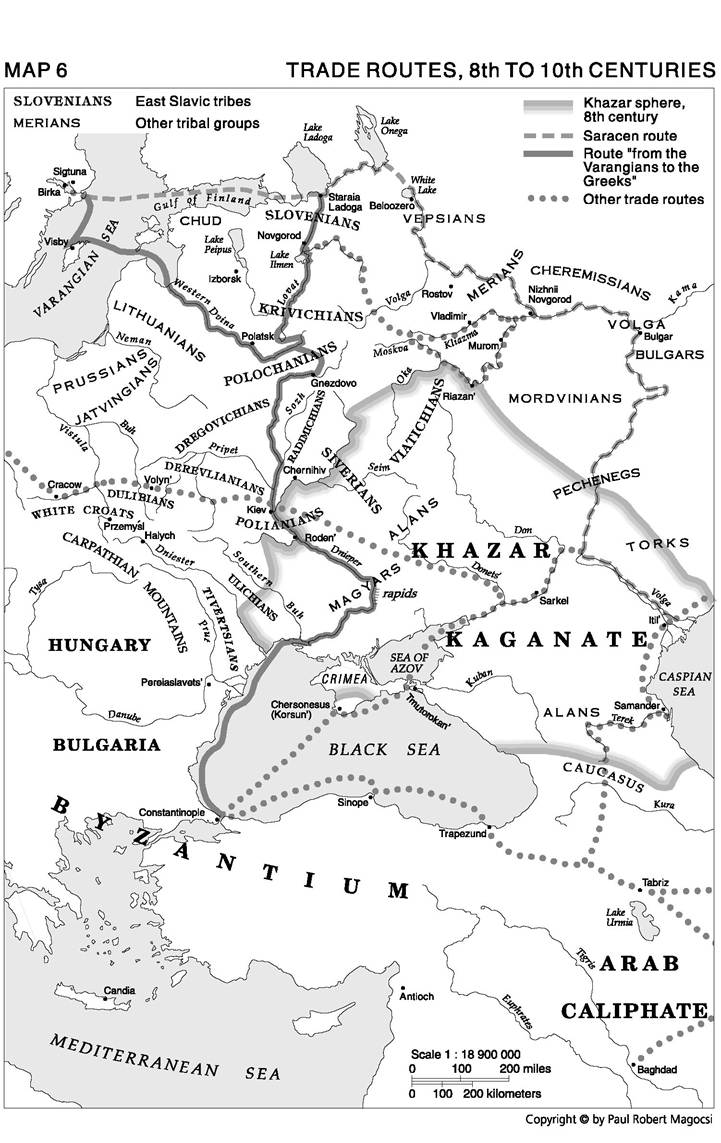
the Western Dvina River virtually to its source. From there they followed the small tributary southward and then carried their boats over land (the so-called portage) to the upper reaches of the Dnieper River, where they established an outpost at Gnezdovo (just west of present-day Smolensk). The Varangians could also cross the Baltic Sea and sail through the Gulf of Finland, reaching their outpost at Staraia Ladoga, and from there go directly south in the direction of Lake Ilmen’, not far from which they set up the outpost of Gorodishche (Scandinavian: Holmgard), later Novgorod. Crossing Lake Ilmen’, they proceeded in a southerly direction up the Lovat’ River to a point near its source. From there it was a short distance carrying their boats (the first portage) to the Western Dvina River and from there on to Gnezdovo. They then sailed down the Dnieper to the Khazar outpost of Kiev. From Kiev the Varangians could travel eastward by overland route to the Donets’ River and Khazar capital of Itil’, or they could sail farther south along the Dnieper (again carrying their boats past that river’s impassible rapids) to the Black Sea and on directly to Constantinople. The route that began in Birka or Sigtuna - and that traversed the Baltic Sea, several rivers to the Dnieper, and from the Dnieper’s mouth across the Black Sea, ending in Constantinople - came to be known as the great waterway “from the Varangians to the [Byzantine] Greeks.”
The potential wealth to be accrued from international trade along the Baltic- Dnieper-Black Sea route is what accounts for the increased Varangian presence in eastern Europe. The Varangian task was made easier by the weakening of the Khazar Kaganate, which in the mid-ninth century was losing control of its western borderland. By then the nomadic Magyars dominated the Dnieper steppe region, and the neighboring East Slavic tribes (the Polianians, Severians, etc.) were becoming restless in the face of the increasingly ineffective Pax Chazarica. In the far north, the Varangians controlled the trade routes until their local Finnic and East Slavic vassals temporarily drove them away. This was the discord and war of “one against another” that set the stage for the mid-ninth-century “invitation to the Varangians” described in the opening pages of the Prim.ary Chronicle.
It is precisely the implications of the “invitation” that have caused such controversy in the historiography of eastern Europe. Of the two basic schools of thought, one accepts the tale of the invitation from the Prim.ary Chronicle, thereby attributing the creation of the Kievan state to Scandivanians known as the Varangian Rus’. The other school minimizes the role of the Varangians, considers the Rus’ to have been an East Slavic, not Scandinavian, people, and sees Kievan Rus’ essentially as the creation of East Slavs who may simply have hired a Varangian military retinue to serve them. Perhaps the most balanced explanation of the problem is to be found in a commentary by twentieth-century scholars on the well-known tenthcentury historical tract De Administrando Imperio, by the Byzantine historian and emperor Constantine Porphyrogenitus (reigned 913-959):
It is now, indeed, widely recognized that the Kiev state was not born ex nihilo with the advent of the Varangians in the ninth century; but that its social and economic foundations were laid in the preceding period, during which the Slavs in the Dnieper basin played an active part in the political and commercial life of the west Eurasian and Pontic steppes; and that a pre-existing Slavonic land-owning aristocracy and merchant class remained the mainstay of the country’s territorial stability and economic growth under its Viking overlords. It is equally clear, however, that it was the Scandinavian invaders who in the second half of the ninth century united the scattered tribes of the Eastern Slavs into a single state based on the Baltic-Black Sea waterway, to which they gave their Rus’ name.5
The era of growth and expansion
Regardless of the uncertainties surrounding the origin of Rus’, with Helgi/Oleh (reigned 878-912) we have a known historical figure credited with building the foundations of a Kievan state. His reign begins the era of the growth and expansion of the Kievan realm that was to last for approximately a century, until 972. During this first stage in Kievan Rus’ history, Helgi/Oleh and his three successors - Ingvar/Ihor, Helga/Ol’ha, and Sveinald/Sviatoslav - faced two basic challenges: ( 1 ) to acquire control of the disparate East Slavic and Finnic tribes who lived along trade routes the Varangians hoped to control; and (2) to establish a favorable relationship with the nomads of the steppe and a positive military and economic position vis-à-vis the two strongest powers in the region, Byzantium and Khazaria.
With Oleh’s invasion of Kiev and the assassination of Askol’d and Dir in 882, the consolidation of the East Slavic and Finnic tribes under the authority of the Varangian Rus’ had begun. According to the Primary Chronicle, Oleh made himself “prince of Kiev and... said, ‘Let this be the mother of the towns of Rus’.”6 The Slovenians, Krivichians, and Merians, who had been under his control in the north, continued to pay him tribute, as did the Polianians, over whom he ruled directly in Kiev. With the far north and the middle of the Dnieper region in Varangian Rus’ hands, Oleh turned to the other East Slavic tribes, and between 883 and 885 he brought the Derevlianians, Siverians, and Radimichians under his hegemony. The Ulichians and Tivertsians, living farther south, took longer to subdue, but control of them was finally accomplished in the course of Varangian steppe politics in the 890s. Thus, by the end of the ninth century, Helgi/Oleh the empire builder - as he is sometimes described - had from his capital in Kiev gained control over most of the East Slavic tribes from the Black Sea coast and Danube Delta in the south to the Gulf of Finland and upper Volga in the far north.
Such rapid expansion inevitably brought him into conflict with Khazaria and Byzantium. Having been shaken by the internal upheavals during the 820s and the subsequent movement of the Magyars and Pechenegs in the steppe, the Khazars were in no position seriously to challenge the loss of their former East Slavic vassals - the Siverians and Radimichians - to the Varangian Rus’. Moreover, as part of the volatile nature of steppe politics during Oleh’s reign, the Magyars were forced by Pecheneg pressure to move even farther westward - to leave Ukraine entirely. They crossed the Carpathians, and, by the beginning of the tenth century, had settled in the Danube-Tisza Plain, which was to become their final homeland, eventually known as Hungary. The Ukrainian steppe was now left open to the Pechenegs, who could raid it at will from their new base between the Volga and Don Rivers.
Oleh’s relations with the Byzantine Empire were more complex and reflected commercial and cultural as well as military concerns. The very rise of Kievan Rus’ depended on the opening of the great Baltic-Dnieper-Black Sea commercial route “from the Varangians to the Greeks,” and its wealth and income depended on favorable trade relations with Byzantium. For their part, the Byzantines were forced to reckon with the Rus’ after the unexpected attack on their capital led by Askol’d and Dir in 860. The initial Byzantine response was to strengthen ties with its traditional Khazar allies (hence the mission of Constantine and Methodius to Khazaria in 860-861) and to try to entice the Rus’ into their Christian sphere. In this they were successful. The envoys of Askol’d and Dir were baptized, a Christian mission was established in Kiev in the late 860s, and as part of a Rus’-Byzantine treaty of 874, a Byzantine archbishop was sent to reside probably in Tmutorokan’.
These favorable Byzantine-Rus’ relations were brought to an end, however, when Oleh drove out Askol’d and Dir and took over Kiev. After Oleh completed the subjugation of the East Slavic tribes, his Rus’ armies were dispatched in a new attack against the Byzantine capital in 907. This successful invasion forced the Byzantines to sign a treaty in 911 that exempted Rus’ traders from customs duties and provided them with a special place of residence (with free lodging for up to six months) during their trading missions in the Byzantine capital. With this treaty the financial basis of the new Kievan state was assured, since the Rus’ were thereby given preferential rights in their commerce with Byzantium, the richest power in the region. In return for furs, wax, honey, and slaves, the Rus’ received “gold, silk fabrics, fruit, and all manner of finery,” which their own ruling elite either retained for themselves or sold for a profit to merchants who plied the Dnieper River en route to the Baltic Sea and to northern and western Europe. By the time of Oleh’s death in 912, he had succeeded in expanding the sphere of Kievan Rus’ over an extensive territory and in neutralizing the most powerful states in the region, Khazaria and Byzantium.
The favorable position of Kievan Rus’ was maintained, though with great difficulty, by Oleh’s succesor, Ingvar/Ihor (reigned 912-945). The East Slavic tribes began to resent the manner in which the Varangian rulers exacted tribute (poliudie) from them. The payments, which included dues to support the prince and his retinue as well as contributions in kind (furs, wax, honey), were collected from each homestead by fiscal agents. In practice, the process of collection was not much different from organized robbery, with the proceeds going to support the opulence of the Varangian ruling elite. This state of affairs prompted several revolts during Ihor’s reign, most notably by the Ulichians and Derevlianians.
External relations also suffered a setback. While the Khazar Kaganate proved not to be a particular threat, the Pechenegs were a problem. They returned to the Ukrainian steppe and, in 915 and 920, undertook at least two major attacks against Kievan Rus’. Relations with Byzantium also deteriorated, and prompted by some misunderstanding with Rus’ trading missions in Constantinople, Ihor decided in 941 to undertake a punitive attack on the imperial capital. This time the Rus’ were defeated, and although a new commercial treaty was signed in 944, it gave Kiev much less favorable terms.
Relations with Byzantium and the internal situation in Kievan Rus’ improved after Ihor’s widow succeeded him in 945. The new ruler, Helga/Ol’ha (reigned 945-962), came to the throne unexpectedly, after her husband was assassinated during one of the Rus’ ruler’s foraging trips for tribute from the nearby Derevliani- ans. The Primary Chronirlt· describes in some detail Ol’ha’s brutal revenge against the Derevlianians for her husband’s death, but one result of the assassination was a change in the manner in which the Rus’ exacted tribute from the various East Slavic tribes. Ol’ha reformed the collection practices by replacing the arbitrary visitations from Rus’ central authorities or their appointed representatives with a system whereby payments were organized by local agents operating from specific posts throughout the land.
Ol’ha is best remembered for her interest in improving relations with Byzantium. In 957, she went to Constantinople, but unlike each of her Kievan Rus’ predecessors, who sent armies to attack the imperial capital, she went on a mission of peace. Ol’ha was even accepted into the imperial fold, which became possible following her conversion to Christianity and adoption of a new name, Helena. This move not only enhanced Byzantine-Rus’ relations but also strengthened the earlier Christian presence in Kiev, which had been largely eliminated after Oleh came to power in the 880s and only slightly restored under Ihor. Nonetheless, despite Ol’ha/Helena’s conversion, neither the Varangian Rus’ elite nor her son accepted Christianity. Satisfied with their own pagan rituals, they tolerated and even seemed amused by the new faith.
Ol’ha/Helena’s reign came to an end in 962, when her twenty-one-year-old son Sveinald/Sviatoslav began to rule in his own right. During his decade of rule, Sviatoslav returned to the expansionist tendencies of Oleh. Like the many “barbarians” before him, Sviatoslav was attracted to the riches of Byzantium and wanted to be as close as possible to the radiance of the imperial capital. His first concern was the north and east. He succeeded in bringing the Viatichians, the last of the East Slavic vassals, within the Rus’ sphere. Then, when the Khazars asked the Rus’ for help against the Pechenegs, his response was to attack the kaganate, capture its capital of Sarkel in 965, and refashion it into the far eastern Rus’ outpost of Bila Vezha. That same year, Sviatoslav subdued the Khazars’ other allies, the Volga Bulgars, and then he returned to Khazaria, looting its old center at Itil’. By the late 960s, Sviatoslav’s forces had destroyed the Khazar Kaganate and with it the last remnants of the Pax Chazarica.
Sviatoslav was now ready to turn to what he considered the ultimate prize, Byzantium. The Byzantines had already realized that their traditional Khazar allies were no longer dependable, and they sought new ones, therefore, among the Rus’. The somewhat naive Sviatoslav allowed himself to become a pawn of Byzantine northern diplomacy. The main players in this diplomatic chess game were the Rus’, the Bulgarian Empire along the lower Danube River, and the Pechenegs of the steppe, each of whom the Byzantines were ready to play off against the others. For his part, Sviatoslav hoped to gain a foothold in the Balkans at the expense of the Bulgarians. He even dreamed of transferring his capital from Kiev to Pereiaslavets’, near the mouth of the Danube. In the end, he was forced to give up his dream and, in 971, to sign an unfavorable peace treaty with Byzantium. A year later, while returning to Kiev, he fell in an ambush by Pecheneg warriors, who had probably been informed of his movements by his erstwhile Bulgarian and/or Byzantine allies.
The death of Sviatoslav in 972 marks the end of the first century of Kievan Rus’. Under the leadership of military lieutenants and descendants of the Varangian leader Riuryk, who had been invited to the Novgorod region in the second half of the ninth century, a new power was created in eastern Europe. Centered after the 880s in Kiev, the Rus’ princes were able to bring under their control several East Slavic and Finnic tribes within less than a century. Carrying on the tradition of the Viking/Varangian marauders who had ravaged Europe throughout most of the ninth century, Kiev’s new leaders, especially Oleh and Sviatoslav, dreamed of an empire that would dominate the trade routes from the Baltic to the Black and Caspian Seas. In the rush to expand their frontiers, however, they hastened the demise of their commercial rival in the east, the Khazar Kaganate. This upset the centuries-old Pax Chazarica, which had provided a measure of peace among the steppe peoples and had blocked new nomadic invasions. The qualified success of the Rus’ princes in the east was counterbalanced, moreover, by the failure of expansionist programs with respect to Bulgaria and Byzantium. While it is true that during the first century of growth and expansion the Varangian Rus’ were able to establish their hegemony over a larger territory in eastern Europe, the Kievan realm still had much more internal consolidation to achieve before it could hope to become an enduring political force in the region.