Political Consolidation and Disintegration
Following the untimely death of Sviatoslav in 972, his successors were left with an enormous territorial expanse stretching from the edge of the Ukrainian steppe in the south to the Gulf of Finland and lake region of Russia in the north.
In the course of the next century and a half - from 972 to 1132 - the rulers of Kievan Rus’ were to consolidate control over this territory, making it one of the strongest and most influential powers in early medieval Europe. This era of consolidation was marked in particular by the successful rule of three charismatic leaders: Volo- dymyr/Volodimer “the Great,” laroslav “the Wise,” and Volodymyr/Volodimer Monomakh. It is their reigns as grand princes of Kiev, which spanned more than half the era in question (84 of 160 years), that will be of particular concern in this chapter. During the era of consolidation (972-1132), Kiev’s grand princes were preoccupied with two problems: (1) to create an administration that could effectively unite and control the vast and expanding territory of Kievan Rus’; and (2) to protect the realm from the threat of external invasion, especially by the nomads of the steppe.General success in these two areas lasted, albeit with interruptions, until about 1132. Thereafter, internal divisiveness and external threats increased, with the result that Kievan Rus’ entered a period of disintegration and gradual diffusion of political authority. The era of disintegration was to last just over a century, culminating during the Mongol invasions of 1237-1240 and the subsequent realignment of political power within the Kievan realm.
The six years between the death of Sviatoslav and the accession of the first of the charismatic leaders, Volodymyr the Great, revealed one of the fundamental problems of Kievan Rus’, namely, the transfer of power from one grand prince to the next. Traditionally, the Varangian Rus’ rulers treated the lands they controlled as their private property, passing it on to their male offspring.
The eldest son, as grand prince, received Kiev; the younger sons, other cities and lands. In order to function, this rudimentary system assumed that the brothers would respect one another’s individual patrimonies, and the younger brothers the hegemony of their elder, the grand prince. Instead, conflict between family members proved to be the rule, resulting in internecine warfare following the death of virtually each grand prince. Such conflict took place upon the death of Sviatoslav, and it was to become a typical feature of Kievan political life during the era of so-called consolidation as well as during that of disintegration.Of Sviatoslav’s three sons, laropolk, Oleh, and Volodymyr, the eldest, laropolk, became grand prince (reigned 972-980). laropolk’s rule witnessed frequent conflict between him and his brothers, however, resulting in the death in 977 of Oleh, who had been assigned to rule the Derevlianians. Oleh’s murder frightened the youngest brother, Volodymyr, who was ruling in Novgorod. Fearing for his own life, Volodymyr fled to Scandinavia. He returned in 980 with a Varangian army, reestablished himself in Novgorod, then turned southward and drove laropolk out of Kiev. That same year, Volodymyr had laropolk killed and began his long reign as grand prince, until 1015. In the absence of rival claimants to the grand princely throne, Kievan Rus’ was spared internecine warfare for nearly four decades.
Volodymyr the Great
Volodymyr I (“the Great,” reigned 980-1015) was able to extend the territorial sphere of Kievan Rus’ and to enhance its internal cohesion. In contrast to his father, Sviatoslav, who had been interested in expanding southward into the Balkans, Volodymyr concentrated on the lands of the East Slavs, subduing the Viatichi- ans and Radimichians. He also strengthened his realm’s frontiers by defeating the Volga Bulgars in the east, by capturing Cherven’, PrzemySl, and other borderland cities from the Poles in the west, and by holding back advances from the north by the Jatvingians (Slavic: latvigians), a Baltic people related to the Lithuanians living along the Neman River.
In the Varangian tradition, Volodymyr used his numerous legitimate and illegitimate sons as personal representatives throughout his far-flung Kievan patrimony. It was, in fact, during Volodymyr’s reign that Kievan Rus’ reached its greatest territorial extent, an achievement that prompted the chroniclers to describe his military activity in poetic terms as the “gathering of the lands of Rus’.” By Volodymyr’s time, the Rus’ lands no longer coincided with the homelands of the various East Slavic tribes, but rather with the spheres of influence of the leading commercial and military-political centers, from which they often derived their names. Thus arose the eight lands of Pereiaslav, Chernihiv, Galicia, Volhynia, Polatsk, Smolensk, Rostov-Suzdal’, and Novgorod. All were satellites of Kiev and its grand prince, who assigned his offspring to rule as local princes over them. In this regard, Kievan Rus’ was not a unified state, but rather a typical medieval conglomerate of various lands or principalities based on a common familial relationship to the grand prince ruling in Kiev (see map 7).
The idea that the realm of Rus’ as a whole formed a single entity began to take hold during the reign of Volodymyr the Great, at least among the princely, military, and commercial elite of Kievan society. The very term Rus’, which until then had been associated simply with the Varangian princes, now began to take on a new connotation. Rus’ came to mean the territories and their inhabitants living under the rule of Volodymyr the Great and his filial representatives. Because of
The Meaning of Rus’
Whereas controversy continues to rage over the origin of the term Rus’, there is some consensus as to how the term came to be applied to the territory and inhabitants of the Kievan realm. Initially, the term Rus’ was associated with the ruling Varangian princes and the lands under their control. This meant, in particular, the cities of Kiev, Chernihiv, and Pereiaslav together with the surrounding countryside.
The lands within this larger Kiev-Chernihiv-Pereiaslav triangle became the Rus’ land par excellence.Beginning with Volodymyr the Great in the late tenth century and, especially, Iaroslav the Wise in the eleventh century, there was a conscious effort to associate the term with all the lands under the hegemony of Kiev’s grand princes. To the concept of Rus’ as the territory of Kievan Rus’ was added another dimension by the Christian inhabitants’ description of themselves collectively as Rus’ (the singular of which term was rusyn, sometimes rusych). Nevertheless, while political and cultural leaders from the various principalities (Galicia- Volhynia, Novgorod, Suzdal’, etc.) may have spoken of their patrimonies as part of the land of Rus’, they often referred to Rus’ in a narrower sense; that is, the triangular area east of the middle Dnieper River surrounding the cities of Chernihiv, Kiev, and Pereiaslav.
Following the end of Kievan Rus’ in the second half of the fourteenth century, the successor states which fought for control of the former realm often used the term Rus’ to describe all the lands that had once been under Kiev’s hegemony. The Lithuanians claimed for themselves and conquered what they described as the Rus’ lands from Polatsk and Smolensk in the north, to Volhynia and Turafl-Pinsk in the center, to Kiev, Chernihiv, Pereiaslav, and beyond in the south. Analogously, the Poles designated Galicia, their midfourteenth-century acquisition, as the Rus’ land or Rus’ palatinate (Ziemia Ruska or Wojewodzowo Ruskie). By the late sixteenth century, Rus’ had come to mean all the Orthodox faithful and the lands they inhabited in the Belarusan and Ukrainian palatinates of the Polish-Lithuanian Commonwealth. Finally, the rulers of the principality of Vladimir-Suzdal’ and then Muscovy fused the concept of the Rus’ land with the idea of their own Riuryk dynasty (ostensibly descended from the ninth-century Varangian leader Riuryk). For them, Rus’ meant not only all the lands already under Muscovy’s control, but also other parts of the Kievan heritage that awaited acquisition in the future.
In short, by the fifteenth and sixteenth centuries, the idea that Rus’ coincided with all the lands of the former Kievan realm of laroslav the Wise and his descendants had become firmly entrenched in the political mind-set of eastern Europe.Another perspective was that of the Orthodox Church and the Byzantine world, of which Kievan Rus’ was a part. From the time of the first appearance of Christianity among the Rus’, the Byzantine Orthodox Church recognized the office of the Metropolitan of Kiev and All Rus’, by which title was meant all the lands of Kievan Rus’. When, in the fourteenth century, Byzantium agreed to the establishment of a second Rus’ metropolitanate (the Metropolitanate of Halych in Galicia) to complement that of the Kiev metropolitan, by then resident in Moscow, terms were needed to distinguish the two jurisdictions. The region closest to Constantinople, the Galician metropolitanate, with its six eparchies on the southern Rus’ or Ukrainian lands, was called in Byzantine Greek Mikra Rosiia - inner or Little Rus’; the more distant Muscovite jurisdiction, with its twelve eparchies, became Megale Rosiia - outer or Great Rus’.
These distinctions were maintained during the political expansion of Muscovy. Beginning in the early fourteenth century, Muscovite rulers styled themselves grand princes, then tsars, of all Rus’ (vseia Rusii), and after the midseventeenth century their title was reformulated as Tsar of All Great, Little, and White Rus’ (vseia Velikiia i Malyia i Belyia Rusii). During the first half of the eighteenth century, the old term Rus’ was transformed into Russia (Ros- siia), when Tsar Peter I transformed the tsardom of Muscovy into the Russian Empire. Henceforth, the terms Little Russia (Malorossiia) and Little Russians were used to describe Ukraine and its inhabitants under Russian imperial rule.
As for the original term Rus’, it was really maintained only in Ukraine’s western lands, Galicia, Bukovina, and Transcarpathia, all of which after 1772 were under Austrian rule.
The Greek Catholic Church in the Austrian Empire used the term in the title of the restored Metropolitanate of Halych and Rus’ (1808). Even more widespread was the use of the term by the East Slavic inhabitants of Galicia, Bukovina, and Transcarpathia, who until well into the twentieth century continued to call themselves the people of Rus’, or of the Rus’ faith, that is, Rusyns (rusyny, rusnatsi).Besides the Greco-Byzantine term Rosia to describe Rus’, Latin documents used several related terms - Ruscia, Russia, Ruzzia - for Kievan Rus’ as a whole. Subsequently, the terms Ruteni and Rutheni were used to describe Ukrainian and Belarusan Eastern Christians (especially members of the Uniate, later Greek Catholic, Church) residing in the old Polish-Lithuanian Commonwealth. The German, French, and English versions of those terms - Ruthenen, ruthene, Ruthenian - generally were applied only to the inhabitants of Austrian Galicia and Bukovina and of Hungarian Transcarpathia. For the longest time, English-language writings did not distinguish the name Rus’ from Russia, with the result that in descriptions of the pre-fourteenth-century Kievan realm the conceptually distorted formulation Kievan Russia was used. In recent years, however, the correct terms Rus’ and Kievan Rus’ have appeared more frequently in English-language scholarly publications, although the corresponding adjective Rus’/Rusyn has been avoided in favor of either the incorrect term Russian or the correct but visually confusing term Rus’ian/Rusian.
Volodymyr’s ability to demand and obtain the respect of his sons, Kievan Rus’ experienced a marked degree of political unity for most of his reign.
The efforts toward political unity based on familial ties to the Kievan grand prince were complemented on the ideological front as well. In contrast to his predecessors, who seemed to show only a passive allegiance to their traditional paganism and therefore a general tolerance of differing religions, Volodymyr decided to make religion an affair of state and, by means of it, he hoped, to make his subjects ideologically united and therefore more loyal to Kievan rule. Such a policy was adopted early in his reign, when he established an animistic pantheon based on gods already familiar to the East Slavs (headed by Perun and including Khors, Dazhboh, Striboh, and Mokosh), which he intended to serve as the official state religion. Simultaneously with this development, Kiev witnessed religious discrimination, as Christians and others who were not loyal pagans became subject to persecution.
While the idea of a state religion seemed politically wise, the choice of paganism proved inappropriate. All the surrounding powers with which Volodymyr was familiar had more advanced systems of religious belief and ritual, whether Christianity among the Byzantine Greeks in the southwest and Poles in the west, Islam among the Volga Bulgars in the east, or Judaism among the Khazars in the southeast. The existence of these faiths among neighboring and often militarily strong entities could not help but have an influence on the politically ambitious and astute Volodymyr.
Christianity and the baptism of Rus’
Of the three systems of belief, Christianity was perhaps best known. There was already a strong Christian presence on Ukrainian lands (especially in the Crimea) going back to the fourth century, and in Kiev, Christianity struck roots during the rule of the first Varangians, Askol’d and Dir, in the second half of the ninth century. After a lull in its development, Christianity was revived a century later by Ol’ha/Helena and her immediate entourage, but it was her grandson Volodymyr who was to establish the new religion permanently in Kievan Rus’.
Notwithstanding the medieval chronicles, whose clerical authors emphasized the spiritual conversion of Volodymyr, politics as much as personal inclinations prompted him to reject the recently established pagan pantheon in favor of the relatively more complex Eastern Christianity from Byzantium. At issue for Volodymyr was the possibility of raising the international prestige of Kievan Rus’, of developing further commercial and diplomatic links with Byzantium, and of consolidating his own rule over a Slavic-Varangian realm through common loyalty to a church of which he would be the secular guardian. The decision to accept Christianity occurred sometime in the late 980s, following a complex series of events over which there is still disagreement regarding the exact timing and sequence.
In late 987, Volodymyr agreed to come to the aid of the Byzantine emperor, whose throne was being threatened by internal revolt. In return for Rus’ military assistance, the Kievan grand prince was to receive a singular honor, the hand in
Christianity in Ukraine
The famed baptism of Rus’ by which Grand Prince Volodymyr the Great accepted Christianity as the official religion of his realm sometime in the late 980s does not mark the first appearance of that religion on Ukrainian territory. The Primary Chronicle dates the beginnings of Christianity in Ukraine to apostolic times. According to the chronicle, during the early decades of the common era, St Andrew included in his missionary itinerary a visit to Chersonesus, in the western Crimea, and from there he is said to have traveled up the Dnieper River through Scythia to the hills upon which Kiev was subsequently built.
Whether or not the story of St Andrew is true, written evidence and archaeological remains reveal that Christianity was well established as one of the many religions flourishing in the coastal cities along the northern Black Sea and Sea of Azov during the first century ce. The Crimea and the revived Bosporan Kingdom under Roman hegemony in particular became a refuge for Christians fleeing from persecution. The most famous of these refugees was the fourth pope, St Clement I, who in the year 92 was banished to Chersonesus. He found several thousand Christians in the city and converted many more people to Christianity before he was put to death in 101 on the orders of the Roman emperor. Clement’s memory remained alive in Rus’ lands, and in 860 his remains were exhumed by the Byzantine missionary Constantine and sent to Rome. Then, in 989, when Grand Prince Volodymyr the Great was baptized and married, Clement’s head was sent as a relic to the newly Christianized Rus’ leader, whose successors preserved it as a sacred treasure for the next several centuries.
After Clement, Christianity continued to flourish in the coastal cities and the steppe hinterland. The Germanic Gothic tribes who invaded Ukrainian lands in the third century had already accepted some form of Christianity - the Visigoths Arianism, and the Ostrogoths Eastern Byzantine Christianity. Christianity survived on southern Ukrainian lands even after the dispersion of the Goths in 375 by the Huns. Those Goths who remained after the Hunnic onslaught - the Byzantine Christian Ostrogoths - retreated to the Crimean Peninsula. They came to be known as the Crimean Goths, and their capital of Doros, in the central Crimea, became in about 400 ce the seat of the Christian Eparchy of Gothia. Under the jurisdiction of the patriarch in Constantinople, the Eparchy, later the Metropolitanate of Gothia and Caffa, was to survive on the peninsula until the end of the eighteenth century.
Christianity flourished to an even greater degree after the sixth century, when the Crimean coastal cities came under direct Byzantine control. The local Byzantine administrative center, Chersonesus, was the site of many churches, and the whole coastal region became a refuge for Christian dissidents, including Pope Martin I. At the height of the iconoclast controversy, which gave rise to profound political and cultural disruptions in the Byzantine Empire during the eighth and early ninth centuries, many more discontented bishops, monks, and clergy arrived in the Crimea. It was during this expansion of Christianity that in Tamatarcha (later Tmutorokan’), on the eastern shore of the Straits of Kerch, a bishopric was established sometime in the 730s under the jurisdiction of the Archbishop of Gothia at Doros, which was in turn subordinate to Constantinople. Although the Tamatarcha bishopric is not mentioned again until the 970s, in the interim it had come to be inhabited by the Varangian Rus’, a development prompting some writers to consider Tmutorokan’ the first Rus’ eparchy.
With the arrival of the Varangian Rus’ in Kiev and their early contacts with Byzantium, Christianity was established in the middle Dnieper region. Following the Varangian attack on Constantinople led by Askol’d and Dir in 866, their Rus’ ambassadors to Byzantium were baptized, and they brought the new faith back to Kiev. It is not clear whether Askol’d and Dir themselves ever converted, but the Byzantine patriarch Photius announced in 867 that the formerly feared Rus’ were now Christian “subjects and friends” living under the spiritual authority of the Byzantine Empire. In consequence, in 874 the patriarch assigned an archbishop to Rus’ (probably to Tmutorokan’). These promising beginnings of Christianity among the Rus’ in the Kiev region ended during the reign of Helgi/Oleh in the 880s. Nonetheless, some remnants of the community seem to have survived and even to have grown in the mid-tenth century, a growth culminating in 957 in the baptism of the Rus’ ruler Helga/ Ol’ha as the Christian Helena.
Aside from the long-term Christian presence in the southern Ukrainian lands (the Crimea) and the appearance of the faith in the Kiev region during the 860s, Christianity also made inroads in far western Ukraine. This development was related to the activity of the “Apostles to the Slavs,” the Byzantine envoys Constantine/Cyril and Methodius, whose mission at various times between 863 and 885 in Moravia, in the heart of central Europe, coincided with the political influence of the Great Moravian Empire. By the second half of the ninth century, the sphere of influence of that empire included far western Ukrainian lands, where the eparchies of Przemysl (Peremyshl’) in Galicia and of Mukachevo in Transcarpathia are reputed to have been established by the Byzantine missionaries in the 890s or, in the more questionable case of Mukachevo, as early as the 860s.
All these observations lead certain authors (M. Chubaty, P Bilaniuk) to maintain that there has been an unbroken Christian presence on Ukrainian territory from apostolic times, through the official “baptism of Rus’” in about 988, to the present. Accepting this premise, they argue that the Ukrainian church is an apostolic one whose origins go back to the very beginnings of Christianity.
marriage of the Byzantine emperor’s sister. Nor was the prize to be just any royal offspring, but one born in the royal bedchamber, literally born into the imperial purple (porphyrogenesis), who might be described more prosaically as someone of “blue blood.” Before the marriage could take place, Volodymyr had to be baptized and agree to bring his entire realm into the Christian sphere of Byzantine influence.
The sequence of these events has remained a source of controversy to this day. Some scholars argue that local Kievan influences may have prompted Volodymyr to accept Christianity even without Byzantium’s political incentive. Moreover, he may have been baptized already, before agreeing to be “re-baptized” in response to Byzantine demands. Finally, there is a question as to whether these events took place in 987, 988, or 989. What we do know is that in 988 Volodymyr supplied military aid to the Byzantine emperor, who was consequently able to retain his throne. We also know that the Rus’ captured the Byzantine city of Chersonesus in the Crimea, an action which probably encouraged the emperor to live up to his side of the political bargain. In the end, Volodymyr the Great returned triumphantly to Kiev in 990, accompanied by his new bride “born of imperial purple.”
Volodymyr seems to have wasted little time in exchanging the recently established pagan state religion for the Christian one. Over a century later, the Primary Chronicle described in dramatic detail how the pagan idols were “cast down,” some “chopped up and others put in the fire,” and how the citizens of Kiev were brought en masse to the Dnieper River to mark the symbolic baptism of Rus’.1 The construction of numerous churches followed; priests and church books were brought from Byzantium and, later, its other Slavic cultural satellite, Bulgaria; and the Byzantine model of church administration was set up - the basic unit being the eparchy (usually headed by a bishop), with a number of eparchies joined together in a metropolitan province (headed by a metropolitan). Missionary activity began as early as 990, and although there was often fierce local resistance to the new faith, seven new eparchies (Kiev, Volodymyr-Volyns’kyi, Bilhorod, Chernihiv, Polatsk, Turau, and Novgorod) were set up during Volodymyr’s reign.
In order to finance this new venture, Volodymyr assigned one-tenth of the state’s income to the Christian church. As a result of his activity on behalf of Christianity, Volodymyr the former “libertine” (reputed to have had 100 concubines, according to the Primary Chronicle), together with his no less worldly grandmother Ol’ha, was especially venerated by the Rus’ church, and both were consecrated as saints in the thirteenth century. In most subsequent Rus’ writings, St Ol’ha/Helena and St Volodymyr have been considered “equals to the apostles.”
Despite the aggressive efforts at proselytization begun under Volodymyr the Great, the acceptance of Christianity by the inhabitants of Kievan Rus’ spread only gradually. The faith may have taken hold early on in Kiev and other urban centers, but it was to be several more centuries before it took root in the countryside, where pagan traditions continued to flourish. Nonetheless, Volodymyr began a process that provided, via Christianity, an ideological mortar which enhanced the unity of Kievan Rus’. Thus, at the same time that the concept of Rus’ was being associated with the territory and inhabitants of the Kievan realm, it was also beginning to take on a religious connotation. In short, being Rus’ and being of the Orthodox Christian faith came to denote the same thing.
The association with Christianity served Kievan Rus’ well also in its foreign affairs. Because they now shared the same faith and Christian culture and, in theory, recognized the authority of the same “god-anointed” temporal ruler, the Byzantine emperor, the Rus’ were finally accepted into the larger sphere of the East Roman, or Byzantine Empire. Closer to home, the introduction of a unified ideology in the form of Christianity helped in the defense against the Pechenegs, who renewed their attacks from the steppes on several occasions toward the end of the century (988, 992, 996, and 997). In the end, Volodymyr turned the Pecheneg threat into a political advantage, by seizing the opportunity to call upon the Christian Rus’ people to struggle against the infidels. The inhabitants of Kievan Rus’ now had a sense of common purpose - to protect the Rus’ nation and faith.
By the time of the death of Volodymyr the Great in 1015, Kievan Rus’ had increased its political and ideological control over the various territories of the realm and had enhanced its relationship with Byzantium while protecting and even expanding its borders in the face of conflict with its neighbors to the west, east, and south. But the problem of succession had not been resolved, and conflict among Volodymyr’s several sons was to rage for nearly a decade. In this new round of internecine struggle, two of his sons played a role that was to become immortalized in Rus’ and East Slavic culture. These were Borys/Boris and Hlib/ Gleb, true Christian believers who, following the principle of non-violence, refused to resist the assassinations carried out against them in 1015 by another of their brother’s soldiers. As a result of an unwillingness “to resist evil with evil,” the martyrs Borys and Hlib became the first Rus’ Christians to be canonized.
Iaroslav the Wise
In 1024, after nearly a decade of internal conflict, stability returned to Kievan Rus’. In that year, two of the brothers, Iaroslav and Mstyslav, emerged as the strongest contenders. Although Volodymyr’s oldest surviving son, Iaroslav, had held the title of grand prince of Kiev since 1019, he had preferred to remain in the north, in Novgorod, where he had ruled during his father’s lifetime. With no prince resident in Kiev, Iaroslav in Novgorod and Mstyslav in Chernihiv remained at peace, dividing the realm into two spheres of influence roughly along the Dnieper River. Working together, they recaptured the western borderlands (lost during the internecine struggle after Volodymyr’s death) from the Poles, and they increased trade with Byzantium. It was also during this period that Tmutorokan’ (part of Mstyslav’s patrimony) came to play an important role in Kievan Rus’ history. As long as the Dnieper trade route was threatened in the open steppe region by the Pechenegs, Kiev’s economic prosperity suffered. Consequently, Novgorod and Chernihiv were able for a while to increase their own trade at Kiev’s expense. Chernihiv was itself linked to a trade route that went up the Desna and Seim Rivers and across a land portage to the upper Don River. From there, traders could descend the Don, pass through the Rus’ fortress at Bila Vezha, and continue across the Sea of Azov to Rus’ Tmutorokan’, which itself, located on the strategic Straits of Kerch, lay at the juncture of several commercial routes extending eastward to Central Asia and Transcaucasia, and southwestward to Constantinople.
The unity of the Kievan realm was further strengthened in 1036, when Mstys- lav suddenly died. laroslav now became in fact as well as in name the grand prince and undisputed sovereign of all of Rus’, from Novgorod to Tmutorokan’. Known to history as laroslav I (“the Wise,” reigned 1036-1054), he decided to leave Novgorod and make Kiev once again the realm’s political and cultural capital. His first step was to secure the city against the Pechenegs, who in the interim had become victims of the traditional nomadic fate on the steppes. Since the late ninth century, the Pechenegs had been the dominant force in the open steppe between the lower Don and lower Danube Rivers, but now they were being forced out by the Torks, who in turn were being pressured by new invaders from the east - the Polovtsians (also known as the Cumans or Kipςaks/ Qipyaqs).
In the face of Tork pressure, the frightened Pechenegs moved north and attempted to capture Kiev itself, but they were defeated in 1036 by a Rus’ army led by laroslav. This victory over the Pechenegs was to be memorialized in a special way: it was supposedly on the battle site that, in commemoration of an earlier victory in 1019 (also over the Pechenegs), laroslav began construction of Kiev’s monumental Cathedral of the Holy Wisdom, or Cathedral of St Sophia. As for the formerly feared Pechenegs, some moved farther south and attacked the Byzantine Empire. In 1091, the Pechenegs were crushed by a Byzantine army (in alliance with the Polovtsians), and soon they disappeared as a distinct political force. Some Pechenegs had remained along the Ros’ River south of Kiev, which served as the frontier with the steppe. There they joined with the remnants of the Torks and other Turkic groups (driven from the steppe by the Polovtsians) to form a new confederation known as the Karakalpaks. Referred to in the Rus’ chronicles as ChorniKlobuky (Black Caps), the Karakalpaks along the Ros’ River frontier were to remain allies of the Rus’ princes.
The Karakalpak experience reveals a lesser-known aspect of Kievan Rus’ society. Although the Kievan historical chronicles (and subsequent historians and belle- trists) invariably paint the steppe nomads in the darkest of colors as the pagan enemies of the Christian Rus’, more often than not the two groups cooperated and interacted at many levels. Certain nomads like the Karakalpaks not only protected the frontier principalities (especially Pereiaslav and Chernihiv) against the attacks of their fellow Turkic Polovtsians, but also played an important role in Rus’ politics by marrying into Rus’ princely families and serving as mercenaries for various sides in the interprincely feuds that racked the Kievan realm.
In addition to the southern steppe frontier, Iaroslav was concerned with the northwest. There he subdued the Mazovians and Jatvingians, and his son Volodymyr, who replaced him in Novgorod, brought several of the Finnic groups directly under Rus’ hegemony. In the far south, however, Iaroslav was less successful. Increased trade with Byzantium caused commercial rivalry and sometimes conflict between Rus’ merchants and Byzantine officials. In an attempt to resolve these disputes, in 1043 laroslav sent a large fleet to attack Constantinople, but it met an ignominious defeat.
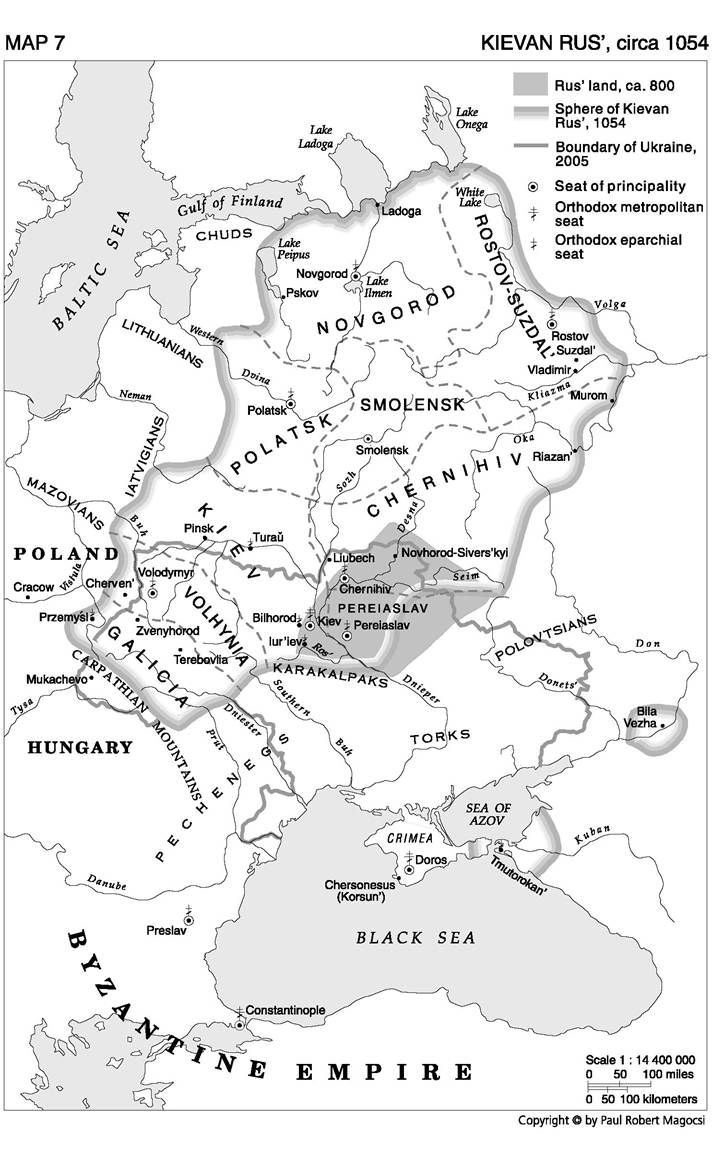
Whether or not laroslav was always successful against his foreign neighbors, he consistently carried out a policy of marital diplomacy. His western European ties were especially strong. His second wife, Ingigard, was the daughter of the king of Sweden (Olaf); of his daughters, Anastasia was married to the king of Hungary (Andras I), Elizabeth to the king of Norway (Harold the Stern), and Anna to the king of France (Henry); and of his sons, Iziaslav was married to the daughter of the king of Poland, Sviatoslav to the sister of the bishop of Trier, in Germany, and Vsevolod to a Byzantine imperial princess. By means of these marital ties, Kievan Rus’ became well known throughout Europe.
laroslav is remembered not only for his military victories and diplomatic initiatives but also for the beautification of Kiev. During his reign, five major buildings were erected: a new citadel with its monumental entrance, the Golden Gate; three churches (the Annunciation above the Golden Gate, St George, and St Irene); and, most important in the whole medieval cityscape of Kiev, the Cathedral of the Holy Wisdom, or Cathedral of St Sophia. Finally, Iaroslav enhanced the sense of unity throughout Kievan Rus’ that had begun to develop under his father, Volodymyr the Great. He did so by means of the church, creative writing, and law.
In negotiations with Byzantium, Iaroslav was able to secure from the ecumenical patriarch in Constantinople - the ultimate authority in the Eastern Christian world - the appointment of a metropolitan (initially all were Byzantine Greeks) to head the Rus’ church based in Kiev. In contrast to previous decades, there does exist concrete documentary evidence about three prelates who held the office of Metropolitan of Rus’ (Greek: Rhosia) during the period of Iaroslav’s reign. Kiev’s metropolitan was also given two assistant bishops (based in the new eparchies of Iur’iev and Bilhorod, near Kiev), and another eparchy was created in Pereiaslav. The Byzantine-Rus’ war that began in 1043 had an effect on church relations, however, and Iaroslav felt obliged to challenge the jealously guarded influence of the Byzantium Empire as exerted through its ecclesiastical representatives. In 1051, the grand prince successfully arranged for the election of Ilarion, a loyal Kievan intellectual, as the first native of Rus’ to become metropolitan.
To promote Rus’ intellectual life as well as to instill a sense of political unity, Iaroslav commissioned the preparation of historical chronicles tracing the history of his realm from earliest times to the present. A further sense of common social order throughout the Kievan realm was encouraged by his commissioning the preparation of a law code. Known as the Ruskaia Pravda/Pravda Russkaia, or Rus’ Law, this compilation of mostly common law was, in an otherwise brutal era, noted for its mild punishments, which consisted of various kinds of payment instead of imprisonment or death. Because of his diplomatic skills, cultural interests, and codification of the first written law code in any Slavic land, Iaroslav came to be known in Rus’ history as “the Wise.”
Iaroslav hoped to impart some of his wisdom to future generations, and in the last years of his life he tried to put some order into the process of the succession and transfer of political power, the settling of which had destabilized Kievan Rus’ following the death of each grand prince. His solution was to group the lands of
The Kievan System of Political Succession
From the time of their very first appearance in eastern Europe, the Varangians treated the regions that came under their control as private property to be passed on to their offspring. Although in theory priority was given to the eldest son, in practice brother fought against brother until the strongest won. Scholars have debated what the actual system of succession was or whether there was any system at all.
Grand Prince laroslav the Wise tried to lessen familial antagonism by defining the order in which his successors should follow him. According to his testament, recorded in the Primary Chronicle, he assigned to each of his surviving sons in the order of their age (and therefore of their prestige) one or more of the Kievan Rus’ lands as his patrimony. The most important were (i) Kiev and Novgorod, for the eldest son, Iziaslav, who became grand prince; (2) Chernihiv (together with Tmutorokan’), for Sviatoslav; (3) Pereiaslav and Rostov-Suzdal’, for Vsevolod; (4) Smolensk, for Viacheslav; and (5) Volhynia, for Ihor. Not mentioned in laroslav’s testament were two other lands: Polatsk, which had been ruled by laroslav’s older brother (Iziaslav) and which continued to be ruled by his descendants; and Galicia, which was eventually ruled by the Rostyslav dynasty, that is, the descendants of laroslav’s grandson Rostyslav. In each of the lands or groups of lands, laroslav’s “sons and grandsons” created local dynasties and power bases, while at the same time expecting to become the grand prince when their turn came in the order of lateral succession.
Lateral succession meant that at the death of the grand prince, the Kievan seat did not go to the eldest son of the grand prince, but rather to his first brother according to the order of rank in the list of seven principalities. In theory, only after all the brothers from one generation had passed from the scene did the next generation have its turn, beginning with the eldest son of the original grand prince. The principle of lateral or horizontal succession to the Kievan realm as a whole clashed, however, with the practice of vertical succession from father to son that was followed in each of the local principalities, where a prince more often than not strove both to retain his individual patrimony and to obtain the title of grand prince of Kiev.
The confusion and conflict between the principles of lateral and of vertical succession prompted Grand Prince Volodymyr Monomakh to convene in 1097 a conference of princes at Liubech. The conference abandoned the complex principle of lateral succession and accepted the practice of vertical succession, essentially transforming Kievan Rus’ into a federation of independent principalities. Yet even this agreement was soon challenged, since Monomakh himself, whose own patrimony was Pereiaslav, crossed dynastic lines and accepted in 1113 the grand princely throne of Kiev. In effect, he returned to the old ideal of establishing a single (Monomakh) dynasty, as most of the principalities of Kievan Rus’ were ruled directly either by him or by his offspring. Upon the death of the charismatic Monomakh in 1125 and his eldest son in 1132, however, the absence of any strong grand prince saw Kievan Rus’ revert to a state of affairs in which brother fought brother and nephew fought uncle in a vain attempt to gain political and military superiority in an environment that continued to be without any orderly principle of political succession. By the era of disintegration beginning after 1132, whatever tenuous political unity still existed in Kievan Rus’ was based on the fact that each of the realm’s component parts (the number of lands had increased from nine at the death of laroslav the Wise in 1054 to twelve in the twelfth century) was ruled by a descendant of one of the many branches of the family of laroslav the Wise.
Only much later, in the late fourteenth century, did the concept of a single Riuryk dynasty (the Riurykids or Riurykovyches) begin to be discussed. The Riurykid concept was evolved by Muscovite chroniclers who were anxious to prove that the Muscovite branch of the family was descended in a direct line from Riuryk, the semi-legendary ninth-century “founder” of the dynasty, through laroslav the Wise, Volodymyr Monomakh, and the junior branch of the Monomakh dynasty, whose princes (lurii Dolgorukii and Andrei Bogoliubskii) ruled what had become the Grand Duchy of Vladimir-Suzdal’. Eventually, that duchy was replaced by one of the younger cities on its territory, which became the new center of the Riuryk dynasty, Moscow. Despite this framework for explaining the transfer of political-dynastic power, it should be remembered that the concept of a Riuryk dynasty was never considered in Kievan times. The rulers of Kievan Rus’ spoke of themselves simply as the sons, grandsons, and great-grandsons of the eleventh-century grand prince laroslav the Wise.
Kievan Rus’ into five patrimonies, each to be assigned to one of his sons, with a sixth land (Polatsk) ruled by his brother. The eldest son became the grand prince of Kiev, to be followed after his death by the other sons in a defined order of succession. At the same time, each of the sons built up his own dynasty on the lands given to him as his patrimony.
Despite laroslav’s admonishment to his sons that they “love one another” and “dwell in amity” under the direction of the eldest, Grand Prince Iziaslav I (reigned 1054-1078), and despite his efforts at establishing a system of succession, conflicts arose among laroslav’s descendants almost immediately. Those conflicts were to disrupt the Kievan realm for nearly a half century. The situation was only made worse by the appearance of a new threat from the south, the Polovtsians, who had dominated the steppe since driving out the Pechenegs earlier in the century. Aware of the dissension among the Rus’ princes (in which the nomads themselves were often allied with one Rus’ prince against another), in 1061 the Polovtsians decided to attack Kiev directly. For nearly a decade, they were able to roam at will and to ravage the Kievan Rus’ countryside, especially the border regions of the Pereiaslav and southern Kiev principalities. Not only did the Polovtsian attacks ruin the agricultural base of the economy in the borderlands (whose population was either killed or deported as slaves), by the end of the eleventh century they had effectively cut off Kievan trade with Byzantium, whether down the Dnieper River or down the Donets’ River and via Tmutorokan’. After 1094, Tmutorokan’ and after 1117 Bila Vezha were permanently severed from the Rus’ lands to the north. Both came under Polovtsian and Byzantine influence until destroyed by the Mongols in the thirteenth century.
The conference of Liubech and Volodymyr Monomakh
The Polovtsian danger and the inconclusive results of the continuing interprincely feuds prompted five of the Rus’ princes to meet in 1097 at Liubech, a small town north of Kiev. There, at what came to be known as the conference of Liubech, the princes agreed to recognize the existing assignment of lands to their present rulers and offspring. In the words of the Primary Chronicle, each prince swore to “hold his own patrimony” and not to cross over local dynastic lines, while together they were to “preserve the land of Rus’’ and defend it against the Polovtsians.2 They also agreed to hold future councils to decide on subsequent differences that might arise among them.
In the spirit of cooperation called for at Liubech, and under the leadership of the dynamic prince of Pereiaslav, Volodymyr Monomakh, the Rus’ princes were able to defeat the Polovtsians on three occasions between 1103 and 1111. As a result of these victories, the Polovtsian threat was eliminated for the next half century. The Liubech example also served as a model for the resolution of inter- princely quarrels at similar conferences that were held from time to time.
Nevertheless, despite the best intentions, the order agreed to at Liubech, whereby each prince would remain within his own domains, was short-lived. In 1113, following the death of Grand Prince Sviatopolk II (reigned 1093-1113), the city assembly (viche) of Kiev decided to invite the hero of the wars against the Polov- tsians, Volodymyr Monomakh of Pereiaslav, to rule over them. At first he hesitated, for fear of disrupting the dynastic agreements reached at Liubech, which he himself had supported. But after riots broke out in Kiev that threatened the wealthy social strata, the monasteries, and the deceased ruler’s widow, he accepted the offer and he ruled as grand prince Volodymyr II Monomakh (reigned 1113-1125). After acquiring the title of grand prince, whose realm included the principalities of Kiev, Turau-Pinsk, and Novgorod, Monomakh still retained his original patrimony of Pereiaslav and through his offspring ruled in Smolensk and Rostov-Suzdal’. In effect, most of the principalities of Kievan Rus’ were under the control of one ruler.
Volodymyr Monomakh was the last of the three outstanding, charismatic rulers of Kievan Rus’ during the era of consolidation. In an effort to strengthen his authority in the city of Kiev and throughout the Rus’ realm, Monomakh did away with the practice of charging excessive interest rates and codified the Expanded Version of the Rus'Law of Iaroslav the Wise. Also, like Iaroslav the Wise, Monomakh extended his own family’s ties to western Europe (his wife was a daughter of the last independent Saxon king in England), and he improved relations with Byzantium, which had worsened in recent decades. All these factors, combined with the peace on the Polovtsian steppe, contributed to make the reign of Volodymyr Monomakh one of the last periods of stability in Kievan Rus’.
Monomakh hoped to retain the unity of the Rus’ realm by returning to the pre- laroslav system of succession, that is, by placing his eldest son on the throne of Kiev and his younger sons in other principalities. Initially, this approach worked. His successor, Mstyslav I (reigned 1125-1132), not only maintained order throughout Kievan Rus’ but even increased the realm’s influence, especially in the Baltic region. After Mstyslav’s death in 1132, however, the reign of his brother laropolk II (reigned 1132-1139) was marked by a renewal of the internal strife that had already characterized certain periods of Kievan history. The periods of decline in central authority, which during the era of consolidation generally had lasted only a few years between the long reigns of strong rulers like Volodymyr the Great, Iaroslav the Wise, and Volodymyr Monomakh, grew into decades, until they became the norm during the era of disintegration, which was to last from 1132 to 1240.
The era of disintegration
A symbolic indication of political disintegration was the frequency with which the title of grand prince changed hands. For instance, whereas during the first two and a half centuries of Kievan Rus’ (878-1132) there were fourteen grand princes, in the initial three decades of the era of disintegration (1132-1169) there were eighteen. The new era witnessed esssentially two trends: (1) the gradual decline of Kiev as a political and economic center, and (2) the diffusion of power to centers in other parts of the realm. This meant that as Kiev declined three new power centers began to take its place: Galicia-Volhynia in the southwest, Vladimir-Suzdal’ in the northeast, and Novgorod in the far north.
In 1136, Novgorod revolted and became independent of the Kiev principality, to which it had previously belonged. Subsequently known as Lord Novgorod the Great, the independent city-republic directed its mercantile interest westward toward the Baltic Sea and northward toward the sparsely inhabited forest regions. On the other hand, Rostov (later, Vladimir-Suzdal’) and Galicia-Volhynia participated actively in the struggle for control of Kiev and the grand princely title. Yet while each of the principalities had its own charismatic leader capable of attacking and controlling Kiev, those leaders were more interested in remaining within their own domains than residing in the weakened seat of the grand prince. In this regard, the activity of the grandson of Monomakh, Andrei Bogoliubskii, is often considered to epitomize the new era. As ruler of Vladimir-Suzdal’, in 1169 he organized a coalition of Rus’ princes, who marched on Kiev, captured the city, pillaged and burned many of its churches and monasteries, and killed many of its inhabitants. Indeed, warring Rus’ princes had fought for control of Kiev before, but none had treated it as a foreign city in the way Andrei Bogoliubskii did. He shuned the title of grand prince, and unlike most of his predecessors who had sought and gained the prize of Kiev, Bogoliubskii was content at leaving the city to someone else whom he could manipulate, preferring instead to reside in his native principality of Vladimir-Suzdal’ in the north.
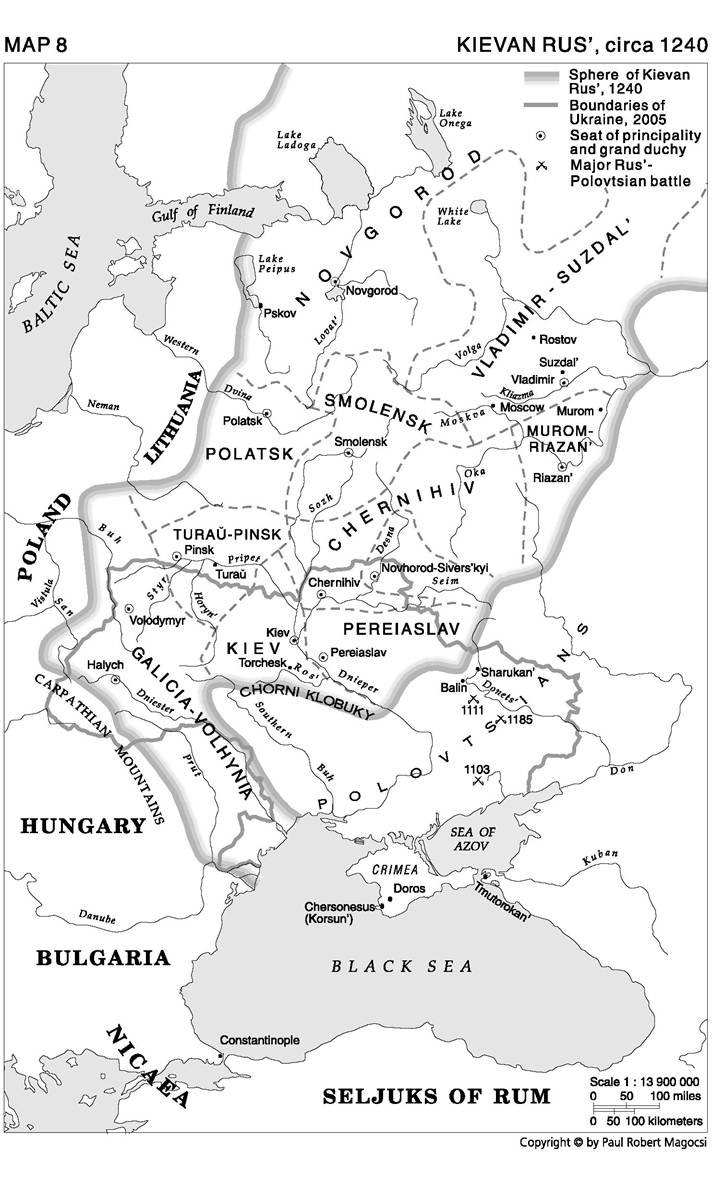
Struggling for Kiev but ruling it from afar was repeated in the first half of the thirteenth century and became the pattern. For instance, Roman of Volhynia gained hegemony over the city in 1200 but remained in his Volhynian homeland. It was during his absence that in 1203 a combined force of lesser Kievan and Chernihiv princes, in alliance with the Polovtsians, attacked Kiev and plundered it so mercilessly that the chroniclers were prompted to report, “Such great evil had not been seen in the Rus’ land since the Christianization of Kiev.”3 At the very end of the era of disintegration, Danylo of Galicia captured Kiev (1239-1240), but he too preferred to remain in his native principality, especially in the face of the Mongol threat to the region.
External invasions from the steppe hastened the disintegration of whatever the interprincely warfare had left of Kievan unity. Ever since their three defeats at the hands of Volodymyr Monomakh, the Polovtsians had not dared to attack the Rus’. In the 1160s, however, under their new dynamic leader Khan Konyak, the Polov- tsians renewed their raids against the southern principalities, especially Pereiaslav, Chernihiv, and Novhorod-Sivers’kyi. Also from this period dates the 1185 expedition against the Polovtsians led by Prince Ihor of Chernihiv, who was immortalized in the literary work Slovo o polku Ihorevi, or the Lay of Ihor’s Campaign After the death of Khan Konyak in 1187, many of the Polovtsians moved farther west toward Bulgaria; those who remained in the steppes drew closer to the Rus’, serving with them in their interprincely battles and becoming integral (by many marriages, as well as in other ways) in Kievan dynastic politics.
Yet even with the Polovtsian danger eliminated or neutralized, the steppe remained a potential source of danger unless a strong defense could be mounted by a unified Kievan realm. By the first half of the thirteenth century, however, this seemed no longer possible. The decline of the grand prince’s authority and the diffusion of political and economic power, especially toward three peripheral regions - Galicia-Volhynia, Vladimir-Suzdal’, and Novgorod - had proceeded so far that any return to the era of Volodymyr Monomakh or laroslav the Wise seemed impossible. The full transformation of Kievan Rus’ into a new alignment of political forces was not to occur until the appearance in 1237 of a new factor in eastern Europe - the Mongols. But before turning to the role of the Mongols in hastening the realignment of Rus’ politics, it is necessary to examine socioeconomic and cultural developments in Kievan Rus’ from its early years to the midthirteenth century.
More on the topic Political Consolidation and Disintegration:
- Contents
- Empires in Western Asia after 2000 все
- The disintegration of the German nation
- Violence and the different phases of constitutional formation
- CENTRALISATION OF POWER
- Models of Constitution-Making in Asia
- European Union: Treaty Establishing a Constitution for Europe(2001-2005)
- Passages in a Genocidal Reordering: Macedonia-Thrace
- Genealogical model
- Introduction