The Wild Frontier and the Cossacks
With the passing of the Mongol holocaust, agriculture in what had been Rus ceased, although pockets remained in regions of high soil fertility. We have the observations of several west European travelers, such as Josaphat Barbaro, a Venetian nobleman who traveled to Thana (today s Azov) where he remained for sixteen years.
“The wheat had a very long beard, and not very infrequently brings forth a fifty-fold yield. The harvest is sometimes so bountiful that the people do not know what to do with the wheat and leave it on the field.”1Much of Rus, however, had been destroyed, and almost overnight the northern steppe began to revert to its natural state. Pastoral nomads reclaimed the tail-grass prairie with its endless pastures and the freedom for the numerous herds, and once again the land became rich in wildlife, fish and other resources such as honey, wax and wild fruit. A detailed description of the bounty to be had was left by Michael “The Lithuanian” in his mid-16th century diary:
Kyiv (the province) has soil so fertile and so easily cultivated that if one ploughs it with a pair of oxen only once the harvest will be very rich. Even uncultivated, this soil yields plants with nutritious roots and stalks. There are also trees with excellent fruit, and vines with large bunches of very good grapes; in some places they grow wild on cliffs. In old oaks and beeches (alders) hollowed by old age one often finds swarms of bees and honeycombs ofbeautiful color and aroma. There is such an abundance of game in the forests and fields that aurochs, wild horses and deer are killed only for their skins. Only the sirloin and the fattier parts of the meat are taken. Roes and boars are not consumed at all. Such a multitude of wild goats come from the steppes to the forests in winter and to the steppes in summer that one kills thousands of them.
There are a great many beaver lodges in the rivers. There is a wondrous multitude of birds so that in the springtime boys gather duck eggs by the boatful (just) as the eggs of wild geese, cranes and swans and then fill their sheds with young birds. They place eaglets in cages for their feathers which are then attached to arrows. Dogs are fed animal meat and fish.The rivers there are full of fish when enormous schools of sturgeon and other large fish enter fresh waters from the sea.2
Among the large fish were catfish, which grew to monstrous proportions—some reportedly 18 feet in length.
The steppe was also a place of immense beauty as described by the great Ukrainian writer Mykola Hohol (Nikolai Gogol), who himself grew up on the Ukrainian prairies in the early 19th century. The use of the name “Ukraine” was officially discouraged by the Russian authorities, and the Zaporizhia territory was renamed as Novorossia (New Russia) in the late 18th century.
The whole south, the whole area that makes up Novorossia as far as the Black Sea, was a green virgin wilderness. No plough had ever made its way through the immense waves of wild growth. Only horses, disappearing into them as into a forest, trod them down. Nothing fairer could have existed in nature. The whole surface of the earth resembled a green gold ocean sprinkled with millions ofvarious flowers. Through the long, thin stems of grass peeped azure, blue and violet cornflowers. The yellow broom thrust up its pyramidal top. The umbrella-like caps of white baby’s breath dotted the surface. An ear of wheat, brought God knows whence, was ripening in the thicket.3
The natural beauty of the great prairie was also praised by the French diplomat Schirer, who was in the king’s foreign service.
Ukraine is a fertile country as is Podolia and Russia. The whole (Ukrainian) prairie abounds in all types of edible herbs: odorous flowers which Europeans cultivate with so much care grow naturally in the fields...
and the (prairie) grass is so tall that a man on horseback can easily hide himself.... Ukraine is one of the most beautiful lands in Europe.4The great steppe was always home to nomadic tribes but by the beginning of the 12th century it was beginning to serve as a refuge for inhabitants of Rus, those seeking a free life without the taxation and other exactions of Prince and Church. As the military ruling class of Rus and the Church hierarchy became entrenched refugees from the law, escaped slaves, bound men, and classless “izgoi” outcasts began to escape into
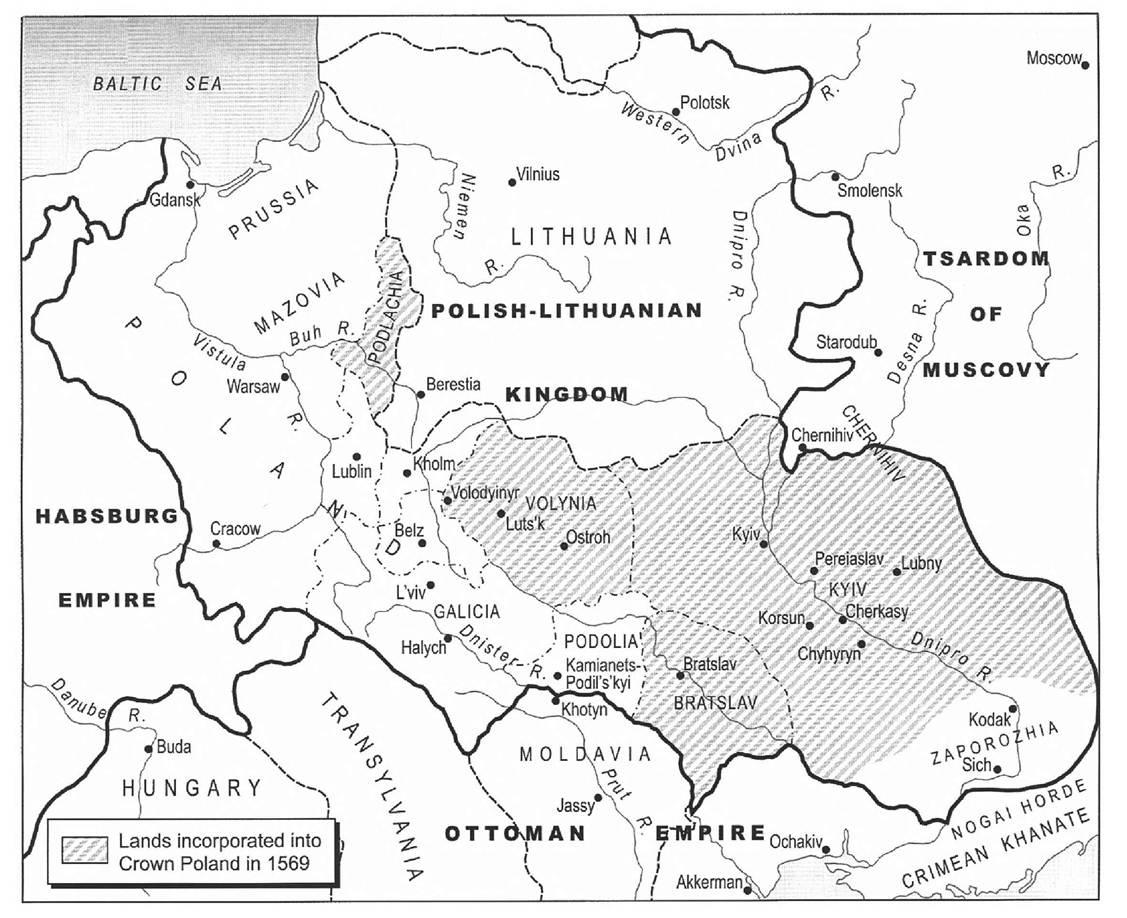
The traditional territories of Kyiv-Rus and Volynia which were transferred to the Polish Kingdom. The transfer was a major factor which contributed to a worsening of relations with the Ukrainian Cossacks.
the steppe, forming armed free-booting bands known as the “Brodniki” (wanderers). No state had successfully imposed control over the vast region, and a refugee soon found himself leading a life of freedom and plenty, able to elect his leaders and avoid all forms of state institutions. The price of freedom was keeping a sharp wit and saber, and being vigilant against the Polovtsi nomads who did not care to share the booty from raiding merchant convoys and caravans. We also know from the Kyiv Chronicles that by the 12th century the Brodniki were strong enough to join the Mongols against the southern princes and their Polovtsi allies in the battle of the Kalka River. Later the Ukrainians would refer to them as the “burlaki,” no doubt a word of Tatar-Turkic origin.
The second type of armed men from Rus in the wide steppe were survivors of the Kyiv and Chernihiv princes’ garrisons, which had for centuries manned the extensive defense system which stretched along the Dnipro River, its tributaries, and the lower region of the Don. Trade with Constantinople and other parts of Romania was the lifeblood of Rus, and the Dnipro water system was well defended by outposts and settlements with workshops and warehouses.
The steppe was a dangerous no-man’s land, and as the Kyiv Chronicle informs us “only the best men” were selected to garrison the forts. People of the steppe, such as the Circassians (“Cherkessy”) and the Torks, were also settled in the strongholds after being properly Christianized to ensure loyalty. Here, far away from the daily life of the prince, slavery and other forms of bondage were unknown, and leadership was earned by ability and personal example. By the late 12th and early 13th centuries the defensive steppe settlements of Rus were home to the frontier garrisons that became known as “qazaqs” to the Polovtsi nomads, designating a “watch” or “sentry” in their Turkic dialect.5Men of the princes’ garrisons that had survived the Mongol onslaught could easily take refuge in the inaccessible wetlands, channels and islands of the lower Dnipro river basin. Here game was plentiful, particularly the huge fish that had always supplemented the frontier settlements’ food supply. The knowledge and experience to pilot boats through the treacherous Dnipro rapids would also have been preserved by the survivors and the lore of the Cossacks, who were the only ones to navigate the “porohy” or cataracts. As time went on, the survivors of the garrisons were joined by adventurous individuals, who despite the constant danger were drawn by the rich resources, occasional booty, and the freedom found in the wild prairie. With a negligible population it was easy to avoid unwanted attention in the great expanse of the steppe.6
The bands of armed men roaming the prairies and frequenting the Dnipro waterways were not the only Rusins in the northern steppe. All defense systems of Rus were destroyed by the Mongol invasion but some outposts and villages survived and were used by the Mongols or Tatars as they became known. This was confirmed by the interesting voyage undertaken by Carpini the Papal envoy to the Tatars shortly after the fall of Kyiv.7 Rather than hinder the arrival of newcomers the Tatars began to establish free settlements or “slobody” on the fertile black soil, without landlords or other feudal obligations so long as the Khan’s tax was paid on time.
We know that many boyars, clergy, merchants and artisans were also hired by the Tatars, and certainly some of the garrisons which survived the invasion as well as the “Brodniki” found themselves in Tatar service as auxiliary troops, with an elected leadership following Mongol tradition.Another Rusian presence in the Dnipro steppe region were seasonal hunters and gatherers, who upon paying a fee to the Tatars could hunt and gather produce during the summer, returning to permanent villages before the snow fell. The southern seasonal migrations increasingly took the form of organized bands of armed men arriving in wagon trains to tap the rich resources of game, fur, fish, honey, and the grapes which had taken hold in the depopulated areas. The expeditions began to assume a greater importance for the local economy and, as Tatar power declined, the fee-for-access arrangements were replaced by widespread free hunting and fishing by men who were rapidly becoming expert in the use of weapons. No doubt once in the open steppe, the hunters were joined by the “Brodniki” in defense against Tatar bands that roamed the countryside.
In 1362 Mongol rule over the Kyiv lands came to an end when they were defeated by Grand Prince Vytautas at “Suni Vody.” The battle marked the beginning of the breakup of the Golden Horde into warring clans and khanates, and independent Tatar bands appeared which fought for booty, or could be hired for pay. Theywere called “kazaks” to designate themselves as free warriors, distinct from the men in the service of a clan chief or a khan. Their first mention seems to be in the chronicles of Riazan, where Tatar “kazaks” are mentioned in 1444, but the entry is unreliable and the earliest verifiable record of “kazaks” is in 1469 by the Polish chronicler Jan Dlugosz, who wrote: “A large Tatar army, collected from fugitives, robbers, and expellees, whom they in their language call “kazaks,” under the command of the Trans-Volgan Khan Maniak, attacked the lands of the Kingdom of Poland, in three detachments.” The Tatar designation of a free warrior as a “kazak” could be related to the earlier Polovtsi (Cuman) word “qasaq,” meaning a “guard,” the similarity arising from both languages being members of the Turkic family.
At first the term “kazak” was not restricted to any ethnic group, but by the end of the 15th century the name begins to be applied mainly to the Slavic-speaking bands roaming the steppes, as well as the inhabitants of the mid-Dnipro region.8 Many of the free bands and the town garrisons of Rus were originally Circassians Settledbythe Grand Princes of Kyiv, and the term “cherkessi” was used Interchangeablywith “kazak” (particularly in Muscovy) to designate Ukrainian Cossacks. Most of the lands of Rus which bordered “the wild prairie,” such as those of Kyiv and Chernihiv, became known as the “(U)kraina” or Borderland, while the name “Rus” was applied to all the Greek Orthodoxprincipalities lying between Poland and Muscovy, as noted in the early 16th century by the Styrian travelerdiplomat Herbertstein.9 “Ruthenia (Rus) extends near the Sarmatian (Poprad) mountains, up to a short distance from Krakow. Thence along the river Tyra which the natives call Dnister, to the Black Sea across to the Dnipro.”10
Following the Mongol defeat at “Suni Vody” the Grand Prince Vytautas began to rebuild towns and strongholds along the Dnipro River, but as his men returned they found local inhabitants living independently of any outside authority and enjoying a free lifestyle under their own elected leaders. The entire character of southern Rus had changed. Gone were the prince’s “druzhina” and regiments now replaced by bands of steppe fighters who modeled themselves on Circassian and Tatar practice. Light cavalry mounted on hardy steppe horses fought in bands known in Sarmatian as “vatahas” under the traditional horsetail standard or a “bunchuk” and led by an elected “vatah” (“ataman”). Larger bodies of men had an “osavul,” who acted as an adjutant to the commander and took care of finances and administration. No defensive armor, helmet, or chainmail was worn and the chief weapons were the lance and the curved Tatar saber. The powerful composite bow was also popular, particu- Iarlybefore the introduction of handheld firearms. Centuries later Ukrainian Cossacks would continue to wear distinctive Sarmatian clothing such as the baggy “sharovary” trousers, “kurtka” vests, and riding boots or “choboty” as well as the Tatar “kepenek” (kobiniak) long-coats. Unlike the princes’ men-at- arms and other military bodies such as the Teutonic Knights, the Cossacks normally didn’t wear beards but cultivated moustaches, which Jsometimes were allowed to grow to great lengths. More senior members of the Brotherhood sported the distinctive chivalry lock on a shaved head known humorously in Ukrainian as a “herring,” or a “khakhol” in Muscovy, which became the Russian nickname for a Ukrainian. At this time Turkic- Tatar and IndirectlyArabic words began to make their way into Ukrainian speech, for example “maidan” or an open square (area) where meetings and elections were held.
With the return of the Grand Prince’s authority came a new system of administration, inspired by the Polish model. The traditional Rus principalities of Volin, Kyiv, Chernihiv and Pereiaslav came under the direct rule of Prince Vytautas and were replaced by provinces or the so-called palatinates (“voivodstvas”) under a military governor (“voivoda”). These in turn were subdivided into areas commanded by a “starosta,” a kind of military sheriff who was responsible for defense, the administration of the executive and judicial branches of the law, and taxation. Appeals against the government officials were possible, but they rarely went very far. The Grand Prince also appointed a marshal known as a “castellan” to maintain the castles and major fortifications, who also had the power to call the local nobility to arms. The nobility of Rus continued to maintain its privileges such as ownership of land and exemption from taxation, and the entire burden of paying taxes was carried by the peasants and town burghers, at times by the Jews. This was due to the common view that only a military landowning class would have the ability and the incentive to defend the country against attack. The Lithuanian-Rus state and the Grand Prince derived income from levies and a monopoly on the sale of salt and alcohol although common beverages such as beer and kvass were excluded.
Three settlements were rebuilt and fortified on the Dnipro and the Buh rivers which would become important centers for the seasonal Cossack hunters and gatherers—Cherkassy and Kaniv on the middle Dnipro, and Bratslav on the Buh. Following the defeat of the Tatars the whole territory was taken over by the Grand Prince and the land leased to local “starostas,” who in turn levied taxes and various fees. According to a mid- 16th century government inspector, the burghers of Bratslav
... go there (into the steppe) Continuallyto live off the meat, fish, honey from apiaries and from wild swarms, and make med (mead) for themselves as if at home.... There are such apiaries that in some cases even (the fees for) three seasonal settlements are not worth one apiary. There is a mile of land around such an apiary, and the smallest... has half a mile. The “owner” also has cropland, drainable ponds, an abundance of bees, all kinds of game, orchards and lush fruit gardens, and all other useful things. Not only is no one allowed to go fishing or hunting or to make any use of such an apiary and the farmlands, meadows and groves belonging to it (the leased estate) but people are not even allowed to take wood or a stalk of grass free of charge; they (the hunter and gatherers) have to give something in exchange for everything.11
The taxation and fees imposed by the starostas were viewed as illegitimate by the Cossack hunters and gatherers who considered the territory to be a part of their medieval heritage. A new breed of man was appearing in the prairie towns of “Ukraina,” men who had become accustomed to a free life and were both willing and able to face danger without having to rely on the Prince’s protection.
It was the princely state that would soon need the protection of the steppe hunters and warriors. Following the great victory at Tannenburg in 1409, Grand Prince Vytautas was able to reverse the defeat which he suffered at the Vorskla River and begin a program of erecting defensive forts on the west side of the Dnipro River. It was abruptly halted in 1416 when Emir Edi- gei assembled a large Tatar army and swept along the Dnipro, stormed into Kyiv and destroyed much of the city and its defenses. The main resistance against the Horde was offered by the local Cossack bands and those serving in the garrisons of Cherkhassy and Kaniv, something which was not lost on the Prince’s administration.
Events which would shape the fate of the Ukrainia frontier were also taking place within the Polish-Lithuanian state. Wla- dyslav II (Jogaila) of Poland had sons late in his life, and on his death the eldest (but still underaged) son became King Wla- dyslav III and was placed under the tutelage of Bishop Zbigniew Olesnicki of Cracow. He also became a controversial candidate for the Hungarian throne but received Pope Eugene IV’s support when he promised to lead a Crusade against the Ottoman Turks. With the help of the experienced Hungarian general Janas Hunyadi, the 18-year-old king won a great victory against the Turks but two years later broke the agreed-upon truce and was killed in the crushing defeat at Varna (Bulgaria). The Polish Crown was offered to Jogailas third son the Grand Prince ofLithuania-Rus and on 25 June 1447 he became King Casimir (Kaziemirz) ΓV. The new King quickly moved to meet the demands of the Orthodox nobility, who supported him by granting the same rights and privileges as were enjoyed by the Catholics. Theybecame entitled to the full ownership of their estates, a greater control over their peasants, and a monopoly of the local courts. Although they were also given a share in the high offices of a principality, the Orthodox nobility never achieved complete equality with Roman Catholics.12 Still, powerful Orthodox Rusin families such as the Chortoriysky, Vishnevetsky, Ostrohsky and Zbarazhsky continued to exercise great
influence in Volin while the Mstislav and Zaslavsky clans dominated eastern Belarus. Finally in 1434 the Greek Orthodox Church was officially recognized in Lithuania-Rus to be legally and politically equal to the Church of Rome, but the situation was not to last.
During Casimir IV s reign the Tatars abstained from major attacks and the middle Dnipro region was beginning to be resettled by individuals granted free land in return for military service. Thus unlike elsewhere in Lithuania-Rus and Poland where only the nobility could legally carry arms, the peasantfarmers and other settlers of Ukraina were obliged to do so. Theywere also becoming exposed to Cossack tactics, fighting techniques and styles that had developed to meet a frontier environment, and the particular conditions of the “wild prairie.” This was a population that could not be subjugated by state administrators, nor did the Starostas have the inclination to alienate the inhabitants of the Ukraina due to a scarcity of manpower. Most settlements were not very large and ranged from 2 to 10 homesteads as described in a contemporary document where a sample region had 18 villages which during a conflict could raise 150 mounted men. Most Cossacks, however, continued to roam the “wild prairie” at will, moving across the wide expanse of prairie and forest like “grey wolves of the steppe,” as described in accounts and songs.
The importance of the Cossacks, however, was becoming disproportionate to their numbers. In 1452 Volin was occupied by the Grand Princes army which ended its autonomous princely status and converted it into a province of the realm, and in 1471 Kyiv and its surrounding territory followed. The princes’ “druzhinas” and armed forces disappeared to be replaced (theoretically) by the Grand Prince s men and the nobility. One of the overall results was a reduction in the defensive capability of the Ukraina and other southern lands, which coincided with a period when the Crimean and Nogay Tatars began their regular raids of the Christian lands.
The world of the Tatars was also changing. A second great conqueror as great and perhaps greater than Genghis Khan appeared in the middle of the 14th century, known as Timur-L Lenk (Timur the Lame) or simply Tamerlane. By then the Golden Horde had split into two warring factions, one led by Khan Mamai and the other by Tamerlane s vassal Tokhtamysh. Mamai made the first move.13 To secure his rear he first moved against Moscowbut was defeated in the great battle of Kulikovo Polje or the Snipes Field (of battle) in 1380 by Grand Prince Dmitry of Moscow. The following year he suffered another defeat by Tokhtamysh, who then marched on Moscow and, tricking the defenders into opening the main gate, burned the city to the ground. Following Tamerlane s death the Golden Horde once again split into factions, fueling the formation of the Crimean (Krim) Khanate by Khan Haji Giray in the 1440s, when he failed to become the Great Khan of the Golden Horde.
A shrewd politician, Haji Giray allied himself with Casimir IV and in 1453 defeated his main rival Seyyid Ahmed, the Great Khan of the Golden Horde. The following year a great period in European history came to an end. Using massed artillery barrages the Turkish Sultan Mehmet II captured Constantinople. Defended by only 5,000 Greeks the city fell on 29 May, bringing the Roman Empire to a symbolic end. It would be replaced by the Muslim Ottoman Empire, putting the Christian world on the defensive for centuries to come. It would also greatly enhance the power of the Crimean Khans. The Turkish Sultans considered themselves to have inherited the territory of the entire Roman Empire by the law of conquest, and began to occupy the northern shores of the Black Sea. Khan Haji Giray died in 1466 (probably poisoned) in the midst of a civil conflict, and was succeeded by his son Mengli Giray In 1475 the Crimea was invaded and Mengli Giray was shipped off to Constantinople where he was imprisoned for three years before Sultan Mehmet II decided that, after all, he would be the best candidate for the Crimean throne. A large Ottoman fleet proceeded to capture Kafa and in a few months all Genoese territory along the Crimean coast was in Ottoman hands. While Mengli Giray retained his fathers territory the Genoese possessions came under Mehmet s rule. Beginning in 1475 the Ottomans began to build forts along the entire coast of the Black Sea at Perekop, Gozleve, Kafa, Yenikale, and Arabat. Mehmet s conquests were continued by his son Bayasid II with the capture of Kilia in the Danube Delta, Bilhorod (Akkerman) in the Dnister estuary, and the whole of the Taman Peninsula to the east of the Crimea. The Black Sea had become a Turkish lake, closed off to all Christian shipping. The forts were built on estuaries of rivers emptying into the Black Sea and could also lead directly to the conquest of the Christian lands of the interior.
In spite of the Ottoman presence the political system governing Crimean Tatar society had not changed and was still based on Mongol traditions but with the adoption of the Ottoman legal model. Unlike the Turkish sultans, however, the khan was not a hereditary autocrat but was elected in a “kuruL tai” by the heads (beys) of four powerful clans. His authority was also limited by the beys, since he could not rule without their consent and cooperation. Most of the political and economic authority lay in the hands of the four clans who owned most of the arable land, and had a much larger military force than the khan himself. The beys of these clans, known as the Karachi clans, formed the highest aristocracy in the Crimea with a female of a single clan, the Shirin, having the exclusive legal right to many the khan. Beneath the Karachi beys were the mirzas or nobles, whose position was largely military, similar to that of the boyars of Rus. By the second half of the 16th century the Ottoman sultans had greatly reduced the power of the beys with the clan leaders losing ownership of their lands, which now could be held only with the khans permission.
The Crimean Peninsula was not well suited to extensive agriculture and, with a rise in the population mainly due to the migrations from the Volga region in the early 16th century, famines began to occur. The land was assigned to villages by the owners and was worked communally with taxes assessed by the beys, mirzas or the khan. By law, the landlord was owed 1Xo of the grain harvest, ⅛o of the livestock value, and occasionally free labor, which was imposed with care since as Muslims the peasants were free to leave at any time. Slaves were the most valuable commodity and the Tatars became the chief providers to the Muslim world. By the middle of the 16th century Tatar raids into Slavic and Lithuanian lands were yielding more wealth than the value of the entire wheat export. Other Tatar clans, such as the Nogays, continued their traditional nomadic life in the southern steppe bordering the Crimean Peninsula.
In 1480 Mengli Giray signed a treaty with Prince Ivan III of Moscow, which was directed against their common enemies, Lithuania-Rus and the Golden Horde on the Volga. The treaty triggered a period of steppe warfare and raids on Ukraina-Rus, and revealed once more the importance of the town and steppe Cossacks in the defense system. In the summer of 1482 at the head of a large army Mengli Giray attacked and penetrated the southern defenses, capturing and destroying eleven strongholds. On 1 September Kyivwas stormed and sacked, being inadequately defended by the nobility and Casimir s royal troops. Even given all the previous damage, the devastation which followed left Kyiv desolate and a mere shell of its former self, a state in which it would remain for many decades. As described by Herbertstein, King Ferdinand s representative with Emperor Charles Vs delegation to Moscow.
Seven miles beyond Circass (Cherkassy) going up the Borys- thenis (Dnipro), lies the town of Cainovu (Kaniv); eighteen miles from which is Chiovuia (Kyiv) the ancient metropolis of Ruthenia (Rus), whose one-time magnificence and evidently royal estates are revealed by the ruins of the city and the monuments, which are still seen lying in heaps. There may still be traced to this city on hills... the remains of churches and deserted monasteries....14