What to Call the Cossack State?
The new Cossack state, coerced into being by military events, was officially known as the Army of Zaporozhia (Viis'ko Zaporiz'ke) or the Zaporozhian Host, even though it was not centered in Zaporozhia.
Despite its name, it was the creation of the registered Cossacks living in Ukrainian territories farther north and not of the Zaporozhians, who were united with it only through the personal leadership of Khmel'nyts'kyi. Another source of confusion is the number of names given to the Cossack state: the Army of Zaporozhia, the Army of Lower Zaporozhia, the Hetmanate, and Little Russia. Actually, the Army of Lower Zaporozhia referred specifically only to the Zaporozhian lands, while the Hetmanate and Little Russia (especially in Muscovite and Russian sources) referred to those Cossack regiments on the Dnieper’s Left Bank that were under the direct authority of the hetman (excluding Zaporozhia and Sloboda Ukraine), which after 1667 had come under Muscovite hegemony.In this and subsequent chapters, the term Cossack state will be used with reference to the period between 1649 and 1711. While it is true that by the second half of the seventeenth century there were already pronounced differences among the various Cossack regions (the Hetmanate, Sloboda Ukraine, Zaporozhia, the Right Bank), the term Cossack state, which implies a single entity, is justified by the fact that throughout this period most hetmans from Khmel'nyts'kyi to Mazepa tried to create some kind of autonomous or independent entity consisting of all lands inhabited by Cossacks. After 1711, the individual regional names will be used. In any case, after that date it was only in the Hetmanate that the tradition of Cossack statehood was preserved.
his social group within the Polish-Lithuanian Commonwealth. When it became increasingly evident, however, that the revolutionary events he had set in motion in 1648 could not be contained, and that his limited demands on behalf of his estate represented an insufficient response in a rapidly changing military, political, and social situation, the Cossack leader was forced to create a new administrative structure for the territories that had come under his control.
The result was the Cossack state.Technically, the Cossack state came into existence at the peace reached at Zboriv in August 1649 between Khmel'nyts'kyi and the Polish government. By the terms of the Zboriv agreement, the palatinates of Kiev, Bratslav, and Chernihiv - that is, the region within Poland that had come to be known as Ukraine - were cleared of Polish administrative and military authorities, who were then replaced by Cossacks. The boundaries of the Cossack state, which encompassed 120,000 square miles (312,000 square kilometers), were reaffirmed by the Zhvanets’ treaty with the Poles in December 1653, and by the agreement of Pereiaslav with the
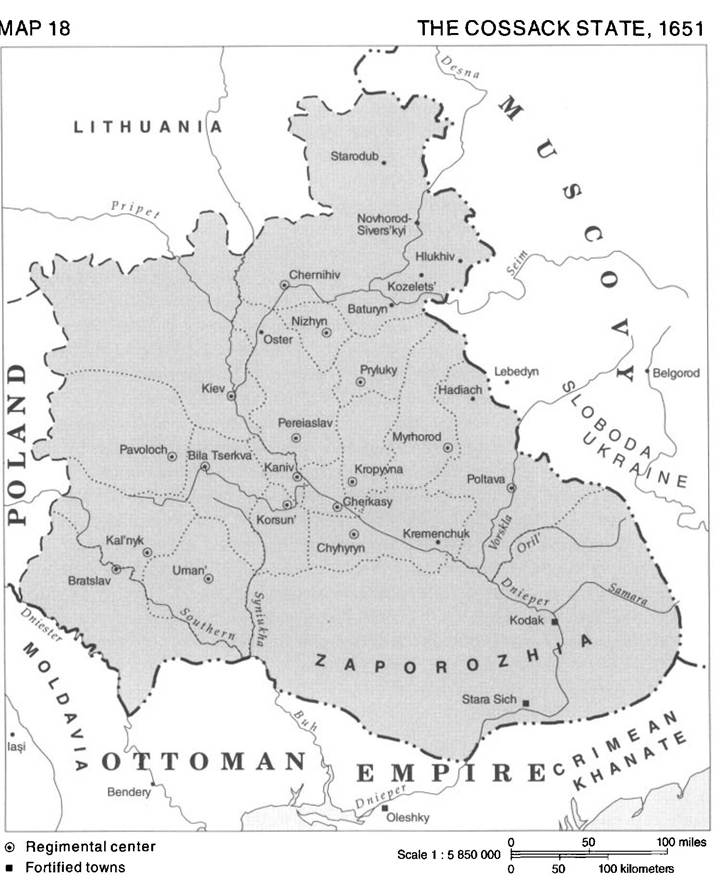
Muscovite tsar in early 1654. Similar boundaries (minus the Starodub region in northern Chernihiv) were again proposed for the Grand Duchy of Rus' in the tripartite confederation of Poles, Lithuanians, and Ukrainians outlined in the Union of Hadiach (1658).
The boundaries of the Cossack state were influenced by the changing military situation during the Khmel'nyts'kyi revolution and the Period of Ruin that followed. The Cossack state reached its greatest territorial extent under Khmel'- nyts'kyi’s rule, including the Kiev, Bratslav, and Chernihiv palatinates on both the Left and Right Banks of the Dnieper River. Moreover, Zaporozhia, along the southern fringes of the Kiev palatinate, and even some Belarusan lands of Lithuania, in the north, recognized the suzerainty of the hetman (see map 16). This situation changed substantially after Khmel'nyts'kyi’s death. Following the Treaty of Andrusovo reached between Muscovy and Poland in 1667 and later renewed as the so-called eternal peace of 1686, the Cossack state remained divided more or less along the Dnieper River between Poland and Muscovy, with both powers having a joint protectorate over Zaporozhia. In consequence, only Ukrainian territory on the Muscovite eastern bank, or Left Bank, continued to survive as an autonomous Cossack state.
This territory, consisting of the old Polish palatinates of Chernihiv and eastern Kiev (as well as the city of Kiev on the Right Bank) and measuring about 80,000 square miles (208,000 square kilometers), has come to be known in historical literature as the Hetmanate.As for Sloboda Ukraine, a Cossack administrative system existed there, although the region never became part of the Cossack state, or the Hetmanate. Instead, from its earliest setdement during the 1630s Sloboda Ukraine was always ruled direcfly from Moscow. Zaporozhia, too, enjoyed a distinct status. It also was not part of the Hetmanate, although after 1686, when Poland gave up its claims to a joint protectorate, the area was theoretically dependent upon both the Het- manate’s government and the tsar. To distinguish it from the Hetmanate, which still carried the official name Army of Zaporozhia (Viis'ko Zaporiz'ke), the lands within Zaporozhia proper were called the Army of Lower Zaporozhia (Viis'ko Zaporiz ke Nyzove), and the region in essence functioned as an autonomous body with little regard for the hetman and his government. Instead, Zaporozhia maintained a tradition of loyal respect for the faraway tsar, who, because of his distance, would be less likely to interfere in its affairs, at least for the time being.
As early as under Bohdan Khmel'nyts'kyi, the Polish palatinates of Kiev, Chernihiv, and Bratslav, each with its own palatine, district officials (s taros ta and vice-starosta), and administration made up largely of aristocrat-controlled courts and other governmental offices, were replaced. Under Cossack rule, the new state was divided into military-administrative units called regimental districts (polky). The number of districts fluctuated with the changing boundaries of the Cossack state. In 1649, when the Cossack state included lands on the Right and Left Banks, there were sixteen regimental districts (a seventeenth was added in 1651), with 272 companies; later, the Hetmanate on the Left Bank alone consisted of ten regimental districts, with 174 companies.
Each regimental district was headed by a colonel, who served as both the supreme military and the supreme civil authority in his territory. Because of his dual authority and the fact that long periods of political instability precluded effective control by any higher, central governmental structure, the regimental colonels often became all-powerful and semi-independent figures, miniature hetmans in a sense. Initially, the colonels were elected by all the Cossacks in the regiment, who met together in a loose regimental council, but by the eighteenth century they had come to be appointed by the hetman. The regimental council also met to decide common problems, but by the eighteenth century that council
The Cossack Si ate Administration
CENTRAL ADMINISTRATION
| HETMAN | |
| General Council (heneral1 na rada) | General Staff (cabinet) Council of Officers (henera I' na starshyna) (rada starshy n) |
| all Cossacks | 1 general quartermaster 1 hetman (heneral'nyi oboznyi) 2 general staff 2 general chancellor 3 regimental colonels ■ andofficers.staff 3 general treasurer (heneral'nyi pidskarbnyi) 4 general judges - 2 (heneral' ni suddi) 5 general aides-de-camp - 2 (heneral’ ni osau/y) 6 general standard bearer (heneral' nyi bunchuzhnyi) 7 general flag-bearer (heneral'nyi khoruzhnyi) General Military Chancellery (heneral'na viis'kova kantse/iariia) 1 general military treasury 2 general military court 3 general accounting office |
REGIMENTAL ADMINISTRATION
COLONEL (polhovnyk)
Regimental council Regimental staff Regimental officer
( polkova rada} ( polkova starshyna) council
( rada polkovol starshyny)
all Cossacks 1 regimental quartermaster 1 colonel
( polkovyi oboznyt)
2 regimental judge
2 regimental staff
3 company captains
4 regimental notables
(po/kovyi suddia)
3 regimental chancellor
(po/kovyi pysar)
4 regimental aide-de-camp (po/kovyi osau!)
5 regimental flag-bearer (po/kovyi khorunz/iyi)
COMPANY ADMINISTRATION
CAPTAIN (sotnyk)
Company council (sotenna rada)
all Cossacks
Company staff
(sotenna starshyna)
1 otaman
2 company scribe (sotennyi pysar)
3 company aide-de-camp
(sotennyi osatd)
had disappeared, and regiments effectively were being run by the colonel and his regimental staff. This staff consisted of a quartermaster (the regiment’s second in command), judge, chancellor, aide-de-camp, and flag-bearer.
Each of the regimental districts in turn was divided into companies (sotnia), which ranged in number from eleven to twenty-three according to the size of the regimental territory. Each company was headed by a captain, who held his office for life and was assisted by a small staff, including an otaman (the second in command), a scribe, and an aide-de-camp. At first, captains were elected by all Cossacks in the company, who met in a council, but by the end of the seventeenth century they had come to be appointed by the hetman or the regimental colonel. In keeping with the trend espoused by Muscovy toward a service state, the office of captain became hereditary and included among its privileges authority over manorial peasants.
At the top of the Cossack administrative structure was the hetman, his cabinet, and two councils, the General Council and the Council of Officers. The supreme authority rested with the hetman, who was elected by the General Council. The hetman ruled without limit of tenure, which in practice meant until he died or was removed by force. In theory, he could be dismissed by the General Council for misconduct. The hetman had full executive power over the administration, the judiciary, finances, and the army, and he nominated and later appointed the colonels of the regimental districts. After 1649, the hetman had at his disposal all the income from the former estates of the Polish king located in the Kiev, Chernihiv, and Bratslav palatinates (about 100,000 gold pieces anually). In subsequent years, the Cossack government’s income came primarily from duties levied on foreign imports and from taxes on the sale of alcohol. The hetman also had the right to grant lands and mills as a reward for military service, and he often did so as a way of reimbursing supporters when the state treasury was low. Finally, the hetman had the right to conduct foreign policy, although the Muscovite government tried to limit this privilege, especially during the eighteenth century.
The hetman’s immediate central administration consisted of a cabinet, or the General Staff, which he appointed. This staff included a general quartermaster - the officer in charge of artillery and, in practice, the second in command in the government - a general chancellor, a general treasurer (two after 1728), two general judges, two general aides-de-camp, a general standard bearer, and a general flag-bearer. The hetman’s General Staff functioned simultaneously as the supreme military command and the cabinet of governmental ministers in the Cossack state. The state was administered by several central institutions (the treasury, the court, and the accounting office) that eventually became subordinate to the General Military Chancellery, headed by the general chancellor. The General Military Chancellery was responsible for the implementation of decrees issued by the tsars and hetmans and for the investigation of all complaints against officials.
The seat of the hetman and his government was first at Chyhyryn, near Khmel'nyts'kyi’s birthplace. Chyhyryn served as the Cossack capital from 1648 to 1663. In subsequent years, when the Cossack state was divided, Chyhyryn served for a time (1665-1676) as the seat of the Right Bank Cossack administration. The Left Bank had its own capitals: Hadiach (1663-1669), Baturyn (1669-1708), and, finally, Hlukhiv, which remained the seat of the Hetmanate until its demise in 1783.
The two other elements of the central administration were the General Council and the Council of Officers. The General Council {heneral’na rada) had its origins in the sixteenth-century Zaporozhian Sich. It both elected hetmans and had the right to dismiss them, and in theory all Cossacks had the right to participate in its proceedings. This irregular assembly, which declined in importance in the decades before Khmel'nyts'kyi, became influential once again during the unstable Period of Ruin, when it included clergy, townspeople, and peasants as well as Cossacks. The so-called Black Council {Chama Rada) of 1663 was the best known, some would say an infamous, example of this unwieldy body. After the Period of Ruin, the importance of the General Council waned again, and it became primarily a ceremonial body, convened only to acclaim the new hetman elected previously by the smaller Council of Officers. The Council of Officers {rada starshyn) consisted of the hetman, the General Staff, and the colonels and officer staffs of the regimental districts. During some periods, townspeople and higher clergy (1672-1708) or the new Cossack nobility (1750-1764) were also admitted. The Council of Officers met twice a year, between Christmas and Epiphany and again at Easter. Its main function was to offer advice to the hetman - advice which most often was disregarded. After the Period of Ruin, however, the Council of Officers elected new hetmans.
International status
The Cossack state and, later, the Hetmanate were never fully independent, but rather were more or less autonomous units within a larger state structure, whether Poland or Muscovy. Between 1649 and 1654, and on the Right Bank between 1658 and 1676, the Polish king was the ultimate sovereign. The relationship between the Cossack state and Poland was based on a kind of personal union between the hetman and the king. The hetman was chosen by the Cossacks, and no Polish administration was permitted on Cossack territory. Between 1654 and 1657, and then on the Left Bank after 1663, the Muscovite tsar was the ultimate sovereign over the Cossack state and the Hetmanate.
The relationship between Muscovy and the Hetmanate was based on the agreement of Pereiaslav, concluded in 1654, and on subsequent treaties concluded with each new hetman. Following Muscovy’s practice of centralized authority, the tsar’s government was anxious to maintain control over its ever-expanding realm. Within a few years after 1654, therefore, the Muscovite government stationed its own representative on Cossack territory. According to the so-called revised articles of Pereiaslav, concluded in 1659, a Muscovite governor (voevoda) with a garrison was to be stationed in Kiev, Nizhyn, Pereiaslav, Bratslav, and Uman'. By 1665, not only was Muscovy claiming direct rule over the cities of Kiev, Chernihiv, Pereiaslav, Nizhyn, Poltava, Novhorod-Sivers'kyi, Kremenchuk, Kodak, and Oster, but the tsar’s government was sending officials to ensure that all taxes, including revenue on liquor, be returned directly to the tsar’s treasury. Although Cossack protests forced Muscovy to repeal these measures in 1669, tsarist governors remained in Kiev and in four other cities on the Left Bank - Chernihiv, Nizhyn, Pereiaslav, and Oster. The Muscovite presence continued to increase, with the result that by the eighteenth century the Hetmanate gradually had lost control of its own governmental affairs. In Moscow itself, matters pertaining to Ukraine’s Cossack state were at first handled by the Central Ministry for Foreign Affairs (Posolskii prikaz, 1654-1663), but after the appearance of a separate hetman on the Left Bank in 1663, a special chancellery was created, the Central Ministry for Little Russia (Malorossiiskii prikaz), which continued to function until the administrative reforms of 1717.
More on the topic What to Call the Cossack State?:
- SECTION D THE COSSACK OFFICER’S COUNCIL
- SECTION C THE COSSACK GENERAL ASSEMBLY
- CHAPTER 1 INTRODUCTORY NOTES
- Socioeconomic Developments in the Hetmanate
- Socioeconomic Developments
- Cossack Tatar Fighters
- Governments and Cossacks
- Contents
- 18 The Khmel’nyts’kyi Uprising of 1648
- PROBLEMS OF TERMINOLOGY AND PERIODIZATION IN THE TEACHING OF UKRAINIAN HISTORY