Epidemiological aspects
By the end of 2000, there were an estimated 1.4 million children under 15 years of age living with HIV infection worldwide and 4.3 million had died. Of these, UNAIDS estimates that 600 000 became infected during 2000 alone, over 90% via mother-to-child transmission (MTCT).
Over 90% of people with HIV live in the developing world and, of these, over two-thirds live in countries in sub-Saharan Africa. Here HIV is reversing gains in child survival and significantly lowering life expectancy. Although the burden of HIV disease borne by African children is enormous, over half of the world's population live in the Asia/Pacific region. The HIV epidemic is at a much earlier stage here than in Africa and the explosive increase seen this decade is alarming.Around half of women who acquire HIV become infected before 25 years of age and die before their 35th birthday, in the prime of their child-bearing years. As a result, by the end of 1999, the epidemic had left behind 13.2 million AIDS orphans under the age of 15 years. The difficulties that poor communities in Africa face in trying to care for this increase in children without parents is enormous and is largely dependent on existing family and social support structures already greatly affected by the AIDS epidemic.
For a vertically infected child in sub-Saharan Africa the probability of death by 12 months is estimated to be between 23% and 50%, and over 75% will not live to see their fifth birthday. HIV-infected children in Western Europe and North America contribute having live babies. This is being undertaken in the UK and covers 70% of births (see Figure 12.3). In 1999, the prevalence of maternal infection was 0.25% (1 in every 400 births) in London, compared with approximately 1 in 6000 births outside London. There has been an increase of around 30% in the number of pregnant HIV-infected women being reported in the last 2 years, which may in part reflect an increasing desire for infected women to have children in the new knowledge that the risk of MTCT is low.
In London, three-quarters of seropositiveTable 12.1 End 2000 global HIV/AIDS estimates in millions
| Children | Total | |
| People living with HIV/AIDS | 1.4 | 36.1 |
| New HIV infections in 2000 | 0.6 | 5.30 |
| HIV/AIDS Deaths in 2000 | 0.5 | 3.0 |
| Cumulative HIV/AIDS deaths | 4.3 | 21.8 |
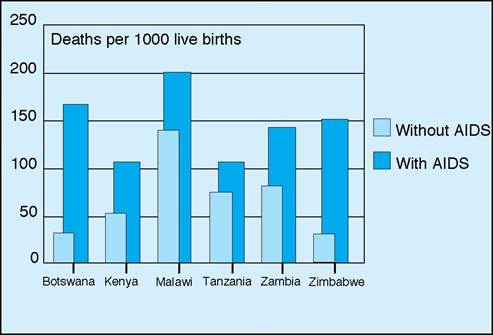
Figure 12.1 Estimated impact of AIDS on under-5 child mortality rates, selected African countries, 2010. Source: US Census Bureau
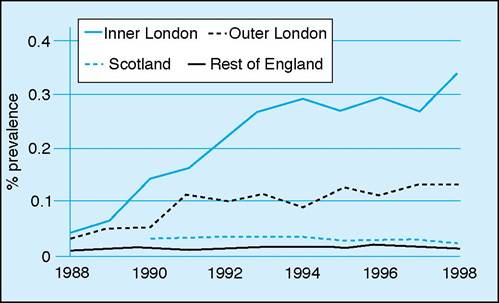
Figure 12.2 HIV prevalence in pregnant women (dried blood spot survey 1988-98)
newborns are delivered to mothers born in sub-Saharan Africa, and similar patterns are seen in European countries such as France and Belgium. In Scotland, Ireland and Southern Europe a high proportion of seropositive children are still born to women with IDU as a risk factor, but here too the proportion of women acquiring HIV from heterosexual transmission is increasing. Romania has the largest number of HIV-infected children in Europe, making up nearly half of the estimated 10 000 children living with HIV/AIDS in East and Western Europe. The majority belong to a cohort of children who were uniquely infected with HIV through contaminated blood products and needles in the late 1980s and early 1990s. Although many have died, there remain a considerable number of these children now entering their teenage years in Romania.
Box 12.1 Mother-to-child transmission of HIV infection
• HIV infection is transmitted to about 15—20% of babies born to HIV infected women (between 1 in 5 and 1 in 6).
• The transmission rate doubles if a woman breastfeeds to about 30% (1 in 3).
• In non-breast fed infants, approximately 70% of transmission occur s around the time of delivery
• Transmission is increased if a women has a high HIV viral load, low CD4 count and/or AIDS.
• Factors around delivery influence transmission.