GP120-INDUCED APOPTOSIS IN T CELLS
The hallmark of HIV infection is a progressive decline in CD4+ T cells and, subsequently, CD8+ T cells. As a result, infected individuals become susceptible to opportunistic infections as well as malignancies.
There are various mechanisms that explain the decreasing CD4+ and CD8+ T cell counts. First, T cell production is impaired during the course of HIV infection, which results in fewer healthy T cells being released into the peripheral bloodstream.37 Second, as with many viral infections, there is a generalized state of immune activation that leads to apoptosis, or programmed cell death. Third, there is now strong evidence that the HIV virus alone can induce a more specific signal to immune cells and directly cause cellular apoptosis.38,39 The peripheral depletion of CD4+ and CD8+ T cells during HIV infection occurs occasionally in HIV-infected cells; however, more often, HIV signals cell death to uninfected bystander CD4+ and CD8+ T cells.40There are several mechanisms by which HIV can directly induce cell death to host immune cells. Both CD4+ and CD8+ T cells are more susceptible to Fas-mediated apoptosis during HIV
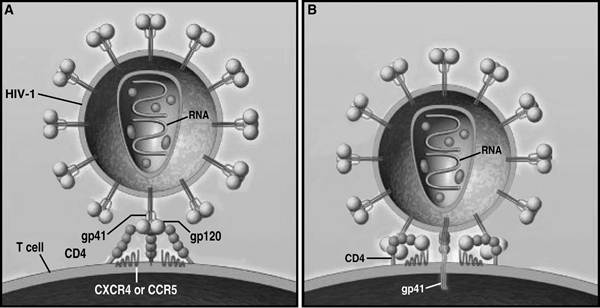
FIGURE 6.2 Mechanism of HIV cellular infection. (A) A trimer of HIV gp120 binds to a host cell CD4 receptor before changing conformation. (B) The gp120 then binds to the host cell chemokine co-receptor, allowing gp41 to spring toward the cell membrane to facilitate cellular infection.
infection.41 T lymphocytes express higher levels of CD95 (Fas) during HIV infection, and the proportion of these Fashi lymphocytes increases with disease progression.42 FasL is also increased in peripheral blood mononuclear cells from HIV-infected individuals, and soluble FasL is increased in the plasma of HIV-infected patients.41,43 Therefore, during HIV infection, excessive immune activation induces T cell death through Fas/FasL interactions.44,45 The HIV proteins Nef, Env, and Tat have been shown to increase Fas and FasL levels on host immune cells and, therefore, enhance susceptibility to a Fas-mediated killing.46-48 Several of the HIV proteins protect the virus from being removed by cytotoxic lymphocytes (CTL) that may recognize an HIV-infected cell and attempt to eliminate it. Tat and Nef proteins downregulate major histocompatibility complex class I (MHC I) expression to avoid cell recognition and the resultant death of HIV-infected cells.49 In addition, HIV gp120, as well as Nef and Vpu, decreases CD4 expression on the cell surface.50,51 By decreasing CD4 expression, HIV protects cells from superinfection.
Taken together, the HIV proteins exert many and sometimes varying effects on the host immune cells. The end result is a state of increased immune activation that leads to increased apoptosis, increased proapoptotic proteins, decreased antiapoptotic proteins in the whole individual, and decreased CD4 receptor expression. Although more work is being done to decipher the exact effects of HIV infection on a cell, it seems that the immune cells are preparing for death while the virus is attempting to protect itself.