INTRODUCTION
Overview
Remarkable progress has been made over the last two and one-half decades in illuminating human immunodeficiency virus (HIV) pathology and disease progression to acquired immunodeficiency syndrome (AIDS).
Accordingly, the broad spectrum of immune dysfunction characteristic of AIDS has been primarily attributed to depletion of CD4+ T helper cells. It is well documented that HIV directly infects CD4 cells resulting in cell death or disruption of function; however, the virus also acts indirectly on several components of adaptive and innate immunity. This chapter will discuss the significant advancements that have been made toward understanding the mechanisms by which HIV disrupts T cell development in the thymus and the consequences pertaining to immune dysfunction in the periphery.T Cell Development in the Thymus
HIV directly infects a variety of cell types in the thymus. Furthermore, the effects of HIV on thymocytes can be catastrophic to the host due to the fact that the thymus is responsible for nurturing T cell development and shaping a T cell repertoire capable of discriminating self from foreign antigens. Typically, T cell development begins with a bone marrow-derived lymphoid progenitor (Figure 4.1). These cells migrate to the thymus, where they develop into various lymphocyte lineages, including αβT cells, γT cells, NKT cells, and NK cells. The αβ T cell lineage emerges as lymphoid progenitors mature into double-negative (DN) thymocytes, named as such because
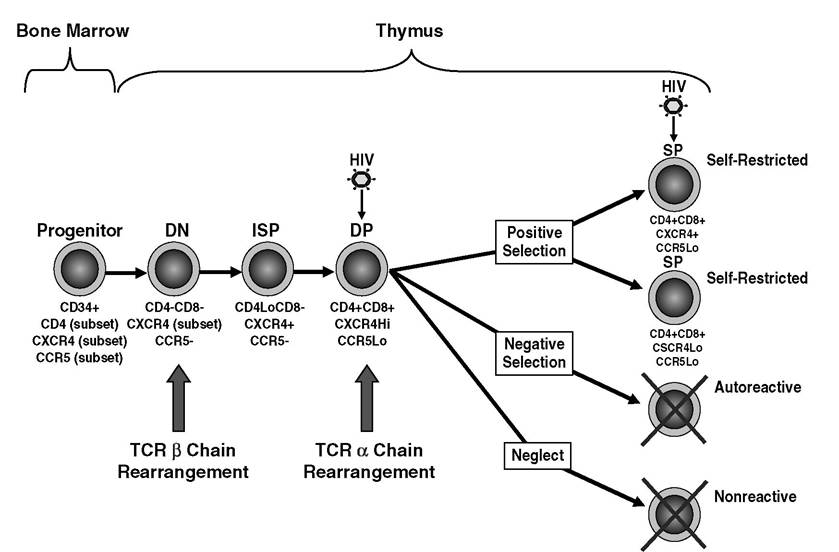
FIGURE 4.1 T cell development. During thymic selection, thymocytes undergo several phenotypic changes that render them susceptible to infection by HIV. Because DP and SP CD4 thymocytes express CD4 and coreceptors, they are preferentially infected and depleted by HIV.
they lack expression of both CD4 and CD8. At this stage, DN cells rearrange their T cell antigen receptor (TCR) β chain genes and express a clonotypic β chain on the cell surface in complex with an invariant pre-Tα chain forming the pre-TCR. DN thymocytes subsequently undergo β selection, at which point cells bearing a functional pre-TCR expand in number and mature into intermediate single-positive (ISP) thymocytes bearing the phenotype CD4loCD8. In contrast to humans, murine ISPs are CD4CD8lo. The ISP stage is transient and rapidly gives rise to double-positive (DP) thymocytes expressing both CD4 and CD8. These cells rearrange their TCR α chain and express it on their surface with the β chain to form a mature TCR. At this stage of development, DP thymocytes undergo a TCR-mediated selection process to ensure self-tolerance. Autoreactive cells bearing TCRs that bind self-peptide major histocompatibility complex (MHC) with high affinity undergo negative selection culminating in apoptosis. If, however, DP thymocytes express TCRs that do not bind self-MHC, they fail to receive survival signals and die by neglect. Conversely, DP thymocytes expressing TCRs that bind self-peptide and MHC with intermediate affinity undergo positive selection and mature into either single-positive (SP) CD8 thymocytes restricted to self- MHC class I or SP CD4 thymocytes restricted to self-MHC class II. Before exiting into the periphery, SP thymocytes undergo several more rounds of division in the thymus. This tightly regulated process of T cell development is particularly vulnerable to corruption by HIV infection. In fact, HIV directly infects thymic stromal cells as well as immature T cells at various stages of development. By disrupting multiple components of the thymic microenvironment, HIV disturbs thymopoiesis and T cell homeostasis.
More on the topic INTRODUCTION:
- Introduction
- Introduction
- A Introduction
- INTRODUCTION TO REASONING IN THE ΠFΓ EXAM
- A Introduction
- Introduction
- Introduction
- Introduction
- INTRODUCTION
- Introduction