MURDER BY PROXY—NONLYMPHOID CELLS IN PERIPHERAL LYMPHOCYTE DELETION
Activated lymphocytes are more mobile than their resting counterparts and often find their way into nonlymphoid tissues. Certain tissues possess a protective mechanism to deal with infiltrating lymphocytes.
These tissues include testes, ovaries, and eye and are considered to be protected by immune privilege.36 Foreign grafts and tumors implanted in these sites are not rejected and often flourish without eliciting an immune response. A well-characterized model of immune privilege is the eye, in which it was demonstrated that lymphocytes introduced into the anterior chamber (or recruited during an inflammatory response) are induced to die by apoptosis. Fas-ligand is constitutively expressed in the eye, and death of infiltrating lymphocytes is dependent on Fas expression by the infiltrating lymphocytes. TRAIL was also implicated in immune privilege, but its role is not yet clear.The mechanisms involved in immune privilege have been used to explain a corresponding scenario involving lymphocyte apoptosis. Expression of Fas-ligand by transformed cells within a tumor can induce apoptosis in Fas-bearing lymphocytes by a process termed Fas counterattack.37,38 Fas-ligand-expressing tumor cells avoid direct cytolytic attack and thereby minimize infiltration and potential inflammatory effects. Attempts were made to exploit features of immune privilege and tumor counterattack in experimental models of allogeneic transplantation, the idea being that Fas-ligand-expressing transplants could avoid rejection by killing infiltrating lymphocytes. In support of this possibility, Fas-ligand-expressing testes allografts were successfully protected from rejection, whereas grafts from Fas-ligand-deficient gld animals were not protected.39 This model fell out of favor when it was demonstrated that, in some cases, Fas-ligand expression by the graft did not result in tolerance or protection but induced a profound granulocytosis resulting in accelerated rejection.
An explanation that accommodates observations both for and against potential for practical application of the tumor counterattack model came in a report showing that Fas- ligand-expressing grafts induced apoptosis in the Fas-expressing cells of the vascular epithelium, which, in turn, led to death of the graft associated with neutrophil recruitment and infiltration.40 Therefore, in this particular model, expression of Fas-ligand by the graft is not the direct cause of rejection but rather an indirect one. This issue is far from resolved, but clearly it should not be dismissed.It has been shown that other nonlymphoid tissues respond to the presence of activated lymphocytes in a manner similar to inducible immune privilege.41,42 Liver, lung, and small intestine induce expression of Fas-ligand during disseminated immune responses. Fas-ligand expressed by epithelial cells of the small intestine (IEC) confers upon IEC the capability of inducing apoptosis in Fas-bearing lymphocytes (Figure 5.4). Surprisingly, TNFα, which is secreted by activated T cells, mediates the induction of Fas-ligand expression by IEC. The phenomenon of inducible Fas-ligand expression to control lymphocyte infiltration has also been observed in the thyroid and, when dysfunctional, results in one of two disparate outcomes: Hashimoto’s thyroiditis through direct destruction of thyrocytes by infiltrating lymphocytes or Graves’ disease due to antibody deposition and secondary autoimmune disorder.43,44
Transfer of activated lymphocytes into animals lacking nonlymphoid Fas-ligand showed that there was an impairment (though not complete prevention) of peripheral lymphocyte deletion. We proposed that the response of nonlymphoid tissue to the presence of lymphocytes represents a sensing mechanism whereby involved tissues can accommodate a limited infiltration without a corresponding inflammatory response. A corollary of this model is that failure to handle the infiltrate, by defect or excessive burden, would result in either direct tissue damage caused by the infiltrating lymphocytes or a sustained inflammation. Induction of Fas-ligand and TRAIL by IEC would be preferable to constitutive expression in this case, because sustained levels may put at risk neighboring epithelial and endothelial cells that express the corresponding death receptors.
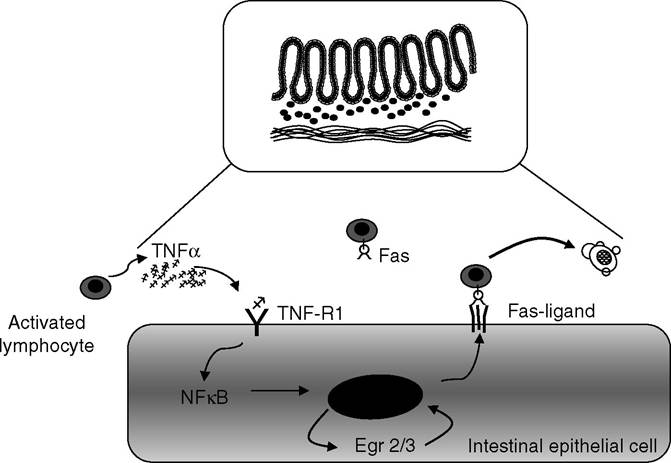
FIGURE 5.4 Involvement of nonlymphoid tissues in deletion of activated peripheral lymphocytes. In this example, activated lymphocytes that traffic through the small intestine secrete TNFα, which engages TNFR1 constitutively present on intestinal epithelial cells (IEC), resulting in upregulation of IEC Fas-ligand. IEC Fas- ligand then triggers Fas-mediated apoptosis of the infiltrating lymphocytes as a means to moderate the amount and severity of allowable infiltration.