CAT 1999
Directions for Questions 1-8: Read each of the eight short passages given below and answer the question that follows it.
1. Three airlines—1A, JA and SA, operate on the Delhi-Mumbai route.
To increase the number of seats sold, SA reduced its fares and this was emulated by IA and JA immediately. The general belief was that the volume of air travel between Delhi and Mumbai would increase as a result.Which of the following, if true, would add credence to the general belief?
(a) Increase in profitability of the three airlines.
(b) Extension of the discount scheme to other routes.
(c) A study that shows that air travellers in India are price conscious.
(d) A study that shows that as much as 80% of air travels in India is company sponsored.
2. According to McNeill, a Brahmin priest was expected to be able to recite at least one of the Vedas. The practice was essential for several centuries when the Vedas had not yet been written down. It must have had a selective effect, since priests would have been recruited from those able or willing to memorise long passages. It must have helped in the dissemination of the work, since a memorised passage can be duplicated many times.
Which one of the following can be inferred from the above passage’?
(a) Reciting the Vedas was a Brahmin’s obligation.
(b) The Vedic priest was like a recorded audio cassette.
(c) McNeill studied the behaviour OfBrahmin priests.
(d) Vedic hymns had not been scripted.
3. Developed countries have made adequate provisions for social security for senior citizens. State insurers (as well as private ones) offer medicare and pension benefits to people who can no longer earn. In India, with the collapse of the joint family system, the traditional shelter of the elderly has disappeared. And a State faced with a financial crunch is not in a position to provide social security.
So, it is advisable that the working population give serious thought to building a financial base for itself.Which one of the following, if it were to happen, weakens the conclusion drawn in the above passage the most?
(a) The investible income of the working population, as a proportion of its total income, will grow in the future.
(b) The insurance sector is underdeveloped and trends indicate that it will be Cxtensivelyprivatised in the future.
(c) India is on a path of development that will take it to a developed country status, with all its positive and negative implications.
(d) If the working population builds a stronger financial base, there will be a revival of the joint family system.
4. Various studies have shown that our forested and hilly regions and, in general, areas where biodiversity, as reflected in the variety of flora is high, are the places where poverty, appears to be high. And these same areas are also the ones where educational performance seems to be poor. Therefore, it may be surmised that, even disregarding poverty status, richness in biodiversity goes hand in hand with educational backwardness.
Which one of the following statements, if true, can be said to best provide supporting evidence for the surmise mentioned in the Passage?
(a) In regions where there is little variety in flora, educational performance is seen to be as good as in regions with high variety in flora, when poverty levels are high.
(b) Regions which show high biodiversity also exhibit poor educational performance, at low levels of poverty.
(c) Regions which show high biodiversity reveal high levels of poverty and poor educational performance.
(d) In regions where there is low biodiversity, at all levels of poverty, educational performance is seen to be good.
5. Cigarettes constitute a mere 20% of tobacco consumption in India, and fewer than 15% of the 200 million tobacco users consume cigarettes. Yet these 15% contribute nearly 90% of the tax revenues to the Exchequer from the tobacco sector.
The punitive cigarette taxation regime has kept the tax base narrow and reducing taxes will expand this base.Which one of the following best bolsters the conclusion that reducing duties will expand the tax base?
(a) The cigarette manufacturers’ association has decided to indulge in aggressive promotion.
(b) There is a likelihood that tobacco consumers will shift to cigarette smoking, if cigarette prices were to reduce.
(c) The cigarette manufacturers are lobbying for a reduction on duties.
(d) An increase in duties on non-cigarette tobacco may lead to a shifty in favour of cigarette smoking.
6. Thomas Malthus, the British clergyman turned economist, predicted that the planet would not be able to support the human population for long. His explanation was that human population grows at a geometric rate, while the food supply grows only at an arithmetic rate.
Which one of the following, if true, would not undermine the thesis offered by Malthus?
(a) Population growth can be slowed down by the voluntary choice of individuals and not just by natural disasters.
(b) The capacity of the planet to feed a growing human population can be enhanced through biotechnological means.
(c) Human systems, and natural systems like food supply, follow natural laws of growth which have remained constant, and will remain unchanged.
(d) Human beings can colonize other planetary systems on a regular and ongoing basis to accommodate a growing population.
7. The company’s coffee crop for 1998-99 totaled 8079 tons, an all time record. The increase over the previous year’s production of 5830 tons was 38.58%. The previous highest crop was 6089 tons in 1970-71. The company had fixed a target of 8000 tons to be realised by the year 2000-01, and this has been achieved two years earlier, thanks to the emphasis laid on the key areas of irrigation, replacement of unproductive coffee bushes, intensive refilling and improved agricultural practices. It is now our endeavor to reach the target of 10000 tons in the year 2001-02.
Which one of the following would contribute most to making the target of 10000 tons in 2001-02 unrealistic?
(a) The potential of the productivity enhancing measures implemented up to now has been exhausted.
(b) The total company land under coffee has remained constant since 1969 when an estate in the Nilgiri Hills was acquired.
(c) The sensitivity of the crop to climatic factors makes prediction about production uncertain.
(d) The target-setting procedures in the company have been proved to be sound by the achievement of the 8000 tonne target.
8. Animals in general are shrewd in proportion as they cultivate society. Elephants and beavers show the greatest signs of this sagacity when they are together in large numbers, but when man invades their communities they lose all their spirit of industry.
Among insects, the labours of the bee and the ant have attracted the attention and admiration of naturalists, but all their sagacity seems to be lost upon separation and a single bee or ant seems destitute of every degree of industry. It becomes the most stupid insect imaginable, and it languishes and soon dies.
Which of the following can be inferred from the above passage?
(a) Humankind is responsible for the destruction of the natural habitat of animals and insects.
(b) Animals, in general, are unable to function effectively outside their normal social environment.
(c) Naturalists have great admiration for bees and ants, despite their lack of industry upon separation.
(d) Elephants and beavers are smarter than bees and ants.
Directions for Questions 9 and 10: For each of the two questions indicate which of the statements given with that particular question is consistent with the description of the unreasonable man in the passage below.
Unreasonableness is a tendency to do socially permissible things at the wrong time. The unreasonable man is the sort of person who comes to confide in you when you are busy. He serenades his beloved when she is ill.
He asks a man who has just lost money by paying a bill for a friend to pay a bill for him. He invites a friend to go for a ride just after the friend has finished a long car trip. He is eager to offer services which are not wanted but which cannot be politely refused. If he is present at arbitration, he stirs up dissension between the two parties, who were really anxious to agree. Such is the unreasonable man.9. He tends to
(a) entertain women.
(b) be a successful arbitrator when dissenting parties are anxious to agree.
(c) be helpful when solicited.
(d) tell a long story to people who have heard it many times before.
10. The unreasonable man tends to
(a) bring a higher bidder to a salesman who has just closed a deal.
(b) disclose confidential information to others.
(c) sing the praises of the bride when he goes to a wedding.
(d) sleep late and rise early.
11. Three labelled boxes containing red and white cricket balls are all mislabelled. It is known that one of the boxes contains only white balls and one only red balls. The third contains a mixture of red and white balls. You are required to correctly label the boxes with the labels red, white and red and white by picking a sample of one ball from only one box. What is the label on the box you should sample?
(a) White
(b) Red
(c) Red and White
(d) Not possible to determine from a sample of one ball
12. Abraham, Border, Charlie, Dennis and Elmer and their respective wives recently dined together and were seated at a circular table. The seats were so arranged that men and women alternated and each woman was three places distant from her husband. Mrs. Charlie sat to the left of Mr. Abraham. Mrs. Elmer sat two places to the right of Mrs. Border. Who sat to the right of Mr. Abraham?
(a) Mrs. Dennis
(b) Mrs. Elmer
(c) Mrs. Border
(d) Mrs. Border or Mrs. Dennis
Directions for Questions 13-15: These questions are based on the situation given below:
Ten coins are distributed among four people P, Q, R, S such that one of them gets one coin, another gets two coins, the third gets three coins and the fourth gets four coins.
It is known that Q gets more coins than P and S gets fewer coins than R.13. If the number of coins distributed to Q is twice the number distributed to P then which one of the following is necessarily true?
(a) R gets an even number of coins.
(b) R gets an odd number of coins.
(c) S gets an even number of coins.
(d) S gets an odd number of coins.
14. If R gets at least two more coins than S, then which one of the following is necessarily true?
(a) Q gets at least two more coins than S.
(b) Q gets more coins than P.
(c) P gets more coins than S.
(d) P and Q together get at least five coins.
15. IfQ gets fewer coins than R, then which one of the following is not necessarily true?
(a) P and Q together get at least four coins.
(b) Q and S together get at least four coins.
(c) R and S together get at least five coins.
(d) P and R together get at least five coins.
Directions for Questions 16-18: These questions are based on the situation given below:
A young girl Roopa leaves home with x flowers, goes to the bank of a nearby river. On the bank of the river, there are four places of worship, standing in a row. She dips all the X flowers into the river. The number of flowers doubles. Then she enters the first place of worship, offers у flowers to the deity. She dips the remaining flowers into the river, and again the number of flowers doubles. She goes to the second place of worship, offers у flowers to the deity. She dips the remaining flowers into the river, and again the number of flowers doubles. She goes to the third place of worship, offers у flowers to the deity. She dips the remaining flowers into the river, and again the number of flowers doubles. She goes to the fourth place of worship, offers у flowers to the deity. Now she is left with no flower in hand.
16. IfRoopa leaves home with 30 flowers, the number of flowers she offers to each deity is
| (a) 30 | (b)31 |
| (c) 32 | (d)33 |
| 17. The minimum number of flowers that could be offered to each deity is | |
| (a)0 | (b)15 |
| (c) 16 | (d) Cannot be determined |
| 18. The minimum number of flowers with which Roopa leaves home is | |
| (a) 16 | (b)15 |
| (c)0 | (d) Cannot be determined |
Directions for Questions 19-20: The following table presents the sweetness of different forms relative to sucrose, whose sweetness is taken to be 1.00.
| Lactose | 0.16 |
| Maltose | 0.32 |
| Glucose | 0.74 |
| Sucrose | 1.00 |
| Fructose | 1.70 |
| Saccharin | 675.00 |
19. What is the minimum amount of sucrose (to the nearest gram) that must be added to one-gram of saccharin to make a mixture that will be less than 100 times as sweet as glucose?
(a) 7 (b) 8
(c) 9 (d) 100
20. Approximately how many times sweeter than sucrose is a mixture consisting of glucose, sucrose and fructose in the ratio of 1: 2: 3?
(a) 1.3 (b) 1
(c) 0.6 (d) 2.3
Directions for Questions 21 and 22: These questions are based on the situation given below:
A, B, C, D, E and F are a group of friends from a club. There are two housewives, one lecturer, one architect, one accountant and one lawyer in the group. There are two married couples in the group. The lawyer is married to D who is a housewife. No lady in the group is either an architect or an accountant. C, the accountant, is married to F who is a lecturer. A is married to D and E is not a housewife.
21. WhatisE?
(a) Lawyer (b) Architect
(c) Lecturer (d) Accountant
22. How many members of the group are male?
(a) 2 (b) 3
(c) 4 (d) None of the above
Directions for Questions 23 and 24: These questions are based on the situation given below.
Seven players who represented a university are to be felicitated in a function. They are A, B, C, D, E, F and G. They are to be seated on the dais along one side of a rectangular table. Some of the conditions are
I. A & G are to be seated at the extreme right which is closest to the exit because they have to leave early.
II. B is to be seated at the centre as he will be given the man of the match award.
III. C and D to be seated as far as possible because they are both wicketkeepers.
23. Which of the following may not be seated at either end of the table?
(a) C (b) D
(c) G (d) F
24. Which of the following pairs may not be seated together?
(a) E & A (b) B & D
(c) B & F (d) G & D
Directions for Questions 25-27: These questions are based on the situation given below.
There are fitly integers α1, α2,..., «50, not all of them necessarily different. Let the greatest integer of these fifty integers be referred to as G and smallest integer be referred to asL. The integers a 1, through «24 form sequence 51, and the rest form sequence 4S,2. Each member of 51 is less than or equal to each member of 4S,2.
25. All values in 51 are changed in sign, while those in 4S,2 remain unchanged. Which
of the following statements is true?
(a) Every member of 51 is greater than or equal to every member of 4S,2.
(b) G is in 51
(c) If all numbers originally in 51 and 1S,2 had the same sign, then after the change of sign, the largest number of 51 and S2 is in 51.
(d) None of the above.
26. Elements of 51 are in ascending order, and those of S2 are in descending order, the world.
B. The orangutan is not angry.
C. The orangutan does not frown upon the world.
D. The orangutan is angry.
(a) CB only (b) DA only
(c) AB only (d) CB and DA
44. Either Ravana is a demon, or he is a hero.
A. Ravana is a hero.
B. Ravana is a demon.
C. Ravana is not a demon.
D. Ravana is not a hero.
(a) CD only (b) BA only
(c) CD and BA (d) DB and CA
45. Whenever Rajeev uses the internet, he dreams about spiders.
A. Rajeev did not dream about spiders.
B. Rajeev used the internet.
C. Rajeevdreamtaboutspiders.
D. Rajeev did not use the internet.
(a) AD (b) DC
(c) CB (d) DA
46. IfI talk to my professors, then I do not need to take a pill for headache.
A. I talked to my professors.
B. I did not need to take a pill for headache.
C. I needed to take a pill for headache.
D. I did not talk to my professors.
(a) AB only (b) DC only
(c) CD only (d) AB and CD
Directions for Questions 47-56: Each question has a set of four statements. Each statement has three segments. Choose the alternative where the third segment in the statement can be logically deduced using both the preceding two, but not just from one of them
47. A. No cowboys laugh. Some who laugh are sphinxes. Some sphinxes are not
cowboys.
B. All ghosts are fluorescent. Some ghosts do not sing. Some singers are not fluorescent.
C. Cricketers indulge in swearing. Those who swear are hanged. Some who are hanged are not cricketers.
D. Some crazy people are paints. All crazy people are whistlers. Some whistlers are paints.
(a) A and B (b) C only
(c) A and D (d) D only
48. A. All good people are knights. All warriors are good people. All knights
are warriors.
B. No footballers are ministers. All footballers are tough. Some ministers are players.
C. All pizzas are snacks. Some meals are pizzas. Some meals are snacks.
D. Some barkers are musk-deer. All barkers are sloth bears. Some sloth bears are musk-deer.
(a) C and D (b) B and C
(c) A only (d) C only
49. A. Dinosaurs are prehistoric creatures. Water-buffaloes are not dinosaurs.
Water-buffaloes are not pre-historic creatures.
B. All politicians are frank. No frank people are crocodiles. No crocodiles are politicians.
C. No diamond is quartz. No opal is quartz. Diamonds are opals.
D. All monkeys like bananas. Some GI Jose like bananas. Some GI Jose are monkeys.
(с) A and D (d) В and C
50. A. All earthquakes cause havoc. Some landslides cause havoc. Some
earthquakes cause landslides.
B. All glass things are transparent. Some curios are glass things. Some curios are transparent.
C. All clay objects are brittle. All XY are clay objects. Some XY are brittle.
D. No criminal is a patriot. Ram is a criminal. Ram is a patriot.
(a) D only (b) B only
(c) C and B (d) A only
51. A. MD is an actor. Some actors are pretty. MD is pretty.
B. Some men are cops. Some men are brave. Some brave people are cops.
C. All cops are brave. Some men are cops. Some men are brave.
D. All actors are pretty; MD is not an actor; MD is not pretty.
(a) D only (b) C only
(c) A only (d) B and C
52. A. All IIMs are in India. No BIMs are in India. No IIMs are BIMs.
B. All IIMs are in India. No BIMs are in India. No BIMs are IIMs.
C. Some IIMs are not in India. Some BIMs are not in India. Some IIMs are BIMs.
D. Some IIMs are not in India. Some BIMs are not in India. Some BIMs are IIMs.
(a) A and B (b) C and D
(c) A only (d) B only
53. A. Citizens of Yes Islands speak only the truth. Citizens of Yes Islands are
young people. Young people speak only the truth.
B. Citizens of Yes Islands speak only the truth. Some Yes Islands are in the Atlantic. Some citizens of Yes Islands are in the Atlantic.
C. Citizens of Yes Islands speak only the truth. Some young people are citizens of Yes Islands. Some young people Speakonlythe truth.
D. Some people speak only the truth. Some citizens of Yes Islands speak only the truth. Some people who speak only the truth are citizens of Yes Islands.
(a) A only (b) B only
(c) C only (d) D only
54. A. All mammals are viviparous. Some fish are viviparous. Some fish are
mammals.
B. All birds are oviparous. Some fish are not oviparous. Some fish are birds.
C. No mammal is oviparous. Some creatures are oviparous and some are not. Some creatures are not mammals.
D. Some creatures are mammals. Some creatures are viviparous. Some mammals are viviparous.
(a) A only (b) B only
(c) C only (d) D only
55. A. Many singers are not writers. All poets are singers. Some poets are not
writers.
B. Giants climb beanstalks. Some chicken do not climb beanstalks. Some chicken are not giants.
C. All explorers live in snowdrifts. Some penguins live in snowdrifts. Some penguins are explorers.
D. Amar is taller than Akbar. Anthony is shorter than Amar. Akbar is shorter than Anthony.
(a) A only (b) B only
(c) B and C (d) D only
56. A. A few farmers are rocket scientists. Some rocket scientists catch snakes.
A few farmers catch snakes.
B. Poonam is a kangaroo. Some kangaroos are made of teak. Poonam is made of teak.
C. No bulls eat grass. All matadors eat grass. No matadors are bulls.
D. Some skunks drive Cadillacs. All skunks are polar bears. Some bears drive Cadillacs.
(с) C only (d) C and D
Directions for Questions 57-59: Each question is followed by two statements A and B. Answer each question using the following instructions.
Choose (a) if the question can be answered by using one of the statements alone, but cannot be answered using the other statement alone.
Choose (b) if the question can be answered by using either statement alone.
Choose (c) if the question can be answered by using both statements together, but cannot be answered using either statement alone.
Choose (d) if the question cannot be answered even by using both statements together.
57. Three professors A, B and C are separately given three sets of numbers to add. They were expected to find the answers to 1 + 1, 1 + 1+ 2, and 1 + 1 respectively. Their respective answers were 3, 3 and 2. How many of the professors are mathematicians?
(a) A mathematician can never add two numbers correctly, but can always add three numbers correctly.
(b) When a mathematician makes a mistake in a sum, the error is + 1 or -1.
58. How many among the four students A, B, C and D have passed the exam?
(a) The following is a true statement: A and B passed the exam.
(b) The following is a false statement: at least one among C and D has passed the exam.
59. Mr. Mendel grew one hundred flowering plants from black seeds and white seeds, each seed giving rise to one plant. A plant gives flowers of only one colour. From a black seed comes a plant giving red or blue flowers. From a white seed comes a plant giving red or white flowers. How many black seeds were used by Mr. Mendel?
(a) The number of plants with white flowers was 10.
(b) The number of plants with red flowers was 70.
Answer Key
| l.(c) | 2. (b) | 3.(c) | 4. (d) |
| 5. (b) | 6. (c) | 7. (a) | 8. (b) |
| 9. (d) | 10. (a) | 11. (c) | 12. (d) |
| 13. (d) | 14. (b) | 15. (a) | 16. (c) |
| 17.(c) | 18. (b) | 19. (c) | 20. (a) |
| 21. (b) | 22. (b) | 23. (d) | 24. (a) |
| 26. (a) | 27. (d) | 28. (c) | |
| 29. (a) | 30. (a) | 31. (b) | 32. (d) |
| 33.(b) | 34. (d) | 35. (a) | 36. (b) |
| 37. (a) | 38. (d) | 39. (b) | 40. (a) |
| 41. (d) | 42. (c) | 43. (d) | 44. (d) |
| 45. (a) | 46. (d) | 47. (c) | 48. (a) |
| 49. (b) | 50. (c) | 51. (b) | 52. (a) |
| 53.(c) | 54. (c) | 55. (b) | 56. (d) |
| 57. (d) | 58. (c) | 59. (d) | |
Solutions:
1. The question is about adding credence, and is to be interpreted as adding a support to the argument or assumption. In this case, the price consciousness is the most important factor which will contribute to an increase in the number of travellers in case of a price drop.
2. In a question which asks about something to be inferred, it has to be answered by what is implicit and not explicit. Here the options (a), (c), (d) had been mentioned in the question, leaving out option (b) to be the implicit answer.
3. The conclusion was drawn on the basis of the country not being able to reach the level of a developed country. If that argument gets countered then it will weaken the argument and the conclusion, so the right answer is being provided by option (c).
4. The argument very clearly disregarded the poverty aspect and focussed on the educational and bio-diversity connection so option (d) is the only one which provides a link without the poverty aspect.
5. This question shows that there is a clear indication that inspite of high duties and the high price of cigarettes, the government earns a lot through the taxes levied by the sale of cigarettes. If the duties were reduced it would lead to a drop in the cigarette prices which might lead to more sales, subsequently increasing the government earnings. Thus option (b) is the correct answer.
6. All the options except the 3rd one focus on how the race can survive. Only
option (c) gives a basis for the theory and thus does not undermine it.
7. The boost in the production was the result of some measures that were taken. If we have to make further production, these measures have to be extended or improved, but if they have exhausted their potential, then further thrust in growth is not possible and is clearly mentioned in option (a).
8. The statement clearly shows the fact that the animals and insects are not able to function normally when their natural environment or habitat is disturbed and is clearly mentioned in option (b).
9. Here the option which shows unreasonable behaviour is option (d), showing a contradictory situation.
10. Option (a) is the best choice among the given options for unreasonable behaviour. Option (c) is a close one but cannot be seen as totally unreasonable.
11. If you were to sample one ball from the box marked Red and White, you would get one of two situations:
(a) You pick up a red ball. This would mean that the box marked red and white actually contains only red balls. We are now required to determine what the other two boxes contain—one of these would be marked red and the other white. Since all three boxes are mislabelled, the box marked white would not actually contain only white balls—and hence must contain red and white balls; while the box marked red must be containing white balls. We are thus able to determine the color of the balls in each of the three boxes correctly by just picking out one ball from the box marked Red and WMte.
(b) If we were to pick up a white ball from the box marked red and white also, by a similar logic we would be able to answer the question asked.
12. If you were to place Mr. Abraham and Mrs. Charlie next to each other on the circle (as stated) you would get two possible positions for Mrs. Abraham and Mr. Charlie. Using the other clue given in the question, it can be seen easily after that, that the place to the right of Mr. Abrahamwould have the option of placing either Mrs. Border or Mrs. Dennis in it.
Solutions for Questions 13-15:
From the basic information given in the question, we know that either Q or R have to be given 4 coins and either P or S have to be given 1 coin. Also we need to keep in mind: Q > P and R > S in order to solve the question.
13. There could be two cases:
Case 1: Q = 4 and P = 2, then R = 3 and S = 1.
Case 2: Q = 2 and P = 1, then R = 4 and S = 3.
Of the four options, the only consistent solution is that S is always odd.
14. There could be the following three cases:
Case 1: R = 4 and S = 1, then Q = 3 and P = 2
Case 2: R = 4 and S = 2, then Q = 3 and P=I
Case 3: R = 3 and S=I5 then Q = 4 and P = 2
In each of the three cases Q > P (which is in fact a basic condition in the question).
15. Q getting fewer coins than R, could mean one of the following cases:
Case 1: R = 4 and Q = 3, then
(a) S = 2 and P = 1 or (b) S = 1 and P = 2
Case 2: R = 4 and Q = 2 then S = 3 and P = 1.
In each of the above cases, the statements in options (b), (c) and (d) are necessarily true. Only the statement in the first option is not necessarily true as it fails in Case 2 above.
16. If she leaves with 30 flowers she has to offer at least more than 30 in order to be left with 0 flowers after 4 iterations of doubling and offering a certain number of flowers. Hence, the options we need to look at are 31, 32 and 33. Looking at the middle value of 32 makes most sense because of two principal reasons-
1. In case we are left with some flowers at the end, it would mean that we would need to increase the number of flowers offered to each deity- thus in that case the number of flowers offered would need to be increased.
2. In case the flowers left at the end of the fourth deity end up as negative, then we can reduce the value of the number of flowers offered to the deity.
The other reason why we should look at only 32 is even more compelling. The logic can be called as the even number logic. Since, the flowers are doubled just before being offered to the deity, and when Rupa offers flowers to the last deity she is left with none- it must follow that the number of flowers she offers is an even number. In case you see this logic, you need to solve no further and can mark 32 as the correct answer to this question.
In case, you do not see this logic, you can still work out the numbers as follows: 30 √zE doubled to 60 √zE after offering 32 flowers to the first deity left with 28 √zE doubled to 56 √zE after offering 32 flowers to the second deity left with 24 √zE doubled to 48 √zE after offering 32 flowers to the third deity left with 16√zE doubled to 32 √zE after offering 32 flowers to the fourth deity left with 0.
17. The solution to this question depends on the solution for question 18. The answer is 15.
18. If she starts with 15 flowers and gives 16 flowers, she would be left with 0 flowers after 4 iterations. This is the minimum number of flowers she would have to take from her home.
19. If we mix 8 grams of sucrose to 1 gram of saccharine, we would have 9 grams with a sweetness quotient of 683. The average sweetness would be 683/9 = 75.88 which is greater than 100 times the sweetness of sucrose. If we mix 9 grams of sucrose to 1 gram of saccharine, the average would be below 74; and hence, this is the required answer.
20. The average sweetness of the mixture as defined would be:
(1 ¥ 0.74 + 2 ¥ 1 + 3 ¥ 1.7)/6 = 7.84/6 = 1.306. Thus, option (a) is correct.
Solutions for Questions 21 and 22:
Basic information summary: 2 housewives, 1 lecturer, 1 architect (male), 1 accountant (male), 1 lawyer.
Also, since A is married to D and the lawyer is married to D, A is the lawyer. Using the direct clues given in the question, we can reach the following conclusions:
| A (lawyer—male) | Married to D |
| B | |
| C (accountant—male) | Married to F |
| D (housewife—female) | Married to D |
| E | |
| F (lecturer—female) | Married to C |
At this point, we are left with one architect (male) and 1 housewife to place between B and E. Since, it is given that E is not a housewife, we may complete the above table as shown below:
A (lawyer—male) Married to D
B (housewife—female)
C (accountant—male) Married to F
D (housewife—female) Married to. D
E (architect—male)
F (lecturer—female) Married to C
The answers can be read off this table:
21. E is an architect.
22. A, C and E are males. Thus, there are 3 males in the group.
Solutions to 23 and 24:
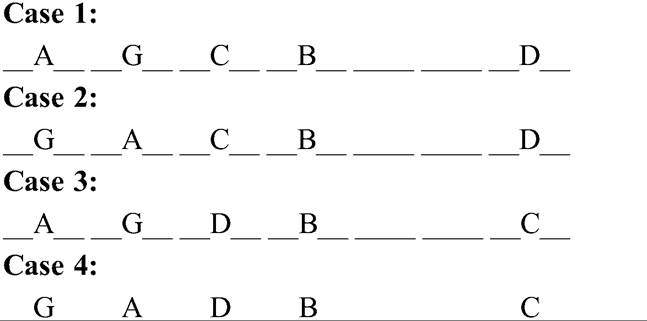
23. It can be seen from the above cases that C, D and G can be placed at the ends, but F cannot be.
24. A can only be seated next to G, C or D as can be seen from the 4 cases above. Hence, E and A cannot sit together.
Solutions for Questions 25-27:
25. In order to get to the correct option in this question, you need to try to disprove each of the options by thinking of possible values for the elements in 51 and 4S,2.
Option (a), (b) and (c) would not be true in case we were to take the elements in 51 to be 1 to 24, while the elements in S2 as 25 to 50. Then if we change the signs of each element ofS,1 we will get these values as -1,-2,...-24. It can be seen that neither of the first three option statements would be true, i.e., we would not have every member ofS,1 greater than every member ofS,2 Eas stated in option (a)], we would not have G inS,1 [as stated in option (b)] and we would not have the largest number between 51 and S2 in 51 [as stated in Option (c)].
26. Let the elements inS,1 be 1, 2, 3...24 and the elements in S2 be 50, 49, 48...27, 26, 25. Then after Interchangingiz24 and zz25, 51 would have (1, 2, 3, 4....22, 23 and 50) while S2 would have (24, 49, 48, 47...28, 27, 26, 25). It is obvious that 51 would continue to be in ascending order, while S2 would not continue to be in the descending order. Thus, option (a) is correct.
27. It is obvious that since every element of 51 has to be made equal to or greater than every element of S2, L would have to be made greater than or equal to G.
For this the value ofx cannot be less than G-L. Thus option (d) is correct.
Solutions for Questions 28 to 29:
17. After the GOTO instruction, the robot is given an instruction of WALK X(2) and WALK Y(4), after which it reaches (6,6). This means that x must be 4 and у must be 2. Thus, option (c) is correct.
18. If we are prohibited from using the GOTO instruction, we would need one WALK X and one WALK Y instruction. Thus we need 2 instructions to get to the origin.
Solutions for 30-32:
| Base Amount (after Playerpicks his card) | Top card characteristic | Resultant | Total for Ghosh Babu for the round | Net total for Ghosh Babu all rounds combined | |
| Round 1 | 8 | Same suit | Ghosh babu pays ' 16 to the dealer | -8 | -8 |
| Round 2 | 10 | Opposite color | Dealer pays ' 10 more to Ghosh Babu | +20 | +12 |
| Round 3 | 6 | Same color | Ghosh Babu pays ' 6 to the dealer | 0 | +12 |
| Round 4 | 8 | Same Suit | Ghosh babu pays the dealer ' 16 | -8 | +4 |
From the table we can answer the questions which follow.
19. His maximum gain is ' 12 after the second as well as the third round.
20. Since, he is not borrowing any money he should be able to cover his maximum loss which is ' 8 after the end of the first round. Thus, he should have had at least' 8 at the beginning of the game sessions.
21. Since, Ghosh Babu ends with a profit of' 4 after his 4 rounds of game sessions, he must have had ' 96 initially.
Introduction to solving questions 33-42:
In such questions, a valid argument has to be constructed from amongst the given statements using a sequence of 3 statements—where the first two are defined as premises and the third is the conclusion. You need to see whether the conclusion can be validly and logically drawn based on the premises.
22. ACB. Since all software companies employ knowledge workers and Tara Tech is a software company, it must employ knowledge workers as stated in conclusion B
23. BAC—As increase in Carbon Monoxide is hazardous to health and traffic congestion increases carbon monoxide—the conclusion stated in C that traffic congestion is hazardous to health is correct. Note that at first glance BDE also seems to be correct, but the use of ‘some’ there is ambigious; hence, BAC is a better solution.
24. CEA—Since all sweets are tasty and no apples are tasty (according to the premises stated in C-E), it must follow that apples are not sweets (stated in A). No other option is close to being logical.
25. BDC is clearly logical as B states that all Polluted towns should be destroyed and D gives us that Town Meghana is polluted—C must follow.
26. ACB
27. ACD
28. ABE. Since some actors are popular and all actors are handsome, it must follow that the actors who are popular are also handsome. Thus, some popular people would also be handsome—as stated in conclusion E.
29. ECB—There is a clear link between E and C as the premises and B as the conclusion, i.e., since technology driven industry is modern and BTI is technology driven, it must be modern too.
30. ABE. Since some smart people are not blue coloured and all Golmal islanders are blue colored people, it must follow that those smart people who are not blue colored must not be Golmal islanders.
31. AEB is the correct logical sequence. ABE also looks fine, but it is not correct because, it is not necessary that only MBAs are in great demand. Hence, if you were to conclude that Ram and Sita are MBA’s on the basis that MBA’s are in great demand; and that Ram and Sita are in great demand—it would be a false conclusion.
32. From the basic statement of this question we know two things—one: if the orangutan is angry, he would frown upon the world; two: if the orangutan is not angry he would not from upon the world. The opposite also holds true, i.e., if the orangutan frowns upon the world, he must be angry as well as ‘if the orangutan does not frown upon the world, he must not be angry. From the options, both CB and DA are valid conclusions; and hence we should mark (d) as the correct answer. Note that even AD would be correct but it is not included in any of the options.
33. Similar to the last question, this is also an either or statement. In Either A or B situations, If A happens B will not happen; IfB happens, A will not happen; if A does not happen then B happens; and if B does not happen, A would happen.
In this case DB and CA both follow.
34. Here the causality relationship is established between two events A and B. If A happens, B happens. In such situations, if A has happened it is necessary that B must happen, but the opposite is not true, i.e., if B has happened A must happen is not true as there could be other reasons independent of A for B to happen. For instance, if I tell Rajiv ‘if you fall from the first floor, you would definitely break you leg’ and it does transpire that Rajiv has broken his leg, then we cannot conclude that he must have fallen from the first floor. There could be many other ways in which he could have broken his leg. However, one additional conclusion that is possible to be drawn from this situation is that if B has not happened, A must also not have happened. Thus, if Rajiv has not broken his leg, we can make a valid conclusion that he must not have fallen from the first floor.
In this case it is stated that whenever Rajiv uses the internet, he dreams about spiders. AD is a valid logical deduction If he did not dream about spiders, it must follow that he must not have used the internet.
35. This is also an ‘If A happens, B happens’ situation. BothAB and CD are valid conclusions.
36. A is valid: Since some who laugh are sphinxes, and no cowboys laugh, it follows that those sphinxes that laugh cannot be cowboys.
D is valid: The whistlers who are crazy people must be paints.
Thus, option (c) is correct.
37. C is valid: Since all pizzas are snacks and some meals are pizzas, it must follow that meals which are pizzas are snacks.
D is valid: Since all barkers are sloth bears and some barkers are musk deer, it must follow that the sloth bears who are barkers must be musk deer. Hence, the conclusion—some sloth bears are musk deer is valid.
38. A is not valid—just because water buffaloes are not dinosaurs, we cannot conclude that they are not prehistoric. There may be other prehistoric creatures than dinosaurs.
B is valid: Crocodiles and frank people are mutually exclusive groups (from the second statement) and also politicians are within the frank people group. Thus, no crocodile can be a politician.
39. B is valid: Curios which are glass things must be transparent.
C is valid too: The logical conclusion that can be derived from the first two statements of C is that All XY must be brittle. The conclusion ‘Some XY are brittle’ is correct because if all XY are brittle, some XY would also be brittle. Thus option (c) is correct.
40. C is valid: The men who are cops must be brave as all cops are brave. Thus option (b) is correct.
41. If all IIMs are in India and no BIMs are in India—we can make both conclusions as given in statements A and B, i.e., No IIMs are BIMs and no BIMs are IIMs. Thus, both A and B are valid. C and D on the other hand are ambigious and are not valid conclusions. Hence, option (a) is correct.
42. C is valid: Young people who are citizens of Yes Island would speak only the truth. Thus, option (c) is correct.
43. C is valid: Creatures that are oviparous would obviously not be mammals. Option (c) is correct.
44. B is valid: Since giants climb beanstalks, and some chicken do not, the chicken which do not climb bean stalks must not be giants. Option (b) is correct.
45. C is valid: As eating grass is mutually exclusive between Bulls (who do) and matadors (who do not), no matadors would be bulls.
D is valid too: Some skunks who drive Cadillacs, would also be polar bears. These bears would drive Cadillacs.
46. Using statement A, we know that B is not a mathematician, and neither is C. But we cannot make a judgment about A—he may or may not be a mathematician. Thus we cannot say how many of A, B and C are mathematicians.
Using Statement B, we cannot again say how many of A, B and C are mathematicians because, A might be a mathematician, B too might be a mathematician and C could also be a mathematician.
Even if we use both the statements we still would not be able to make a judgment about A—he could or could not be a mathematician.
Thus, we mark option (d).
47. FromA alone we know that A and B definitely passed the exam, while from B alone we definitely know that neither C nor D has passed the exam Thus, if we use both A and B, we know definitely that 2 among the four students has passed the exam.
48. Data is insufficient even if we were to use both statements together as we would not know, how many of the 70 plants with red flowers were coming out of white seeds and how many of them were coming out of black seeds.
More on the topic CAT 1999:
- References
- Combined hepatocellular-cholangiocarcinoma
- References
- Preface
- REFERENCESAND I RECOMMENDED READING
- Lipid
- References
- References
- References
- References