Introduction
Why is this thus? What is the reason of this thusness?1
Modal operators are commonly understood to qualify the truth status of a proposition: necessary truth, proved truth, known truth, believed truth, and so on.
The ubiquitous possible world semantics for it characterizes things in universal terms: ?X is true in some state if X is true in all accessible states, where various conditions on accessibility are used to distinguish one modal logic from another. Then ?(X → Y) → (?X → ?Y) is valid, no matter what conditions are imposed, by a simple and direct argument using universal quantification. Suppose both ?(X → Y) and ?X are true at an arbitrary state. Then both X and X → Y are true at all accessible states, whatever “accessible” may mean. By the usual understanding of →, Y is true at all accessible states too, and so ?Y is true at the arbitrary state we began with. Although arguments like these have a strictly formal nature and are studied as modal model theory, they also give us some insights into our informal, everyday use of modalities. Still, something is lacking.Suppose we think of ? as epistemic, and to emphasize this we use K instead of ? for the time being. For some particular X, if you assert the colloquial counterpart of KX, that is, if you say you know X, and I ask you why you know X, you would never tell me that it is because X is true in all states epistemically compatible with this one. You would, instead, give me some sort of explicit reason: “I have a mathematical proof of X,” or “I read X in the encyclopedia,” or “I observed that X is the case.” If I asked you why K(X → Y) → (KX → KY) is valid you would probably say something like “I could use my reason for X and combine it with my reason for X → Y, and infer Y.” This, in effect, would be your reason for Y, given that you had reasons for X and for X → Y.
1 Charles Farrar Browne (1834-1867) was an American humorist who wrote under the pen name Artemus Ward. He was a favorite writer of Abraham Lincoln, who would read his articles to his Cabinet. This quote is from a piece called Moses the Sassy, Ward (1861).
Notice that this neatly avoids the logical omniscience problem: that we know all the consequences of what we know. It replaces logical omniscience with the more acceptable claim that there are reasons for the consequences of what we know, based on the reasons for what we know, but reasons for consequences are more complicated things. In our example, the reason for Y has some structure to it. It combines reasons for X, reasons for X → Y, and inference as a kind of operation on reasons. We will see more examples of this sort; in fact, we have just seen a fundamental paradigm.
In place of a modal operator, ?, justification logics have a family of justification terms, informally intended to represent reasons, or justifications. Instead of ?X we will see t:X, where t is a justification term and the formula is read “X is so for reason t,” or more briefly, “t justifies X.” At a minimum, justification terms are built up from justification variables, standing for arbitrary justifications. They are built up using a set of operations that, again at a minimum, contains a binary operation ∙. For example, x ■ (y ■ x) is a justification term, where x and y are justification variables. The informal understanding of ■ is that t ■ u justifies Y provided t justifies an implication with Y as its consequent, and u justifies the antecedent. In justification logics the counterpart of
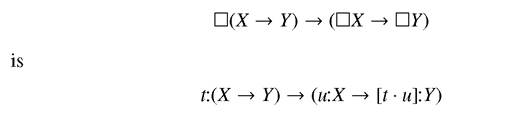
where, as we will often do, we have added square brackets to enhance readability. Note that this exactly embodies the informal explanation we gave in the previous paragraph for the validity of K(X → Y) → (KX → KY).
That is, Y has a justification built from justifications for X and for X → Y using an inference that amounts to a modus ponens application—we can think of the ■ operation as an abstract representation of this inference. Other behaviors of modal operators,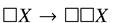 for instance, will require operators in addition
 to ∙, and appropriate postulated behavior, in order to produce justification logics that correspond to modal logics in which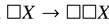 is valid. Examples,
general methods for doing this, and what it means to “correspond” all will be discussed during the course of this book. 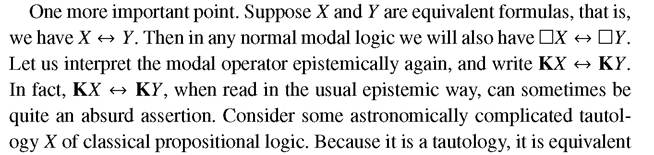
to , which we may take for Y. Y is hardly astronomically complicated. However, because
 we will have
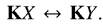 Clearly, we know Y es
sentially by inspection and hence KY holds, while KX on the other hand will involve an astronomical amount of work just to read it, let alone to verify it. Informally we see that, while both X and Y are tautologies, and so both are knowable in principle, any justification we might give for knowing one, combined with quite a lot of formula manipulation, can give us some justification for knowing the other. The two justifications may not, indeed will not, be the same. One is simple, the other very complex.
Modal logic is about propositions. Propositions are, in a sense, the content of formulas. Propositions are not syntactical objects. “It's good to be the king” and “Being the king is good” express the same proposition, but not in the same way. Justifications apply to formulas. Equivalent formulas determine the same
t
I
Modal logics can express, more or less accurately, how various modal operators behave. This behavior is captured axiomatically by proofs, or semantically using possible world reasoning. These sorts of justifications for modal operator behavior are not within a modal logic, but are outside constructs. Justification logics, on the other hand, can represent the whys and wherefores of modal behavior quite directly, and from within the formal language itself. We will see that most standard modal logics have justification counterparts that can be used to give a fine-grained, internal analysis of modal behavior. Perhaps, this will help make clear why we used the quotation we did at the beginning of this Introduction.
More on the topic Introduction:
- A Introduction
- A Introduction
- Introduction
- A Introduction
- Introduction
- INTRODUCTION
- Introduction
- Introduction
- Introduction
- AVIAN CHOLERA