INTRODUCTION
One of the difficulties that arise in studying logic is that we are all convinced that we are logical: not necessarily merely logical, as Mr. Spock and Data are supposed to be on the TV series Star Trek', but we do suppose that we all can be logical when we need to be.
(But doesn’t there seem to be something a little strange, even paradoxical, about this idea that we can “turn on” our logical mode?) The great French philosopher Rene Descartes summed it up well when he said: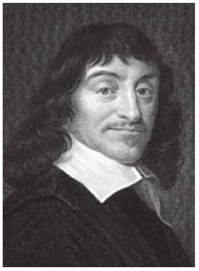
Rene Descartes image by Frans Hals, c. 1580-1666
Good sense is the best distributed thing in the world: for everyone thinks himself so well endowed with it that even those who are hardest to please in everything else do not usually desire more of it than they possess.—Descartes, Discourse on Method, 1637
And it’s unlikely that we are all mistaken in thinking that we do have the ability to reason well, as Descartes went on to point out. Our native logical ability does not vary greatly about the mean (although we can of course improve it by concentrating on it, as we shall in this book!), and we all tend to make the same kinds of errors in similar psychological circumstances. All of this we owe perhaps to our biological and social evolution. After all, as Chrysippus observed in ancient Athens, even a dog is capable of reasoning logically to some extent. For suppose it is following the scent of some animal down a path and it comes to a fork in the path. Then if it finds no scent along one of the paths, it will immediately retrace its steps to the fork and try the other (thus implicitly applying the rule of inference called Disjunctive Syllogism!).
But as we all know from experience, having the ability to reason well in a relatively simple situation like the fork is one thing; but to follow a long chain of deductive reasoning, or to follow the logic of a technical argument with many unfamiliar terms, requires a less intuitive and more analytical skill.
Consider the following two examples:There is no box of mine here that I dare open. My writing desk is made of rosewood. All my boxes are painted, except those that are here. There is no box of mine I dare not open, unless it is full of live scorpions. All my rosewood boxes are unpainted. Therefore my desk is full of live scorpions.
—Charles Dodgson (aka Lewis Carroll), Symbolic Logic
If the money supply were to increase at less than 5%, the rate of inflation would come down. Since the money supply is increasing at about 10%, inflation will not come down.
—Alec Fisher, The Logic of Real Argument
The first of these arguments, Lewis Carroll’s wacky example, is a valid piece of reasoning (provided his writing desk counts as a box—perhaps he couldn’t afford a proper desk?). You will prove it to be so later in the book. The second example, as Fisher points out in giving it, is often advanced by monetarist politicians, but should never have been accepted by anyone. It might appear that we would have to know some economics to criticize it—what factors contribute towards inflation? what might bring it down?—but this is not so. We can criticize the argument on logical grounds alone. The conclusion does not necessarily follow from the premises of the argument as stated: something else might bring inflation down. If it had been stated that the rate of increase of the money supply were the only factor affecting inflation, then the argument would be valid; but this is clearly a much stronger claim. One of the virtues of logic that I will be aiming to promote in this book is that it helps to break through the “cult of the expert” in exactly this way: no matter how expert someone is in a particular subject, if she is to convince her audience, then she must adduce reasons that sufficiently support the point she wants to make. And deciding whether she has done so is precisely a task for logic.
Here I have been happily speaking of “arguments,” “conclusions,” “premises,” “validity,” etc.
as if you all understand exactly what I mean. But it’s time to define our terms. What exactly is an argument in the logicians’ sense? The key notions are as follows. First there is an overall conclusion: this is the statement the argument is intended to establish. In support of this statement, some other statements are given: these are the premises (variant spelling: premiss, premisses). The act of drawing a conclusion from some given premises is called the making of an inference. We may define an inference as follows: An inference is the drawing of a conclusion from one or more other statements given as premises.Here
A conclusion is a statement inferred from one or more other statements. These statements are the premises of the inference.
An argument may now be defined as a chain of inferences from premises to an overall conclusion:
An argument is a chain of (one or more) inferences from some initial premises to an overall conclusion.[I]
Thus in a typical argument there may well be several intermediate conclusions which themselves serve as premises for the main conclusion, or perhaps as premises for other intermediate conclusions. One virtue of the above definition is that it is applicable even to these extended arguments that occur in natural contexts, as well as to the simpler, well-formulated examples favoured by logicians. (It is also applicable to the case of the suppositional arguments we’ll encounter in later chapters, where an inference may be made on the basis of a previous inference, rather than on the given premises alone.)
These definitions depend crucially on the notion of a statement, which we will define as follows:
A statement is a sentence (or part of a sentence) that expresses something true or false.
The “something” that it expresses has traditionally been called a proposition:
A proposition is what a statement expresses as true or false.
Our definition of statement suffices to distinguish it from other types of sentence—for instance, a question, a command, or an exhortation—none of which expresses something that can be true or false.
Also, it takes into account that propositions are often expressed by (and statements constituted by) parts of sentences, or sentence-fragments.[II] Thus of the following seven sentences from St. Augustine’s City of God,(1) Courage, my mind, and press on mightily.
(2) God is our helper, he made us and not we ourselves.
(3) Press on where truth begins to dawn.
(4) Suppose, now, the voice of a body begins to sound.
(5) What, then, is time?
(6) If no one asks me, I know.
(7) But if someone asks me, I cannot give an answer.
only (2), (6), and (7) are statements by our definition. Numbers (1) and (3) are exhortations or commands that Augustine is making to himself in order to summon up the courage necessary to tackle the difficult question of what time is, and (5) is that question. In (4) “the voice of a body begins to sound” is a statement, but the introductory word “Suppose...” signals that it has a special status: Augustine is supposing it for the sake of example, rather than asserting it. Such a statement is a supposition. We will deal with suppositions in chapter 7.
Notice that parts of the other sentences are statements, too: “truth begins to dawn” is a statement, even though sentence (3) as a whole is not. Sentence (2), on the other hand, is not only a statement itself, but also contains the statements “God is our helper” and “he made us and not we ourselves”; and the latter could be analyzed as containing “he made us” and “[it was] not we ourselves [who made us],” each of which could be true or false individually. The sentence as a whole is a compound of these three statements, each of which is not further reducible in this way. But the whole question of how statements are made up out of other statements needs to be treated with some care, and we shall return to it in chapter 3.
SUMMARY
• An inference is the drawing of a conclusion from one or more other statements given as premises.
• An argument is a chain of (one or more) inferences from some initial premises to an overall conclusion.
• A statement is a sentence (or part of a sentence) that expresses something true or false.
• A proposition is what a statement expresses as true or false.
• Thus if a sentence or sentence-fragment does not express something true or false, then it is not a statement. In particular, questions, exhortations, commands, and suppositions are not themselves statements (although they may contain statements).
EXERCISES 1.1
1. Based on your understanding of this chapter, state whether each of the following statements about logic is true or false, and why:
(a) We study logic in order to Ieam how to reason.
(b) Animals seem to be able to use logic, at least implicitly.
(c) Logic helps you decide whether something is true even if you know nothing about the subject.
(d) An argument is the automatic gainsaying of any statement the other person makes.
(e) Animals don’t argue, so they don’t use logic.
(f) The point of an argument is to contradict your opponent.
Example:
(f) Wrong: the point of an argument is to persuade someone of something. It is not necessary to take up a contrary position, unless perhaps you are engaged in debate.
2. Identify which of the following sentences is a statement, with a brief explanation for your answer:
(a) My hovercraft is full of eels. (Monty Python’s “Hungarian Phrasebook”)
(b) Let the flow of time from some first instant A be represented by the line AB... (Galileo Galilei, Discorsi)
(c) Get thee to a nunnery. (Shakespeare, Hamlet)
(d) Why woulds’t thou be a breeder of sinners? (Shakespeare, Hamlet)
(e) O heavenly powers, restore him! (Shakespeare, Hamlet)
(f) Nature never makes leaps. (Gottfried Leibniz)
(g) ’Scuse me, while I kiss the sky! (Jimi Hendrix, “Purple Haze”)
(h) When the body arrives at B, suppose that a centripetal force acts with great impulse... (Isaac Newton, Principia)
(i) If Gorbachev made a mistake, well, who hasn’t? (Russian V-P Alexander Rushkoi, 1991)
Example:
(c) Not a statement, since it doesn’t express something that can be true or false; it’s a command or exhortation.
3. Identify whether each of the following sentences or sentence-fragments from the ancient Greek philosopher Heraclitus is a statement:
(a) It is not possible to step twice into the same river.
(b) The road up and the road down are one and the same.
(c) Nature loves to hide.
(d) Knowing neither how to hear nor how to speak.
(e) Listening not to me but to the logos, it is wise to agree that all things are one.
(f) Let us not make aimless conjectures about the most important things.
(g) If all things were smoke, nostrils would distinguish them.
(h) How could one fail to be seen by that which does not set?
(i) Dogs bark at everyone they do not know.
(j) Turnings of fire: first sea; of sea, half is earth and half lightning-flash.
Example:
(e) This is a statement, since it asserts something that could be true or false.
4. Determine which of the following sentences from Albert Einstein is a statement:
(a) Science has been charged with undermining morality, but the charge is unjust.
(b) Compare the spirit which animated the youth in our universities a hundred years ago with that prevailing today.
(c) Let every man judge by himself, by what he has himself read, not by what others tell him.
(d) How can cosmic religious feeling be communicated from one person to another, if it can give rise to no definite notion of a God and no theology?
(e) Only the absolute repudiation of all war can be of any use here.
(f) Suppose, for example, that the American, English, German, and French governments insisted that the Japanese government put an immediate stop to their warlike operations in China, under pain of a complete economic boycott.
(g) Mere agreements to limit armaments furnish no sort of security.
(h) May I begin with an article of political faith?
(i) I regard it as the chief duty of the state to protect the individual and give him the opportunity to develop into a creative personality.
Example:
(b) This is not a statement, but a command or exhortation.
5. For each of the following sentences from Neal Stephenson’s novel Quicksilver, list any and all statements it contains:
(a) Enoch rounds the corner just as the executioner raises the noose above the woman’ s head.
(b) Her knees pimple the front of her apron and her skirts telescope into the platform as she makes to collapse.
(c) The crowd scratches and shuffles.
(d) He’s not come to watch witch-hangings, but now that Enoch has blundered into one it would be bad form to leave.
(e) There is a drum-roll, and then a sudden awkward silence.
(f) As they are cutting the limp witch down, a gust tumbles over the common from the north.
(g) If Herr Fahrenheit were here with one of his new quicksilver-filled, sealed-tube thermometers, he would probably observe something in the fifties.
Example:
(a) This sentence is itself a statement, and contains the two other statements: “Enoch rounds the comer,” and “the executioner raises the noose above the woman’s head.”
6. For each of the following sentences from Heraclitus, list any and all statements it contains:
(a) This logos holds always, but humans always prove unable to understand it.
(b) If they are gods, why do you grieve?
(c) If you grieve, no longer think them gods.
(d) If it were not for Dionysus that they hold processions and sing hymns to the phallus, it would be a most shameless act.
(e) Eternity is a child playing a game of checkers, and the king is in the hands of a child. Example:
(a) This sentence is itself a statement, and contains the two other statements: “This logos holds always,” and “humans always prove unable to understand it.”
1.2
More on the topic INTRODUCTION:
- INTRODUCTION
- Introduction
- INTRODUCTION TO REASONING IN THE SNAP EXAM
- Introduction
- Introduction
- Introduction
- INTRODUCTION
- INTRODUCTION
- Introduction
- Introduction: Repurposing an Extant Constitution