INFERENCE INDICATORS
An argument occurs wherever someone is trying to convince someone of something by giving reasons for it. These reasons or grounds (contained in the premises) are given in support of some claim (the conclusion); that is, an argument is being given whenever one statement is supposed to be inferred from others, either by the person giving the argument or by a person hearing or reading it.
Of course, arguments are usually given to persuade somebody of something. To do this, people will generally mix in a whole load of rhetoric too; but this is generally what you shouldn't be persuaded by. Arguments are the basic units of reasoning, and we use them to express our reasoning even when we have no specific readership in mind.In natural contexts it is not always easy to tell when an argument is being given, but certain words habitually crop up whenever we are making an inference. Thus when the great natural scientist Sir Isaac Newton began the second “Rule of Reasoning in Philosophy” in his Principia with the word ‘Therefore,’ he was indicating that we should infer it from the first:
(Rule 1) No more causes of natural things should be admitted than are both true and sufficient to explain their phenomena.... (Rule 2) Therefore, the causes assigned to natural effects of the same kind must be, so far as possible, the same.3
Isaac Newton, The Principia: Mathematical Principles of Natural Philosophy, trans. I. Bernard Cohen and Anne Whitman (U of California P, 1999), pp. 794-95.
Similarly Roger Cotes, elaborating on the implications of these rules in the following passage from his preface to the second edition of Newton’s masterwork, uses the word ‘since’ to introduce the reason why we should conclude that gravity is universal:
Now, since all terrestrial and celestial bodies on which we can make any experiments or observations are heavy, it must be acknowledged without exception that gravity belongs to all bodies universally, (ibid, 391)
Words used to indicate the conclusion of an inference, like So..., Thus..., and Therefore..., are called conclusion indicators; similarly, words that are often used to indicate the giving of reasons or grounds for the conclusion, like since...,for..., etc., are called premise indicators. Collectively, all such words are known as inference indicators, i.e., words indicating that an inference is being made, that an argument is being given.
Here are lists of other such inference indicators; neither list is intended to be exhaustive. [Can you think of any other premise or conclusion indicators?]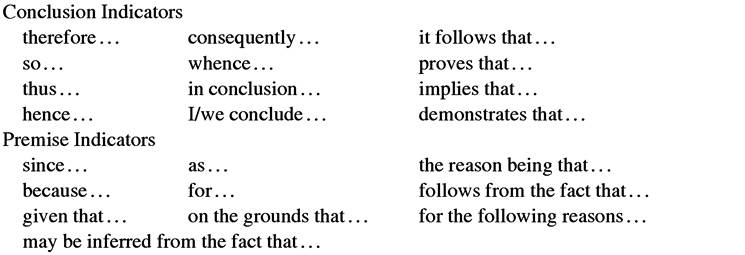
caution: you can’t be uncritical in using these indicator words to establish whether an argument is being given. Natural language is very flexible, and the same words are pressed to many different uses. Consider: “We haven’t made love since George fell off his horse,” iiThus are dreams unmasked,” “I was never given that chance,” iiFor want of a better idea...,” “... as I have already mentioned,” and so on!
1.2.2
More on the topic INFERENCE INDICATORS:
- TECHNIQUES OF DIAGRAMMING
- Enthymemes
- Robustness Analysis with Statistical Inference
- Relationships among Indicators
- CONTENTS
- Statistical Approaches
- Distribution and Dynamics
- REFERENCES
- Robustness Analysis
- DEFINITION OF INEQUALITY MEASURES AND THEIR VARIABILITY