TECHNIQUES OF DIAGRAMMING
The first thing to do in examining any argument is to see what is intended to follow from what. In each case that we can identify this, we have an inference from the premise statements to the conclusion.
Each such inference will be represented by a downwards arrow, so: ∣. The following argument is an example (yes, it’s a real argument, formulated by a second-century CE philosopher!):Male lions do not desire other male lions, because lions are not philosophers.
First we shall number the statements, circle or bracket the inference indicator ‘because,’ and underline the conclusion:
(і) “(1) Male lions do not desire other male lions, (because) (2) lions are not philosophers.”
The structure of this simple argument is:
(2)
Although (1) occurs before (2), (1) is asserted to follow logically from (2), as indicated by the premise indicator ‘because.’ Another way of expressing this assertion of logical dependence is to say that (2) entails (1). Not many people would accept the validity of this inference, of course; but we shall return to that issue in the next chapter. For now we are just looking at inferential structure. A slightly more complex example is this:
(ii) “(1) Drug use is wrong because (2) it is immoral, and it is immoral because (3) it enslaves the mind and destroys the soul.”—James Q. Wilson, Newsweek, January 9,1989
This argument is diagrammed: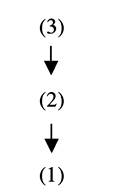
Here statement (2) is given as a reason for statement (1), so that it is a premise. But (2) in turn is inferred from statement (3), so that it also functions as a conclusion. Any such statement occurring in an argument that is inferred from one or more other statements in the argument but is not the overall conclusion, is called an intermediate conclusion. As the diagram makes clear, the validity of the overall argument will depend on the validity of both inferences, from (3) to (2), and from (2) to (1).
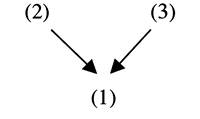
Usually, of course, arguments are more complex than the ones above. In particular, many inferences involve several premises, rather than just one. Here there are two cases to be distinguished: the premises may entail the conclusion conjointly; or each of them may entail it independently. Here is an example of each kind:
(iii) (1) Universities must expect further cuts because (2) they have suffered less than other sectors of education. But even if that were not so, (1) they should expect further cuts because (3) they are not sufficiently vocationally oriented.
This is diagrammed:
(iv) Since (1) morals have an influence on the actions and affections, it follows that (2) they cannot be derived from reason;... because (3) reason alone, as we have already proved, can never have such an influence.
This is diagrammed: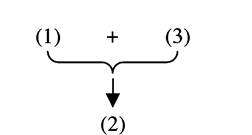
Here now is a more complex argument, one typical of the way arguments occur in natural contexts. It was originally given in note form by Charles Darwin in one of his early notebooks:
(v) The general delusion about free will [is] obvious. Because (1) man has power of action, and (2) he can seldom analyze his motives—[since (3) they are] mostly instinctive, and therefore (4) now great effort of reason [is required] to discover them—(5) he thinks they have none.[6]
First let’s ignore the subsidiary argument for premise (2). Premises (1) and (2) jointly support the overall conclusion (5). This gives:
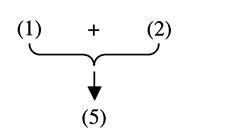
Turning to the subsidiary argument, we see that (3) is given as a reason for (2) by way of (4): it is because motives are instinctive that great effort of reason is required to discover them, and this having to apply a great effort of reason makes it difficult to analyze them.
So (3) is given as a reason for (4), and (4) as a reason for (2). This gives: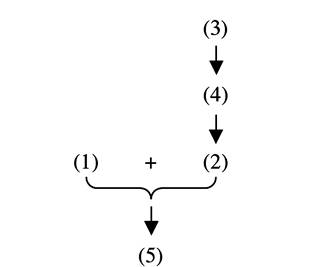
There are other possibilities. A piece of argumentative reasoning may, for example, serve to justify two distinct conclusions. Here is an example from a 1932 essay by the Italian fascist leader, Benito Mussolini, “The Doctrine of Fascism”:
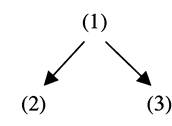
(vi) (1) Outside the State there can be neither individuals nor groups (political parties, associations, syndicates or classes). Therefore (2) Fascism is opposed to that Socialism which views the movement of history as the process of class struggle, and (3) analogously it is opposed to class syndicalism.
Here (1) is given to support both (2) and (3):
Finally, let’s consider the following argument given by the philosopher Spinoza on behalf OfDescartes, whose Principles of Philosophy he was expounding axiomatically:
(vii) Proposition 13: (1) God by his power conserves the same quantity of motion and rest which he once gave to matter. Demonstration: Since (2) God is the cause of motion and rest (by (3) Proposition 12), (4) he conserves these by the same power by which he also created them (by (5) Axiom 10 of Part I), and (6) indeed with the same quantity of power (by (7) Corollary to Prop. 20, Part I). QED.
Here “Proposition 12,” which I have numbered (3), is that iiGod is the principal cause of motion,” and Axiom 10 of Part I, which I have numbered (5), is iiNo lesser cause is required for the conservation of a thing than for its initial creation,” and the Corollary to Prop. 20 of Part I, which I have numbered (7), is iiGod is unchangeable in all his works.”
Now Spinoza gives (3) as the reason for (2), which, together with (5), is given as a reason for (4). But (4), together with the corollary, (7), is then given as a reason for (6).
The “QED” (Latin for “what was to be demonstrated”) indicates that Spinoza takes (4) and (6) together to establish the proposition (1). This gives the following inferential structure: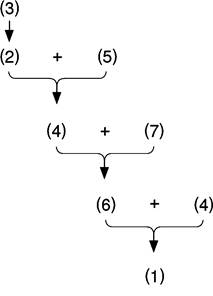
SUMMARY ______________________________________________________________
• Many natural arguments—those naturally occurring in speech, in writing, etc.— are extended arguments involving more than one inference.
• Each inference in an extended argument has its own premise(s) and conclusion.
• The overall point being argued for in an extended argument is the main conclusion; in some (rare) cases, there may be more than one.
• The conclusions of the other inferences in the argument are intermediate conclusions. An intermediate conclusion will function as a premise for other inferences in the argument.
• In an argument diagram, each inference is represented by a downward pointing arrow, ∣.
• Premises may entail a conclusion conjointly, in which case they are joined with a +, and the arrow goes from them together to the conclusion; or each may entail it independently, in which case there will be an arrow from each premise to the same conclusion.
• The point of an argument diagram is to make explicit what is supposed to follow from what. Only when the inferences have been identified, can we judge how good they are.
EXERCISES 1.3
Analyze each of the following extended arguments as follows: (i) {bracket) or∖box∖the inference indicators, set the premises in, underline the conclusions, and double-underline the main conclusion, and (ii) construct the argument diagram.
12. (1) Reality is one. It must be single because (2) plurality, taken as real, contradicts itself.—F.H. Bradley, Appearance and Reality, 2nd ed., p. 519
13. Because (1) the greatest mitochondrial variations occurred in African people, scientists concluded that (2) they had the longest evolutionary history, indicating (3) a probable African origin for modem humans.—Science, May 26, 1995
14.
As (1) force is always on the side of the governed, (2) the governors have nothing to support them but opinion. (3) It is therefore on opinion only that government is founded.—David Hume, Essays, Moral, Political, and Literary, I, iv, 177715. (1) Contrary to what many people think, a positive test for HIV is not necessarily a death sentence. For one thing, (2) the time from the development of antibodies to clinical symptoms averages nearly ten years. For another, (3) many reports are now suggesting that a significant number of people who test positive may never develop clinical AIDS.—R.S. Root-Bemstein, “Misleading Reliability,” The Sciences, March 1990
16. (1) Nor is what exists empty in any respect. For (2) what is empty is nothing; and so, (3) being nothing, it would not exist.—Melissus, Fragment B7
17. (1) One should avenge injustices to the best of one’s ability and not pass them by; for (2) to do so is just and good, and (3) not to do so is unjust and bad.—Democritus, Fragment B261
18. (1) The promise you make with a gun to your head is devoid of moral or legal force. (2) Nobody is obligated in any way to keep a pledge extracted under duress.—William Saffire, “Made Under Duress,” The New York Times, June 22, 1995
19. Since (1) there is no single objective world-wide ‘now’ in special relativity, and since (2) there cannot be multiple rivers of time each of which determines the advance of reality, (3) it follows that there simply is no such thing as the universal, worldwide flux of ‘now’ or lapse of time consistent with relativity.—Palle Yourgrau, The Forgotten Legacy of Godel and Einstein (Cambridge, MA: Basic Books, 2005), p. 132
20. (1) The central problem evolutionary biology must explain is the existence of complex adaptation. So, (2) natural selection has a special status within evolutionary biology, for (3) complex adaptation can only be explained by natural selection.—Kim Sterelny, Dawkins vs. Gould (Cambridge: Icon Books, 2001), p. 168
Example:
16. (1) Nor is what exists empty in any respect. (For) (2) what is empty is nothing; (and so), (3) being nothing, it would not exist.—Melissus, Fragment B7
The ‘For’ indicates that what precedes it is being argued for. Here, despite the “and so” introducing (3), it seems that (3) must be taken together with (2) to support (1). For we may rewrite (3) as “What is nothing does not exist,” which together with (2) entails that “what is empty does not exist,” and this is equivalent to “what exists is not empty.”
This is diagrammed: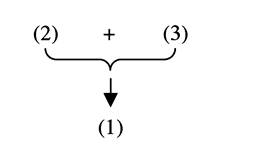
More on the topic TECHNIQUES OF DIAGRAMMING:
- ARGUMENT AND INFERENCE
- Arthur R.T.W.. An Introduction to Logic: Using Natural Deduction, Real Arguments, a Little History, and Some Humour. Broadview Press,2016. — 456 p., 2016
- Preface for Instructors
- CHAINING
- CARROLL’S DIAGRAMS
- Since the early twentieth century, poverty measurement has predominantly used an income approach.[77]
- CARROLL DIAGRAMS FOR 4 OR 5 CATEGORIES
- KEY DIAGRAM 1
- DRAWING PICTURES
- INFERENCE INDICATORS