Solutions
Questions 1 to 5
The direct clues give you the following linkages—green - Pentasoft, Blue- Sunmet A- Pink - Quark, E - Udupi, C - Pentasoft
Combining these clues will give you the following table:

At this point use Clue no.
(ii) [about F]. This will give you that the correct pairing for Sunmet is with F. Also use Clue (iv) at this stage.The table would evolve to:
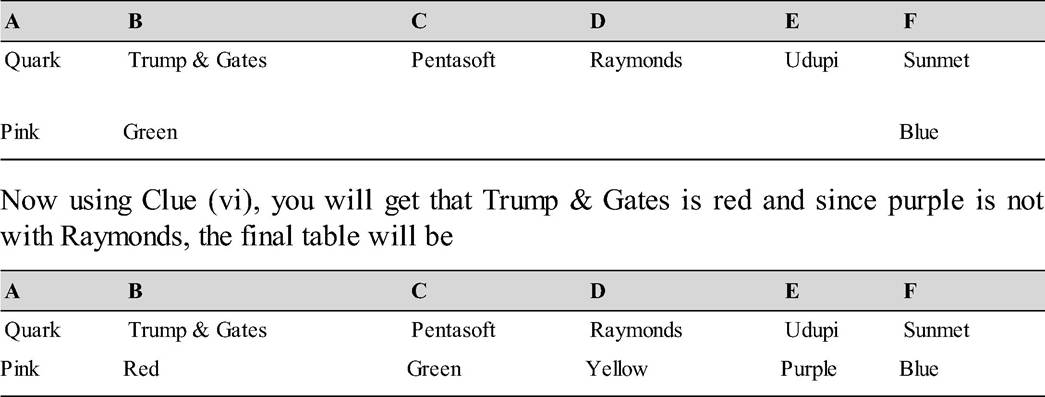
From this point, you need to just read off the respective answers to the questions asked from the completed table.
The answers are:
1. Yellow. Option (a)
2. Option (b) is correct.
3. Option (d) is correct.
4. Option (c) is correct.
5. Option (a) is correct.
Questions 6 to 8
Reaction Tracker
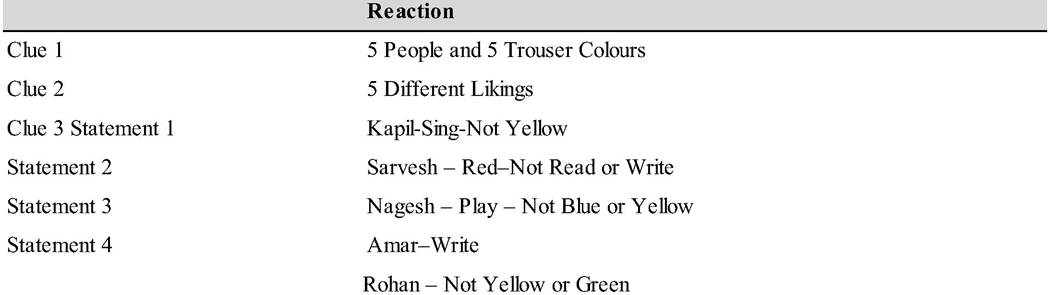
At this stage, combining Statements 1, 2, 3 and 4 of Clue (iii) you will get the following table:

[1] Since Sarvesh does not read, Rohan must like reading and Sarvesh must like travelling.
# Amar must be yellow, since Kapil, Rohan and Nagesh are not yellow.
Further we are not able to define the exact colours of Kapil, (who can be blue/white or green), Rohan (blue or white) or Nagesh (white/green). Hence the above table is the final one.
Thus, Kapil’s trouser colours cannot be answered. (Question 6) Sarvesh likes travel (Question 7) and Amar-yellow-write is the correct combination.
The answers are:
6. Option (d)
7. Option (b)
8. Option (c)
Questions 9 to 11
Reaction Tracker
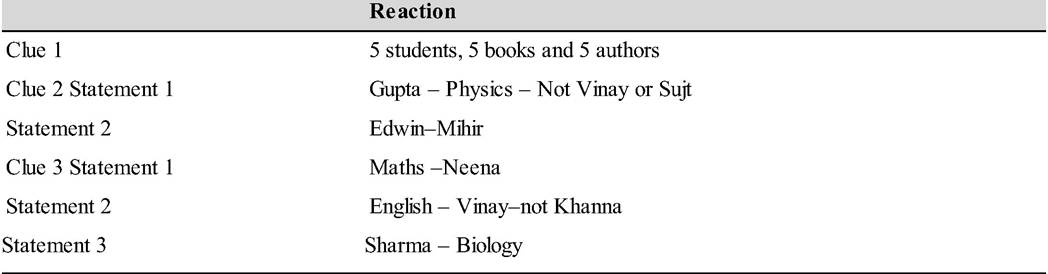
On the basis of the reaction to Clue (ii) and (iii) as shown above, you should realise that the maximum numbers of direct links are between the author and the subject.
Hence, your solution table should first give a structural placement of authors and subjects. When you do so, the following table shall emerge.SolutionTable 1:

Reacting to the above the table, you will immediately see that Edwin must be Chemistry. Further using Sentence (ii) of Clue (iii) you will get that since Vinay is not using a book authored by Khanna, he must be using Harish and consequently Khanna must have authored Maths.
We also know from Clue (ii), Sentence 1 that Gupta and Physics is not owned by Vinay or Sujit. Hence, Sujit must be Biology and Randhir must be Physics. The final table then becomes:

Consequently the correct answers are:
9. Biology-Sujit-Sharma
10. Edwin
11. Vinay
Questions 12 to 15
FromClues (і), (іі), and (ііі):
7 people-A, В, C, D, Е, F & G
5 cities - Delhi, Chennai, Lucknow, Bangalore and Kolkata
5 specialisations - Admin, HRM, Marketing, Systems, Finance FromClues (iii) and (iv) we have:
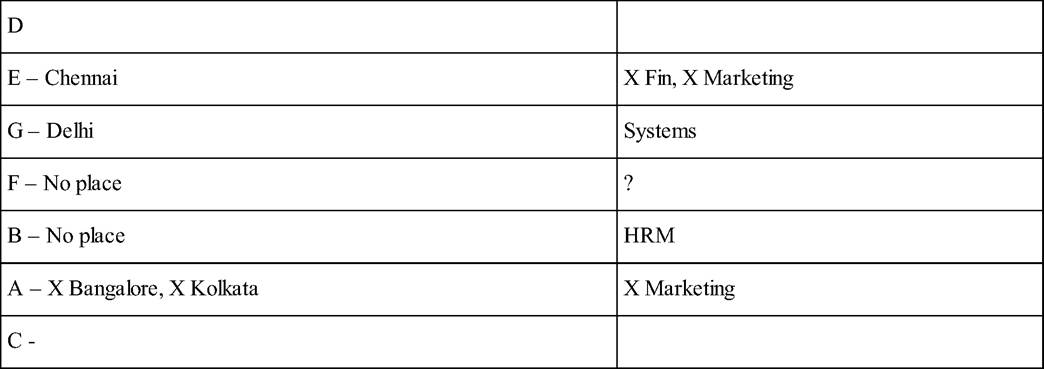
Refining the above table, the following deduction can be made: E must be from Admin. The table evolves to:
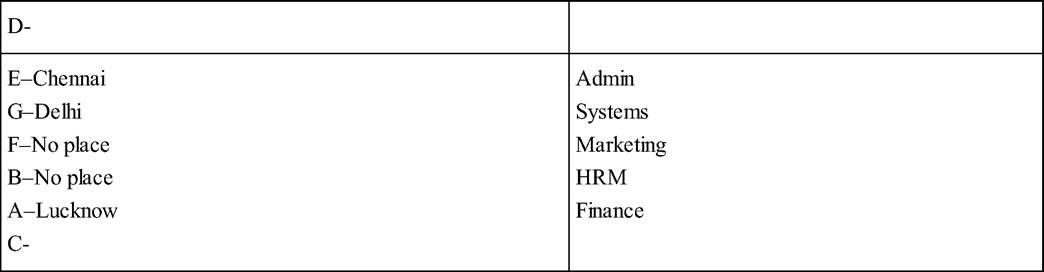
Hence the answers are:
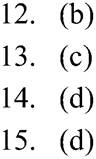
Questions 16 to 20: The following table will emerge out of the given clues:


Start from the Statement (iv).
Then go through statement (v): P travels only two stations and gets down at Chinchpokli which means that he must have boarded at Elphinston.
Then go to Statement (ix), proceed through (viii) to Statement (ii) and proceed as said in the remaining statements.
The answers are:
16. Elphiston. Option (c) is correct.
17. Data inadequate as we do not know whether it is the base station or Andheri. Option (d) is correct.
18. Data inadequate as we do not know whether it is the base station or Andheri. Option (d) is correct.
19. T gets down after 4 stations. Option (c) is correct.
20. Option (c) is correct.
Questions 21 to 24:
Reaction Tracker
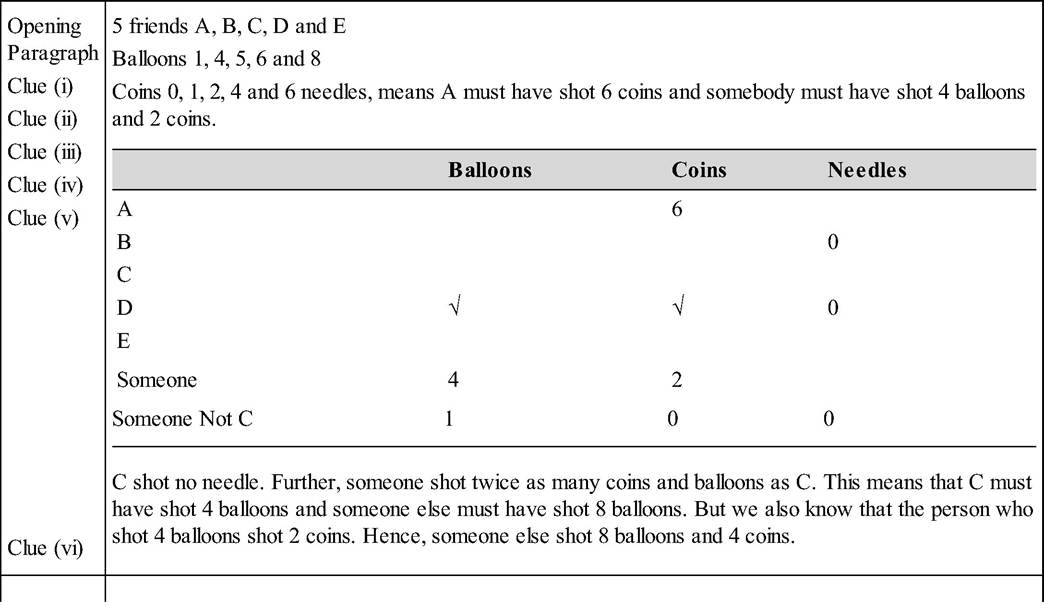
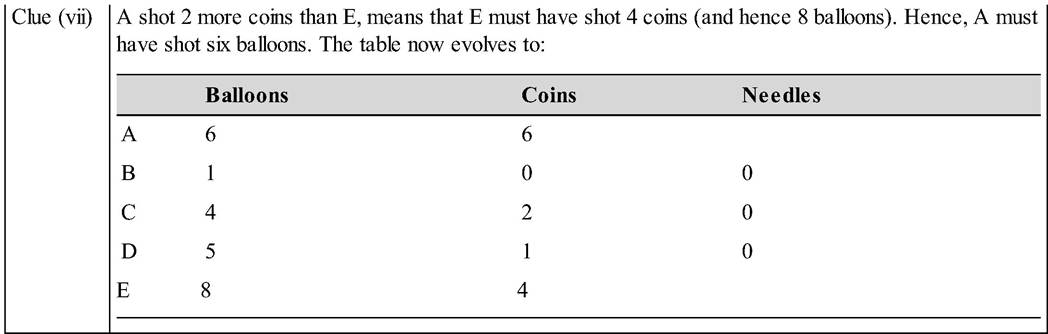
Hence the answers are:
21. Option (c) is true for A. Hence (c).
22. D shot 5 balloons is true. Hence Option (a) is correct.
23. Option (c) is again correct from the table.
24. A. Hence Option (a) is correct.
Questions 25 and 26: The following 19 possibilities emerge for what 101 could have seen. (Note: Be systematic while making this table.)
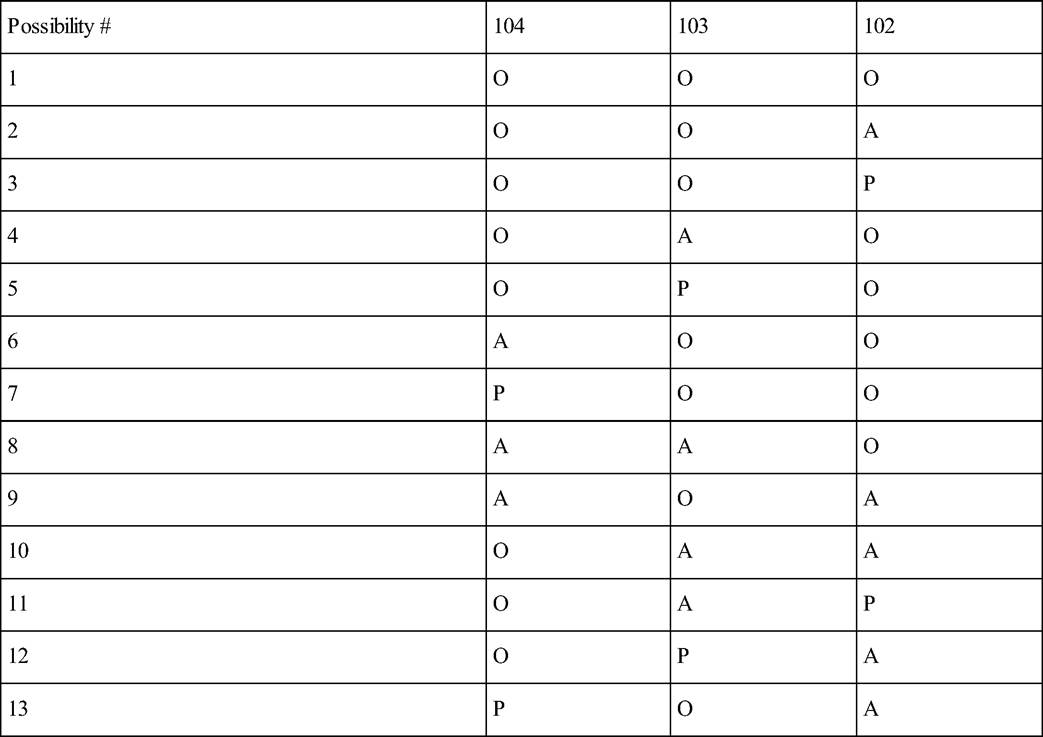
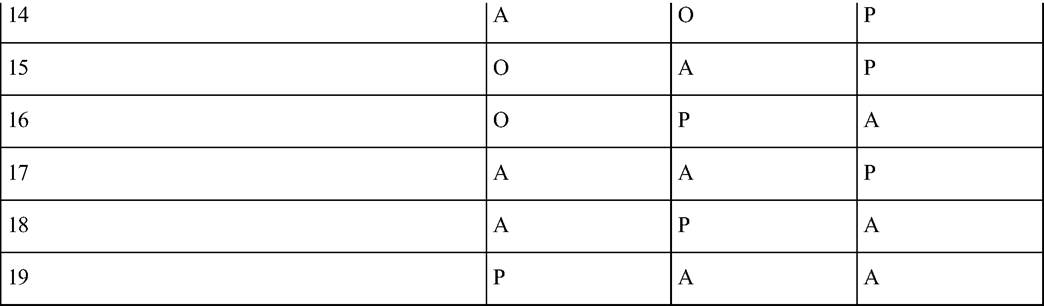
From the table above it is clear that if 101 had seen 2 apples and 1 pineapple he would have answered immediately. But since he doesn’t answer, possibilities 17, 18 or 19 can be ruled out.
102 also realises that 101 is not answering and hence rules out possibilities 17, 18 and
19. He considers what he sees on 103 and 104 in the context of possibilities 1-16. It can be seen from the table that if he had seen 2 apples, he would know that there was only Possibility 8 to consider. In such a case he would know that there was definitely an orange on his head. However, he does not answer. Thus, we can conclude that Possibility 8 is not possible. 103 realises that 102 is not answering and considers only possibilities 1-7 and 9-16.
Of these, we can realise that if he had seen an apple or a pineapple on 104 he would know that he had an orange on his head. But, since he doesn’t answer, we can eliminate Possibilities 6, 7, 9, 13 and 14. This leaves us WithonlyPossibilities 1-5, 10-12 and 15-16. Hence:
25. (a) 104 must have an orange on his head.
26. (d) All statements are true.
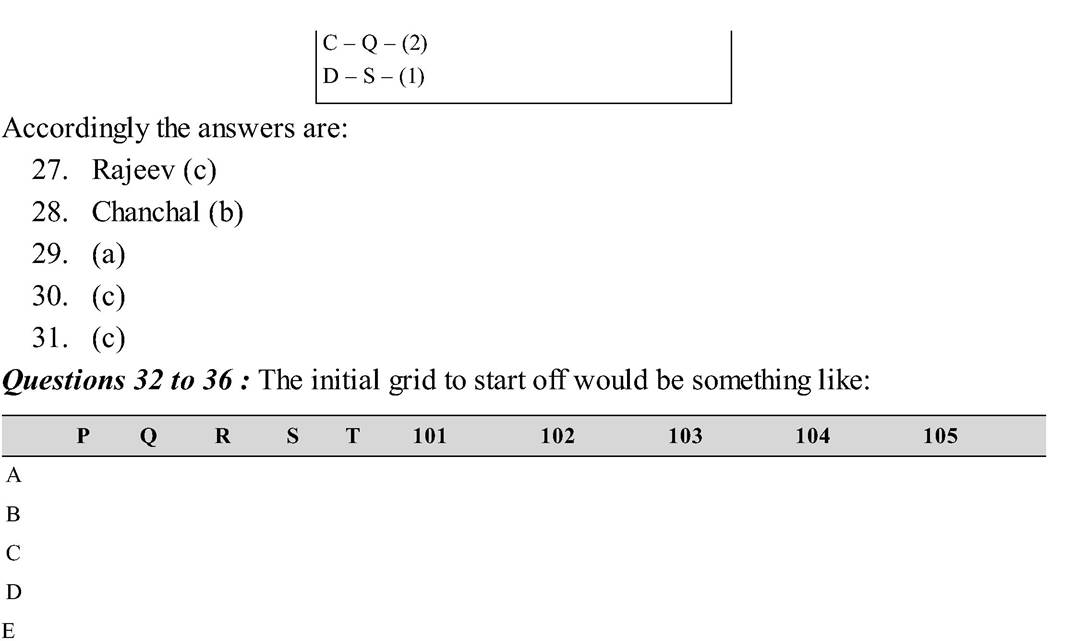
Questions 27 to 31: The starting grid in random order would be:

Using Clue (i) and Clue (iii), we can make some conclusions about Asha and Chanchal.

Divya Sanjay(S) (4) Green, Yellow, Black
Using Clues (ii) and (iv), we get some conclusions about the men and the colour combination they used. (Note: We know Bhavna is not Sanjay’s wife because Clue (iv) mentions them as separate individuals).

From the above table (the wives column) it is clear that P, Q and R have to be shared amongst A, B and C in random order. Hence, Divya must be Sanjay’s wife.
The table evolves to:

From the above table, it is evident that Color Combination 4 belongs to Asha (as Color Combinations 1/2/3 are shared between Bhavna, Chanchal and Divya). Also, Chanchal would get Color Combination 2 as it cannot go to any other woman.
The table now becomes:

At this stage Clue (ii) gives us that Qartar ,s wife used only one colour out of yellow and black.
Hence, Asha (Color Combination 4) cannot be Qartar ,s wife and thus must be Rajeev’s wife.
This means that P and Q must be shared between B and C. Since we know that Pradeep’s wife used yellow and black colours, Chanchal cannot be married to Pradeep (Chanchai’s colour combination does not use both the colours yellow and black).
Thus Pradeep must be married to Bhavana. Thus, the table evolves to:
The following deductions would follow:
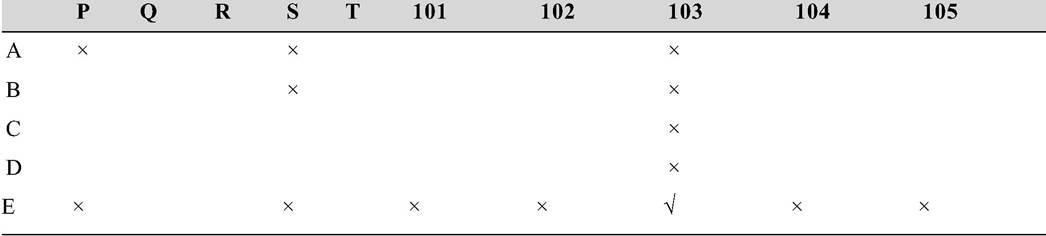
FromClues (ii), (iii), (iv) and (v) the grid would evolve to:
Besides, Ifomthese 4 clues we could also realise the following additional deductions:
(a) Order of marriage p F ⅛ ∖ (From Clue iv)
(b) Shailja must be in either 102 or 104.
(c) Abhay’s room must be either 101 or 105.
Using Clue (vi) we get that Shailja is not Abhay’s wife and neither is she Chandan’s wife. (Since Chandanwas married before Abhay and Shailja was married after Abhay). Hence, she must be Dinesh’s wife.
Also, Clue (viii) gives us that Quindal is in Room 102, hence from deduction (b) above Shailja must be in Room 104 and consequently Abhay must be in Room 105. The table
would evolve to:
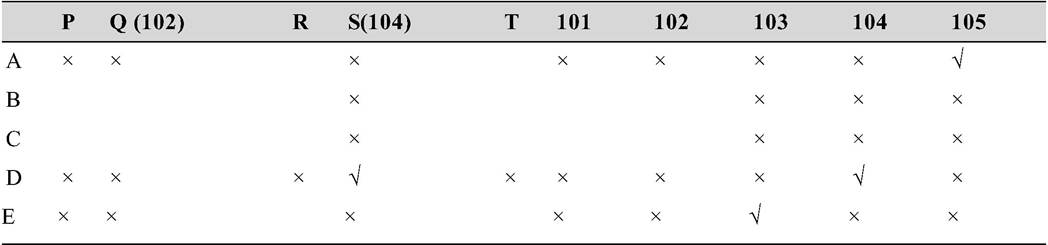
Note: One additional deduction we have drawn in the above table is that Quindal (being in Room 102) cannot be the wife of either Abhay (105) or Eklakh (103). Hence R and T would be the wives of A and E (in random order) as they have to be shared between A and E.
This also means that P and Q must be shared between B and C. Thus the grid evolves to:
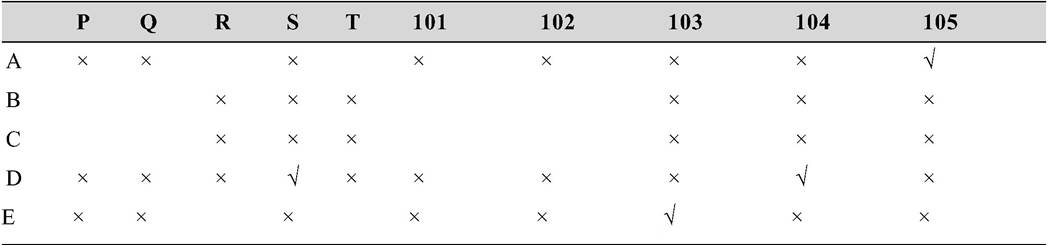
At this point use Clue (ix), along with the deduction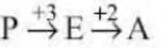
Since Tulsi and Riya have to be shared between Abhay and Eklakh and Eklakh has got married before Abhay he must be married to Tulsi and Abhay to Riya. The grid would evolve to:
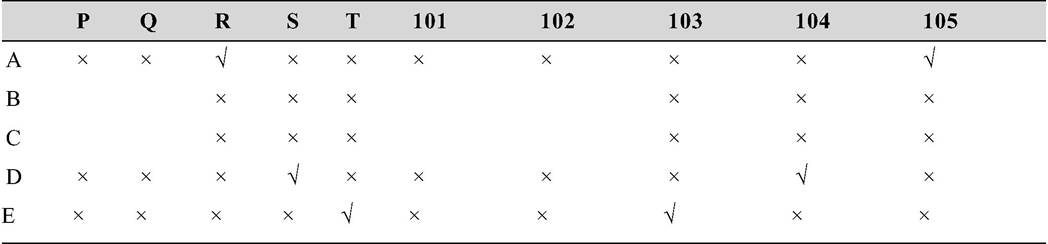
At this stage if you try to draw a time line for their marriages, you would get the following figure:
Existing figure ∣,πya 4 LkIakhiiAbhay
If we use the logic contained in Clue (vi), we get that Abhay married 5 years after Chandan.
Hence, Chandan and Priya must be married. Consequently Quindal and Balbir must be married. Also, since Balbir got married 3∕4th the number of years ago as Dinesh we can conclude that Balbir got married 15 years ago. Based on these deductions the timeline looks like: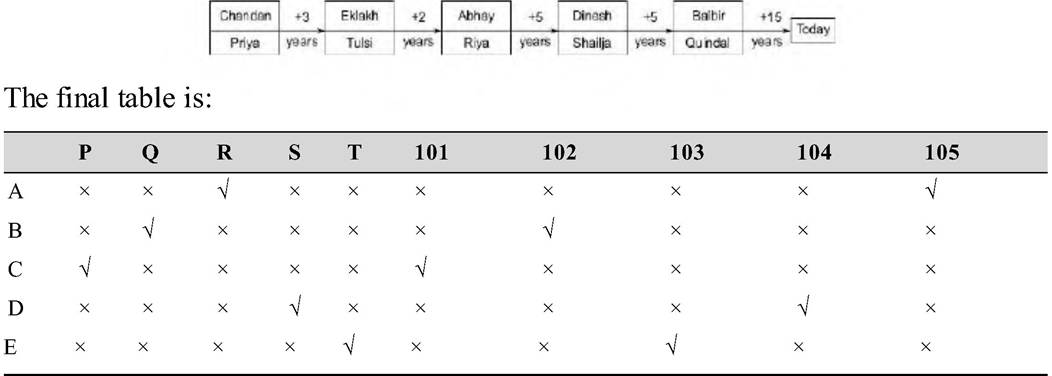
The answers are:
32. Abhay. Option (b) is correct.
33. Abhay has been married for 25 years. Option (b) is correct.
34. Quindal. Option (b) is correct.
35. All the rooms would need to shift. Option (d) is correct.
36. 27 years. Option (b) is correct.
37. We have two possible combinations.
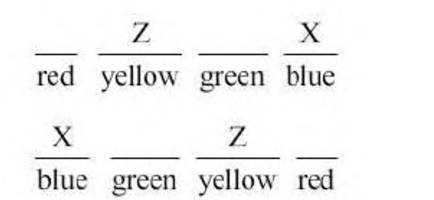
But from both combinations we get that X lives in the blue house. Option (a) is correct.
38. M would live in a palace as U,T and P like either black or blue and X lives in a hotel. Option (b) is correct.
39. The grid would be:

Option (c) is correct.
Questions 40 and 41: Let us tabulate the given information to get a clear picture of the scenario.
The first piece of information that fills the blanks is that no boy likes Commerce or Urdu. Then next information that is useful is that Dharmendra does not prefer Sociology and Statistics and is a boy hence he does not like Urdu and Commerce also. He is also brother of the person who opts for Computers. (Thus the person opting for computers must be a girl). So he must be having either Economics or Zoology. Now we are given that Amitabh and Bhagyashree are brother and sister and, hence Amitabh and Bhagyashree both will not have computers. Also Farhan is given as a boy student hence, by default from previous information, he does not like Urdu and Commerce, and also since he is a boy he cannot be Dharmendra’s sister and thus cannot have computers. Thus, we have covered all the possibilities for boys except for the pair of brother and sister having Economics and Sociology. Clearly since Amitabh and Bhagyashree are the only brother and sister mentioned in the information, they must be the ones having those subjects. Consequently Dharmendra must be having Zoology and Farhan would have Statistics. Commerce, Urdu and Computers would be shared between Chunky, Ekta and Govinda in some random order. Hence, they must be girls. The resultant table can be drawn as follows:
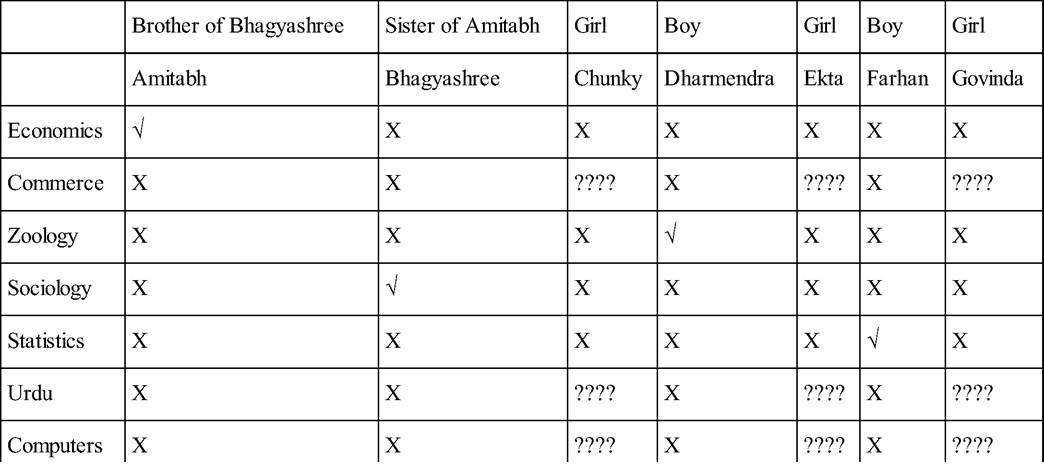
The answers are:
40. Option (d) is the correct answer as we do not know who Dharmendra’s sister is.
41. Option (c) is the correct answer as there are 4 girls in the group.
Questions 42 and 43: From the given information a table can be formed which will give a clear picture of the scenario.
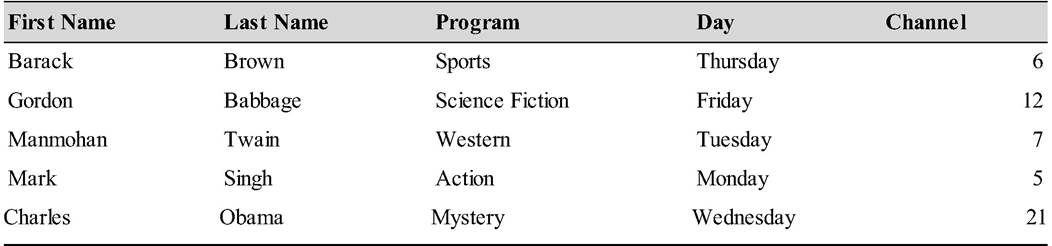
42. Option (c) is the correct answer.
43. Option (d) is the correct answer.
Questions 44 and 45: To solve the question, we have to decode the information step by step and hence interpret the information.
Anshul owns the Honda and Vivek teaches Bengali => Gujrati teacher owning Suzuki - who isn’t Anurag Kesarwani - is Siddhartha in House No. 4D (Clues (ii), (vi), (i), (viii))∙
Prof. Singh who teaches Sanskrit is Anshul (Clue (iv)). Anurag Kesarwani, who teaches Urdu owns 2001 model bike which is not BMW (Clue (v)), neither is it Suzuki nor Honda - an unknown make.
So, Vivek Khanduja owns BMW in House No. 3C and Siddhartha’s surname is Saxena (Clue (iii)).
Since Siddhartha’s vehicle is not a 2002 or 2004 model (Clue (vii)) and neither a 2001 model - it is model of an unknown year (which could be 2005 or an earlier year).
Now 2002 model belongs to House No. 2 and 2004 model to House No. 4.
Anshul Singh’s is 2002 model and VivekKhanduja5S is 2003 model.
Remaining House No. IA is Anurag Kesarwani,s.
The summary is as under
Anurag - Kesarwani - Urdu -???? - 2001
Anshul - Singh - Sanskrit - Honda - 2002
Vivek - Khanduj a - Bengali - BMW - 2003
Siddhartha - Saxena - Gujrati - Suzuki - ????
44. Option (c) is the correct answer.
45. Option (d) is the correct answer.
Questions 46 to 48: To understand the arrangement we need to tabulate all the clues and facts given in the question.
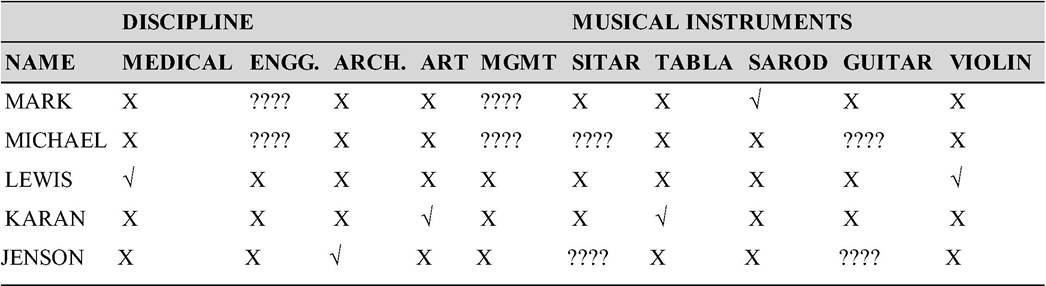
46. Hence Option (b) is the correct answer.
47. There is a choice of Engineering, Architecture and Management. Hence Option (d) is the correct answer.
48. No clear clue provided hence Option (d) is the correct answer.
Questions 49 to 51: The following solution table would emerge out of these clues.

Hence, the answers are:
49. Monday. Option (b)
50. Biology. Option (d)
51. Thursday. Option (d)
More on the topic Solutions:
- Foreword: Frances Moore Lappe
- ILLUSTRATION 4
- Cicero on Gyges’ ring and how Plutarch deals with the Puzzles
- PREFACE
- The British slave-free colony in Sierra Leone
- Somalia
- Preface
- Beakley Brian, Ludlow Peter (eds.). The Philosophy of Mind: Classical Problems/Contemporary Issues, 2nd edition. — Bradford Book Publication,2006. — 1080 p., 2006
- Legal battlefields after the 1994 genocide In Rwanda
- Towards the domestication of Rwandan genocide trials