Appropriate and Inappropriate Technologies and Productivity Differences
The models presented so far in this chapter explicitly introduced a slow process of technology diffusion from the world stock of knowledge to the set of techniques used in production in each country.
This was motivated either by some process of costly (and slow) technology absorption or because of barriers to technology adoption. However, as noted at the beginning of the chapter, in the highly globalized world we live in, where information technology and information flows make a wide range of blueprints easily accessible to most individuals and firms around the world, we should perhaps expect even faster technology transfer across countries. Why does rapid diffusion of ideas not remove all, or at least most, cross-country technology differences? Leaving the discussion of institutional or policy barriers preventing 718technology diffusion to later, in this section we focus on how “technology” differences and income gaps can remain substantial even with free flow of ideas.
A first important idea is that productivity differences may remain even if all differences in “techniques” disappear, because production is organized differently and the extent of inefficiency in production may vary across countries. A model along these lines will be discussed later in this chapter. Another important idea, which we now discuss, is that technologies of the world technology frontier may be inappropriate to the needs of specific countries, so that importing the most advanced frontier technologies may not guarantee the same level of productivity for all countries. At some level, this idea is both simple and attractive. Clearly, technologies and skills consist of bundles of complementary attributes and these bundles vary across countries, so that there is no guarantee that a new technology that works well given the skills and competences in the United States or Switzerland will also do so in Nigeria or Turkey.
Nevertheless, without specifying these attributes that make some technologies work well in certain nations and not in others, this story will have little explanatory power. In this section, we will discuss three versions of this story that may have some theoretical and empirical appeal. First, we will discuss how differences in exogenous (e.g., geographic) conditions may make the same set of technologies differentially productive in different areas. Second, we will discuss how differences in capital intensity across countries may change the appropriateness of different types of technologies. Finally, we will spend most of this section on the implications of differences in skill intensity across countries for the appropriateness of frontier technologies to developing economies. In this context, we will show how the degree of appropriateness or inappropriateness of technologies may arise endogenously in the world equilibrium and also introduce a model of economic growth where labor has to be allocated across different sectors, which is of independent interest.18.4.1. Inappropriate Technologies. The idea of inappropriate technologies can be best illustrated by an example on health innovations. Suppose that productivity in country j at time t, Aj (t), is a function of whether there are effective cures against certain diseases affecting their populations. Suppose that there are two different diseases, heart attack and malaria. Countries j = 1,...,J0 are affected by malaria and not by heart attacks, while j = J' + 1,...,J are affected by heart attacks and are unaffected by malaria. If the disease
affecting country j has no cure, then productivity in that country given by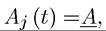 while
while
when a cure against this disease is introduced, we have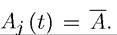 Now imagine that a
new cure against heart attacks is discovered and becomes freely available to all countries.
Consequently, the productivity in countries j = J0 + 1,...,J increases from but
but
productivity in countries j = 1,...,J' remains at This simple example thus illustrates how technologies of the world frontier may be “inappropriate” to the needs of some of the countries 719
(in this case, the J' countries affected by malaria). In fact, in this extreme case, a technological advance that is freely available to all countries in the world increases productivity in a subset of the countries and creates cross-country income differences.
Is there any reason to expect that issues of the sort might be important? The answer is both yes and no. Over 90% of the world R&D is carried out in OECD economies. There is therefore natural reasons to expect that new technologies should be optimized for the conditions in OECD countries or should explicitly deal with the problems that these countries are facing. This suggests that an analysis of the implications of appropriate technology is a promising area. Nevertheless, other than the issue of disease prevention, there are not many obvious fixed country characteristics that will create this type of “inappropriateness”. Instead, the issue of appropriate technology is much more likely to be important in the context of whether new technologies increasing productivity via process and product innovations will function well at different factor intensities. The next two subsections focus on whether technologies developed in advanced economies can be productively used at different capitallabor and skilled-unskilled labor ratios than those for which they have been designed.
18.4.2. Capital-Labor Ratios and Inappropriate Technologies. A classic paper by Atkinson and Stiglitz (1969) entitled “A New View of Technical Change” argued that a useful way of modeling technological change is to view it as shifting isoquants (increasing productivity) at a given capital-labor ratio.
For example, a firm that is using a specific machine, say a particular type of tractor, with a single worker, may discover a way to increase the productivity of the worker. This innovation can be used by any other firm employing the same tractor with a single worker. But it would be much less valuable to firms using oxen or less advanced tractors, or even to firms using more advanced tractors. Thus technological changes are localized for specific capital-labor ratios and when used with different capital labor ratios, they do not bring the same benefits. The implications of this observation for cross-country income differences can be quite major. If new technologies are developed for high capital-intensive production processes in OECD countries, they may be of little use to labor-abundant less-developed economies, where most production units will be functioning at lower capital-labor ratios than those in the OECD. This point is developed in the context of a Solow-type growth model by Basu and Weil (1998). I provide a simple version of their argument here.Suppose that the production technology for all countries in the world is

so that output per worker becomes 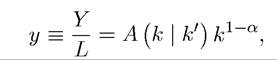
where k = K/L is the capital-labor ratio, and A (k | k') is the (total factor) productivity of technology designed to be used with capital-labor ratio k' when used instead with capitallabor ratio k. I have suppressed the time and country indices to simplify notation.
For example, suppose that

for some γ ∈ (0,1). That is, when a technology designed for the capital labor ratio k' is used with a lower capital-labor ratio, there is a loss in efficiency.
Now suppose that new technologies are developed in richer economies, which have greater capital-labor ratios.
Then productivity in a less developed country with the capital-labor ratio k < k' will be
An immediate implication of equation (18.15) is that less-developed countries will be less productive even when they are producing with the same techniques. Moreover this productivity disadvantage will be larger when the gap in the capital intensity of production between these countries and in the technologically advanced economies is greater. Depending on the value of the parameter γ, the implication of this type of inappropriateness might be important for understanding cross-country income differences. With the same arguments as in Chapters 2 and 3, we may want to think of α ≈ 2/3. Then an economy with an eight times higher capital-labor ratio then another would only be twice as rich, when both countries have access to the same technology and there is no issue of inappropriate technologies. But if γ = 2/3 and the county with the higher capital-labor ratio is the frontier one setting the level of k' in terms of the function A (k | k'), the implied difference would be eightfold rather than the twofold difference implied by the model that overlooked the issue of appropriate technology. Thus inappropriateness of technologies have the potential to increase the implied cross-country income differences, even when all countries have access to the same technologies. Exercise 18.20 provides more details on this model.
18.4.3. Endogenous Technological Change and Appropriate Technology. The Atkinson-Stiglitz and Basu-Weil approach discussed in the previous subsection emphasizes differences in capital intensity between rich and poor economies. The evidence discussed in Section 18.1 suggests that differences in human capital may be particularly important in the adoption of technology. Moreover, the past 30 years have witnessed the introduction of a range of skill-biased technologies both in developed economies and in many developing countries (see Autor, Katz and Krueger, 1998, Acemoglu, 2002b, for general surveys, Berman, Bound and Machin, 1998, for evidence across OECD countries, and Berman and Machin, 2000, for evidence on skill-biased technological change in developing economies).
Given this evidence, 721we may expect a mismatch between the skill requirements of frontier technologies and the available skills of the workers in less-developed countries to be potentially more important than differences in capital intensity. In this subsection, I outline the model introduced in Acemoglu and Zilibotti (2001), which emphasizes the implications of the mismatch between technologies developed in advanced economies and the skills of the work force of the less- developed countries. Furthermore, this will enable us to use the ideas related to directed technical change developed in Chapter 15 and also provide us with a tractable multi-sector growth model.
The world economy consists of two groups of countries, the North and the South, and as in Chapter 15, two types of workers, skilled and unskilled. There are two differences between the North and the South. First, all R&D and new innovations take place in the North (so that the North approximates the OECD or the US and some of the other advanced economies). Instead, the South simply copies technologies developed in the North. Because of lack of intellectual property rights in the South, we will presume that the main market of new technologies will be Northern firms. Second, the North is more skill-abundant than the South, in particular, 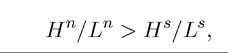
where Hj denotes the number of skilled workers in country j and Lj denotes the number of unskilled workers. We will use j = n or s to denote the North or the South, and assume that there are many Northern and many Southern countries. There is no population growth. Throughout, all countries have access to the same set of technologies, so there will be no issue of slow technology diffusion. All differences in productivity will arise from the potential mismatch between technology and skills.
On the preference side, all economies are assumed to admit a representative household with the standard preferences, e.g., (18.6) above with nj = O for all countries, since there is no population growth. The final good in each country is produced as a Cobb-Douglas aggregate of a continuum 1 of intermediate goods, that is,

where Yj (t) is the amount of final good in country j at time t, while yj (i, t) is the output of intermediate i. As usual, total output is spent on consumption, Cj (t), intermediate expenditures, Xj (t), and also in the North, there will be R&D expenditures equal to Zj (t). The South will not undertake R&D, but can adopt technologies developed in the North.
Let us assume that the technology for producing intermediate i in country j at time t is given as follows:

A number of features about this intermediate production function is worth noting. First each intermediate can be produced using two alternative technologies, one using skilled workers, the other one using unskilled labor. Here lj (i, t) is the number of unskilled workers working in intermediate i in country j at time t. hj (i, t) is defined similarly. Second, skilled and unskilled workers have different productivities in different industries—incorporating a pattern of crossindustry comparative advantage. In particular, the presence of the terms 1 — i and i in the production function (18.17) implies that skilled workers are relatively more productive in higher indexed intermediates, while unskilled workers have comparative advantage and lower indexed intermediates. Third, skilled workers also have an absolute advantage, captured by the parameter ω, which is assumed to be greater than 1. Fourth, as in the standard models with machine varieties, Xlj(i, v) denotes the quantity of machines of type v used with unskilled workers, and xhj(i,v) is defined similarly. This part of the production function is parallel to those used in Chapter 15. The number of machine varieties available to be used with skilled and unskilled workers differ and are equal to Nl (t) and Nh (t). The important point here is that these quantities are not indexed by j, since all technologies are available to all countries, that is, we are ignoring the issue of slow diffusion and focusing on differences arising purely from inappropriateness of technology. Finally, as usual, the term 1/ (1 — β) is introduced as a convenient normalization.
We assume that the final good sectors and the labor markets are competitive. Again as in Chapters 13 and 15, a technology monopolist can produce these machines at marginal cost ψ and supplies the quantities of machines. Let the prices of these machines be denoted by  for the two sectors in country j for machine of type ν at time t. Note that these prices do not depend on i, since the machines are not sector-specific. Instead, they are skill-specific. As in Chapters 13 and 15, profit maximization by the final good producers leads to the following demands for machines:

where pj (i,t) is the relative price of intermediate i in country j at time t in terms of the final good (which is set as the numeraire in each country). The technology monopolist in the 723
North will be the firm that invents the new type of machine, so here the analysis is identical to that in Chapters 13 and 15.
What about in the South? To keep the treatment of Northern and Southern economies symmetric, we assume that in each Southern economy a “technology” firm adopts the new technology invented in the North (at no cost) and acts as the monopolist supplier of that machine for the producers in its own country. Moreover, we assume that the marginal cost of producing machines for this firm is the same as the inventor in the North, equal to ψ.
As we have seen a number of times before, the isoelastic demand for machines imply that the profit-maximizing price for the technology monopolists will be a constant markup over marginal cost, and we normalize the cost to ψ ? 1 — β. The symmetry between the North and the South we have introduced above implies that the price of machines and thus the demand for machines will take the same form in all countries. In particular, we obtain output in sector i in any country j as

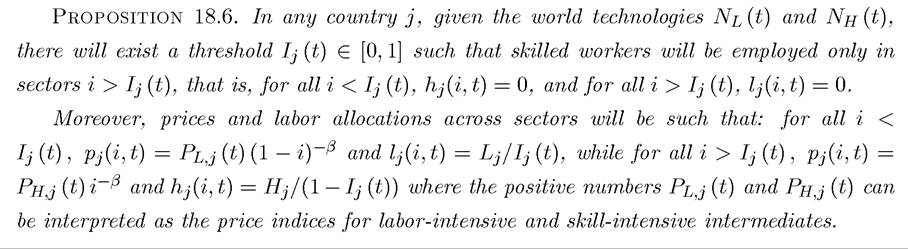
For each economy, Nl (t) and Nh (t) are the state variables. Given these state variables the equilibrium is straightforward to characterize. In particular, the following proposition characterizes the structure of equilibrium in each country.
Proof. See Exercise 18.21. ?
With Proposition 18.6, the characterization of equilibrium given the level a world technologies Nl (t) and Nh (t) is straightforward. In particular, the technology for the final goods sector in (18.16) implies that the price indices in country j at time t must satisfy

Moreover, the threshold sector Ij (t) in country j at time t is indifferent between using 

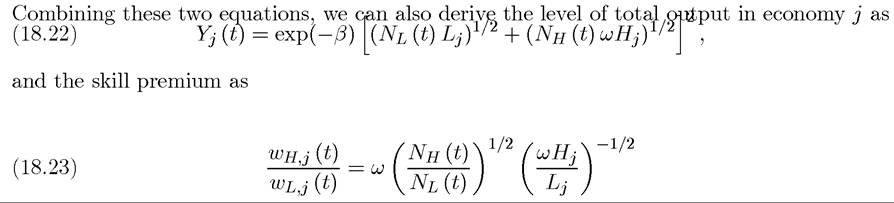
(see Exercise 18.22). An interesting feature of this characterization, apparent from equation (18.22) is that the multi-sector model in this section leads to an equilibrium allocation so that the level of output is identical to that given a constant elasticity of substitution production function within elasticity of substitution equal to 2. In fact, this phenomenon is more general and by changing the pattern of comparative advantage of skilled and unskilled workers in different sectors, one can obtain models with aggregate production functions of any elasticities of substitution.
The characterization of the equilibrium above already shows that the type of technologies, Nl (t) and Nh (t), will impact economies with different factor proportions differently. For example, consider the extreme case in which Hs = 0, so that there are no skilled workers in the south. Then an increase in Nh (t) will increase productivity in the North, but will have no effect in the South. Naturally, when there are skilled and unskilled workers in both the North and the South, the implications of the changes in these two technologies will not be as extreme, but the general principle will continue to apply: an increase in Nh (t) relative to Nl (t) will benefit the skill-abundant North more than the skill-scarce South. But conversely, an increase in Nl (t) will tend to benefit Southern economies relatively more. Thus the question becomes whether the world technology will be appropriate to the needs of the North or the South. Here the features that new technologies are developed in the North and that there are no intellectual property rights for Northern R&D in the South become important. In particular, these features imply that new technologies will be developed—designed—for the needs of the North.
To communicate the main ideas related to the emergence of technologies that are inappropriate to factor proportions in the South, let us adopt the simplest version of the directed technical change model from Chapter 15 (in particular, Section 15.3 with the lab equipment specification) and suppose that

which is the same as the innovation possibilities frontier in Section 15.3, except that η∣< and Пн have been set equal to each other for simplification. The analysis there, combined with 725
the fact that the relevant market sizes are given by Hn and Ln (because research firms can only sell their technologies to Northern firms) implies that the steady-state (balanced growth) equilibrium must take the following form:
Proposition 18.7. With the lab equipment specification of directed technical change as in (I8.24) and no intellectual property rights in the South, the unique steady-state equilibrium
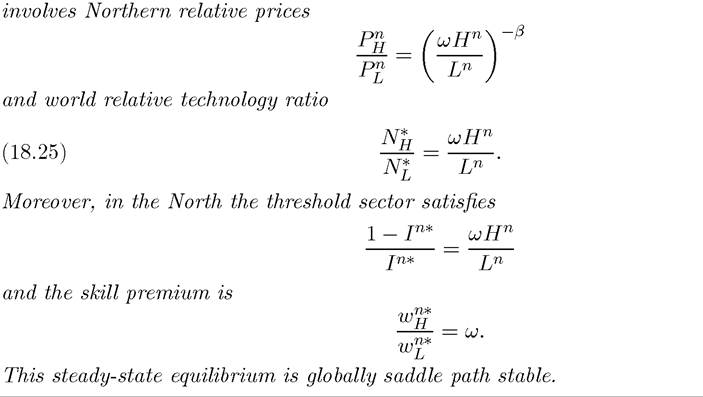
Proof. (Sketch) Equation (18.18) immediately implies that, given Nl (t) and Nh (t) and the prices of skilled and unskilled workers, relative profitability on employing skilled workers is strictly increasing in i ∈ [0,1]. This implies that there must exist a threshold Ij (t) as specified in the proposition. The Cobb-Douglas specification in (18.16) implies an allocation of labor across intermediates, and the corresponding relationship between the prices of intermediates using skilled labor and those using unskilled labor, so that expenditures on different intermediates are equalized. You are asked to complete the details of this argument, derive the expression for the threshold and the skill premium, and also establish the stability of the equilibrium in Exercise 18.23. ?
To understand the implications of directed technical change for equilibrium relative technologies Nl and Nh, let us next introduce three simple concepts. The first is net output in country j defined as

that is, output minus the spending on intermediates. The second and the third are income per capita and income per effective unit of labor in different countries, defined as

All of these quantities are functions of labor supplies and of relative technologies, in particular of Nh/Nl. These dependences are suppressed to simplify notation.
726
The next result shows that the steady-state technologies NL and N∏ are indeed “appropriate” for the conditions (factor proportions) in the North, and that this creates endogenous income differences between the North and the South.
Proposition 18.8. Consider the above-described model. Then:
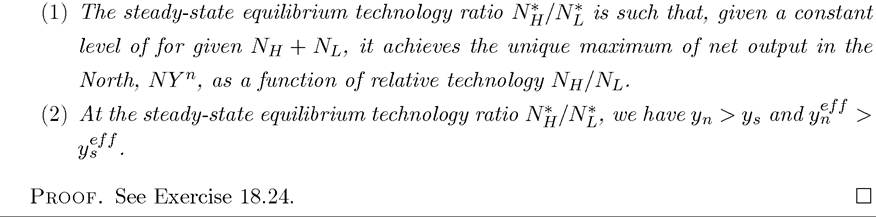
This proposition establishes two important results. First, the steady-state equilibrium technology is indeed appropriate for the needs of the North. This is intuitive, since research firms are innovating targeting the Northern markets (in particular the relative supply of skills in the North). Moreover, the statement that there is a unique maximum of NYn (given the total amount of “technology” Nh + Nl) also implies that net output in the South, NYs, given by a similar expression, will not be maximized by NH/NL. This is the essence of the second result contained in this proposition: because technologies are developed in the North (in practice, corresponding loosely to the OECD) and are designed for the needs (factor proportions) of Northern economies, they are inappropriate for the needs of the South. As a result, income per capita and income per effective units of labor in the North will be higher than in the South. Thus the process of directed technical change, combined with import of frontier technologies to less-developed economies, creates an advantage for the more advanced economies and acts as a force towards greater cross-country inequality. Therefore, the issue of potential mismatch between the technologies of the world frontier and the skills of less- developed countries creates a force towards large income per capita differences among these countries. Acemoglu and Zilibotti (2001) show that this source of cross-country income differences can be quite substantial in practice. Therefore, inappropriateness of technologies of the world to the needs of the less-developed countries, especially the potential mismatch between technology and skill, can create significant income differences.
18.5.