Capital-Skill Complementarity in an Overlapping Generations Model
The analysis in the previous section suggests that the neoclassical growth model with physical and human capital does not generate significant imbalances between these two different types of capital (unless we impose irreversibilities, in which case it can do so along the transition path).
I next investigate possibility of capital-skill imbalances in a simple overlapping generations model with impure altruism, similar to the models introduced in Section 9.6 of the previous chapter. I will see that this class of models also generates only limited capital-skill imbalances. Nevertheless, it provides a simple framework in which labor market frictions can be introduced, and capital-skill imbalances become much more important in the presence of such frictions. We will also use the model in this section to go back to the more natural production function, which features capital and effective units of labor (with human capital-augmenting the effective units of labor), as opposed to the production function used in the previous section with human capital as a third separate factor of production.The economy is in discrete time and consists of a continuum 1 of dynasties. Each individual lives for two periods, childhood and adulthood. Individual i of generation t works during adulthood at time t, earns labor income equal to w (t) hi (t), where w (t) is the wage rate per unit of human capital and hi (t) is the individual’s human capital. The individual also earns capital income equal to R (t) bi (t — 1), where R (t) is the gross rate of return on capital and bi (t — 1) is his asset holdings, inherited as bequest from his parent. The human capital of the individual is determined at the beginning of his adulthood by an effort decision. Labor is supplied to the market after this effort decision. At the end of adulthood, after labor and capital incomes are received, the individual decides his consumption and the level of bequest to his offspring.
Preferences of individual i (or of dynasty i) of generation t are given by 
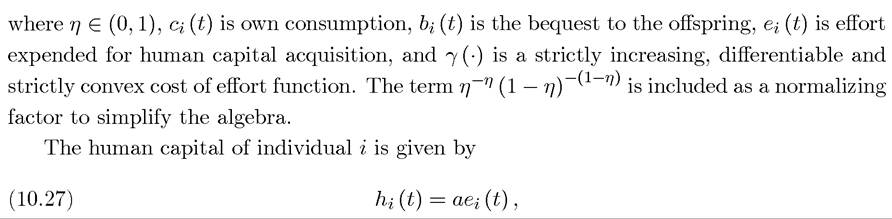 where a corresponds to “ability” and increases the effectiveness of effort in generating human capital for the individual. Substituting for ei (t) in the above expression, the preferences of
406
individual i of generation t can be written as

The budget constraint of the individual is
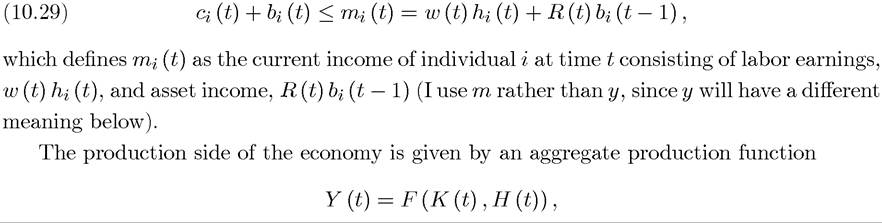
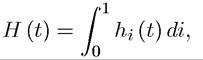
that satisfies Assumptions 1 and 2, where H (t) is “effective units of labor” or alternatively the total stock of human capital given by,
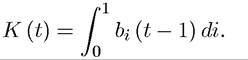
while K (t), the stock of physical capital, is given by
Note also that this specification ensures that capital and skill (K and H) are complements. This is because a production function with two factors and constant returns to scale necessarily implies that the two factors are complements (see Exercise 10.8), that is,

Furthermore, let us again simplify the notation by assuming capital depreciates fully after use, that is, δ = 1 (see Exercise 10.9).
Since the amount of human capital per worker is an endogenous variable in this economy, it is more useful to define a normalized production function expressing output per unit of human capital rather than the usual per capita production function. In particular, let κ ? K/H be the capital to human capital ratio (or the “effective capital-labor ratio”), and
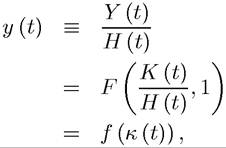
where the second line uses the linear homogeneity of F (∙, ∙), while the last line uses the definition of κ. Here we use κ instead of the more usual k, in order to preserve the notation k for capital per worker in the next section.
From the definition of κ, the law of motion ofeffective capital-labor ratios can be written as

Factor prices are then given by the usual competitive pricing formulae:

with the only noteworthy feature that w (t) is now wage per unit of human capital, in a way consistent with (10.29).

The characterization of an equilibrium is simplified by the fact that the solution to the
maximization problem of (10.28) subject to (10.29) involves
(10.33)
Ci (t) = ηmi (t) and bi (t) = (1 - η) mi (t),
and substituting these into (10.28), we obtain the indirect utility function (see Exercise 10.17):

which the individual maximizes by choosing hi (t) and recognizing that mi (t) = w (t) hi (t) + R (t) bi (t — 1). The first-order condition of this maximization gives the human capital investment of individual i at time t as


An important implication of this equation is that the human capital investment of each individual is identical, and only depends on the effective of capital-labor ratio in the economy. This is a consequence of the specific utility function in (10.28), which ensures that there are no income effects in human capital decisions so that all agents choose the same “incomemaximizing” level of human capital (as in Theorem 10.1).
Next, note that since bequest decisions are linear as shown (10.33),
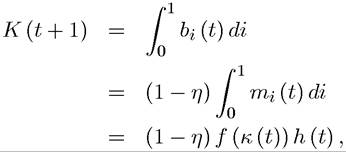
where the last line uses the fact that, since all individuals choose the same human capital level given by (10.36), H (t) = h (t), and thus Y (t) = f (κ (t)) h (t).
Now combining this with (10.31),

Using (10.36), this becomes



which defines the unique positive steady-state effective capital-labor ratio, κ* (since f (∙) is strictly concave).
PROPOSITION 10.2. In the overlapping generations economy with physical and human capital described above, there exists a unique steady state with positive activity, and the physical to human capital ratio is κ* as given by (10.38).
This steady-state equilibrium is also typically stable, but some additional conditions need to be imposed on f (∙) and γ (∙) to ensure this (see Exercise 10.18).
An interesting implication of this equilibrium is that, the capital-skill (k-h) complementarity in the production function F (∙, ∙) implies that a certain target level of physical to human capital ratio, κ*, has to be reached in equilibrium. In other words, physical capital should not be too abundant relative to human capital, and neither should human capital be excessive relative to physical capital. Consequently, this model does not allow equilibrium “imbalances” between physical and human capital either.
A possible and arguably attractive way of introducing such imbalances is to depart from perfectly competitive labor markets. This also turns out to be useful to illustrate how the role of human capital can be quite different in models with imperfect labor markets.
10.6.