Distributional Conflict and Competition
In this and the next section, I will use the canonical framework with Cobb-Douglas production functions and full depreciation of capital (δ = 1) to illustrate two important issues.
I will first investigate how competition (in the marketplace or in the political arena) between those with political power and the rest can lead to significantly more distortionary policies than the revenue extraction motive discussed so far in this chapter. In the next section I will use the same framework to derive some preliminary insights on how distributional conflict can provide perspectives on equilibrium economic institutions regulating the formation of policies.The model and the setup are essentially identical to the canonical Cobb-Douglas model in Section 22.2. In particular, the elite, of size θe, are in political power and decide all the policies. The timing of events is identical to that in Section 22.2. There are three differences.  two groups may differ, for example, because they are engaged in different economic activities (e.g., agriculture versus manufacturing, old versus new industries), or because they have different human capital or talent. Workers do not have access to these production functions and supply their labor inelastically. As in Section 22.2, each entrepreneur can hire at most L workers, and we no longer impose (22.6). Second, I reintroduce the constitutional maximum
  and τm (t), applying to middle-class entrepreneurs. The government budget constraint then takes the form

where φ ∈ [0,1] is a parameter that captures how much of tax revenue can be redistributed (with the remaining 1 — φ being wasted).
This parameter can be thought of as a measure of “state capacity”—with high φ, the state has the capacity to raise and redistribute significant revenues. Rn denotes rents from natural resources or from other sources unrelated to the production activities of the elite and the middle class. In Section 22.2, the government budget constraint, (22.8) involved φ = 1 and Rn = 0. These parameters will be useful for comparative static exercises below.Since there are entrepreneurs both from the elite and the middle class, the condition for full employment is different from (22.6). In particular, we assume throughout that and
and so that neither of the two groups generates enough labor demand by itself to
employ the entire labor force. The following condition then determines whether the elite and the middle class together will generate enough labor demand for the entire labor force:

When thiscondition holds, there will be full employment.When it does not (by which I mean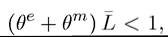 excluding the knife-edge case
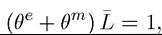 where there could be
multiple equilibrium wage levels), there is a shortage of labor demand and equilibrium wages will be equal to 0. Whether this condition holds or not will affect the nature of the political equilibrium.
The analysis in Section 22.2, in particular, equation (22.18), implies that the capital-labor ratio choice of each entrepreneur i ∈ Sm U Se will be given by

where the expression ki (τ) is implicitly defined by the second equality.
This expression is very similar to equation (22.11), but is adapted to the Cobb-Douglas production function, with labor-augmenting productivity of entrepreneur i equal to Ai. Substituting ki (τ) into the production function for each entrepreneur and subtracting the cost of investment, we obtain that the net revenue per worker This implies
 that the labor demand for each entrepreneur at time t as a function of the wage rate w (t) will take the form

This expression states that if the wage exceeds the net profitability for the entrepreneur, the entrepreneur would hire zero labor and shut down the firm. If the wage is strictly less than this net profitability, then the entrepreneur would like to hire up to the maximum possible amount of labor, L. The following proposition is immediate:
PROPOSITION 22.3. Consider the canonical elite-dominated politics model with Cobb- Douglas technology. Let the taxes on output of the elite and middle-class entrepreneurs at time t be τe (t) and τm (t), then the equilibrium capital-labor ratio of each entrepreneur is uniquely given by (22.20). In addition, if Condition 22.1 holds, then the equilibrium wage at time t is

If Condition 22.1 does not hold, then w (t) = O.
22.3.1. Competition in the Marketplace: The Factor Price Manipulation Effect. The next proposition is the equivalent of Proposition 22.2, except that it now applies when Condition 22.1 fails to hold. The reason for this is that, when this condition holds, there will also be the competition effect, changing the policy preferences of the elite. Propositions 22.4 and 22.5 below will focus on the implications of competition in the factor market.
PROPOSITION 22.4. Consider the canonical elite-dominated politics model with Cobb- Douglas technology. Suppose that Condition 22.1 does not hold and φ > 0, then the unique Markov Perfect Political Economy Equilibrium features

for all t. Te (t) is then determined from (22.19) holding as equality.
Proof. See Exercise 22.4. ?
This proposition thus shows that as in the version of the economy with Cobb-Douglas technology discussed in Section 22.2, the elite would like to set a tax rate of 1 — α on middleclass entrepreneurs. If this tax is less than the constitutionally allowed maximum the political equilibrium will involve τm = 1 — α. If on the other hand, T < 1 — α, the utility maximizing tax rate for the elite is τm = T (this follows because the maximization program of the elite is strictly concave, see Exercise 22.4). Notice, however, that this proposition is stated under the assumption that Condition 22.1 fails to hold—so that the equilibrium wage rate is w (t) = 0 for all t. If this were not the case, the elite would also recognize the effect of their taxation policy on equilibrium wages. This would introduce the competition motive in the choice of policies, which is our next focus. An extreme form of this competition effect is shown in the next proposition. The state this proposition, I introduce one more condition:

The role of this condition will be discussed below.

Proof. See Exercise 22.5. ?
In this case, φ is set equal to 0, so that there is no revenue extraction motive in taxation. Instead, the only reason why the elite might want to use taxes is in order to affect the equilibrium wage rate as given in (22.22).
Clearly, for this we need Condition 22.1 to hold; otherwise, the wage rate would be equal to zero and there would be known motive to 953manipulate factor prices. Condition 22.2 is necessary, since otherwise even at the maximal tax rate τ, the middle class entrepreneurs are more productive than the elite and the elite make zero profits. The noteworthy conclusion of Proposition 22.5 is that the equilibrium tax rate in this case, τfpm, is greater than the tax rate when the only motive for taxation was revenue extraction (τre). This might at first appear paradoxical, but is quite intuitive. With the factor price manipulation mechanism, the objective of the elite is to reduce the profitability of the middle class as much as possible, whereas for revenue extraction, the elite would like the middle class to invest and generate revenues. Consequently, τre puts the elite at the top of the Laffer curve, while τfpm tries to harm middle-class entrepreneurs as much as possible so as to reduce their labor demand (and thus equilibrium wages). It is also worth noting that, differently from the pure revenue extraction case, the tax policy of the elite is indirectly extracting resources from the workers, whose wages are being reduced because of the tax policy.
The role of the assumption that φ = 0 in this context also needs to be emphasized. Taxing the middle class at the highest rate is clearly inefficient. Why is there not a more efficient way of transferring resources to the elite? The answer again relates to the limited fiscal instruments available to the elite. In particular, φ = 0 implies that they cannot use taxes to extract revenues from the middle class, so they are forced to use inefficient means of increasing their consumption, by directly impoverishing the middle class. The absence of any means of transferring resources from the middle class to the elite is not essential for the factor price manipulation mechanism, however.
This will be illustrated next by combining the factor price manipulation motive with revenue extraction (though the absence of non-distortionary lump-sum taxes is naturally important).Naturally, the assumption that φ = 0 is extreme. The next proposition derives the equilibrium when Condition 22.1 holds and φ > 0, so that both the factor price manipulation and the revenue extraction motives are present. Proposition 22.5 showed that by itself the factor price manipulation motive leads to the extreme result that the tax on the middle class should be as high as possible. Revenue extraction, though typically another motive for imposing taxes on the middle class, will serve to reduce the power of the factor price manipulation effect. The reason is that high taxes also reduce the revenues extracted by the elite (moving the economy beyond the peak of the Laffer curve), and are costly to the elite. To derive the political equilibrium in this case, first note that the elite will again not tax themselves, i.e., τe (t) = 0 for all t. Next the maximization problem of the elite at time t — 1 for setting the tax rate τm (t) can be written as:
subject to (22.22) and

where Lm (t) denotes equilibrium employment by a middle-class entrepreneur and is equilibrium employment by an elite entrepreneur. The first term in (22.24) is the elite’s net revenues and the second term is the transfer they receive. Equation (22.25) is the labor market clearing constraint, while (22.26) ensures that middle class producers employ as much labor as they wish provided that their net productivity is greater than those of elite producers.
The solution to this problem can take two different forms depending on whether (22.26) holds at the optimal solution. If it does, then and elite producers
make zero profits and their only income is derived from transfers. Intuitively, this corresponds to the case where the elite prefer to let the middle class producers undertake all of the profitable activities and maximize tax revenues. In this case, the equilibrium will be clearly identical to that in Proposition 22.4. If, on the other hand, (22.26) does not hold, then the elite generate revenues both from their own production and from taxing the middle class producers. In this case, the equilibrium wage will be The
The
next proposition focuses on this case:
PROPOSITION 22.6. Consider the canonical elite-dominated politics model with Cobb- Douglas technology. Suppose that Condition 22.1 holds, φ > 0, and

Then the unique Markov Perfect Political Economy Equilibrium features

for all t, where

Proof. See Exercise 22.6. ?
955
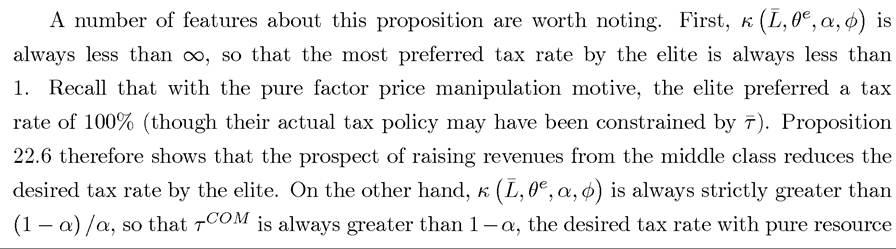
extraction. Therefore, the factor price manipulation motive always increases taxes above the pure revenue maximizing level, and thus beyond the peak of the Laffer curve (though never to as high as 100%). Naturally, if this level of tax is greater than T, the equilibrium tax will be T.
Second, since Proposition 22.6 incorporates both the revenue extraction and the factor price manipulation motives, it contains the main comparative static results of interest for us. First, the equilibrium tax rate is decreasing in φ, because as φ increases, revenue extraction becomes more efficient and this has a moderating effect on the tax preferences of the elites. Loosely speaking, this shows the positive side of “state capacity”; with greater state capacity, the politically powerful can raise revenues through taxation, thus their motives to impoverish competing groups become weaker (we will see a potentially negative or “dark” side of state capacity below). Second, the equilibrium tax rate is increasing in θe. The reason for this is again the interplay between the revenue extraction and factor price manipulation mechanisms. When there are more elite producers, reducing factor prices becomes more important relative to raising tax revenues. This comparative static thus reiterates that when the factor price manipulation effect is more important, there will typically be greater distortions. Third, a decline in α raises equilibrium taxes for exactly the same reason as in the pure revenue extraction case; taxes create fewer distortions and this increases the revenue-maximizing tax rate. Finally, for future reference, note that rents from natural resources, Rn, have no effect on equilibrium policies.
22.3.2. Political Competition: The Political Replacement Effect. The previous subsection illustrated how competition in the factor market between the elite and the middle class induces the elite to choose distortionary policies to reduce the labor demand from the middle class. In this section, I will briefly outline the implications of competition in the political arena for equilibrium taxes. The main difference from the models studied so far is that we will allow for endogenous switches of political power. Institutional change and the implications of different political regimes for economic growth will be discussed in greater detail in the next chapter. For now, let us denote the probability that in period t political power permanently shifts from the elite to the middle class by η (t). Once they come to power, the middle class will pursue the policies that maximize their own utility. We can easily derive what these policies would be using the same analysis as in the previous subsection. Since the analysis is identical to that above, this is left to Exercise 22.7. Denote the utility of the elite when they are in control of politics and when the middle class are in control of politics by Ve (E) and Vе (M) respectively.
When the probability of the elite losing power to the middle class, η, is exogenous, the analysis in the previous subsection applies without any significant change. New political 956
economy effects arise, however, when the probability that the elite will lose power is endogenous. To save space while communicating the main ideas, I use a very reduced-form model and assume that the probability that the elite will lose power to the middle class is a function of the net income level of the middle class, in particular,

where Cm (t) is the net income of a representative middle-class entrepreneur, which is also equal to his consumption. I assume that η is continuously differentiable and strictly increasing, with derivative This assumption implies that when the middle class producers
are richer, they are more likely to gain power, which may be because with greater resources, they may be more successful in solving their collective action problems or they may increase their military power. The assumption that when the middle class are better-off they are more likely to replace the elite is not just reduced-form but also only approximates certain situations. One can also imagine environments in which groups that are better-off are less likely to take action against the existing regime. This issue will be discussed in the next chapter (using a more microfounded model) in the context of endogenous changes in political institutions.
To simplify the discussion, let us focus on the case in which Condition 22.1 fails to hold, so that equilibrium wage is equal to 0 and there is no factor price manipulation motive. Thus in the absence of the political replacement motive, the only reason for taxation will be revenue extraction (resulting in an equilibrium tax rate of τre). Given these assumptions and the definitions of Vе (E) and Vе (M), we can write the maximization problem of the elite when choosing the tax rate τm (t) at t — 1 as

where I wrote η [τm] to emphasize the dependence of the replacement probability on the tax rate on the middle class (while economizing on notation by not explicitly spelling out the argument of the η (∙) function).
The first-order condition for an interior solution for the tax rate τm is:
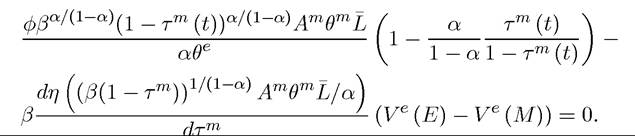
The first-term in this first-order condition corresponds to the revenue extraction motive, while the second term relates to the political replacement effect. Inspection of this condition shows that when as above. However, when

The important point here is that, as with the factor price manipulation mechanism, the elite tax beyond the peak of the Laffer curve. Their objective is not to increase their current revenues, but to consolidate their political power (in fact, taxes beyond the peak of the Laffer curve reduce the current income of the elite). However, higher (more distortionary) taxes are useful for the elite because they reduce the income of the middle class and their political power. Consequently, there is a higher probability that the elite remain in power in the future, enjoying the benefits of controlling the fiscal policy.
A number of new comparative static results follow from the possibility that the elite might lose political power. First, as Rn increases, it is straightforward to verify that the gap between Vе (E) and Vе (M) increases (see Exercise 22.7). This immediately translates into a higher equilibrium tax rate on the middle class. Intuitively, the party in power receives the revenues from natural resources, Rn and when these revenues are higher, political stakes— defined as the value of controlling political power—are greater. Consequently, the elite are more willing to sacrifice tax revenue (by overtaxing the middle class) in order to increase the probability that they remain in power (because remaining in power has now become more valuable). This contrasts with the results so far where Rn had no effect on taxes. Moreover, in this case a higher state capacity, φ, also increases the gap between Ve (E) and Vе (M) (because this enables the group in power to raise more tax revenues, see Exercise 22.7) and thus creates a force towards higher equilibrium taxes (though this effect might be dominated by the tax-reducing effect of φ emphasized in the previous subsection). This comparative static result therefore shows the potential dark side of greater state capacity; when there is no political competition, greater state capacity, by allowing more efficient forms of transfers, improves the allocation of resources. In contrast, in the presence of political competition, a greater state capacity, increases the political stakes and may induce more distortionary policies.
Finally, when the replacement of the elite by the middle class is very likely, i.e., η ≈ 1 or when such political replacement is very unlikely, i.e., η (∙) ≈ 0, we will have that η0 (∙) will be uniformly low. In these cases, there is only limited increase in the tax rate above the revenue maximizing level. It is only when η takes intermediate values that depend on the wealth level of the middle class that η0 (∙) is high and the political replacement effect leads to substantially more distortionary taxes. Therefore, we expect the elite to choose more distortionary policies when they have an intermediate level of security (rather than when they are entirely secure in their political power, i.e., η (∙) ≈ 0, or when they definitely expect to replaced, i.e., η (∙) ≈ 1). This is the sense in which the political replacement effect here
is very similar to the replacement effect pointed out by Arrow in the context of innovation (recall Chapter 12).
22.3.3. Subgame Perfect Versus Markov Perfect Equilibria. I have so far focused on Markov Perfect Equilibria (MPE). In general, such a focus can be restrictive. A natural question is whether the set of Subgame Perfect Equilibria (SPE) is larger than the set of the MPE and whether some of the SPE can lead to more efficient allocation of resources (see Appendix Chapter C for formal definitions of MPE and SPE and differences between the two concepts). We will first see that in the setup analyzed so far the set of SPE and MPE coincide (this is of course not always the case, for example, as suggested by the discussion in footnote 2). We will then turn to potential holdup problems, exacerbating the commitment problems involved in the economy, and see that the SPE can lead to a more efficient allocation of resources than the MPE because it allows for greater “equilibrium commitment” on the part of the elite.
Essentially, the MPE are generally a subset of the SPE, because the latter include equilibria supported by some type of “history-dependent punishment strategies”. If there is no room for such history dependence, SPEs will coincide with the MPEs. In the models analyzed so far, such punishment strategies are not possible even in the SPE. Intuitively, each individual is infinitesimal and makes its economic decisions to maximize profits. Therefore, (22.20) and
(22.21) determine the factor demands uniquely in any equilibrium. Given the factor demands, the payoffs from various policy sequences are also uniquely pinned down. This means that the returns to various strategies for the elite are independent of history. Consequently, there cannot be any SPEs other than the MPE characterized above. Therefore, we have:
Proposition 22.7. The MPEs characterized in Propositions 22.f-22.6 are the unique SPEs.
Proof. See Exercise 22.9. ?
In addition, Exercise 22.10 shows that the MPE in the model of subsection 22.3.2 is also the unique SPE. This last result, however, depends on the assumption that there is only one possible power switch (from the elite to the middle class). If, instead, there were continuous power switches, potential punishment strategies could be constructed and the set of SPEs could include non-Markovian equilibria.
22.3.4. Lack of Commitment—Holdup. The models discussed so far featured full commitment to one-period ahead taxes by the elites. In particular, at the end of period t, the elite (and in the model of Section 22.7, the median voter) could commit to the tax rate on output that would apply at time t + 1. Using a term from organizational economics, this corresponds to the situation without any “holdup”. Holdup, on the other hand, corresponds
to a situation without commitment to taxes or policies, so that after entrepreneurs have undertaken their investments they can be “held up” by higher rates of taxation or by expropriation. These types of holdup problems are endemic in political economy situations, since commitments to future policies is difficult or impossible. Those who have political power at a certain point in time are likely to make the relevant decisions at that point. Moreover, when the key investments are long-term (so that once an investment is made, it is irreversible), there will be a holdup problem even if there is a one period commitment (since there will be taxes that will affect this investment after the investment decisions are sunk).
The problem with holdup is that the elite will be unable to commit to a particular tax rate before middle class producers undertake their investments (taxes will be set after investments). This lack of commitment will generally increase the amount of taxation and distortions. Moreover, in contrast to the allocations that we have seen so far, which featured distortions but were Pareto optimal, the presence of commitment problems will lead to Pareto inefficiency. To illustrate the main issues that arise in the presence of commitment problems in the simplest possible way, I consider the same model as above, but change the timing of events such that taxes on output at time t are decided in period t, that is, after the capital investments for this period have already been made (instead of at t — 1, before these capital investments, as we have assumed so far). The economic equilibrium is essentially unchanged, and in particular, (22.20) and (22.21) still determine factor demands, with the only difference that τm and τe now refer to “expected” taxes. Naturally, in equilibrium expected and actual taxes coincide.
What is different is the calculus of the elite in setting taxes. Previously, they took into account that higher taxes on output at date t would discourage investment for production at date t. Since, now, taxes are set after investment decisions are sunk, this effect is absent. As a result, in the MPE, the elite will always want to tax at the maximum rate, so in all cases, there is a unique MPE where τm (t) = τhp ? T for all t. This establishes:
PROPOSITION 22.8. With holdup, there is a unique Markov Perfect Political Economy Equilibrium with
It is clear that this holdup equilibrium is more inefficient than the equilibria characterized above. For example, imagine a situation in which Condition 22.1 fails to hold, so that with the original timing of events (without holdup), the equilibrium tax rate is
Consider the extreme case where Now without holdup,
 and there
is positive economic activity by the middle class producers. In contrast, with holdup, the equilibrium tax is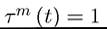 and the middle class stop producing. This is not only costly for
the middle-class entrepreneurs, but also for the elite since they lose all their tax revenues.
960
In this model, it is no longer true that the unique MPE is the only SPE, since there is room for an implicit agreement between different groups whereby the elite (credibly) promise a different tax rate than T. Relatedly, the MPE in this model, provided in Proposition 22.8 is Pareto inefficient, and a social planner with access to exactly the same fiscal instruments can improve the utility of all agents in the economy.
To illustrate the difference between the MPE and the SPE (and the associated Pareto inefficiency of the MPE), consider the example where Condition 22.1 fails to hold and T = 1. Recall that the history of the game is the complete set of actions taken up to that point. In the MPE, the elite raise no tax revenue from the middle class producers. Instead, consider  in the history, the elite set τm = 1 and the middle class producers invest zero. Does this strategy constitute a SPE? First, it is clear that the middle class have no profitable deviation, since at each t, they are choosing their best response to taxes along the equilibrium path as implied by (22.20). To check whether the elite have a profitable deviation, note that with

If, in contrast, they deviate at any point, the most profitable deviation for them is to set 3001" class="lazyload" data-src="/files/uch_group77/uch_pgroup317/uch_uch7364/image/image2999.jpg">and they will raise a tax revenue of

at that period. Following such a deviation, the continuation equilibrium involves switching to the unique MPE (which is here the worst possible continuation SPE). We have seen above that, with T = I the continuation value of the elite in this case is equal to 0. Therefore, the trigger-strategy profile will be an equilibrium as long as (22.31) is greater than or equal to
(22.32), which requires β ≥ α. Therefore we have:
PROPOSITION 22.9. Consider the holdup game, and suppose that Condition 22.1 holds and that T = I. Then for β ≥ α, there exists a SPE where
Proof. See Exercise 22.11. ?
An important implication of this result is that in societies where there are greater holdup problems, for example, because typical investments involve longer horizons, the MPE leads to a Pareto inefficient equilibrium allocation and there is room for coordinating on a SPE supported by an implicit agreement (trigger strategy profile) between the elite and the rest 961
of the society that can make all the agents in the society better-off. This analysis also shows that whether we use the MPE or the SPE equilibrium concept has important implications for the the structure of the equilibrium and its efficiency properties. While the use of the equilibrium concept is a choice for the modeler, different equilibrium concepts approximate different real-world situations. For example, MPE may be much more appropriate when the institutional structure, the frequency of interactions or the past history make coordination and mutual trust unlikely, while SPE may be be useful in modeling equilibria in societies where some degree of mutual trust can be developed among the different parties with conflicting interests.
22.3.5. Technology Adoption. Another source of holdup comes from the technology adoption decisions of entrepreneurs, which may, in practice, be more important than the timing of taxes. Many important technology adoption decisions are made with the long horizon in mind, thus future tax rates matter for these decisions. The analysis earlier in the book highlighted the importance of technology adoption decisions for economic growth, thus the new types of political economy interactions that arise in the presence of such decisions are of practical as well as theoretical interest.
To illustrate the main issues raised by the presence of technology adoption decisions, let us go back to the original timing where taxes for time t + 1 are set and committed to at time t (so that the source of holdup in the previous subsection is now removed). Instead, suppose that at time t = 0 before any economic decisions or policy choices are made, middle class agents can invest to increase their productivity. In particular, suppose that there is a cost Γ (Am) of investing in productivity Am. The function Γ is non-negative, continuously differentiable and convex. This investment is made once and the resulting productivity Am applies forever after.
Once investments in technology are made, the game proceeds as before. Since investments in technology are sunk after date t = 0, the equilibrium allocations are the same as those presented above. The interesting question is whether the presence of the technology adoption decisions creates additional inefficiencies (including Pareto inefficiencies). One way of answering this question is to ask whether, if they could, the elite would prefer to commit to a tax rate sequence at time t = 0 different from the MPE or the SPE tax sequence characterized above. The following proposition answers this question in the case of pure factor price manipulation affect:
PropoSITION 22.10. Consider the game with technology adoption and suppose that Condition 22.1 and 22.2 hold and φ = O. Then the unique MPE and the unique SPE involve  for all t. Moreover, if the elite could commit to a tax sequence at time t = 0, then they would still choose
The result that the allocation described in the proposition is the unique MPE follows immediately from the analysis so far. The fact that it is also the unique SPE follows from Proposition 22.7 and implies that the elite would choose exactly this tax rate even if they could commit to a tax rate sequence at time t = 0. The reason is intuitive: in the case of pure factor price manipulation, the only objective of the elite is to reduce the middle class’ labor demand, so they have no interest in increasing the productivity of middle class producers.
The situation is quite different, however, when the elite would also like to extract revenues from the middle class. To illustrate this in the starkest possible way, let us next consider the pure revenue extraction case, where Condition 22.1 fails to hold (so that the equilibrium wage is equal to 0 and there is no factor price manipulation). Once again, the MPE is identical to before and involves a tax of as in (22.23) at each date. As a result, the first-order condition for an interior solution to the middle class producers’ technology choice is:

Once again, Proposition 22.7 implies that a tax rate of and
and
technology choice given by (22.33) is also the unique SPE. Intuitively, once again after the middle class producers have made their technology decisions, there is no history-dependent action left, and it is impossible to create history-dependent punishment strategies to support a tax rate different than the static optimum for the elite. However, in this case this equilibrium allocation is Pareto inefficient and in fact, if the elite could commit to a tax rate sequence at time t = 0, they would choose lower taxes. To illustrate this, suppose that the elite can indeed commit to a constant tax rate at t = 0 (it is straightforward to show that they will in fact choose a constant tax rate even without this restriction, but this restriction saves on notation). Therefore, the optimization problem of the elite is to maximize tax revenues taking the relationship between taxes and technology as in (22.33) as given. In other words, they will maximize The constraint (22.33)
incorporates the fact that (expected) taxes affect technology choice.
The first-order condition for an interior solution can be expressed as

where takes into account the effect of future taxes on technology choice at time
t = 0. This expression can be obtained by differentiating (22.33) written with
 instead of
  This immediately implies that the solution to the maximization problem of the elite when they can commit to a tax rate sequence at t = 0 has a solutioι
(provided that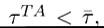 for example, because τ is sufficiently close to 1). Hence, if they
could, the elite would commit to a lower tax rate in the future in order to encourage the middle class producers to undertake technological improvements. Their inability to commit to such a tax policy leads to more distortionary policies (and in fact in this case to Pareto inefficiency). The next proposition states this result and to simplify the statement, I assume τ = l.
PROPOSITION 22.11. Consider the game with technology adoption, and suppose that Condition 22.1 fails to hold, that Condition 22.2 holds, that φ > 0 and that 1. Then the unique

An important feature is that in contrast to the pure holdup problem where SPE could prevent the additional inefficiency (when β ≥ α, recall Proposition 22.9), with the technology adoption game, the inefficiency survives the SPE. The reason is that, since middle class producers invest only once at the beginning, there is no possibility of using history-dependent punishment strategies. This illustrates the limits of implicit agreements to keep tax rates low. Such agreements not only require a high discount factor (β ≥ α), but also frequent investments by the middle class, so that there is a credible threat against the elite if they deviate from the promised policies. When such implicit agreements fail to prevent the most inefficient policies, there is greater need for economic institutions to play the role of placing limits on future policies.
22.4.