Exercises
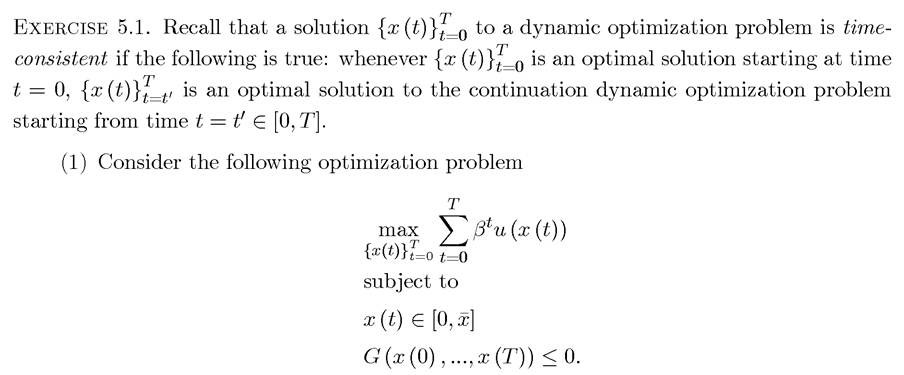
197
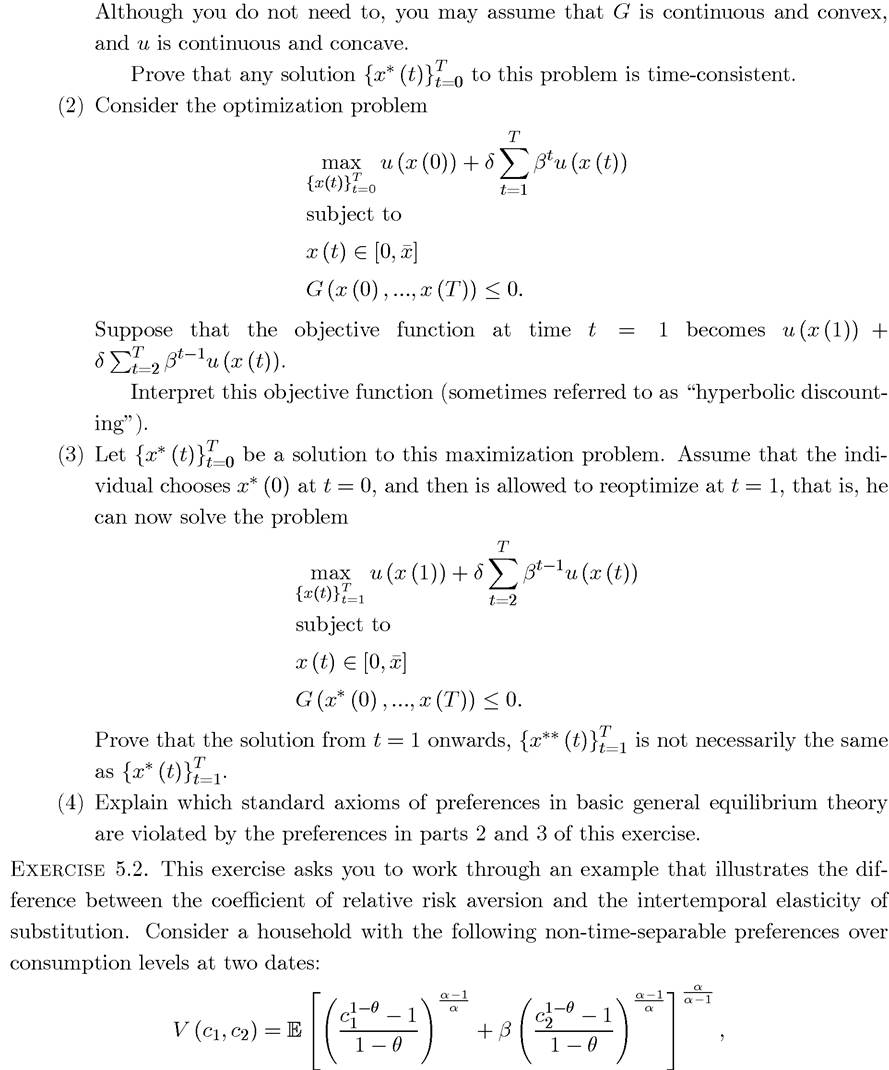
where E is the expectations operator.
The budget constraint of the household is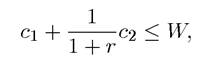
where r is the interest rate and W is its total wealth, which may be stochastic.
(1) Let us first suppose that W is nonstochastic and equal to Wo > 0. Characterize the utility maximizing choice of ci and c2.
(2) Compute the intertemporal elasticity of substitution.
(3) 
choice of ci and compute the coefficient of relative risk aversion. Provide conditions under which the coefficient of relative risk aversion is the same as the intertemporal elasticity of substitution. Explain why the two differ and interpret the conditions under which they are the same.
Exercise 5.3. Prove Theorem 5.2.
Exercise 5.4. Prove a version of Theorem 5.3 when there is also production.
Exercise 5.5. * Generalize Theorem 5.3 to an economy with a continuum of commodities.
Exercise 5.6. (1) Derive the utility maximizing demands for consumers in Example
5.1 and show that the resulting indirect utility function for each consumer is given by (5.5).
(2) Show that maximization of (5.6) leads to the indirect utility function corresponding to the representative household.
 Repeat the same computations and verify that the resulting indirect utility function is homogeneous of degree 0 in p and y, but does not satisfy the Gorman form. Show, however, that a monotonic transformation of the indirect utility function satisfies the Gorman form.
Exercise 5.7. Construct a continuous-time version of the model with finite lives and random death. In particular suppose that an individual faces a constant (Poisson) flow rate of death equal to ν > 0 and has a true discount factor equal to ρ. Show that this individual will behave as if he is infinitely lived with an effective discount factor of ρ + ν.
Exercise 5.8. (1) Will dynastic preferences as those discussed in Section 5.2 lead to
infinite-horizon maximization if the instantaneous utility function of future generations are different (ut (∙) potentially different for each generation t)?
(2) How would the results be different if an individual cares about the continuation utility of his offspring with discount factor β, but also cares about the continuation utility of the offspring of his offspring with a smaller discount factor δ?
Exercise 5.9. Prove Theorem 5.8.
Exercise 5.10. Consider the sequential trading model discussed above and suppose now that households can trade bonds at time t that deliver one unit of good 0 at time t'. Denote the price of such bonds by qtt∣.
(1) Rewrite the budget constraint of household h at time t, (5.22), including these bonds.
(2) Prove an equivalent of Theorem 5.8 in this environment with the extended set of bonds.
Exercise 5.11. Consider a two-period economy consisting of two types of households. Na households have the utility function
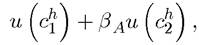
where cf( and c) denotes the consumption of household h into two periods. The remaining Nb households have the utility function
481" class="lazyload" data-src="/files/uch_group77/uch_pgroup317/uch_uch7365/image/image481.jpg">
with вв < βa. The two groups have, respectively, incomes yA and ув at date 1, and can save this to the second date at some exogenously given gross interest rate R > 0.
Show that for general u (∙), this economy does not admit a representative household.Exercise 5.12. Consider an economy consisting of N households each with utility function

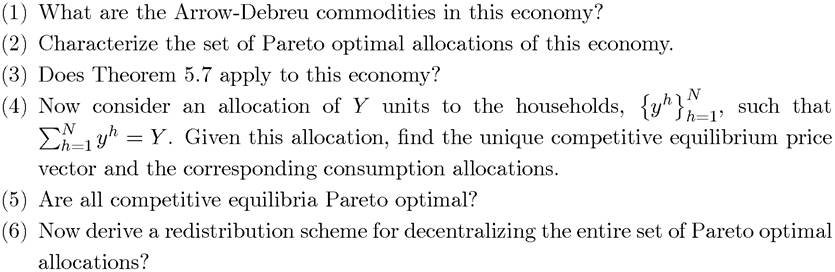
with β ∈ (0,1), where denotes the consumption of household h at time t. The economy starts with an endowment of Y units of the final good and has access to no production technology. This endowment can be saved without depreciating or gaining interest rate between periods.
More on the topic Exercises:
- EXERCISE ON QUANTITATIVE REASONING
- Normative Foundations
- PREFACE
- Preface
- Conclusion
- Bibliographical Essay
- BETWEEN- AND WiTHiN-COUNTRY INEQUALITY
- PRAEDIAL SERVITUDES
- FIVE COMPONENTS OF LEGAL COMPETENCIES