EXERCISE ON QUANTITATIVE REASONING
Directions for Questions 1 to 5: A quiz competition was organised in a school and the performance of students was recorded on piece of paper with ink. But somehow some water fell on the paper and the information remained incomplete.
However the scorer has same clues which are:

(i) Half the students were either excellent or good.
(ii) 40% of the students were females.
(iii) One-third of the males students were average.
1. How many students are both female and excellent?
(a) 0 (b) 8
(c) 16 (d) None of these
2. What proportion of good students are male?
(a) 0.73 (b) 0
(c) 0.4 (d) None of these
3. What proportion of female students are good?
(a) 0.25 (b) 0
(c) 0.5 (d) None of these
4. How many students are both male and good?
(a) 16 (b)24
(c) 27 (d) None of these
5. Among average students, what is the ratio of males to females?
(a) 1:3 (b) 2:3
(c) 3:2 (d) None of these
Directions for Questions 6 to 10: A, B, C and D are four friends living together in a
flat and they have an agreement that whatever edible comes they will share equally among themselves. One day A’s uncle came to him and gave him a box of Iaddoos. Since no one was around, A divided the Iaddoos in four equal parts and ate his share after which he put the rest in the box. As he was closing the box, B walked in, took the Box from A & divided the Iadoos in 4 equal parts & A & B took one part each and ate it. Suddenly C appeared and snatched the box. He again divided the Iaddoos in four equal parts, the three of them ate one part each and kept the remaining Iaddoos in the box. Later when D came he again divided the Iaddoos in four equal parts and all four ate their respective share. In total D ate 3 Iaddoos.
6.
How many Iaddoos, in total did C eat?(a) 12 (b) 15
(c) 39 (d) None of these
7. How many Iaddoos, in total did B eat?
(a) 24 (b) 15
8. How many Iaddoos, in total did A eat?
(a) 56 (b) 68
(c) 71 (d) None of these
9. How many Iaddoos were given to A by his Uncle?
(a) 128 (b) 125
(c) 113 (d) None of these
10. How many Iaddoos did A eat the first time?
(a) 32 (b) 24
(c) 15 (d) None of these
Directions for Questions 11 to 14: Rajeev planted some plants in his lawn but in certain fixed pattern:
i. In most of the rows there are neither Roses nor Marigolds.
11. There are two more rows of Orchids than Tulips and two more rows of Roses than Orchids.
iii. There are four more rows of Roses than Tulips.
iv. There aren’t as many rows of Lilly as Fireball.
V. There is one less Marigold row than Rose.
vi. There is just one row of Tulips.
vii. The maximum number of rows he planted is six.
11. How many rows of rose did he planted?
(a) Two (b) Five
(c) Four (d) Cannot be determined
12. Which of the above information is redundant and can be dispensed with?
(a) (i) (b) (iii)
(c) (i) and (iii) both (d) All are necessary
13. What is the sum of the rows of Orchids and Marigold he planted?
(a) Three (b) Nine
(c) Seven (d) Cannot be determined
14. How many rows of fireball did he plant?
(c) Two or Six (d) Data inadequate
Directions for Questions 15 to 20: In a class of 540 students, for every 9 girls these are 11 boys. The weight of students varies from 40 to 50 kg. There are as many 44 kg girls as there are 46 kg boys and as many 40 kg boys as 50 kg girls. The number of 50 kg boys is 35 more than that of 44 kg girls while there are as many 44 kg boys as 46 kg girls. The ratio of 40 kg boys and girls is 4:3 while that of 50 kg girls and boys is 1:3.
15. How many boys weigh 40 kg?
(a) 22 (b) 24
(c) 28 (d) None of these
16. How many girls weigh 44 kg?
(a) 37 (b) 36
(c) 39 (d) None of these
17.
How many girls weight 46 kg?(a) 165 (b) 164
(c) 146 (d) None of these
18. The number of boys weighing 50 kg is:
(a) 72 (b) 74
(c) 76 (d) None of these
19. The number of girls weighing 40 kg is:
(a) 16 (b) 18
(c) 22 (d) None of these
20. The number of students weighing 50 kg is:
(a) 96 (b) 42
(c) 201 (d) None of these
Directions for Questions 21 to 26: A, B, C, D and E are five different integer. When written in the ascending order of values, the difference between any two adjacent integers is 4. D is the greatest and A the least. B is greater than E but less than C. The sum of the integers is equal to E.
21. The value of A is:
(a) -7 (b) -9
(с) -5 (d) None of these
22. The sum of A and B is:
(a)-10 (b)-15
(c) 10 (d) None of these
23. The greatest number has the value:
(a) 9 (b) -5
(c) 3 (d) 7
24. The sum of the integers is:
(a) 25 (b) -6
(c) -15 (d) None of these
25. The product of the integers is:
(a) -945 (b) 945
(c) 315 (d) None of these
26. What is the positive difference between the lowest and the highest integers?
(a) 8 (b) 6
(c) 16 (d) None of these
Directions for Questions 27 to 31: InNovember the answers of a prestigious test held nationwide were leaked to a group of unscrupulous people. The CBI has arrested the Don, the mastermind behind it and nine other people—P, Q, R, S, T, U, Y W and X in this matter. On interrogation, certain facts came into light:
Their modus operandi consisted of the Don initially obtaining the answer key, then the other nine persons created their answer keys in the following manner:
They obtained the answer key from one or two sources, then he/she compares the answer keys to a question from both sources. If the key to a question from both sources is identical, it is copied, otherwise it is left blank. If the person has only one source, he/she copies the source’s answer into his/her copy. Finally, each person compulsorily replaces one of the answers (not a blank one) with a wrong answer in his/her answer key.
The paper contained 150 questions. So the CBI has ruled out the possibility of two or more of them introducing wrong answer to the same question. The CBI has a copy of correct answer key and tabulated the following data. The data represents question numbers.
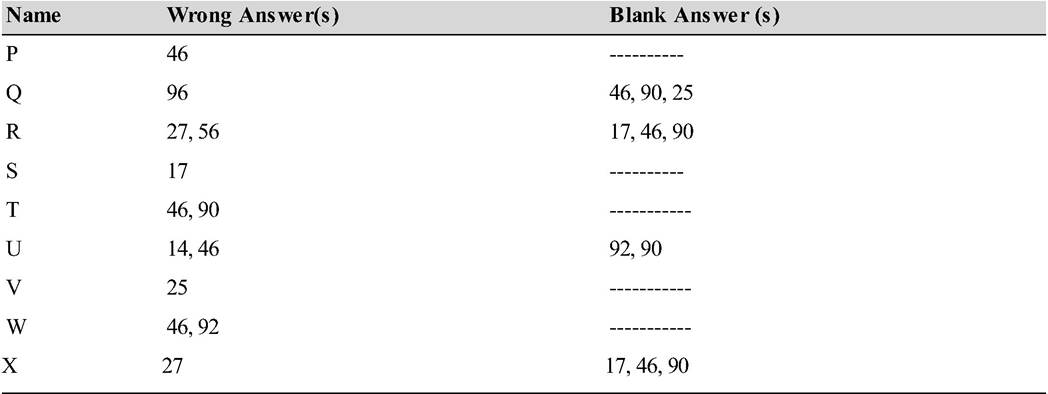
27. Who among the following must have two sources?
(a) P (b) Q
(c) R (d) S
28. How many people (excluding the Don) needed to make answer keys before R could make his answer key?
(a) 3 (b) 4
(c) 6 (d) None of these
29. Both T and W were sources to:
(a) U (b) X
(c) Q (d) None of these
30. Which of the following is definitely true?
(a) R introduced the wrong answer to question 27.
(b) T introduced the wrong answer to question 46.
(c) U introduced the wrong answer to question 14.
(d) W introduced the wrong answer to question 46.
31. Which of the group has the same sources?
i. P, S & V ii. T and W
(a) Only (i) (b) Only (ii)
(c) both (i) & (ii) (d) None of these
Directions for Questions 32 to 35: Three classmates—X, Y and Z live on the AN Jha Marg, yet they do not know the house number of each other. The houses are numbered from 1 to 99. Since Z is a regular student and attends every class sincerely, his notes are very good and updated. X and Y are not so regular, therefore they desire to meet Z at his house individually.
One day X asks Z, “The number of your house in which you reside is a perfect square or not?” Z replies. Then X asks, “Is it greater than 50?” He again replies. X thinks that he has got the address and decides to visit Z. When X reaches at the address he realises that he is wrong. He then thinks over it again and is not surprised as Z answered only the second question honestly.
Y not aware of X’s conversation, asks Z two questions of his own. Y asks “Is your house number a perfect cube?” Z replies. Then Y asks “Is it greater than 25?”
He answers again.
Y thinks that he has got the address but upon reaching there he finds the address incorrect and realises that Z answered only the second question honestly.If Z’s house number is less than the house number of X and Y and the sum of all three of their house numbers is twice the perfect square of some number then answer the following question:
32. What is X’s house number?
(a) 64 (b)81
(c) 49 (d) Cannot be determined
33. What is Y’s house number?
(a) 64 (b)81
(c) 36 (d) Cannot be determined
34. What is Z’s house number?
(a) 55 (b) 65
(c) 25 (d) 85
35. What is the sum of house numbers of all the three X, Y and Z?
(a) 100 (b) 200
(c) 128 (d) Cannotbe determined
Directions for Questions 36 to 41: Study the following information and answer the following questions.
It is very easy to remember the ID number of my ATM card which is a nine digit number and every digit is distinct. If I tell you some clues then you will also be able to remember my ATM card ID number. Let us say the number is PQRSTUVWX and the digit corresponding to it are 1 to 9 though not respectively. The ID is divisible by 9.
If you delete the digit at its units place, the remaining 8-digit number of my ID is divisible by 8. If you again delete the last digit of the 8-digit number the remaining 7- digit number is divisible by 7 and the process goes on.
36. What is the sum of the digits of the ID number of my ATM card?
(a) 55 (b) 45
(c) 90 (d) Cannot be determined
37. What is the digit sum of the ID number of my ATM?
(a) 9 (b) 8
(c) 3 (d) Cannot be determined
38. What is the number represented by the letter R?
(a) 9 (b) 8
(c) 1 (d) Cannot be determined
39. The number 2 represents which letter?
(a) V (b) W
(с) X (d) Cannot be determined
40. What are the first 5-digits of the ID number of my ATM card?
(a) 38165 (b) 61853
(c) 65472 (d) 56427
41. What are the last 5-digits of the ID number of my ATM card?
(a) 54729 (b) 74592
(c) 65312 (d) 47295
Directions for Questions 42 to 45: Some friends went to Netram Sweets.
Following is the information about the number of rosogollas they ate:i. Gimmy ate 8 less than Akshit.
ii. Dileep and Raj together ate 37.
iii. Jugal ate 8 more than Dileep.
iv. Akshit ate 5 more than Dileep.
V. Akshit and Gimmy together ate 40.
42. How many rosogollas did Raj eat?
(а) 18 (b)24
(с) 16 (d)27
43. Jugal and Dileep together ate how many rosogollas?
(a) 46 (b) 36
(c) 40 (d) None of these
44. What is the difference between number of rosogollas eaten by Dileep and Raj?
(a) 1 (b) 2
(c) 3 (d) Data inadequate
45. If the cost of each rosogolla is ' 2, what was the total amount they had to pay?
(a)' 208 (b)' 200
(c)' 198 (d) None of these
Directions for Questions 46 to 49: Coach Johan sat with the score cards of Indian players from the 3 games in a one-day cricket tournament where the same set of players played for India and all the major batsmen go out. John summarised the batting performance through three figures, one for each game. In each figure, the three outer triangles communicate the number of runs scored by the three top scorers from India. K, R, S, V and Y represent Kaif, Rahul, Saurav, Virender and Yuvraj respectively. The middle triangle in each diagram denotes the percentage of total score that was scored by the top three Indian scorers in that game. No two players score the same number of runs in the same game. John also calculated two batting indices for each players based on his scores it he tournament; the R-index of a batsman is the difference between his highest and lowest scores in the 3 games while the M-index is the middle number, if his scores are arranged in a non-increasing order.
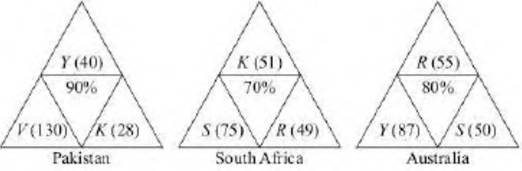
Batting performance of five Indian Batsmen in three Games of One-day International Cricket Tournament.
46. For how many Indian players is it possible to calculate the exact M-Index?
(a) 0 (b) 1
(c) 2 (d) More than 2
47. Among the players mentioned, who can have the lowest R-index from the tournament?
(a) Only Kaif, Rahul or Yuvraj
(b) Only Kaif or Rahul
(c) Only Kaif or Yuvraj
(d) Only Kaif
48. How many players among those listed definitely scored less than Yuvraj in the tournament?
(a) O (b) 1
(c) 2 (d) More then 2
49. Which of the players had the best M-index from the tournament?
(a) Rahul (b) Saurav
(c) Virendra (d) Yuvraj
Directions for Questions 50 to 52: Five women decided to go shopping to M.G. Road, Bangalore. They arrived at the designated meeting place in the following order: 1. Archana, 2. Chellama, 3. Dhenuka, 4. Helen and 5. Sahnaz.
Each woman spent at least' 1000. Below are some additional facts about how much they spent during their shopping spree.
i. The woman who spent' 2234 arrive before the lady who spent' 1193.
ii. One woman spent' 1340 and she was not Dhenuka.
iii. One woman spent '1378 more than Chellamma.
iv. One woman spent '2517 and she was not Archana.
V. Helen spent more than Dhenuka.
vi. Shahnaz spent the largest amount and Chellamma the smallest.
50. The woman who spent '1193 is:
(a) Archana (b) Chellamma
(c) Dhenuka (d) Helen
51. What was the amount spent by Helen?
(a)'1193 (b)'1340
(c)'2234 (d)'2517
52. Which of the following amounts was spent by one of them?
(а)'1139 (b)'1378
(с)'2571 (d)'2718
53. Three travellers are sitting around a fire, and are about to eat a meal. One of them has five small loaves of bread, the second has three small loaves of bread. The third has no food, but has eight coins. He offers to pay for some bread. They agree to share the eight loaves equally among the three travellers, and the third traveller will pay eight coins for his share of the eight loaves. All loaves were of the same size. The second traveller (who had three loaves) suggests that he be paid three coins, and that the first traveller be paid five coins. The first traveller says that he should get more than five coins. How much the first traveler should get?
(a) 5 (b) 7
(c) 1 (d) None of these
54. My bag can carry no more than ten books. I must carry at least one book each of management, mathematics, physics and fiction. Also, for every management book I carry I must carry two or more fiction books, and for every mathematics book I carry I must carry two or more physics books. I earn 4, 3, 2, and 1 points for each management, mathematics, physics and fiction book, respectively, I carry in my bag. I want to maximise the points I can earn by carrying the most appropriate Combinationofbooks in my bag.
The maximum points that I can earn are:
(a) 20 (b)21
(c) 22 (d) 23
55. Eighty kilograms (kg) of store material is to be transported to a location 10 km away. Any number of couriers can be used to transport the material. The material can be packed in any number units of 10, 20 or 40 kg. Courier charges are ' 10 per hour. Couriers travel at the speed of 10 km/hr if they are not carrying any load, at 5 km/hr if carrying 10 kg, at 2 km/hr if carrying 20 kg and at 1 km/hr if carrying 40 kg. A courier cannot carry more than 40 kg of load.
The minimum cost at which 80 kg of store material can be transported to its destination will be:
(a)' 180
(c)' 140
(b) ' 160
(d)' 120
Directions for Questions 56 to 57: Elle is three times older than Yogesh; Zaheer is half the age of Wahida. Yogesh is older than Zaheer.
56. Which of the following can be inferred?
(a) Yogesh is older than Wahida.
(b) Elle is older than Wahida.
(c) Elle may be younger than Wahida.
(d) None of the above.
57. Which of the following information will be sufficient to estimate Elie’s age?
(a) Zaheer is 10 years old.
(b) Both Yogesh and Wahida are older than Zaheer by the same number of years.
(c) Both 1 and 2 above.
(d) None of the above.
58. On the walk through the park, Hamsa collected 50 coloured leaves, all either maple or oak. She sorted them by category when she got home, and found the following:
(i) The number of red oak leaves with spots is even and positive.
(ii) The number of red oak leaves without any spot equals the number of red maple leaves without spots.
(iii) All non-red oak leaves have spots, and there are five times as many of them as there are red spotted oak leaves.
(iv) There are no spotted maple leaves that are not red.
(v) There are exactly 6 red spotted maple leaves.
(vi) There are exactly 22 maple leaves that are neither spotted nor red.
How many oak leaves did she collect?
(a) 22 (b) 17
(c) 25 (d)18
59. I have a total of' 1000. ItemA costs ' 110, item B costs ' 90, item C costs ' 70, item D costs ' 40 and item E costs ' 45. For every item D that I purchase, I must also buy only two items of B. For every item A, I must buy one item of C. For every item, E, I must also buy two of item D and one of item B. For every item purchased I earn 1000 points and for every rupee not spent I earn a penalty of 1500 points. My objective is to maximise the points earned. What is the number of items that I must purchase to maximise my points?
(a) 13 (b) 14
(c) 15 (d) 16
60. Four friends Ashok, Bashir, Chirag and Deepak are out shopping. Ashok has less money than three times the amount that Bashir has. Chirag has more money than Bashir. Deepak has an amount equal to the difference of amounts with Bashir and Chirag. Ashok has three times the money with Deepak. Each of them have to buy at least one shirt, or one shawl, or one sweater, or one jacket that are priced ' 200,' 400,' 600, and ' 1000 a piece, respectively. Chirag borrows 300 from Ashok and buys a jacket. Bashir buys a sweater after borrowing ' 100 IfomAshokand is Ieftwithno money. Ashokbuys three shirts.
What is the costliest item that Deepak could buy with his own money?
(a) A shirt (b) A shawl
(c) A sweater (d) Ajacket
Directions for Questions 61 to 63: Recently, Ghosh Babu spent his winter vacation on Kyakya Island. During the vacation, he visited the local casino where he came across a new card game. Two players, using a normal deck of 52 playing cards, play this game. One player is called the ‘dealer’ and the other is called the ‘player’. First, the player picks a card at random from the deck. This is called the base card. The amount in rupees is equal to the face value of the base card and is called the base amount. The face values of Ace, King, Queen and Jack are ten. For other cards the face value is the number on the card. Once the ‘player’ picks a card from the deck, the ‘dealer’ pays him the base amount. Then the ‘dealer’ picks a card from the deck and this card is called the top card. If the top card is of the same suit as the base card, the ‘player’ pays twice the base amount to the ‘dealer’. If the top card is of the same colours as the base card (but not the same suit), then the ‘player’ pays the base amount to the ‘dealer’. If the top card happens to be of a different colour than the base card the ‘dealer’ pays the base amount to the ‘player’.
Ghosh Babu played the game four times. The first time he picked eight of clubs and the ‘dealer’ picked queen of clubs. Second time, he picked ten of hearts and the ‘dealer’ picked two of spades. Next time, Ghosh Babu picked six of diamonds and the ‘dealer’ picked ace of hearts. Lastly, he picked eight of spades and the ‘dealer’ picked Jack of spades.
Answer the following questions based on these four games.
61. If Ghosh Babu stopped playing the game when his gain would be maximised, the gain in rupees would have been;
(a) 12 (b) 20 1 1
(c) 16 (d) 4
62. The initial money Ghosh Babu had (before the beginning of the game sessions) was ' X. At no point did he have to borrow any money What is the minimum possible value of X?
(a) 16 (b) 8
(c) 100 (d) 24
63. If the final amount of money that Ghosh Babu had with him was ' 100, what was the initial amount he had with him?
(a) 120
(b)8
(c) 4 (d) 96
Answer Key
| l.(a) | 2. (a) | 3∙(a) | 4. (b) |
| 5. (b) | 6. (b) | 7. (c) | 8. (c) |
| 9. (a) | 10. (a) | ll.(b) | 12.(b) |
| 13.(c) | 14. (b) | 15.(b) | 16. (a) |
| 17.(b) | 18. (a) | 19.(b) | 20. (a) |
| 21∙(b) | 22. (a) | 23. (d) | 24. (d) |
| 25. (a) | 26. (c) | 27. (b) | 28. (b) |
| 29. (a) | 30. (c) | 31. (c) | 32. (b) |
| 33. (a) | 34. (a) | 35. (b) | 36. (b) |
| 37. (a) | 38. (c) | 39. (b) | 40. (a) |
| 41. (a) | 42. (a) | 43. (a) | 44. (a) |
| 45. (a) | 46. (c) | 47. (d) | 48. (b) |
| 49. (b) | 50. (c) | 51∙(b) | 52. (a) |
| 53.(b) | 54. (c) | 55. (b) | 56. (b) |
5Ί. (с)
61. (а)
58. (b)
62.(b)
59. (b)
63. (d)
60. (b)