Quantitative Reasoning
Quantitative reasoning, as the name itself suggests, is reasoning involving numbers and numerical logic. Quantitative reasoning questions are common in all kinds of aptitude exams and require the student to work out numerical relationships as defined by the parameters in the problem.
The key skills involved in solving quantitative reasoning questions are the following:
(i) The ability to understand the specific quantitative logic being utilised inside the questions
(ii) The ability to order the clues in the correct order of usage (as explained in the theory of logical reasoning)
(iii) The ability to understand basic mathematical concepts like percentages, averages, ratios, multiplications, etc.
(iv) The ability to create symbolic representations of the various clues provided so that you can bring together each of the relevant clues while creating the teams
(v) The ability to wait for and reach the appropriate time in the problem solving situation from where the indirect clues provided in the question can be used.
Illustrated below are the solutions to a few typical questions on quantitative reasoning. We would urge you to first have a look at the questions and try to solve the same on your own before looking at the solutions.
Example 1 The classic quantitative reasoning question:
A man would like to take a new health insurance. An officer taking care of these matters says to the man, “Please tell me how many children you have.” The man answers, “I have three of them.” The officer, “What are the ages of your children?” The man answers, “The product of the ages is equal to 36.” The officer replies, “This is not enough information Sir!”; the man replied, “Sorry that I was a little bit unclear, but the sum of the ages is equal to the number of shops in front of your office.” The officer: “This still isn’t enough information Sir!”; The man replies, “My oldest child loves chocolate.” The officer: “Thanks for your cooperation, I now know the ages.” Are you as smart as the officer? Then give the sum of the ages of the children.
1.13 2.22
3. 36* 4. 38
Solution:
The product of the ages is 36*. Using this one can make the following combination of ages:
1, 36, 1 sum = 38
1, 18, 2 sum = 22
1, 12, 3 sum= 16
1, 9, 4 sum= 14
1, 6, 6 sum= 13
2, 9, 2 sum = 13
2, 6, 3 sum = 11
3, 3, 4 sum= 10
After the man had said that the product of the ages is equal to 36, the officer didn’t have enough information. Then he was told that the sum is equal to number of shops in front of the office. He replied by saying that this still isn’t enough information. So the sum of the ages should be 13, because otherwise he would have known the ages immediately. The last statement is that that the oldest child loves chocolate. So there is an oldest child. Hence the officer concludes that the ages of the children are 2, 2 and 9 years. Hence option (3) is the correct answer.
Example 2 Early one Monday morning, four snails—Aman, Bubbly, Charu and Devi, set off together down the garden path. Aman and Bubbly kept the same steady pace, slithering only 8 meters by the time Charu and Devi had already reached the azalea. Charu was winded and had to stop for an hour to rest. Although Devi was tired, too, she pressed on, but reduced her pace to be the same as Aman’s and Bubbly’s.
Charu started off again just as Aman and Bubbly got even with her. She raced off at her original pace. Aman promptly sped up to the same speed as Charu and kept even with her. Bubblyjust kept going at her original pace.
WhenAman reached the end of the path, she was 1 meter ahead of Bubbly, but she was a half hour later than Devi was.
How many meters long was the path?
1. 10 2. 15
3.8 4. None of these
Solution:
A few things are evident from the current situation:
Deduction i) Since Charu rests for 1 hour before Aman and Bubbly reach the azalea, it is clear that Devi would be exactly 1 hour ahead of Bubbly when she reaches the end point.
Deduction ii) Since Devi has already reached half an hour ago when Aman and Charu reach, Bubbly must be only half an hour from her destination.
Since, Bubbly is 1 meter away from the destination, she would cover this 1 meter in 30 minutes. Thus, Bubbly’s speed must be 2 m∕hr. This would be the slower of the two speeds.This would also be the speed of Bubbly and Aman for the first 8 meters.
Deduction iii) Since, Bubbly and Aman take 4 hours to reach 8 meters, in 1 hour more (when Charu rests) they will cover 2 meters more. Thus, the azalea is at a distance of 10 meters from the starting point.
Deduction iv) The 10 meter distance to the azalea is covered in 4 hours by Charu and Devi. Thus, the faster speed would be 2.5 m∕hr.
Deduction v) After the azalea, when Aman and Charu start moving at 2.5 m∕hr, Bubbly would be moving at 2 m∕hr. When Aman and Charu reach the end, Bubbly is 1 meter behind. This gap can only be created in a 2 hour journey.
Thus, the distance from the azalea to the end point is 5 meter. Total distance is 10 + 5 = 15 meters.
Example 3 Dhimanwas admiring the output of her new program to generate random number. She had printed out the first ten numbers of the results. She soon noticed something interesting. Each of the 10 numbers had exactly one digit, in the proper placement, of the 5 digit code she used to open her car door without a key.
In the first number 14073, for example, Dhiman’s car code could not be 34170 (two digits Correctlyplaced) or 92365 (none).
Find Dhiman’s car entry code from these first 10 randomly generated numbers: 14073, 79588, 05892, 84771, 63136, 42936, 37145, 50811, 98174 and 29402?
1.05892 2.63136
3. 42936 4. None of these
Solution:
In the given grid of 10 five digit numbers, since every number has exactly 1 digit matched correctly with the correct code, there must be exactly 10 instances of correct code matches amongst the 50 possible instances (10x5).
If we were to look at the first digit it is clear that the first digit has 10 different values in the ten number. Thus, only 1 number can be correctly matched for the first digit’s value.
The other 4 places in the 5 digit number must match 9 more times for the above grid to be correct. This can be principally done in 2 ways:
First way: 3+3+2+1 OR Second way: 2+2+2+3
If we were to observe the numbers the following deductions would come up:

Looking at the number 98174, it is clear that both 1 & 7 cannot occur in the third and fourth place digits as then the number 98174 would have 2 numbers matched with the code.
Thus, the structure 1+2+3+3+1 or indeed 1+1+3+3+2 is ruled out (i.e., the use of two triplicate matches is ruled out).
Thus, the 10 matches between the code and the 10 random numbers must be in one of the following structures:

Thus, the number would be either xxl3x or xx87x. The first possibility is rejected because 63136 contains both 1 & 3 in the third and fourth places of the number. Thus, the number must be of the form xx87x. From this point thinking about the second place digit gives us that the second place has to be occupied by 9 ( as only 4 & 9 give us 2 matches with the code & amongst this 4 cannot be taken for the second place because if the number is x487x then the number 84771 contradicts the basic condition of the problem)
Thus, the number must be x987x.
Thinking of the last digit— this digit must be either 1, 2 or 6. It cannot be 1 because of
the presence of 84771 in the ten number. It cannot be 2 because the number 29402 would have 2 digits in the correct place. Hence, it must be 6. Thus, the number becomes x9876.
Thinking of the first digit, it has to be 3, because it is only the number 37145 which lacks a single digit matching with the 2nd to 5th digit of the code x9876. Thus, the code is 39876.
Example 4 Abe, Buddy, Carmen, Dennis and Earl all live on Pine Street which has house numbers from 10 to 111, both inclusive.
Two of them live in the same house. The others all live in different houses. They all have made remarks about where they live, but not all the remarks are true.Abe said, “My house number is a factor of Buddy’s house number. Earl’s house number is 10 greater than Dennis.”
Buddy said, “My house number is greater than 70. Abe’s house number is greater than 30.”
Carmen said, “My house number is both a cube and a square. Dennis’s house number is greater than 50.”
Dennis said, “My house number is a square. Buddy’s house number is a cube.”
Earl said, “My house number is twice Buddy’s.”
But who’s telling the truth? It turns out that all statements made by people living in houses Withnumbers greater than 50 were false. All the other statements were true.
Can you tell the house number of Earl?
1.49 2.16
3. 59 4. None of these
Solution:
In order to solve this question you need to look at the options for Earl’s house number. Option 1 cannot be true since if Earl’s house number is 49, he must be speaking the truth - but his statement cannot be true. If we take Earl’s house number as 16 (Option 2), then Buddy must be 8 which is against the problem’s basic condition that all house numbers are between 10 to 111.
If we go with Option 3—59, then if Abe is true then Dennis must be 49. Hence, Dennis’s statements must be true. So Buddy’s house number would be a cube. There are only 2 perfect cubes between 10 and 111— viz 27 and 64. If Buddy’s house number is 27, then he must be speaking the truth—which is not true if we look at the statement of the problem. Thus, Buddy must be 64 and Abe’s house number must be less than 30 - only factor of 64 less than 30 and greater than 10 is 16. At this time we have the grid as:
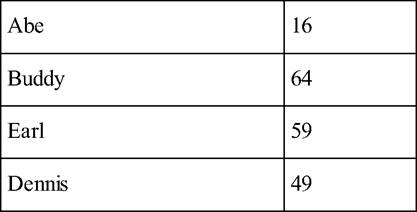
We just need to place Carmen in this grid. Looking at Carmen’s statement and looking at the numbers available below 50, the two numbers (16 and 49) do not satisfy the condition that the room number is both a square and a cube.
Hence, Carmen must be lying and the possible values of Carmen is 59 and 64. If we were to place Carmen at 64, then Carmen’s first statement becomes true— an internal contradiction. Thus, Carmen must be at 59. The final arrangements of house numbers are: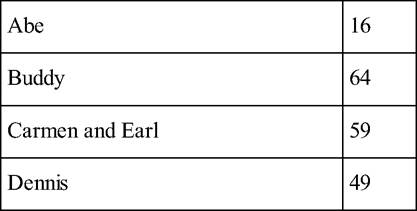
Example 5 During a game of five card draw poker, played with a standard deck, you are dealt a hand with the following characteristics:
• It contains no aces or face cards.
• No two cards have the same value.
• All four suits are present.
• The total value of the odd cards equals the total value of the even cards.
• There are no three card straights.
• The total value of the black cards is 10.
• The total value of the hearts is 14.
• The card with the lowest value is a spade.
Exactly what are the five cards in your hand?
1. 2 of spades, 5 and 9 of diamonds, 4 of spades and 8 of clubs
2. 2 of diamonds, 5 and 9 of spades, 4 of hearts and 8 of clubs
3. 2 of clubs, 5 and 9 of hearts, 4 of diamonds and 8 of spades
4. 2 of spades, 5 and 9 of hearts, 4 of diamonds, 8 of clubs
Solution:
Deduction і) Since there are no aces or face cards, we only have 2, 3, 4, 5, 6, 7, 8, 9 or 10 as the value of the cards.
Deduction ii) Since total of odd = total of evens and the minimum even total is 12 (2 + 4 + 6), there must be 2 odds and 3 evens. Only then can the two odds add up to an even total and be equal to the total of 3 even cards.
Deduction iii) There are 2 cards of 1 suit and 1 card each of the other 3 suits. The two cards belonging to 1 suit must be hearts because there is no other way for the hearts to total up to 14.
Deduction iv) There are 3 cases:
a) If the sum of the evens is 12, the odds would be 5 and 7 and the evens would be 2, 4, 6. This cannot happen because in such a case 2 cards would not add up to 14— which is the requirement for the 2 hearts.
b) If the sum of the evens is 14, the odds would be 5 and 9 and the evens would be 2,4,8. This can happen if we put the hearts as 5 and 9 and 2 goes to spades, and since the total of the blacks is 10, clubs must be the 8 of clubs and 4 would be the 4 of diamonds.
c) If the sum of the evens is 16, the evens should be 2, 4 and 10; the odds must be 7 and 9. But this is not possible because if we take the two hearts to total 14, it is not possible.
Thus, the solution is: 2 of spades, 5 and 9 of hearts, 4 of diamonds, 8 of clubs Option 4 is correct.
More on the topic Quantitative Reasoning:
- Quantitative Reasoning
- EXERCISE ON QUANTITATIVE REASONING
- INTRODUCTION TO REASONING IN THE SNAP EXAM
- Reasoning
- REVIEW OF FORENSIC ASSESSMENT INSTRUMENTS
- Public expenditure