Solutions
Questions 1 to 5
From Clue No. (iii),
40% of the total students are female
40% = 36
100% - 90
Total students = 90

Half of the students are either good or excellent means that total of (good + excellent) students = 45
∖ Number of excellent =12
1/3 of male = average male students = 18
Questions 6 to 10
The following structure would work:

Hence, the answers are:
6.
3 + 12 = 15(b)7. 3 + 12+ 24 = 39 (c)
8. 3 + 12 + 28 + 32 = 71 (c)
9. 128 (a)
10. 32(a)
Questions 11 to 14
Fromclues 1, 2, 3, 4, 5 we get:
Orchids = Tulips + 2, Rose = Tulips + 4 Marigold = Tulips + 3 and since Lily
Fireball.
IfTulips is 1 (Clue 6), we get
Tulip = 1, Orchids = 3, Marigold = 4, Rose = 5
Hence, Lily = 2 and Fireball = 6
The answer are:
11. Five (b)
12. Statement (iii) is redundant. Hence (b)
13. 3 + 4-7 (c)
14. Six(b)
Questions 15 to 20
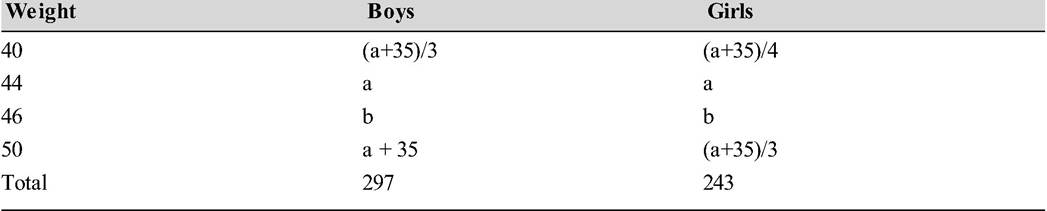
Start from the fourth line and take ‘a’ as the number of girls of 44 kgs.
Questions 21 to 26
Reaction Tracker
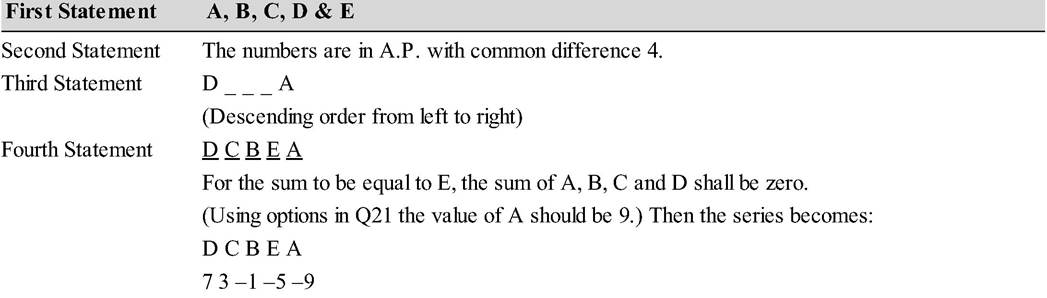
Hence the answer are:
21. (b)
22. -10 (a)
23. D is ‘7’. Hence (d).
24. The value of E is -5. Hence (d).
25. 7¥3¥ 1 ¥-5 ¥-9--945 (a).
26. 7-(-9) - 16. Hence (c).
Questions 27 to 31
| Paragraph 1 | Ten people P, Q, R, S, T, U, V, W, X and the Mastermind 3 |
| Paragraph 2& 3 | Two ways of creating an answer key: ONE SOURCE: Copy entire answer key and introduce 1 wrong answer. Deduction: If you have one source, then you introduce only 1 wrong answer and carry over any wrong answers as well as any blanks from the answer key of the source. |
| TWO SOURCES: Introduce blank if the two answer keys differ on one particular question. [This means that if one answer key has the answer correct and the other answer key has it wrong then we introduce a blank]. Note: Ifboth answer keys are correct or if both answer keys are incorrect on a particular question, then they will give us the same answer and hence will not differ. Consequently their answer will be copied into the answer key ‘under construction’. | |
| Paragraph 4 | Note also that since it is given that two or more people have not introduced a wrong answer to the same question, we can deduce that if two answer keys have the same answer wrong, they will be showing the same incorrect answer to that question. Consequently if someone has two sources who have the wrong answer to thesame question both of them will show the same incorrect answer to that particular question and that answer will get replicated as it is, into the answer key which is constructed using them both. With this understanding we move to the information contained in the table. |
| Deductions from the table | The first thing we see when we see the table is that P, S and V have only 1 incorrect answer and no blanks. A little thought will give you that this can happen only if there is a single all-correct answer key as the source. Hence, P, S & V must have had the Don as their source and further that P must have introduced the wrong answer to Q 46. 5 must have introduced the wrong answer to Q 17 6 V must have introduced the wrong answer to Q 25. At this point we also know that— In case of 1 source, there will be the introduction of only 1 extra wrong answer and that blanks can only be introduced if there are two sources. From this point on move ahead in the question using two main objectives— (a) Decoding the answer key patterns of the remaining six people (Q, R, T, U, W & X) and (b) Trying to decode the introduction of the remaining wrong answers and the blanks. From the table, T and W are pretty easy to decode. P must have been the source for both of them and T must have introduced the wrong answer to Q 90, while W must have introduced the wrong answer to Q 92. |
At this point the table would look like:
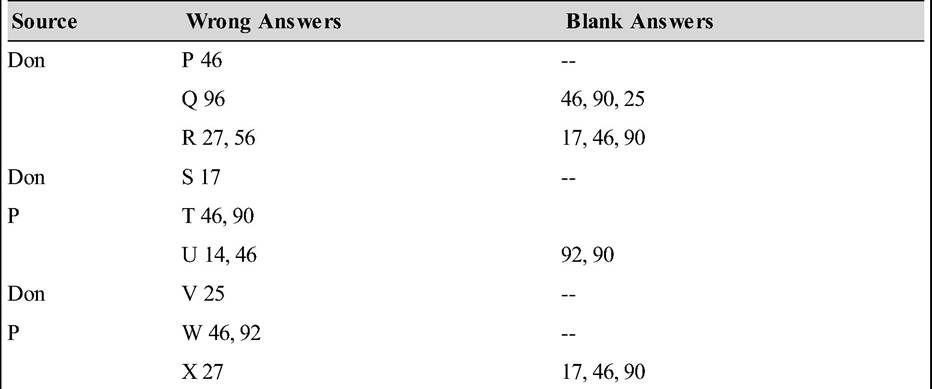
Q’s Answer Key: He must have had T and V as his sources. In such a case his answer to Questions 25, 46 and 90 would remain blank and he would introduce the wrong answer to Q. 96.
We are now left with R, U & X and need to think how these answer keys could have been created.
It is evident that X must have been R’s only source (since the blanks are just carried forward by R and he has introduced the wrong answer to Q. 56).
Further, X’s answer key could have been formed if he had his sources as S and T.
U’s answer key could have been created only if his sources were T and W. In that case he would introduce the blank answers 90 and 92, copy the incorrect answer 46 as it is (since there would be no mismatch in that answer) and introduce the wrong answer to Q. 14. Thus the final table would look like:
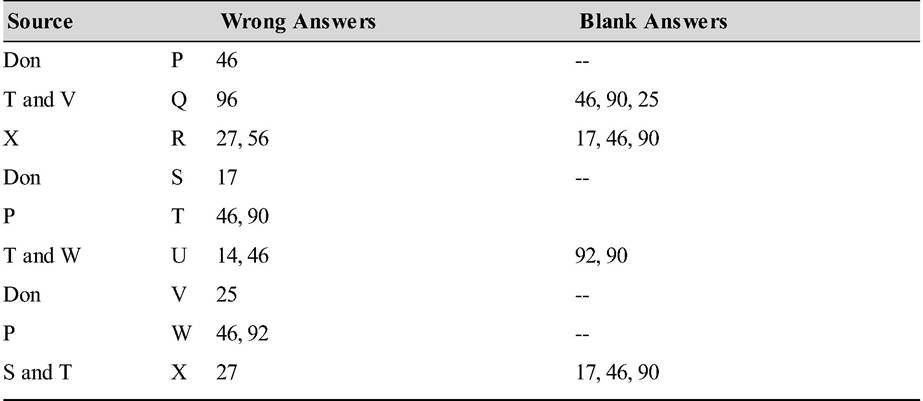
Thus the answers to the questions are:
27. (b)
28. P, T, S, X. Hence 4, Option (b).
29. U. Option (a)
ЗО. (с)
ЗІ- (с)
Questions 32 to 35
| Paragraph 2 | Smce X has thought that he has the answer to the house number of Z, he must have got ‘yes’ as an answer to both questions he asked. In such a case he would think that Z’s number is one of 64 or 81 (the two 2 digit perfect squares which are greater than 50). Also, we can deduce that since he thinks that he knows the answer he must be living in one of the two houses. Hence, X’s house number is either 64 or 81. |
| Paragraph 3 | By a similar logic Y’s house number is either 27 or 64. |
| Paragraph 4 | We know Z’s house number is greater than 50 but less than Y’s and X’s house numbers. Hence Y’s number must be 64 and X’s number is 81. Also from options to Q. No. 34 we get that Z’s number must be 55 since (81+64+55) is the only addition that satisfies the condition of the sum of the three numbers to be double of a perfect square. |
Hence answers are:
32. (b)
33. (a)
34. (a)
35. (b)
Questions 36 to 41
The alphabets PQRSTUVWX represent the nine digit number with the given property. Deductionl: Since all numbers having even digits have to be divisible by even numbers (i.e., PQ is divisible by 2, PQRS is divisible by 4, PQRSTU is divisible by 6 and PQRSTUVW is divisible by 8), Q, S, U & W must be the 4 even numbers viz. 2, 4, 6 and 8 in some random order.
Consequently P, R, T, V & X (the odd placed digits) must be sharing the odd digits 1,3, 5,7 and 9 in some order.
Deduction 2: Since PQRST is divisible by 5, T must be equal to 5. Thus, the number must be PQRS5UVWX.
Deduction 3: PQR is divisible by 3 and PQRSTU is divisible by 6, hence STU must be divisible by 3. i.e., S+T+U=S+5+U must be divisible by 3. Also, S and U are even number. Through trial and error you should realise that there are only two ways this could happen:
(a) IfSTU represents 258
or (b) If STU represents 654
Note: S can only be 2 or 6 since for PQRS to be divisible by 4, RS should be divisible by 4 and R being an odd number S can only be 2 or 6.
Deduction 4: The following 4 options of filling in the other two even numbers (4 and 6 in case STU is 258 or 2 and 8 in case STU is 654) emerge:

36.
Sum of digits—1+2+3+4+5+6+7+8+9=45.Hence (b)
37. Digit sum = 4 + 5 = 9. Hence (a)
38. R = l. Hence (c)
39. 2 = W. Hence(b)
Now solve Questions 40 and 41 through options.
40. The first five digits could only be 38165 (no other option fits). Hence (a)
41. If 38165 are the first 5 digits, the last 5 emerge out of possibility 4 in the table above and it gives us 54729. Hence (a)
Questions 42 to 45
You will get the following equations:
A + G = 40___________ (1)
A + D = 5____________ (2)
J + D = 8_____________ (3)
This means that A is 3 less than J.
D + R = 37________ (4)
A-G = 8__________ (5)
Using (1) and (5) we get A = 24 and G = 16,
Hence D = 19, J = 27 and R = 18.
Thus the answer are:
42. R= 18 (a).
43. 27+ 19 = 46 (a)
44. 19-18 = 1(a)
45. 24 + 16 + 19+ 27 + 18 → 104 ¥2 = 208 (a)
Questions 46 to 49
Runs scored by top three batsmen against Pakistan
-40+130 + 28
- 198
90% - 198
100% - 220 runs ‘
The rest of the players made only 22 runs.
Runs scored by top three batsmen against South Africa
-51+75 + 49
- 175
70% - 175
100%-250
The rest of the players made only 75 runs
Runs scored by top three batsmen against Australia
-55 + 87 + 50
- 192
80% - 192
100-240
The rest of the players made only 48 runs Y→ 40 + South Africa + 87 - 127 + runs scored against South Africa.
V → 130 + South Africa + Australia -130 + runs scored against South Africa + Australia
K→28 + 51 + Australia - 79 + Runs scored against Australia.
S → Pakistan + 75 + 50 - 125 + Runs scored against Pakistan.
R → Pakistan + 49 + 55- 104 + Runs scored against Pakistan.
46. (c) For Yuvraj, middle index cannot be determined as we don’t know the exact runs scored by him against South Africa.
Same is the case with Virendra and Kaif
For Saurav the middle index will be 50 because whatever runs he scores against
Pakistan, they could be maximum 22 or minimum zero.
This will not affect the middle number 50.For Rahul middle index will be 49. (Same logic)
47. (d) R-Index → Difference between highest and lowest score.
For Yuvraj minimum R-index can be 87 - 40 - 47
For Virendra minimum R-index can be 130 - 48 = 82
For Kaif minimum R-index can be 51 - 28 = 23
For Sourav 75 - 22 = 53
For Rahul 55 - 22 = 33
∖ It is Kaif who can have minimum R-index.
48. (b) No. of players who definitely scored less than Yuvraj is 1.
In the worst case if we suppose that Yuvraj scored zero against South Africa, so we have to find how many players definitely scored less than 127.
This could be only Rahul who can score maximum 22 runs against Pakistan and will be able to get a score of 126, which is less than 127.
49. (b) Saurav’s middle index is the best.
Questions 50 to 52
From the given information it is clear that four numbers which must have been the values of money Spentwould be: 2517 (Clue 4), 2234 (Clue 1), 1340 (Clue 2) and 1193 (Clue 1 again).
We need to work out the fifth value.
Also, since Chellamma spent the least and Shahnaz the maximum and since one woman spent' 1378 more than Chellamma, a little bit of introspection will give you the following possibilities for the five numbers:
Possibility 1: If 1193 is the least value
The five numbers are:
1193, 1340, 2234, 2517 and 2571 (since 2571 -1193 + 1378)
Possibility 2: If 2517 is the maximum value, the five numbers are:
1139 (since 1139 - 2517- 1378), 1193, 1340, 2234 and 2517
Accordingly, we have the following possible arrangements for the five women and the amount they spent:
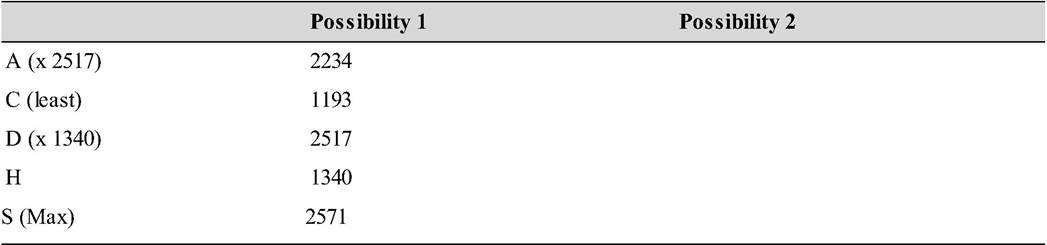
Note: The thought structure for placing the 5 values with 5 women in the case of
possibility 1, goes as follows:
Step 1: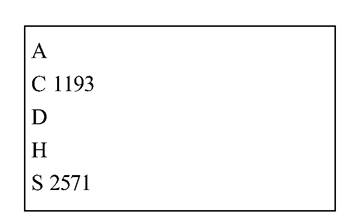
After placing the least and maximum.
Step 2: 2234 should be before 1193 and Dhenuka cannot have spent' 1340.
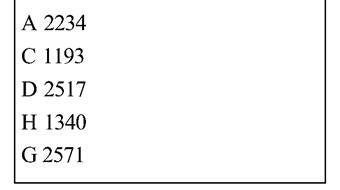
A close look at the above table shows that clue 5 (H > D) is not obeyed by this arrangement. Hence, this solution is wrong.
We thus move into possibility 2, i.e.:
1139, 1193, 1340, 2234, 2517, are the five values. The thought structure for placing the five numbers for the five women goes as:
Step 1: Place the maximum and least values for G and C respectively.
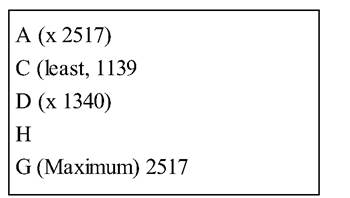
This leaves us with 1340, 1193 and 2234 to place. ∙
Step 2: We need to keep 2 constraints in mind while doing this.
(a) 2234 has to come before 1193 (remember not immediately before). At the same time H > D. (Clue 5)
We can arrange 2234 before 1193 in 3 ways as shown below and then 1340 automatically falls into the vacant space.
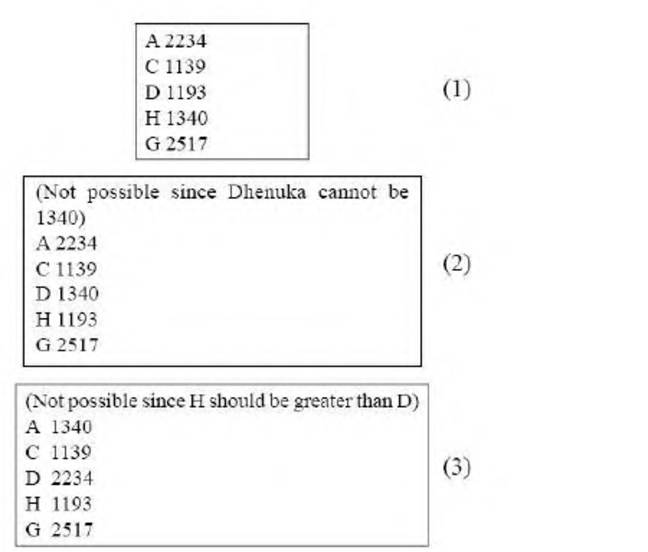
Hence, the Onlypossible arrangement is as in (1) above. Hence the answers are:
50. (c) Dhenuka
51. (b) 1340
52. (a) 1139
53. (b) Each loaf of bread is divided into 3 parts. So we have 24 parts and each traveller gets 8 parts.
1st traveller has 15 parts. He ate 8 parts and gave his 7 parts to the Illrd traveller.
IInd traveller has 9 parts. He ate 8 parts and gave his 1 part to the IIIrd traveller. So 8 coins should be divided in the ratio 7: 1.
First traveller gets 7 coins.
54. (c) Maximum points of 22 can be achieved by taking (1 Management + 2 Fiction + 2 Maths + 5 Physics) books.
4 + 2 + 6+10-22
55. Option (b) is correct.
Questions 56 and 57
Elle 3y
Yogesh у Wahida 2z
Zaheer z
56. (b) From the above table we can infer that Elle must be older than Wahida (as
she is thrice a higher value (y) while Wahida’s age is twice a lower value (z)).
57. (c) Using both pieces of information we get that if Zaheer = 10, then Wahida and Yogesh = 20 and hence Elle = 60 years.
Thus Option (c) is correct.
58. (b)
59. (b)
60. (b)
Questions 61 and 62
The following matrix will help you solve the problem.

61. '12. Hence (a)
62. The maximum negative he goes to is - 8 after the first game. Hence, Option (b) is correct.
63. Ghosh Babu’s net gain is ' 4. If after that he has ' 100 with him, he must have had ' 96 at the start. Hence, (d) is correct.
Puzzle Test
Reasoning puzzles are a favourite question type in all aptitude examinations. In the scheme of chapters on reasoning contained in this book, we have created separate chapters for specific kinds of puzzles which are often asked (like arrangements, rankings etc., which constituted the chapters prior to this one).
All other categories of puzzles—which cannot be specifically categorised as any of the foregoing chapters—you will get to see and practice in this chapter.
As the name suggests, questions on puzzles challenge you to match multiple factors (like name, colour of shirt, place of living, car model driven, etc.).The key skills involved in solving questions on puzzles include but are not limited to:
(i) The ability to make a relevant tabular structure for using the clues seamlessly: For example, suppose you have 5 people A, B, C, D, E wearing 5 colour of shirts red, yellow, green, blue and white drinking 5 kinds of soft drinks Coke, Pepsi, Mirinda, Thums Up and Seven Up—the solution table structure would look like this:
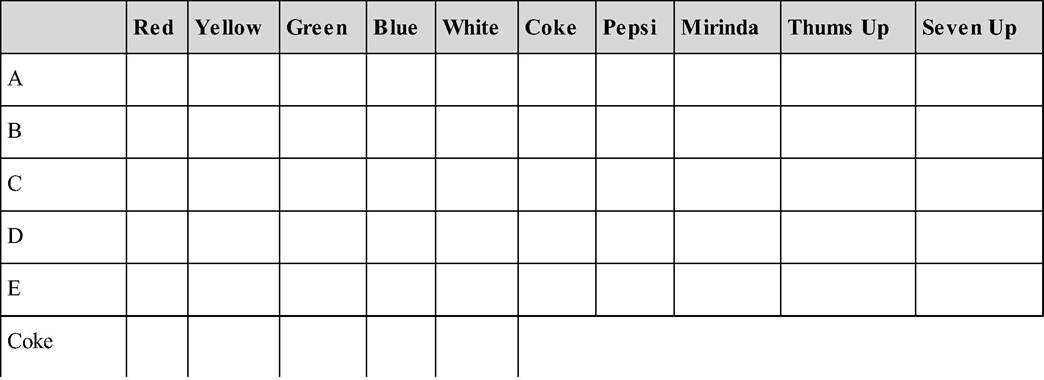
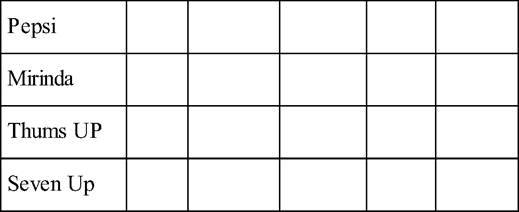
In the table above, you can see clearly that there is a direct correlation structure between each of the three ‘variables’ in the problem. More of this you would get to see and experience as you move through the solved illustrations and the exercises that follow it.
(ii) The ability to order the clues in the correct order of usage (as explained in the theory of logical reasoning): This includes the ability to perceive the direct clues and use them first to set up the ‘framework’ of problem solving.
(iii) The ability to perceive what indirect clues are talking about - and how to use them;
(iv) The ability to convert clues written in language form into visual cues so that you do not need to read the text again and again. Also, converting the language clues to visual cues is critical for the purpose of being able to ‘see’ all the clues at one go.
Illustrated below are the solutions to a few typical questions on puzzles. We would advise you to first have a look at the questions and try to solve the same on your own before looking at the step-by-step process of solving the same.
More on the topic Solutions:
- Foreword: Frances Moore Lappe
- .. the value of science as metaphysic belongs... with religion and art and love, with the pursuit of the beatific vision, with the Promethean madness that leads the greatest men to strive to become gods.
- Conclusion: Emerging Problems in Theory and Practice
- Gangs
- That crimes were ultimately offenses against the community, not just against individual plaintiffs, was perhaps the most important conceptual breakthrough in law's development. Individual harm was self-evident but only tangentially the state's business.
- “Generals” and Summer School in Madison
- Cicero on Gyges’ ring and how Plutarch deals with the Puzzles
- ILLUSTRATION 2
- Legal battlefields after the 1994 genocide In Rwanda
- Reform?