An Extended New Keynesian Phillips Curve: Combining Staggered Pricing with Periodic Nominal Wage Contracts
We can now combine staggered pricing with periodic nominal wage contracts set by insiders, such as the ones introduced in section 17.4. Wages in period t are set at the beginning of the period, based on information available until the end of t − 1, to ensure that expected employment is equal to the target of labor market insiders:

Hence, from (17.57), the nominal wage in period t satisfies

which is the equivalent of equation (17.36) in the case of staggered pricing.
Note that if we set γ = 0 in (17.59), we recover (17.36).Substituting (17.59) for the nominal wage in the new Keynesian Phillips curve (17.57) and rearranging, we get
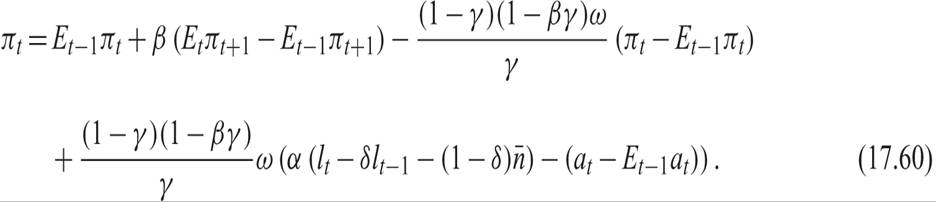
Noting that, lt − δlt−1 − (1 − δ) ≃−(ut − δut−1 − (1 − δ)
 ), (17.60) can be expressed as
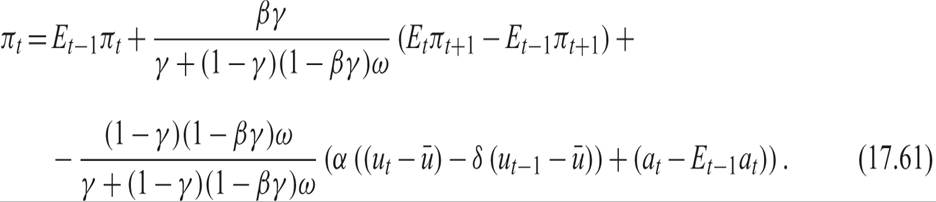
Equation (17.61) is an extended new Keynesian Phillips curve, which encompasses both the new Keynesian Phillips curve and the original expectations-augmented Phillips curve (17.38) as special cases.
For example, by dropping the assumption of staggered pricing and setting γ = 0, (17.61) is transformed to

This is the same as (17.38), which determines inflation only as a function of previously expected inflation, unanticipated productivity shocks, and current and lagged deviations of unemployment from its natural rate.
Equation (17.61) allows for both current expectations of future inflation (due to the assumption of staggered pricing) and past expectations of current inflation (due to the assumption of predetermined nominal wage contracts). It also allows for the effects of both the current and the past unemployment rate, because of the dynamics in the objectives of labor market insiders.
From the Okun-type relation (17.41), it follows that

where  is the natural rate of output, given by (17.42).
Through the use of (17.62), the extended new Keynesian Phillips curve (17.61) can be expressed in terms of deviations of output from its natural rate:
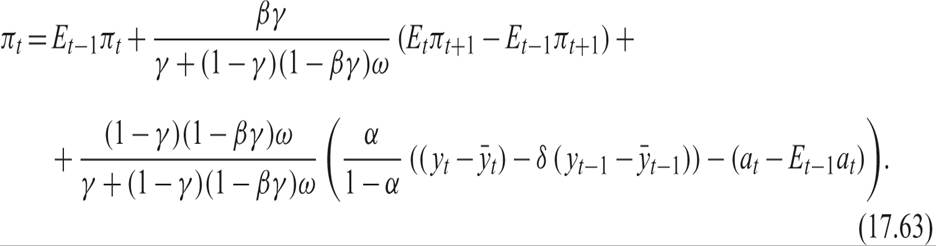
In what follows, we shall use this version of the extended new Keynesian Phillips curve. When determining unemployment, we shall use the Okun-type equation (17.62).
17.7