A First Look at Sustained Growth
Can the Solow model generate sustained growth without technological progress? The
answer is yes, but only if some of the assumptions imposed so far are relaxed.
The Cobb-Douglas example above already showed that when α is close to 1, the adjustment of the capital-labor ratio back to its steady-state level can be very slow.
A very slow adjustment towards a steady-state has the flavor of “sustained growth” rather than the economy (quickly) settling down to a steady state. In fact, the simplest model of sustained growth essentially takes α = 1 in terms of the Cobb-Douglas production function above. To do this, let us relax Assumptions 1 and 2 (which do not allow α = 1), and suppose that
where A > 0 is a constant. This is the so-called “AK” model, and in its simplest form output does not even depend on labor. The results here apply with more general constant returns to scale production functions, for example, with

Nevertheless, it is simpler to illustrate the main insights with (2.39), leaving the analysis of the case when the production function is given by (2.40) to Exercise 2.17.
Let us continue to assume that population grows at a constant rate n as before (cfr. eq. (2.32)). Then, combining this with the production function (2.39), the fundamental law of motion of the capital stock becomes
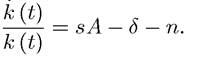
This equation shows that when the parameters satisfy the inequality sA — δ — n > 0, there will be sustained growth in the capital-labor ratio and thus in output per capita. This result is summarized in the next proposition.
Proposition 2.10.
Consider the Solow growth model with the production function (2.39) and suppose that sA — δ — n > 0. Then, in equilibrium, there is sustained growth of output per capita at the rate sA — δ — n. In particular, starting with a capital-labor ratio k (0) > 0, the economy has
and 
This proposition not only establishes the possibility of endogenous sustained growth, but also shows that in this simplest form, there are no transitional dynamics. The economy always grows at a constant rate sA — δ — n, regardless of the level of capital-labor ratio it starts from. Figure 2.10 shows this equilibrium diagrammatically.
Does the AK model provide an appealing approach to explaining sustained growth? While its simplicity is a plus, the model has a number of unattractive features. First, it is a somewhat knife-edge case, which does not satisfy Assumptions 1 and 2; in particular, it requires the production function to be ultimately linear in the capital stock. Second and relatedly, this feature implies that as time goes by the share of national income accruing to capital will increase towards 1 (if it is not equal to 1 to start with). The next section shows that this does not seem to be borne out by the data. Finally and most importantly, a variety of evidence suggests that technological progress is a major (perhaps the most major) factor in understanding the process of economic growth. A model of sustained growth without technological progress fails to capture this essential aspect of economic growth. Motivated by these considerations, we next turn to the task of introducing technological progress into the baseline Solow growth model.
2.7.