How Exchange Rates Are Determined: A Supply-and-Demand Analysis
Use a supply-and- demand framework to explain how exchange rates are determined.
In flexible-exchange-rate systems, exchange rates change constantly. In fixed- exchange-rate systems, by definition, exchange rates are stable most of the time; even under a fixed-rate system, large devaluations or revaluations aren't uncommon.
What economic forces cause a nation's exchange rate to rise or fall? In this section we address this question by using supply and demand to analyze the determination of exchange rates in a flexible-exchange-rate system. (We return to fixed exchange rates in Section 13.5.)For clarity, our supply-and-demand analysis focuses on the nominal exchange rate rather than the real exchange rate. However, recall from Eq. (13.1) that, for given levels of domestic and foreign prices, the real exchange rate and the nominal exchange rate are proportional. Because we hold price levels constant in this section, all our conclusions about the nominal exchange rate apply equally to the real exchange rate.
The nominal exchange rate, e nom, is the value of a currency—say, the dollar. The value of the dollar, like that of any asset, is determined by supply and demand in the relevant market. For dollars, the relevant market is the foreign exchange market, where banks and currency traders continuously trade dollars for other currencies.
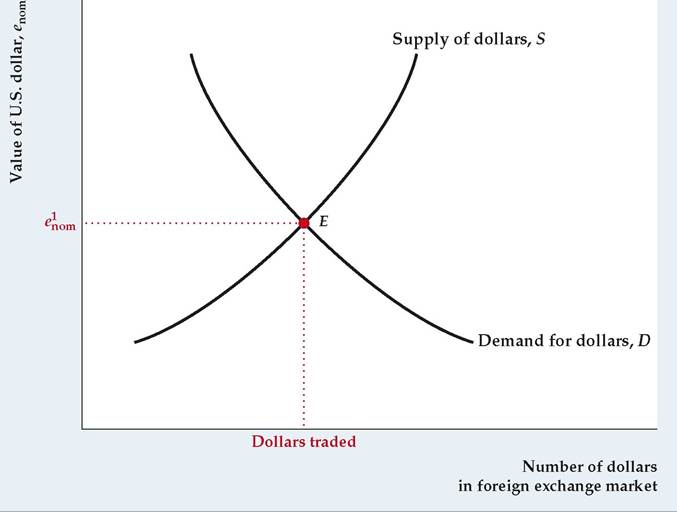
Figure 13.3 shows the supply and demand for dollars. The horizontal axis measures the quantity of dollars supplied or demanded, and the vertical axis measures the value of the dollar in terms of other currencies, or the nominal exchange rate, enom. The supply curve for dollars, S, shows the number of dollars that people want to supply to the foreign exchange market at each "price" (nominal exchange rate). To supply dollars to the foreign exchange market means to offer to exchange dollars for some other currency.
When the dollar 's value in terms of other currencies is high, people are more willing to supply dollars to the market; thus the supply curve slopes upward. Similarly, the demand curve for dollars, D, shows the quantity of dollars that people want to buy in the foreign exchange market at each exchange rate. When the dollar is more expensive in terms of other currencies, people demand fewer dollars, so the demand curve slopes downward. The equilibrium value of the dollar at point E is e Jiom, the exchange rate at which the quantity of dollars supplied and the quantity of dollars demanded are equal.Figure 13.3 helps explain the forces that determine the value of the dollar, or any other currency. To go any further, though, we must ask why people decide to demand or supply dollars. Unlike apples or haircuts, dollars aren't demanded
FIGUREJ3.3
The supply of and demand for the dollar The figure shows the determination of the value of the dollar in the foreign exchange market. The supply curve for dollars, S, indicates the number of dollars that people are willing to sell in the foreign exchange market at each value of the U.S. nominal exchange rate, e nom.
The demand curve for dollars, D, shows the number of dollars that people want to buy at each nominal exchange rate. At equilibrium, point E, the value of the dollar, e nom, is the nominal exchange rate at which the quantity of dollars supplied equals the quantity of dollars demanded.
because people value them in themselves; rather, people value dollars because of what they can buy. Specifically, foreign individuals or firms demand dollars in the foreign exchange market for two reasons:
1. to be able to buy U.S. goods and services (U.S. exports), and
2. to be able to buy U.S. real and financial assets (U.S. financial inflows).
Note that the two types of transactions for which foreigners need dollars (to purchase U.S.
exports and U.S. assets) correspond to the two major components of the balance of payments accounts: the current account and the financial account.[240]Similarly, U.S. residents supply dollars to the foreign exchange market, thereby acquiring foreign currencies, for two reasons:
1. to be able to buy foreign goods and services (U.S. imports), and
2. to be able to buy real and financial assets in foreign countries (U.S. financial outflows).
FIGUREJ3.4
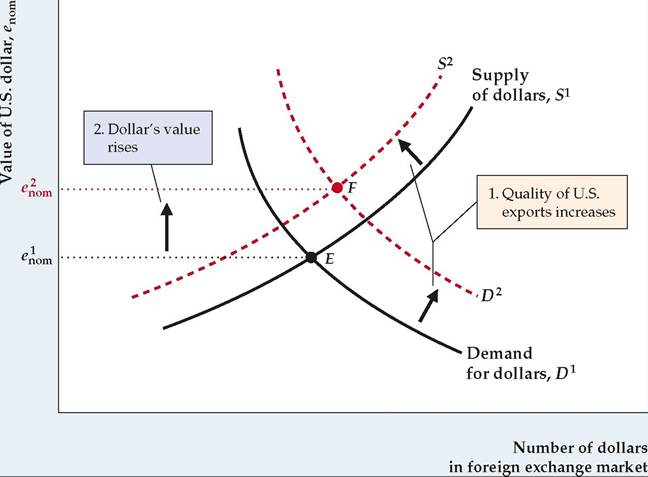
The effect of increased export quality on the value of the dollar
An increase in the quality of U.S. exports raises foreigners' demands for U.S. goods and hence their demand for U.S. dollars, which are needed to buy U.S. goods. The demand curve for dollars shifts from D1 to D2, and the supply curve of dollars shifts from S1 to S2, raising the value of the dollar (the nominal exchange rate) from e nom to e2 uo e nom.
Thus factors that increase foreigners' demand for U.S. exports and assets will also increase the foreign-exchange-market demand for dollars, raising the dollar exchange rate. Likewise, the value of the dollar will rise if U.S. residents' demand for foreign goods and assets declines, so they supply fewer dollars to the foreign exchange market.
For example, suppose that U.S. goods improve in quality so that foreigners demand more of them. This increase in the demand for U.S. exports would translate into an increase in the demand for U.S. dollars. In Figure 13.4 the demand curve for dollars shifts to the right, from D1 to D2. An improvement in the quality of U.S. goods may also lead U.S. residents to substitute U.S. goods for foreign goods, thereby reducing U.S. imports, and reducing the supply of dollars in the foreign exchange market at each real exchange rate, shifting the supply curve of dollars from S1 to S2.
As a result, the equilibrium value of the dollar rises from e... to e 2om. All else being equal, then, improvements in the quality of U.S. goods would lead to an appreciation of the dollar.Macroeconomic Determinants of the Exchange Rate and Net Export Demand
In our previous IS-LM analyses we emphasized two key macroeconomic variables: real output (income), Y, and the real interest rate, r. In anticipation of the open-economy version of the IS-LM model presented in Section 13.3, we now consider how changes in real output or the real interest rate (either at home or abroad) are linked to the exchange rate and net exports. Again, because we are holding domestic and foreign price levels constant, the results we discuss here apply equally to the nominal exchange rate and the real exchange rate.
Effects of Changes in Output (Income). Imagine that domestic output (equivalently, domestic income), Y, increases but that other factors (such as the real interest rate) remain unchanged. How would the increase in Y affect the exchange rate and net exports?
To consider the effect on net exports first is easier. We know that spending by consumers depends in part on their current incomes. When domestic income rises, consumers will spend more on all goods and services, including imports. Thus when domestic output (income) rises, net exports (exports minus imports) must fall, other factors held constant.[241]
To determine the effect of increased domestic output on the exchange rate, recall that, to increase their purchases of imports, domestic residents must obtain foreign currencies. Equivalently, domestic residents must supply more domestic currency to the foreign exchange market. An increased supply of domestic currency causes its value to fall; that is, the exchange rate depreciates.
We can also analyze the effects of an increase in the real output of the country's trading partners, YFor (foreign output or income).
An increase in YFor leads foreign consumers to increase their spending on all goods and services, including the exports of the domestic country. Thus an increase in the income of Germany and Japan, for example, would increase those nations' demand for U.S. exports and raise U.S. net exports. The increase in foreign demand for U.S. goods also would increase foreigners' demand for U.S. dollars, raising the value of the dollar. Note that the effects of changes in foreign income are the opposite of the effects of changes in domestic income.Effects of Changes in Real Interest Rates. A second key macroeconomic variable to be considered is the real interest rate. Imagine that the domestic country's real interest rate, r, rises, with other factors (including the foreign real interest rate) held constant.[242] In this case, the country's real and financial assets will become more attractive to both domestic and foreign savers seeking the highest return on their funds. Because domestic currency can be used to buy domestic assets, a rise in the domestic real interest rate also increases the demand for and reduces the supply of domestic currency. An increased demand and decreased supply of domestic currency in turn leads to exchange rate appreciation.
A rise in the domestic real interest rate, r, has no direct effect on net exports, but it does have an indirect effect through the exchange rate. An increase in r raises the exchange rate so that domestic exports become more expensive and imports from abroad become cheaper. Thus other factors being constant, an increase in r reduces the domestic country's net exports.
The effects of a change in the foreign real interest rate, rFor, are the opposite of the effects of a change in the domestic real interest rate. If the foreign real interest rate rises, for example, foreign assets will become more attractive to domestic and foreign savers. To get the foreign currency needed to buy foreign assets, domestic savers will supply domestic currency to the foreign exchange market.
Foreign savers will also demand less domestic currency. The increased supply and decreased demand for domestic currency will lead to a depreciation of the exchange rate. The depreciation of the exchange rate caused by the rise in rFor in turn raises the domestic country's net exports.Summary tables 16 and 17 list the effects of the various macroeconomic factors on the exchange rate and net exports.
| SUMMARY 16 | ||
| Determinants o | f the Exchange Rate (Real or Nominal) | |
| An increase in | Causes the exchange rate to | Reason |
| Domestic output | Fall | Higher domestic output raises demand for imports |
| (income), Y | and increases supply of domestic currency. | |
| Foreign output | Rise | Higher foreign output raises demand for exports |
| (income), YFor | and increases demand for domestic currency. | |
| Domestic real | Rise | Higher real interest rate makes domestic assets |
| interest rate, r | more attractive and increases demand and | |
| Foreign real | Fall | decreases supply of domestic currency. Higher foreign real interest rate makes foreign |
| interest rate, rFor | assets more attractive and increases supply and | |
| World demand for | Rise | decreases demand for domestic currency. Higher demand for domestic goods increases foreign |
| domestic goods | demand for domestic currency and reduces supply of | |
| domestic currency in foreign exchange market. | ||
| SUMMARY 17 | ||
| Determinants of Net Exports | ||
| Causes net | ||
| An increase in | exports to | Reason |
| Domestic output (income), Y | Fall | Higher domestic output raises demand for imports. |
| Foreign output (income), YFor | Rise | Higher foreign output raises foreign demand for exports. |
| Domestic real interest rate, r | Fall | Higher real interest rate appreciates the real exchange rate and makes domestic goods more expensive relative to foreign goods. |
| Foreign real interest rate, rFor | Rise | Higher foreign real interest rate depreciates the real exchange rate and makes domestic goods cheaper relative to foreign goods. |
| World demand for domestic | Rise | Higher demand for domestic goods directly |
| goods | increases net exports. | |
13.3