Origins of Today’s Income Differences and World Economic Growth
The growth rate differences shown in Figures 1.7 and 1.8 are interesting in their own right and could also be, in principle, responsible for the large differences in income per capita we observe today.
But are they? The answer is no. Figure 1.8 shows that in 1960 there was 12already a very large gap between the United States on the one hand and India and Nigeria on the other.
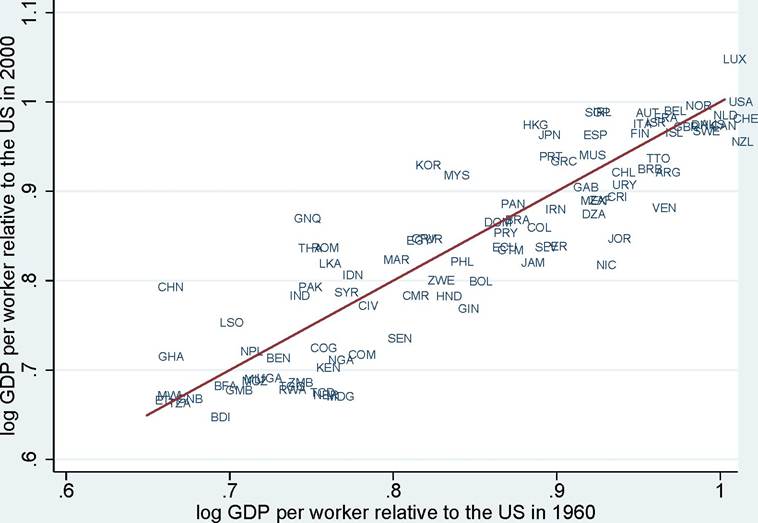
Figure 1.9. Log GDP per worker in 2000 versus log GDP per worker in 1960, together with the 45o line.
This can be seen more easily in Figure 1.9, which plots log GDP per worker in 2000 versus log GDP per capita in 1960 (in both cases relative to the US value) superimposed over the 45o line. Most observations are around the 45o line, indicating that the relative ranking of countries has changed little between 1960 and 2000. Thus the origins of the very large income differences across nations are not to be found in the postwar era. There are striking growth differences during the postwar era but the evidence presented so far suggests that the “world income distribution” has been more or less stable, with a slight tendency towards becoming more unequal.
If not in the postwar era, when did this growth gap emerge? The answer is that much of the divergence took place during the 19th and early 20th centuries. Figures 1.10 and 1.12 give a glimpse of these 19th-century developments by using the data compiled by Angus Maddison for GDP per capita differences across nations going back to 1820 (or sometimes earlier). These data are less reliable than Summers-Heston’s Penn World tables, since they do not come from standardized national accounts. Moreover, the sample is more limited and 13
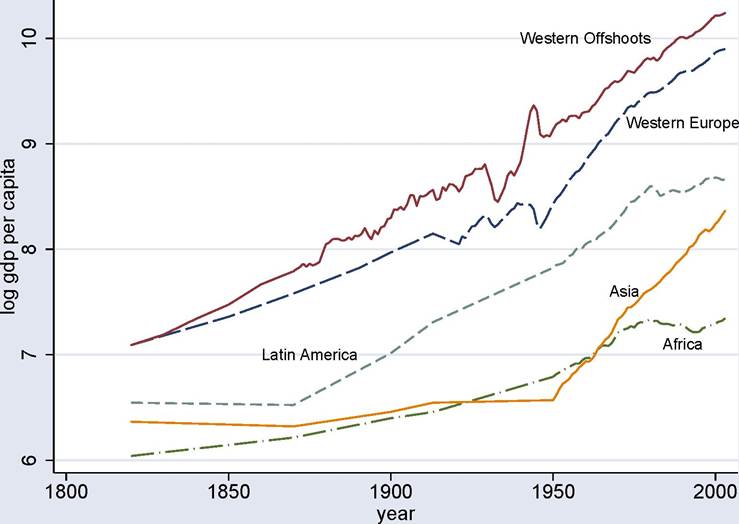
Figure 1.10.
The evolution of average GDP per capita in Western Offshoots, Western Europe, Latin America, Asia and Africa, 1820-2000.does not include observations for all countries going back to 1820. Finally, while these data include a correction for PPP, this is less reliable than the price comparisons used to construct the price indices in the Penn World tables. Nevertheless, these are the best available estimates for differences in prosperity across a large number of nations going back to the 19th century.
Figure 1.10 illustrates the divergence; it depicts the evolution of average income between five groups of countries, Western Offshoots of Europe (the United States, Canada, Australia and New Zealand), Western Europe, Latin America, Asia and Africa. It shows the relatively rapid growth of the Western Offshoots and West European countries during the 19th century, while Asia and Africa remained stagnant and Latin America showed little growth. The relatively small income gap in 1820 had become much larger by 1960.
Another major macroeconomic fact is visible in Figure 1.10: Western Offshoots and West European nations experience a noticeable dip in GDP per capita around 1929. This is because of the famous Great Depression. Western offshoots, in particular the United States, only recovered fully from this large recession in the wake of WWII. How an economy can experience such a sharp decline in output and how it recovers from such a shock are among the ma jor questions of macroeconomics. While the Great Depression falls outside the scope 14
of the current book, we will later discuss the relationship between economic crises and growth as well as potential sources of volatility in economic growth.
A variety of other evidence suggests that differences in income per capita were even smaller once we go back further than 1820. Maddison also has estimates for average income for the same groups of countries going back to 1000 AD or even earlier. We extend Figure 1.10 using these data; the results are shown in Figure 1.11.
Although these numbers are based on scattered evidence and informed guesses, the general pattern is consistent with qualitative historical evidence and the fact that income per capita in any country cannot have been much less than $500 in terms of 2000 US dollars, since individuals could not survive with real incomes much less than this level. Figure 1.11 shows that as we go further back, the gap among countries becomes much smaller. This further emphasizes that the big divergence among countries has taken place over the past 200 years or so. Another noteworthy feature that becomes apparent from this figure is the remarkable nature of world economic growth. Much evidence suggests that there was only limited economic growth before the 18th century and certainly before the 15th century. While certain civilizations, including Ancient Greece, Rome, China and Venice, managed to grow, their growth was either not sustained (thus ending with collapses and crises) or progress at only at a slow pace. No society before 19th-century Western Europe and the United States achieved steady growth at comparable rates. In fact, Maddison’s estimates show a slow but steady increase in West European GDP per capita even earlier, starting in 1000. This view is not shared by all economic historians, many of whom estimate that there was little increase in income per capita before 1500 or even before 1800. For our purposes this is not central, however. What is important is that, using Walter Rostow’s terminology, Figure 1.11 shows a pattern of takeoff into sustained growth; the economic growth experience of Western Europe and Western Offshoots appears to have changed dramatically about 200 years or so ago. Economic historians debate whether there was a discontinuous change in economic activity to deserve the terms takeoff or Industrial Revolution. This debate is besides the point for our purposes. Whether or not the change was discontinuous, it was present and transformed the functioning of many economies. As a result of this transformation, the stagnant or slowly-growing economies of Europe embarked upon a path of sustained growth. The origins of today’s riches and also of today’s differences in prosperity are to be found in this pattern of takeoff during the 19th century. In the same time as much of Western Europe and its Offshoots grew rapidly, much of the rest of the world did not experience a comparable takeoff or did so much later. Therefore, an understanding of modern economic growth and current cross-country income differences ultimately necessitates an inquiry into the causes of why the takeoff occurred, why it did so about 200 years ago, and why it took place only in some areas and not in others.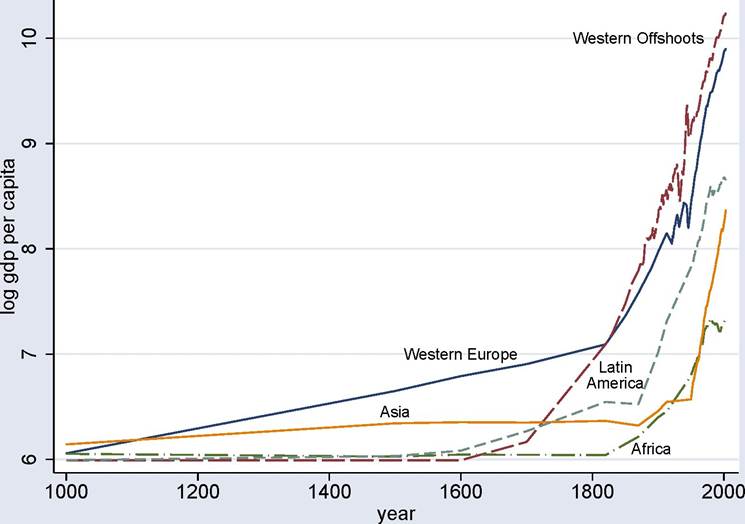
Figure 1.11. The evolution of average GDP per capita in Western Offshoots, Western Europe, Latin America, Asia and Africa, 1000-2000.
Figure 1.12 shows the evolution of income per capita for United States, Britain, Spain, Brazil, China, India and Ghana. This figure confirms the patterns shown in Figure 1.10 for averages, with the United States Britain and Spain growing much faster than India and Ghana throughout, and also much faster than Brazil and China except during the growth spurts experienced by these two countries.
Overall, on the basis of the available information we can conclude that the origins of the current cross-country differences in economic performance in income per capita lie during the 19th and early 20th centuries (or perhaps even during the late 18th century). This divergence took place at the same time as a number of countries in the world “took off” and achieved sustained economic growth. Therefore understanding modern economic growth is not only interesting and important in its own right but also holds the key to understanding the causes of cross-country differences in income per capita today.
1.5.
More on the topic Origins of Today’s Income Differences and World Economic Growth:
- The Agenda
- The Agenda
- In this chapter, I discuss various different approaches to the analysis of structural change.
- Taking Stock
- This chapter investigates human capital investments and the role of human capital in economic growth and in cross-country income differences.
- Political Economy of Institutions: First Thoughts
- This chapter contains concluding remarks. Instead of summarizing the models and ideas presented so far,
- The models presented so far focused on physical and human capital accumulation, and sustained economic growth has been generated by exogenous technological progress.
- References and Literature
- Proximate Versus Fundamental Causes