The Theory of Discretionary Monetary and Fiscal Policy
The potential for monetary and fiscal policy to achieve full employment is clear in Keynesian models. The question that arises relates to the appropriate use of monetary and fiscal policy.
This question was first posed in the important contribution of Tinbergen [1952], who distinguished between targets and instruments of (macro) economic policy. Tinbergen argued that as long as the policy authorities had as many independent policy instruments as they had policy targets, they would be able to fully achieve their targets by using one policy instrument for each target. If they had fewer instruments than targets, then they would not be able to achieve all their targets simultaneously. Moreover, if the policy authorities had access to an econometrically estimated model, they could calculate, with relative precision, the appropriate response of policy instruments to stochastic shocks that shift the economy away from the targets of the authorities.Tinbergen’s ideas were further developed by Theil in a series of contributions (Theil [1954, 1956, 1964]). Theil analyzed how to optimally adjust policy instruments to calculate policy responses, and these ideas gradually became operational through the development of large-scale Keynesian macroeconometric models, which were used for both forecasting and policy evaluation.
The policies that are decided in this way are often referred to as discretionary policies, as opposed to rules-based policies, according to which the path of policy instruments is not determined at the discretion of governments but on the basis of restrictive policy rules.
In effect, Keynesian models and the Tinbergen-Theil theory of economic policy tilted macroeconomic policy in the direction of discretion rather than rules.
15.3.1 The Tinbergen-Theil Theory of Discretionary Aggregate Demand Policies
To introduce the Tinbergen-Theil theory of discretionary macroeconomic policy, we shall consider the following simplified stochastic log-linear version of the AD-AS Keynesian macro model:
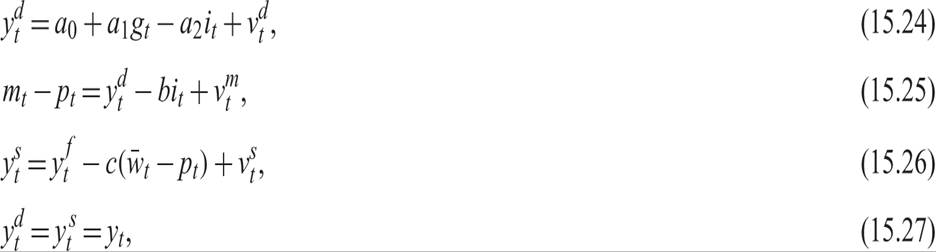
where y denotes the logarithm of aggregate real output, which is determined by the equality of aggregate demand y d with aggregate supply y s; g is the logarithm of real government expenditure; i is the nominal interest rate; m is the logarithm of the money supply; p is the logarithm of the price level; v d is an exogenous stochastic shock to aggregate demand; v m is an exogenous stochastic shock to money demand; v s is an exogenous stochastic shock to aggregate supply; w is the log of the nominal wage, assumed exogenous; and a0, a1, a2, b, and c are exogenous fixed parameters.
Equation (15.24) is a log-linear IS curve, (15.25) a log-linear LM curve, and (15.26) a log-linear AS curve (the aggregate supply function). Equation (15.27) is the equilibrium condition in the output market.In the Tinbergen terminology, the (potential) policy targets are y and p, and the policy instruments are g, m, and i. Because m and i are linearly related through the money demand function, only one of the two can be used as an independent instrument of monetary policy, and the other will be determined endogenously.
Let us initially assume that the monetary policy instrument of the government is the money supply. Then the model determines three endogenous variables, y, p, and i, as functions of the exogenous policy instruments g and m, the exogenous shocks, and the exogenous parameters. Using the money demand function to substitute for the nominal interest rate in the IS curve (15.24), we get the following aggregate demand function:

Thus, the model consisting of the aggregate demand function (15.28), the aggregate supply function (15.26), and the equilibrium condition (15.27) determines output and the price level as functions of the exogenous shocks and the policy instruments m and g.
15.3.2 Monetary and Fiscal Policy with a Full Employment Target
Let us assume that the sole target of macroeconomic policy is to maintain output at its full employment level. This can be done by using either fiscal policy, monetary policy, or both to ensure that aggregate demand is equal to full employment output y f. From (15.26) and (15.28), output and the price level satisfy

Using (15.30) to substitute for the price level in (15.29), we get

From (15.31), we see that the government can use its aggregate demand instruments (i.e., m and g) to achieve the target of full employment output.
If m and g satisfy (15.31) for all periods, then output will always be at its full employment target under the discretionary policy.If the monetary instrument of the government is the nominal interest rate and not the money supply, then (15.31) would be replaced by

The money supply would then become endogenous, and the price level would still be determined by (15.30).
The above analysis is the justification for discretionary aggregate demand policies in the Keynesian model. In principle, aggregate demand policies can be used to counteract the effects of both demand and supply shocks on aggregate output and unemployment. This ability would imply that aggregate demand policies could in principle be used to stabilize economic activity at the level of full employment and help avoid the repetition of phenomena such as the Great Depression.
15.3.3 Monetary and Fiscal Policy with a Full Employment Target and a Price Level Target
From the preceding analysis, note that if output is stabilized at its full employment level, then the price level cannot be controlled and depends only on the exogenous nominal wage and aggregate supply shocks through equation (15.30). If the government wanted to achieve a price level target as well as full employment, it would not be able to do so, as its monetary and fiscal policy instruments both operate through aggregate demand and are thus linearly dependent. Effectively, the government has only one instrument, aggregate demand policy, and thus can only achieve one target. To affect the price level, it would need an independent instrument (such as an incomes policy) that would affect the nominal wage in (15.30). Without such an additional instrument, it would have to balance deviations from the full employment target against deviations from the price level target.
Let us assume, following Theil [1964], that the government selects monetary and fiscal policy to minimize a loss function that depends on quadratic deviations of output from full employment output and the price level from a socially desirable fixed price level target.
This loss function takes the form
where  is the price level target, and ζ measures the relative marginal social cost of price deviations relative to output deviations in the social welfare ranking of the government.18
The problem of discretionary economic policy can be modeled as the minimization of the welfare loss (15.33), subject to the constraint of the model of the economy described by equations (15.26)–(15.28). The outcome of such a policy process is often described as discretionary policy, because the government chooses its policy instruments in every period to minimize its one-period loss function.
From the first-order conditions for a minimum, it follows that

At the optimum, the government aggregate demand policies equate the marginal social cost of deviations of output from full employment to the marginal welfare cost of deviations of the price level from its target.
If the government possessed enough instruments to eliminate deviations of both output from its full employment level and the price level from its target, then (15.34) would be satisfied for zero deviations from the targets of the government. However, the government essentially has one policy instrument, as both monetary and fiscal policy operate through aggregate demand. Using the aggregate supply function (15.26) to substitute for y − y f in (15.34), we find that under the optimal policy,

The price level will deviate from the government’s target under the optimal policy, unless there is a “divine coincidence,” which ensures that the exogenous nominal wage, the price level target of the government, and the supply shock are such that the right-hand side of (15.35) adds up to zero.
Aggregate demand policies do not affect (15.35).Substituting (15.35) in (15.34), we can see that under the optimal policy, output will also deviate from full employment output, and the deviation is determined by

Supply shocks will cause positive deviations of output from full employment output, and wage shocks will cause negative deviations of output from full employment output. The lower the price level target of the government relative to the nominal wage is, the smaller the deviation of output from full employment output will be: Thus, a government with a low price level target, given nominal wages, will end up with lower output and employment compared to full employment under the optimal discretionary policy.
In the presence of wage and supply shocks, discretionary aggregate demand policies can only ensure that the deviation of output from full employment output satisfies (15.34), but no more. Wage and supply shocks induce a trade-off between the employment and price level target of a government. Full employment is not compatible with the optimal discretionary macroeconomic policy, because the government has one instrument (aggregate demand policies) but two targets (output and the price level). The optimal discretionary policy is thus second best, as the government just balances, at the margin, the welfare costs associated with deviations of the price level and output from its targets.
From (15.34), note that if ζ = 0 (i.e., if the government cares only about output and not the price level), this trade-off disappears, and we are back to a full employment equilibrium, as analyzed in sub-section 15.3.2. However, in such a case, the price level is destabilized.
The problem is that monetary and fiscal policy in Keynesian models (such as the AD-AS model we analyzed) can only affect aggregate demand. It is optimal to use them to achieve full employment only if the government cares about output and employment and not the price level.
If the government cares about both output and the price level, achieving full employment through discretionary aggregate demand policies is not feasible in the presence of wage and supply shocks, because the optimal policy is second best. The government does not have enough instruments to achieve both targets. Thus, under the optimal discretionary aggregate demand policy, the best a government could do is to equalize the marginal welfare cost of deviations of output from full employment to the marginal welfare cost of deviations of the price level from its target, as suggested by (15.34).If the government is to be able to achieve both of its targets fully under the discretionary policy, it needs another policy instrument in addition to monetary and fiscal policies. Such an instrument could, for instance, be a price or incomes policy that would operate through controls of nominal wages or prices. Note from (15.35) and (15.36) that if a government could control nominal wages, then it would be able to achieve both full employment and the price level target.
From the 1950s to the 1970s, when many governments tried to implement discretionary aggregate demand policies, conflicts often arose between the targets of full employment and price stability. In such cases, many governments resorted to nominal wage and price controls as an additional policy instrument that would help resolve the conflicts. These conflicts became even more acute with the negative supply shocks of the 1970s, which led to stagflation, a combination of recession with a rise in inflation.
We shall return to the dilemma of rules versus discretion after we discuss the evolution of Keynesian models since the 1960s, following the emergence of the Phillips curve.
15.4