Total Factor Productivity and Population Growth
The savings rate is of course one of the parameters affecting per capita output, income, and consumption in the Solow model. All the other parameters also affect the evolution of per capita output, income, and consumption, both on the balanced growth path and on the convergence path.
In this section, we concentrate on two additional parameters: total factor productivity A and population growth n.3.4.1 Dynamic Effects of Total Factor Productivity in the Solow Model
Figure 3.6 shows the dynamic effects of a one-off increase in total factor productivity A in the Solow model. An increase in total factor productivity raises total output for given factor inputs, such as capital and labor. Through the savings function, it also raises aggregate savings and investment. Hence, as shown in figure 3.6, a one-off increase in total factor productivity results in a gradual accumulation of capital and a shift from the initial balanced growth path k* to a new balanced growth path k** with higher capital and output per efficiency unit of labor.
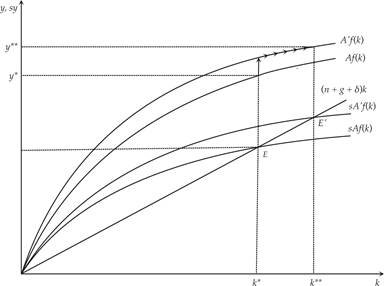
Figure 3.6 Implications of a rise in total factor productivity.
An increase in total factor productivity has both direct and indirect effects on output per efficiency unit of labor. It raises output for given capital per efficiency unit of labor and also causes additional capital accumulation through higher savings and investment. Hence, the elasticity of steady state per capita output with respect to total factor productivity is higher than unity, because of the induced accumulation of capital.
The Solow model thus implies that economies with higher total factor productivity will not only have higher per capita incomes but also higher capital per worker, which will further increase their per capita income.
3.4.2 Dynamic Effects of Population Growth in the Solow Model
Figure 3.7 shows the dynamic effects of a one-off increase in the rate of growth of population n in the Solow model. A rise in the population growth rate raises the steady state investment rate (i.e., the investment required to maintain a constant capital stock per efficiency unit of labor). For a given level of savings, this leads to decumulation of capital, as the initial steady state savings are lower than the new steady state investment. The decumulation of capital reduces equilibrium investment until a new balanced growth path is reached, in which equilibrium investment is equal to savings. In the new steady state, both capital and output (as well as consumption) per efficiency unit of labor will be lower. Hence, a higher growth rate of population results in lower per capita income and consumption on the balanced growth path. This is a direct implication of the assumption of an exogenous savings rate in the Solow model.
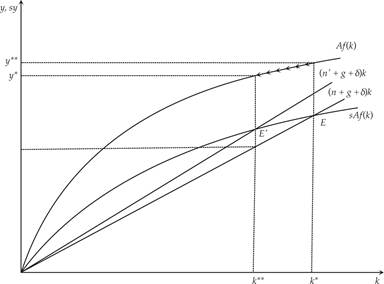
Figure 3.7 Implications of a rise in population growth.
3.5