Speed of Convergence toward the Balanced Growth Path
How fast does the economy converge to the balanced growth path from an initial condition that is not on this path? This is a theoretically and empirically interesting question worth answering.
In the neighborhood of the balanced growth path, the speed of convergence of k toward k* depends on their difference. On the basis of widely accepted values for the parameters of the model, one can show that the speed of convergence in the Solow model is about 4% per year. As a result, the Solow model predicts that it should take slightly more than 17 years to close half of any given gap between k and k*, and therefore any given gap between y and y*.
To derive the speed of convergence, we start from the basic accumulation equation of the Solow model:

Steady state capital (per effective unit of labor) k* is determined from (3.29) for  . To determine the speed at which k(t) approaches k*, we linearize (3.29) around k*. From the linear Taylor approximation of the nonlinear differential equation (3.29) around k*, we get

where the first derivative is taken from (3.29). Equation (3.30) can be written as

where  , which implies that around the steady state k*, k approaches k* with a speed that depends on its distance from k*.
Solving the linear first-order differential equation (3.31), we get that

where k(0) is the initial value of k.
To calculate the speed of convergence λ in terms of the structural parameters of the model, rearrange the definition of λ in (3.31) as
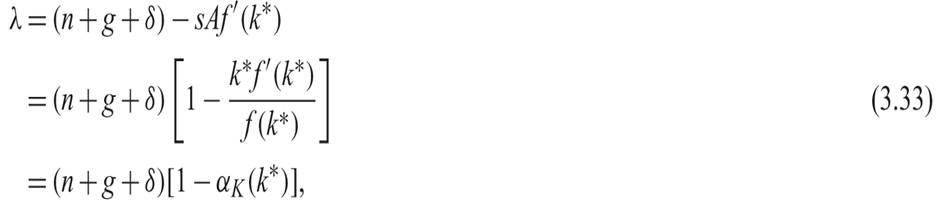
where αK(k*) is the share of capital in total income at the steady state. To proceed from the initial expression in (3.33), note that in the steady state, sAf(k*) = (n + g + δ)k*, which can be used to eliminate s. To get to the final expression in terms of the share of capital, note that in a competitive equilibrium, the return on capital is equal to its marginal product.
Widely accepted annual estimates of n + g + δ suggest a value of about 6%. For example, this would be the result with n = 1%, g = 2%, and δ = 3%. With the share of capital estimated at about 1/3, (3.33) implies an annual speed of convergence of about 4%.
Thus, on the basis of these estimates, the Solow model implies that each year, roughly 4% of the gap between the current capital stock (and income) and the steady state capital stock (and income) is closed through the process of capital accumulation.
From (3.32), which is the solution of the linearized differential equation (3.31), we can estimate how many years it will take with this speed of convergence to close a particular percentage of the gap between k(0) and k*. To calculate the number of years required to cover half of the initial difference, we need to calculate the time span t that satisfies

for λ = 4%.
This suggests that t = −ln(0.5)/λ = 0.69/λ = 0.69/0.04 = 17.3. Thus, for an annual speed of convergence of 4%, it would take 17.3 years to cover half of any initial difference between the initial capital stock (and real income) and its steady state value. This is often referred to as the half-life of the convergence process.To calculate the number of years required to cover two-thirds of the initial difference, we need to calculate the time span t that satisfies

for λ = 4%. This suggests that t = −ln(0.333)/λ = 2.1/λ = 2.1/0.04 = 27.5. Thus, it would take 27.5 years to cover two-thirds of any difference between the initial capital stock (and real income) and its steady state value.
Econometric evidence from, among others, Mankiw et al. (1992) suggests that the speed of convergence for many economies in the postwar period was on average about 2% per year. Thus, the speed of convergence predicted by the Solow model, based on the parameter estimates we used, is on the high side compared with the econometric evidence. We shall return to this issue in chapter 8.
3.6
More on the topic Speed of Convergence toward the Balanced Growth Path:
- Dynamic Simulations of a Calibrated Solow Model
- Exercises
- Total Factor Productivity and Population Growth
- Exercises
- Solow Model and Regression Analyses
- Solow Model and Regression Analyses
- Ricardian Equivalence and the Ramsey Model