Understanding Endogenous Political Change
23.4.1. General Insights. The analysis so far has focused on the implications of different political institutions on economic growth and how their economic consequences shape the preferences of different agents over these political institutions.
The only example of institutional change we have seen was one of voluntary transition from oligarchy to democracy in the previous section. In practice, however, most institutional change does not happen voluntarily, but is a result of social conflict. Consider, for example, the democratization of most Western European nations during the 19th and early 20th centuries or the democratization experience in Latin America during the 20th century. In both cases, democracy was not voluntarily granted by the existing elites, but resulted from the process of social conflict, in which those previously disenfranchised demanded political rights and in some cases were able to secure them. But how does this happen? A nondemocratic regime, by its nature, vests political power with a narrow group. Those who are excluded from this group, the non-elites, do not have the right to vote or nor do they have any voice in collective decisions. So how can they influence, the course of the political equilibrium and induce equilibrium political change? The answer to this question lies in drawing a distinction between de jure (formal) and de facto political power. De jure political power refers to power that originates from the political institutions in society, and has been the form of political power that has been our focus so far. One may view it as the more “legitimate” type of political power. Political institutions determine who gets to vote, how representatives make choices, and the general rules of collective decision-making in society. In Max Weber’s famous description, they also reserve “the legitimate use of violence” to the state (and to the actors that control the state). These various different types of political power are all of the de jure kind. However, there is 1057another, equally important type of political power that features importantly in equilibrium political changes—de facto political power. The political power of protesters that marched against the existing regime before the First Reform Act in Britain in 1832 was not of the de jure kind. The law of the land did not empower them to influence the political course of actions—in fact, they were quite explicitly disenfranchised. But they had a different kind of power, emanating from their ability to solve the collective action problem and organize protests. This power was also supported by the fact that they were the majority in the society. This type of political power, which lives outside the political institutions, is de facto political power.
De facto political power is ever present around us. Civil wars, revolutions, and social unrests are manifestations of the use of de facto political power by various groups. Military excursions are another example. More interesting for our purposes are the types of de facto political power that coexist with de jure political power in orderly (or semi-orderly societies). For example, in many Latin American countries governments are elected via democratic means, as it should be according to the political institutions that have specified the distribution of de jure power in society, but at the same time there is ample fraud, vote buying, and use of violence via paramilitaries and other organizations to influence the outcomes of elections. All of these fall within the category of the exercise of de facto political power. Then there are grey areas. For example, the ability of the rich and well-organized groups to use money for campaign contributions or for lobbying, and thus influencing the policy choices and platforms of politicians can be viewed as an example of the exercise of de facto power, though it can also be viewed as part of the regular functioning of political institutions, since in many societies, like the United States, lobbies are legal.
De facto political power is important for political change, since de jure political power itself will act as a source of persistence—not of change. For example, consider the model of the previous section when (23.32) does not hold, so that the oligarchs are happy to maintain the oligarchic regime. If de jure power is the only source of power, the elite will be the only one with the decision-making powers in the society, and they will never change the political regime away from oligarchy towards democracy. However, if the non-elites had some source of power—which, by its nature, has to be de facto power—then, political change becomes a possibility. Perhaps in some periods, the non-elites will be able to solve their collective action problem and thus exercise enough pressure on the system to force some changes. In the extreme, they can induce the elites to disband oligarchy and transition to democracy, or they can themselves topple the oligarchic regime.
I will argue that the interaction between de jure and de facto political power is the most promising way to approach the analysis of equilibrium political change. Moreover, this interaction becomes particularly interesting when studied in a dynamic framework. This is for at
least two reasons. First, most of the issues we are discussing are dynamic in nature—they refer to political change. Second, whether the distribution of de facto political power is permanent or changing stochastically over time has major consequences for the structure of political equilibrium. When a particular (disenfranchised) group has permanent (and unchanging) amount of de facto political power, it can use this at each date to demand concessions from those holding de jure political power. Such a situation may lead to an equilibrium without political change (though the equilibrium will have a very different distribution of resources because of the concessions induced by the de facto power of the disenfranchised group. Next consider a situation in which the de facto political power of the disenfranchised group is highly transient—in the sense that, they have been able to solve their collective action problem and exercise de facto political power today, but it is unlikely that they will have the same type of power tomorrow.
Then, the disenfranchised group cannot rely on the use of their de facto political power in the future to receive concessions. If they want concessions and redistribution of resources towards themselves in the future, they have to use their current power in order to secure such a change. This generally involves a change in political institutions as a way of changing the future distribution of de jure power. More explicitly, consider a situation in which a particular group of individuals know that today they have the power to change institutions and create a playing field favoring themselves in the future, but they also understand that this de facto political power will be gone tomorrow. Thus any limited transfer of resources or other concessions made to them today will be either reversed or will be insufficient relative to the benefits from changing the playing field in their favor. It will therefore be precisely the transient nature of their de facto political power that will encourage them to take actions to change political institutions in order to cement their power more firmly (so that they can change their transients de facto political power into more durable de jure political power). This informal discussion therefore suggests a particular channel via which the interaction between de facto and de jure political power can lead to equilibrium changes in political institutions. I next give a historical example to illustrate this point further.23.4.2. An Example. As a brief example, consider the development of property rights in Europe during the Middle Ages. There is broad agreement in the literature that lack of property rights for non-elite landowners, merchants, and early industrialists was detrimental to economic growth during this epoch. Since political institutions at the time placed political power in the hands of kings and various types of hereditary monarchies, such rights were largely decided by these monarchs. The monarchs often used their powers to expropriate producers, impose arbitrary taxation, renege on their debts, and allocate the productive resources of society to their allies in return for economic benefits or political support.
Consequently, economic institutions during the Middle Ages provided little incentive to invest in 1059land, physical or human capital, or technology, and failed to foster economic growth. These economic institutions also ensured that the monarchs and their allies controlled a large fraction of the economic resources in society, solidifying their political power and ensuring the continuation of the political regime.
The 17th century witnessed major changes in the economic and political institutions that paved the way for the development of property rights and limits on monarchs’ power, especially in England after the Civil War of 1642 and the Glorious Revolution of 1688, and in the Netherlands after the Dutch Revolt against the Hapsburgs. How did these major institutional changes take place? In England until the 16th century the king also possessed a substantial amount of de facto political power, and leaving aside civil wars related to royal succession, no other social group could amass sufficient de facto political power to challenge the king. But changes in the English land market and the expansion of Atlantic trade in the 16th and 17th centuries gradually increased the economic fortunes, and consequently the de facto power of landowners and merchants opposed to the absolutist tendencies of the Kings.
By the 17th century, the growing prosperity of the merchants and the gentry, based both on internal and overseas, especially Atlantic, trade, enabled them to field military forces capable of defeating the king. This de facto power overcame the Stuart monarchs in the Civil War and Glorious Revolution, and led to a change in political institutions that stripped the king of much of his previous power over policy. These changes in the distribution of political power led to major changes in economic institutions, strengthening the property rights of both land and capital owners and spurring a process of financial and commercial expansion. The consequence was rapid economic growth, culminating in the Industrial Revolution, and a very different distribution of economic resources from that in the Middle Ages.
This discussion poses, and also gives clues about the answers to, a crucial question: why do groups with political power want to change political institutions in their favor? In the context of the example above, why did the gentry and merchants use their de facto political power to change political institutions rather than simply implement the policies they wanted? The answer lies with the transient nature of de facto political power and the lack of commitment to future policies.
As already discussed in the previous chapter, the commitment problem arises because groups with political power cannot commit to not using their power to change the distribution of resources in their favor. For example, economic institutions that increased the security of property rights for land and capital owners during the Middle Ages would not have been credible as long as the monarch monopolized political power. He could promise to respect others’ property rights, but then at some point, renege on his promise, as exemplified by the numerous financial defaults by medieval kings. Credible secure property rights necessitated a reduction in the political power of the monarch. Although these more secure property rights would foster economic growth, they were not appealing to the monarchs who would lose their rents from predation and expropriation as well as various other privileges associated with their monopoly of political power. This is why the institutional changes in England as a result of the Glorious Revolution were not simply conceded by the Stuart kings. James II had to be deposed for the changes to take place.
The reason why de facto political power is often used to change political institutions is closely related to the transient nature of this power and to commitment problems. Individuals care not only about economic outcomes today but also in the future. In the example above, we presume that the gentry and merchants were interested in their profits and therefore in the security of their property rights, not only in the present but also in the future. Therefore, they would have liked to use their (de facto) political power to secure benefits in the future as well as the present. However, commitment problems make this difficult. If the gentry and merchants would have been sure to maintain their de facto political power, this would not have been a problem. However, de facto political power is often transient, for example because the collective action problems that are solved to amass this power are likely to resurface in the future, or other groups, especially those controlling de jure power, can become stronger. The commitment problems, in turn, imply that promises made today cannot be trusted and any change in policies and economic institutions that relies purely on de facto political power is likely to be reversed in the future. A plausible story for the nature of political changes in early modern Europe is therefore that when they had the transient political power, the English gentry, merchants, and industrialists strove not just to change economic institutions in their favor following their victories against the Stuart monarchy, but they also sought, and managed, to alter political institutions and the future allocation of de jure power in their favor. Using political power to change political institutions then emerges as a useful strategy to make gains more durable. Consequently, political institutions are an important as way in which future political power can be manipulated, and thus indirectly shaping future, as well as present, economic institutions and outcomes.
23.4.3. Modeling. The discussion so far illustrated how we can use the interaction between de facto and de jure political power in order to study equilibrium political changes, and their implications for economic growth. While the discussion has given some clues about what the incentives of different parties with and without de jure political power will be in a dynamic game, it is so far unclear how one would construct models to analyzed these forces and generate useful comparative statics. In this subsection, I suggest a general framework that is useful for thinking about the dynamic interactions between de facto and de jure political power. In the next subsection and the next section, I will illustrate this framework further.
Imagine a dynamic model in which there are two state variables, political institutions and the distribution of resources. For example, P (t) ∈ P denotes a specific set of political institutions in place at time t. This can be democracy or nondemocracy, parliamentary versus presidential system, different types of oligarchic institutions, etc. The set P denotes the entire set of feasible political institutions relevant for the situation we are studying. Similarly, let W (t) ∈ W denote a variable encoding the distribution of resources at time t. For example, in a society consisting of two groups, the rich and the poor, this could be the relative incomes of the two groups. In a society with many individuals, it could be the density function of income or wealth. Again, W is the set of all possible distributions of resources in society. It is useful to think of both P (t) and W (t) as state variables for three reasons. First, they are relatively slow-changing, thus corresponding to the loose notion of a state variable. Second, they will typically be the payoff-relevant variables when we set up the problem is a dynamic game, thus they will be the “Markovian states”. Third and perhaps most important, these two variables will determine the two sources of political power essential for understanding equilibrium political change. The variable P (t) will determine the distribution of de jure political power, which I denote by J (t) ∈ J, in particular, it determines who has the right to vote and which politicians are sub ject to what types of constraints and what decisions they can take. The distribution of resources is not the only variable that affects de facto political power but it is one of its main determinants. In particular, as already hinted in the discussion above, de facto political power is typically the result of the ability of certain groups to solve their collective action problem, or emerges when certain groups have the resources to hire their own armies, paramilitaries, and supporters, or simply use the money for lobbying and bribing. Let the distribution of de facto political power in the society at time t be F (t) ∈ F. As in the beginning of Part 8, let us also denote economic institutions by R (t) ∈ R, and let Y (t) ∈ Y be a measure of economic performance, such as income per capita or growth (though it could also include other performance-related variables, such as the level of poverty, health, human capital etc.).
A dynamic framework that is useful for thinking about political change and its implications for economic growth would consist of a mapping φ : P ? Z → J, which determines the distribution of de jure power at time t as a function of political institutions at time t, P (t) ∈ P, as well as some potential stochastic elements, captured by z (t) ∈ Z. It will also consist of a mapping determining the distribution of de facto power in a similar manner, φ : W?Z → F, where the types of stochastic elements influencing whether a particular group has de facto political power will be different than those affecting the distribution of de jure power, but we can summarize both of them with the variable z (t) ∈ Z. Then given the realization of J (t) ∈ J and F (t) ∈ F, another mapping J ? F → R ? P determines both
economic institutions today and also one of the future state variables, the political institutions tomorrow, P (t + 1) ∈ P. Intuitively speaking, the distribution of de facto and de jure political power regulates what types of economic institutions will be in place today and also leaves the door open for potential political change, for example a switch from nondemocracy to democracy if such a change is necessary because of the balance of de facto and de jure power today. Finally, an economic equilibrium mapping ρ : R → Y ? W determines both the economic performance variables and the distribution of economic resources. For example, if economic institutions are competitive markets, they may lead to high wages and high output, and if they are repressive labor markets, they will lead to low wages, high profits, but perhaps lower output because of greater distortions they may be creating because of monopsony distortions or the induced misallocation of workers to tasks.
The next chart summarizes this discussion diagrammatically.
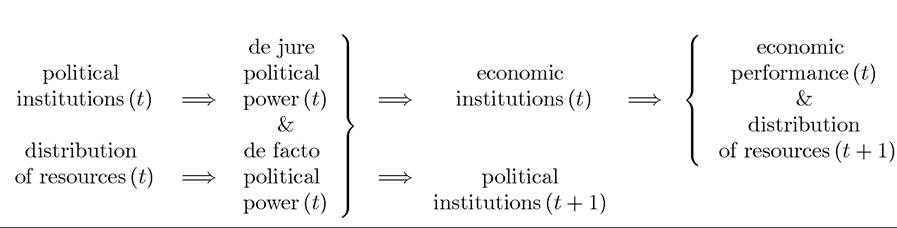
This framework and the associated diagram emphasize both the effects of economic institutions on economic performance and the distribution of resources—what we have tried to understand so far. But they have also introduced the dynamics of political power and political institutions. Of course, at this level of generality, such a dynamic framework is somewhat vacuous. It would only be useful and meaningful if we can put more content into the set of political institutions and the distribution of resources that need to be considered, derive the mappings φ, φ, ι and ε from economic interactions with sound microfoundations and then conduct useful comparative statics. This is a tall order, and a full dynamic model of the sort, that is able to deliver on all of these counts, does not currently exist. Nevertheless, a number of models that are useful for the analysis of political change and the interaction between politics and economics can be viewed through the lenses of this framework. This suggests that an abstract framework like the one presented here might be useful in emphasizing what the important frontiers for research are and what types of models we may want to think about for furthering our understanding of political change and the relationship between political institutions and economic growth.
In the next subsection, I will provide an informal discussion of one application of this framework, and then in the next section, I will present another application in greater detail, 1063
because it will not only illustrate the basic ideas highlighted here, but also shed light on the economic tradeoffs between different political regimes.
23.4.4. Another Example: The Emergence of Democracy. The framework presented above is largely inspired by the the models of the emergence of democracy developed in Acemoglu and Robinson (2000a, 2006a). Acemoglu and Robinson construct a model of the emergence of democracy based on social conflict between the elite, who originally hold de jure political power, and the masses, that are initially without de jure political power, but can sometimes solve their collective action problems and gather significant de facto political power. A historical case that illustrates the main issues emphasized by Acemoglu and Robinson is the emergence of democracy in 19th century Europe. Many European nations during the 19th century were run by small elites. Most had elected legislatures, often descendents of medieval parliaments, but the franchise was highly restricted to males with relatively large amounts of assets, incomes or wealth. However, as the century and the Industrial Revolution progressed, this political monopoly was challenged by the disenfranchised who engaged in collective action to force political change.
In response to these developments, the elites responded in three ways. First, the elites could use repression to prevent social unrest, as they have done in much of Europe during the revolutionary waves of 1848. Second, as in Germany under Bismarck, they may try to use economic concessions to buy off opposition. Finally, if neither repression nor concessions were attractive or effective, elites expanded the franchise and gave political power to the previously disenfranchised—they created the precedents of modern democracy.
The first important move towards democracy in Europe came in Britain came with the First Reform Act of 1832, which we have already discussed above. This act removed many of the worst inequities under the old electoral system, in particular the “rotten boroughs” where several members of parliament were elected by very few voters. The 1832 reform also established the right to vote based uniformly on the basis of property and income. The reform was passed in the context of rising popular discontent at the existing political status quo in Britain.
By the 1820s the Industrial Revolution was well under way and the decade prior to 1832 saw continual rioting and popular unrest. Notable were the Luddite Riots from 1811-1816, the Spa Fields Riots of 1816, the Peterloo Massacre in 1819, and the Swing Riots of 1830. Another catalyst for the reforms was the July revolution of 1830 in Paris. Much of this was led and orchestrated by the new middle-class groups who were being created by the spread of industry and the rapid expansion of the British economy. For example, under the pre-1832 system neither Manchester nor Sheffield had any members of the House of Commons.
There is little dissent amongst historians that the motive for the 1832 Reform was to avoid social disturbances. The 1832 Reform Act increased the total electorate from 492,700 to 806,000, which represented about 14.5% of the adult male population. Yet, the majority of British people could not vote, and the elite still had considerable scope for patronage, since 123 constituencies still contained less than 1,000 voters. There is also evidence of continued corruption and intimidation of voters until the Ballot Act of 1872 and the Corrupt and Illegal Practices Act of 1883. The Reform Act therefore did not create mass democracy, but rather was designed as a strategic concession. As a result, parliamentary reform was still very much on the agenda in the middle of the century, especially with the greater demands of the Chartist movement. Despite its various achievements and fame, the Chartist movement could not secure a ma jor democratic reform, in part, because the de facto political power of the disenfranchised groups was not strong enough to force reform. This, however, changed in the latter half of the 19th century, partly because of the sharp business cycle downturn that caused significant economic hardship and the increased threat of violence. Also significant was the founding of the National Reform Union in 1864 and the Reform League in 1865, and the Hyde Park riots of July 1866 provided the most immediate catalyst. Following these events, major electoral reform got underway with the Second Reform Act in 1867, which increased the total electorate from 1.36 million to 2.48 million, and made working class voters the majority in all urban constituencies. The electorate was doubled again by the Third Reform Act of 1884, which extended the same voting regulations that already existed in the boroughs (urban constituencies) to the counties (rural constituencies). The Redistribution Act of 1885 removed many remaining inequalities in the distribution of seats and from this point on Britain only had single member electoral constituencies (previously many constituencies had elected two members—the two candidates who gained the most votes). After 1884 about 60% of adult males were enfranchised. Once again social disorder appears to have been an important factor behind the 1884 act.
In Britain, the Reform Acts of 1867-1884 were a turning point in the history of the British state. Economic institutions also began to change. In 1871 Gladstone reformed the civil service, opening it to public examination, making it meritocratic. Liberal and Conservative governments introduced a considerable amount of labor market legislation, fundamentally changing the nature of industrial relations in favor of workers. During 1906-1914, the Liberal Party, under the leadership of Asquith and Lloyd George, introduced the modern redistributive state into Britain, including health and unemployment insurance, government financed pensions, minimum wages, and a commitment to redistributive taxation. As a result of the fiscal changes, taxes as a proportion of National Product more than doubled in the 30 years following 1870, and then doubled again. In the meantime, the progressivity of the tax system also increased. Finally, there is also a consensus amongst economic historians that inequality in Britain fell after the 1870s. At the same time as the fiscal reforms were taking place, there were also major educational reforms changing the distribution of resources and distribution of opportunities in the British society in a major way. The Education Act of 1870 committed the government to the systematic provision of universal education for the first time, and this was made free in 1891. The school leaving age was set at 11 in 1893. In 1899, it was further increased to 12 and special provisions for the children of needy families were introduced. As a result of these changes, the proportion of 10-year olds enrolled in school that stood at 40 percent in 1870 increased to 100 percent in 1900. Finally, a further act in 1902 led to a large expansion in the resources for schools and introduced the grammar schools which subsequently became the foundation of secondary education in Britain.
Overall, the picture that emerges from British political history is clear. Beginning in 1832, when Britain was governed by the relatively rich, primarily rural aristocracy, a series of strategic concessions were made over an 86 year period. These concessions were aimed at incorporating the previously disenfranchised into politics since the alternative was seen to be social unrest, chaos, and possibly revolution. The concessions were gradual because in 1832, social peace could be purchased by buying off the middle classes. Moreover, the effect of the concessions was diluted by the specific details of political institutions, particularly the continuing unrepresentative nature of the House of Lords. Although challenged during the 1832 reforms, the House of Lords provided an important bulwark for the wealthy against the potential of radical reforms emanating from a democratized House of Commons. Later, as the working classes reorganized through the Chartist movement and through trade unions, further concessions had to be made. The Great War and the fallout from it sealed the final offer of full democracy.
Faced with the threat of revolt and social chaos, political elites may also attempt to avoid giving away their political power by making concessions, such as income redistribution or other policies that favor non-elites and the disenfranchised. However, because the promise of concessions is typically non-credible when threats are transient, such promises are typically insufficient to defuse social unrest. Democratization can then be viewed as a credible commitment to the disenfranchised. In particular, democratization is a credible commitment to future redistribution because it redistributes de jure political power away from the elites to the masses. In democracy, the poorer segments of the society would be more powerful, and could vote and use their de jure political power to implement economic institutions and policies consistent with their interests. Therefore, democratization was a way of transforming the transitory de facto power of the disenfranchised poor into more durable de jure political power.
The above account of events makes it quite clear that democracy in many Western societies, and particularly in Britain, did not emerge from the voluntary acts of an enlightened elite. Democracy was, in many ways, forced on the elite, because of the threat of revolution. Nevertheless, democratization was not the only potential outcome in the face of pressure from the disenfranchised, or even in the face of the threat of revolution. Many other countries faced the same pressures and political elites decided to repress the disenfranchised rather than make concessions to them. This happened with regularity in Europe in the 19th century, though by the turn of the 20th century most West European nations had accepted that democracy was inevitable. Repression lasted much longer as the favorite response of elites in Latin America, and it is still the preferred option for current political elites in China or Burma. And yet, repression is costly not only for the repressed, but also for the elites. Therefore, faced with demands for democracy political elites face a tradeoff. If they grant democracy, then they lose power over policy and face the prospect of, possibly radical, redistribution. On the other hand, repression risks destroying assets and wealth. In the urbanized environment of 19th century Europe (Britain was 70% urbanized at the time of the Second Reform Act), the disenfranchised masses were relatively well organized and therefore difficult to repress. Moreover, industrialization had led to an economy based on physical, and increasing human, capital. Such assets are easily destroyed by repression and conflict, making repression an increasingly costly option for elites. In contrast, in predominantly agrarian societies like many parts of Latin America earlier in the century or current-day Burma, physical and human capital are relatively unimportant and repression is easier and cheaper. Moreover, not only is repression cheaper in such environments, democracy is potentially much worse for the elites because of the prospect of radical land reform. Since physical capital is much harder to redistribute, elites in Western Europe found the prospect of democracy much less threatening.
So far I have offered a verbal account how one might develop a theoretical model of the democratization process in line with the abstract framework of the previous subsection. Once the main ideas are understood, a formal framework is not difficult to construct. In this bare-bone form, Acemoglu and Robinson (2006a) consider the following framework (see Exercise 23.15 for a simplified version of this theory, which also highlights some additional implications): the society consists of two groups, the elite and the masses. Political power is initially in the hands of the elite, but the masses are more numerous. Thus if there is ever democratization, the masses will become politically more powerful and dictate the policies. All individuals are infinitely lived and the elite are richer than the masses. Because the society starts as a nondemocracy, de jure power is in the hands of the elite. Let us suppose that the only policy choice is a redistributive tax, τ, the proceeds of which are distributed lump sum. The elite prefer zero taxation, τ = 0, since they are richer and any taxation will redistribute income away from them to the poorer masses.
Let us imagine that while de jure power in nondemocracy lies with the elite, the poor may have de facto political power. In particular, suppose that with probability q in each period, the masses are able to solve their collective action problem and can threaten to undertake a revolution. A revolution is very costly for the elite, but generates only limited gains for the masses. These limited gains may nonetheless be better than living under elite control and the inequitable distribution of resources that this involves. So when they are able to solve their collective action problem (with probability q), the revolution constraint of the masses becomes binding. In this case, the rich need to take some action and make concessions to avoid a revolution.
As in the historical account I provided in the previous subsection, the elites in the theory also have have three options to defuse the revolutionary threat. The first is to make concessions through redistributive policies today. This will work if q is high. In the limit, where q = 1, the masses can undertake a revolution in each date, thus the rich can credibly commit to making redistribution towards them at each date, because if they fail to do so, the masses can immediately undertake a revolution, which is costly for the elite. However, the same strategy does not work when q is small. Consider the polar case where q → 0. In this case, the masses essentially expect never to have the same type of de facto political power in the future. Presuming that the amount to redistribution that the elite can give to the masses during a particular period is limited, they will not be satisfied by temporary concessions. If temporary concessions are not sufficient, the elite may want to use repression. Repression will be successful if the revolutionary threat is not very well-organized and it will be profitable for the rich elite if they have a lot to lose from democratization. Thus repression will be the action of choice for elites that fear major redistribution, in the form of fiscal taxation or land reform, after democratization, such as the land-based elites in Central America and Burma. But in a highly urbanized and industrialized society like Britain, where the costs repression will be significant and the elite would have less to fear from democratization, the third option, which is enfranchisement, becomes an attractive choice. This third option involves the elite changing the political system and manufacturing a transition to democracy. As long as this change in institutions is credible, the distribution of de jure power has changed and transferred at least some of the decision-making power to the masses. With their newly- gained decision-making power, the masses know that they can choose policies in the future that will create a more equitable distribution of resources for themselves and will typically be happy to accept democratic institutions instead of a revolution that is costly for themselves as well. This shows how one can build a dynamic model of endogenous changes in political institutions.
Compared to the abstract framework in the previous subsection, the model described here is stripped down (and to save space, I have not even provided the equations to establish the main claims). First, the distribution of resources is no longer a state variable (it
is constant and does not affect transitions or the distribution of political power). In addition, de jure political power is simply a non-stochastic outcome of political institutions; in nondemocracy, the elite make the decisions; and in democracy, there is one person one vote, and the masses, thanks to their ma jority, become the decisive voters. Finally, there are very limited economic decisions. The only relevant decision is one of taxation. Thus, in its current form, this is not a satisfactory framework for analyzing the impact of political institutions on economic institutions or the relationship between political regimes and economic growth. Acemoglu and Robinson (2006a) consider extensions of the framework, which go some way towards a framework for the analysis of economic institutions and economic growth. Instead of discussing these extensions, however, in the next section, I will present a related model, in which there is more explicit interaction between economic and political institutions, and it will again be the sum total of de facto and de jure powers that will determine the evolution of equilibrium institutions.
23.5.