Worked-Out Numerical Exercise for Calculating the Multiplier in a Keynesian Model
This appendix illustrates the model from Appendix 9.A with a numerical exercise to show how to calculate the government purchases multiplier. In that problem, the economy is given by the following equations:
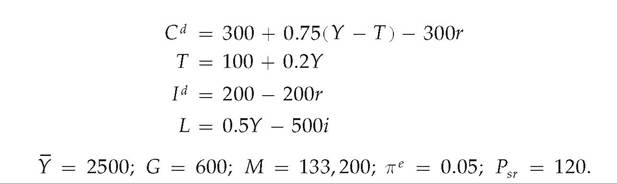
In Appendix 9.A, we found the short-run and long-run equilibrium values of Y, P, r, T, C, I, and i.
Now we want to calculate the government purchases multiplier in the short run if government purchases rises from 600 to 690. (Of course, in the long run, the multiplier is zero because output will be at its full-employment level, and increases in government purchases do not affect the full-employment level of output in the Keynesian model.) To do this, we use the short-run equilibrium results from Appendix 9.A and then repeat our procedure with the higher level of government purchases to see how output is affected. From that, we can calculate the multiplier, which is the change in output divided by the change in government purchases.In Appendix 9.A, we found that in the short run, Y = 2400. With an increase in government purchases, in the short run, the IS curve will change, but the LM curve will be the same as before, r = 0.001Y — 2.27.
First, we find the equation for the IS curve by using the goods market equilibrium condition. The goods market equilibrium condition is Y = Cd + Id + G. Substitute the equation for T into the equation for Cd from above. Then substitute the resulting equation and the equation for Id from above, along with the value of G, into Y = cd + Id + G to obtain: Y = {300 + 0.75[Y — (100 + 0.2Y)] — 300r} + [200 — —200r] + 690. Rearrange this equation as an equation for r in terms of Y: Y = {300 + 0.75Y — [(0.75 ? 100) + (0.75 ? 0.2Y)] — 300r} + [200 — 200r] + 690, so Y = [300 + 0.75Y — 75 — 0.15Y — 300r] + [200 — 200r] + 690, so 0.4Y = [300 — 75 + 200 + 690 ] — (300 + 200) r, so 500r = 1115 — 0.4Y.Therefore, r = ( 1115/500) — (0.4/500) Y, so r = 2.23 — 0.0008Y. This is the IS curve.
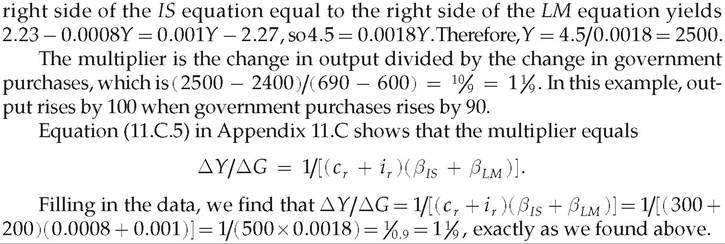
Next, we find the intersection of the IS and LM curves to calculate the short-run equilibrium values of Y and r. We have written the equations of the IS and LM curves so that the left side of each equation is simply r. Setting the