CARTOONISH DHIMMITUDE IN AMERICA
p,№ p*’T,rt
XiiTt ’H'cjtcT^äürci'
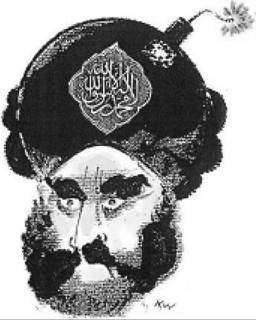
Figure 12.1.
An example of one of the twelve Jy/Iaads-Poste» Muhammad cartoons—Muhammad with a bomb in his turban, with a lit fuse and the Islamic creed written on the bomb. This cartoon by Kurt Westergaard has been deemed the most ‘incendiary.” Reprinted from “Danish Muslim Cartoons,” http://www.outsidethebeltwfly.com/danish_muslim_cartoocis/.Beaumarchais's Marriage of Figaro, written at the close of the eighteenth century, included this freedom- of-speech monologue in Act V, Scene 3,
Sadly, today, over two centuries later, Danish embassies are ablaze in the Muslim world, and European, especially British, Muslims are engaged in vile displays threatening violence (both individual and collective)—all in response to a carefully orchestrated campaign of incitement which used, as a pretext, the publication of twelve rather tame cartoons depicting the Muslim prophet Muhammad.2 Jyllands-Posten cultural editor Flemming Rose decided to publish these cartoons this past September 30 [2005] when Danish author Kare Bluitgen was unable to find an illustrator for his book titled The Koran and The Life of Muhammad (just published this week [2006]).3These potential illustrators feared for their safety because traditional Islam (for example, in these hadith, Bukhari vol. 7, book 72, nos. 836-464), and its pious adherents, forbid any imagery that depicts Mohammed. Rose decided, courageously, to publish the caricatures in response to the worsening climate of fear overcoming European artists and writers who censured themselves due to the threat of violent Muslim reprisals.5 In early October 2005, Rose stated, “Religious feelings cannot demand special treatment in a secular society..
In a democracy one must from time to time accept criticism, or becoming a laughingstock.”6Following the tumultuous events of this past week, Rose remained entirely unbowed: “Apologizing would imply that if you intimidate us enough we will follow your demands.. This is blackmail. You cannot edit this newspaper [ Jyllands-Posten] according to mafia rules.”7
He fully accepted his decision to uphold free speech which might conceivably cost his life and the lives of the cartoonists whom he commissioned (and in fact are now hiding for their very lives8): “I do not regret it.. It is a bit like asking a rape victim if she regrets wearing a short skirt at a disco.”9
The distressing reaction to this cartoon jihad by most United States political and media elites has been one of craven and ill-informed dhimmitude. Pious pronouncements condemning the cartoons and their publication have been issued across the political spectrum, from the State Department,10 to the Washington Post editorial-page editor Fred Hiatt,11 to conservative blogger Hugh Hewitt.12 Mainstream television and print news media have declared, almost uniformly, that they will not display the cartoons. Will these self-righteous institutions and individuals remain unmoved even by appeals from those intrepid secular Muslims, such as Ibn Warraq, who have embraced our uniquely Western heritage and are struggling to defend it? In Der Spiegel, on Friday, February 3, Warraq elucidated what is at stake:
The cartoons in the Danish newspaper Jyllands-Posten raise the most important question of our times: freedom of expression. Are we in the west going to cave into pressure from societies with a medieval mindset, or are we going to defend our most precious freedom—freedom of expression, a freedom for which thousands of people sacrificed their lives? A democracy cannot survive long without freedom of expression, the freedom to argue, to dissent, even to insult and offend.
It is a freedom sorely lacking in the Islamic world, and without it Islam will remain unassailed in its dogmatic, fanatical, medieval fortress; ossified, totalitarian and intolerant. Without this fundamental freedom, Islam will continue to stifle thought, human rights, individuality; originality and truth.Freedom of expression is our western heritage and we must defend it or it will die from totalitarian attacks. It is also much needed in the Islamic world. By defending our values, we are teaching the Islamic world a valuable lesson, we are helping them by submitting their cherished traditions to Enlightenment values.13
And what better real-time illustration of Warraq’s concerns about the stultifying absence of “freedom of expression...human rights, and individuality” in the contemporary Muslim world, than the firing and arrest of Jordanian tabloid editor Momani (despite his groveling apology “Oh, I ask God to forgive me,” he wrote in a public letter of apology Friday, February 3—), who earlier had the “temerity” to publish the cartoons, and state lucidly, “What brings more prejudice against Islam, those caricatures or pictures of a hostage-taker slashing the throat of his victim in front of the cameras or a suicide bomber who blows himself up during a wedding ceremony in Amman?”15 Will the State Department, and the Washington Post, and Hugh Hewitt condemn the reaction of that paragon of “moderate” Islam, Jordan, and its lionized leader King Abdullah II, who declared yesterday that insulting the Prophet Mohammed was “a crime that cannot be justified under the pretext of freedom of expression”?16 Abdullah’s inappropriate and inflammatory words made a mockery of accepted international human-rights norms regarding freedom of expression and gave license to Jordanian security forces to arrest both Mr. Momani, and Hashem El-Khalidi, editor of Al-Mewhar, which also published the cartoons.17
There is an equally important subtext to the cartoon controversy, addressed previously by the Dutch parliamentarian Hirsi Ali, which has also been ignored in its entirety.18 Hirsi Ali, a secular Muslim immigrant to the Netherlands, raised as a traditional Muslim in Somalia, has argued cogently that true reform of Islam, to render it compatible with modern human-rights standards, must include criticism of both its core sacred text and founder.
She observes, “You cannot liberalize Islam without criticizing the Prophet and the Koran.. You cannot redecorate a house without entering inside.”19 How else does one confront the beliefs, stated openly in court by Theo Van Gogh's murderer Bouyeri, and clearly resonant now throughout the global Muslim community, that “[t]he prophet Mohammed justifies Islamic violence in the battle between the faithful and unfaithful. Paradise awaits the faithful who die as a result”?20 The modern Muslim scholar Ali Dashti's biography of Muhammad, 23 Years: Study of the Prophetic Career of Mohammad, chronicles Muhammad's “changed course” at Medina, where the Muslim prophet begins to “issue orders for war” in multiple and repeated Koranic revelations21 (chapter [sura] 9 being composed almost entirely of such war proclamations, for example). Prior to enumerating the numerous assassinations Muhammad ordered, Ali Dashti observes:Thus Islam was gradually transformed from a purely spiritual mission into a militant and punitive organization whose progress depended on booty from raids and [tax] revenue.. The Prophet's steps in the decade after the hejra [emigration from Mecca to Medina] were directed to the end of establishing and consolidating a religion-
based state. Some of the deeds done on his command
[were] killings of prisoners and political assassinations.22 Dashti highlights one particularly disturbing assassination ordered by Muhammad:
Abu Afak, a man of great age (reputedly 120 years) was killed because he had lampooned Mohammad. The deed was done by Salem b. Omayr at the behest of the Prophet, who had asked, “Who will deal with this rascal for me?” The killing of such an old man moved a poetess, Asma b. Marwan, to compose disrespectful verses about the Prophet, and she too was assassinated.23
Images of Muhammad, both pious and critical, have been produced almost continuously, for a half millennium by Muslim and non-Muslim artisans alike.24 Will the particularly radicalized Muslims of today destroy Dante's images?25 And in an age where jihadism is run amok, why not ridicule one of its primary sources, that is, the sacralized violence of Muhammad himself, this “Ecce Homo Arabicus”?— The cartoons are a healthy dose of long-overdue criticism of the direct nexus between Muhammad's actions and jihadism, more therapeutic for the cowering West, but ultimately therapeutic for those Muslims who wish to embrace modernity as well.
Postscript: In early November, 2011, Charlie Hebdo, a Parisian magazine known for investigative journalism, and, notably, trenchant satire, was firebombed after publishing a cartoon (reproduced below) of Muhammad accompanied by the slogan, “100 Lashes If You Don't Die of Laughter.”27 As reported by the Daily Mail, in addition to extensive damage caused by the fireboming
—which deliberately targeted the magazine’s computer systems,
The magazine’s website was also hacked, with messages appearing in English and Turkish denouncing its journalists for causing widespread offence. Armed police were...surrounding the charred remains of the building, which is close to a number of housing estates where the occupants are predominantly Muslim. [Emphases added]28
And the Telegraph (London) reported on a specific message left by hackers:
You keep abusing Islam’s almighty Prophet with disgusting and disgraceful cartoons using excuses of freedom of speech. Be God’s curse upon you!29
The substance of the Charlie Hebdo issue, renamed Charia [Sharia] Hebdo, which precipitated such violence, addressed legitimate concerns about how the so-called Arab Spring “democratic” uprisings were in fact propagating Islam’s totalitarian theo-political “law.”30 Journalist Diana West encapsulated the unstated, if obvious, “dynamics” with this pellucid blog title: “Islam Bombs Satire in Paris to Enforce Sharia.”31
Finally, Italian journalist Giulio Meotti’s analysis of the Charlie Hebdo bombing included a morose update on the plight of French philosophy professor Robert Redeker.32 In an essay published by Le Figaro on September 19, 2006, Redeker defended remarks about Islam made a week earlier by Pope Benedict XVI, during an address in Regensburg. Redeker launched directly into the fray, stating in his first sentence,
The reactions caused by Benedict XVI's analysis of Islam and violence highlight the underhanded maneuver carried out by Islam to stifle what the West values more than anything, and which does not exist in any Muslim country: freedom of thought and expression.33
He reiterated this theme toward the essay's conclusion, decrying Islam's attempt “to place its leaden mantel over the world.”34
Redeker was also unsparing in his criticism of Islam's prophet Muhammad, whom he characterized thusly:
A merciless war chief, plunderer, slaughterer of Jews and a polygamist, such is the man revealed through the Koran.35
Predictably, shortly after the appearance of his essay, Redeker was sentenced to death in a posting on a jihadist website that, to facilitate a potential assassin's task, also provided his address, telephone number, and a photograph of his home.36 Giulio Meotti's updated coverage included these depressing details of Redeker's predicament, five years later, living as a refugee—and pariah—in his own country:
“I just went to Austria for a conference and even there the bodyguards were always with me,” Redeker said.
The police did not even allow him to announce his father's death, because someone could have noted the surname. “I had to bury my father like a criminal,” he said. The marriage of his daughter was also attended by the police. Redeker had to sell his house and buy another one in a secret location. “I cannot go out to buy bread or newspapers or for a glass of wine. I cannot walk in the streets. I am a refugee in my own country. I cannot take the train, bus or subway. I cannot answer the question of what I can expect from the future. This new situation has changed my perception of time....It’s as if there is no future for me.”37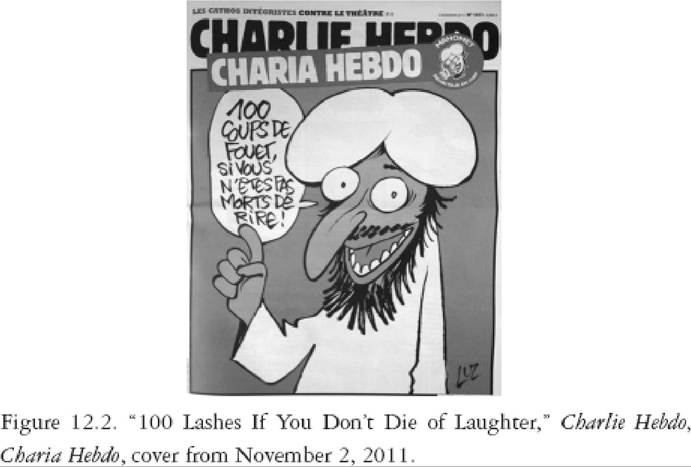
13.
More on the topic CARTOONISH DHIMMITUDE IN AMERICA:
- From the first permanent English settlement in North America to 1800, the character and causes of violence in Anglo-America revealed both continuities and changes.
- THE “TOLERANT” MILLET SYSTEM— FROM OTTOMAN JIHAD TO OTTOMAN DHIMMITUDE
- North America
- America's conundrums: hyperpower humbled
- Hinduism and Sikhism in America
- Russian Orthodoxy Colonizes America
- The unipolar moment: America at the apex
- Ukrainian History in North America
- The Church of England in Colonial America
- German Sectarians in British America
- Buddhism in America
- Islam in America
- Wilsonianism: Making the World Safe for America
- Eastern Orthodoxy in America
- Ukrainian Communities beyond North America
- French Catholicism in North America