Editions Used
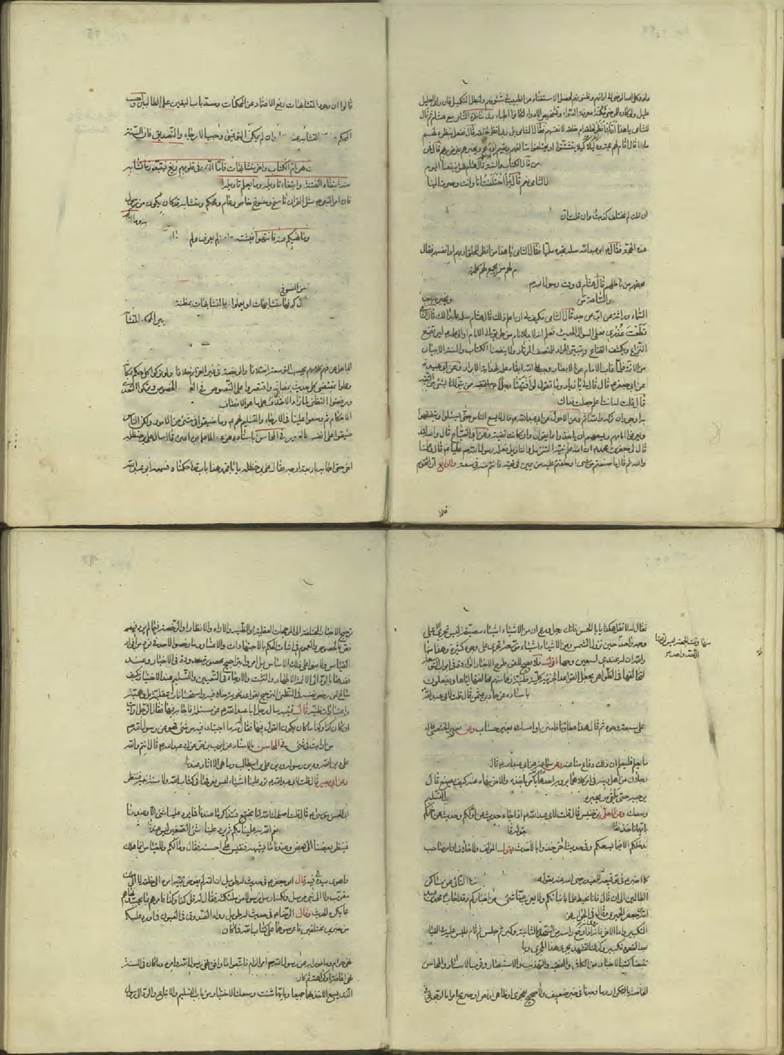
al-Akhbari, Mirza Muhammad b. 'Abd al-Nabi, Fath al-bab ila l-haqq wa-l-sawab (Najaf: n.p., 1342/1923).
al-Akhbari, Mirza Muhammad b. 'Abd al-Nabi, Fath al-bab ila l-haqq wa-l-sawab (Karbala: Man- shurat Dar al-Husayn, 1440/2018).
al-Akhbari, Mirza Muhammad b. 'Abd al-Nabi, Fath al-bab ila l-haqq wa-l-sawab, ed. Muhammad Rida al-Ansari al-Qummi, in Pazuhishha-ye usuli (1393Sh/2015), pp. 163-229.
V Р
u *■ "
-
J^bUu^dLiiitbc-l^^ti^lia^L
®Цчі>Ціі> l£üU ubülu^bttiHiii imbuii f
b^fc ^W«1 VtMU JL·
p3Kp5Щ^/Яч WdÌuJ^1^1 Шл^а^ЬсЛуЛ.ЛЙ
jfr&to* ÄÜÄ1 ^i^^Gwiui^SüxUAJüЫ*1ДгШW liei* 4Ід> !Λώ ^qj> 1й^Ч!»£ Ч* u6i’ 4*^ ^(*ч^liU4z^bb^lUk4X>l^ L*
Ц!у^>1Ц^Х.0^ьи1;
^LblÙ^k>li>jjl^^tl^tl:b^cXitobjl< J
ТА » Τα
—! UiÜA» «v^^4>*ì?c4j4ì»
I ^^Lti>^A>4Ì^liiUb»JI*^**^Ue'iipl^*i4/xL·
ο* ΙφΛΗΪΑώίΧ tblijt? |L·** bUA Li Ιϋΰ l*j Geo^ Uki>h^uü? * LL^-^-tb·4
Cì>> i GdaioL-J-io Ü^j L· |*Ж#/li ΙγJ SXi$z&t>< ь “У
LA0L^l'L^ί5ίi^χ;1!ιl^ή^L^ftJlìl^^χ^L·^^ц^J4> èll^^L^^provides and teaches them.”10 By contrast, humans are not responsible for that which God conceals from them. In another report, al-Sadiq explains, “God does not oblige humans to independently know anything, rather, they expect God to teach them. When God provides them with knowledge, then they are obliged to accept those teachings.”11
In another report, al-Sadiq cites a number of verses of the Qur’an as evidence that God always identifies the paths of guidance and misguidance before holding members of a community responsible for their decisions and actions.
For example, Qur’an reads, “Indeed we guided him to the path, be he thankful or ungrateful.”12 The Imam interprets the verse in the following way, “We provide him with knowledge, but he either takes it or casts it aside.” Qur’an reads, “As for Thamud, we provided them with guidance, but they preferred blindness to guidance.”13 Al-Sadiq interprets this: since God gave them knowledge, they intentionally chose blindness over guidance. They were fully aware of what they were doing.14 When a disciple asks al-Sadiq about the verse, “Have we not shown him the two paths?”15 he explains, “it is the virtuous path and the evil one.”16[14] In a more detailed explanation of the above arguments, al-Sadiq is reported to have explained that God is the source for all knowledge pertaining to religion. Even when commandments cannot be properly carried out, God provides knowledge regarding the appropriate remedy in such cases. It was God who commanded the Prophet to worship him, but then caused him to sleep. It was God who then awoke the Prophet and taught him that one could offer a lapsed prayer upon waking. It is the same with the one who is obliged to fast, but then falls ill. It is God who provides one with good health and causes one to fall ill. For this reason, God instructs a sick person to make up for a missed fast only once he is in better health. God never commands anything beyond the capacity of humans. Humans only fail to carry out his commands when there is no goodness in their own selves.17
[15-17] Mirza Muhammad then turns to three reports that substantiate the quintessential doctrine of Twelver Shi'a, namely, that there should always be a deputy of God on earth. This deputy serves as God’s unequivocal proof (hujja) of all that is right. Al-Sadiq states, “God cannot hold members of a community accountable without an imam who first provides them with knowledge.”18 According to another report, “God never leaves the earth without one endowed with knowledge.
Otherwise, no one would know truth from falsehood.”19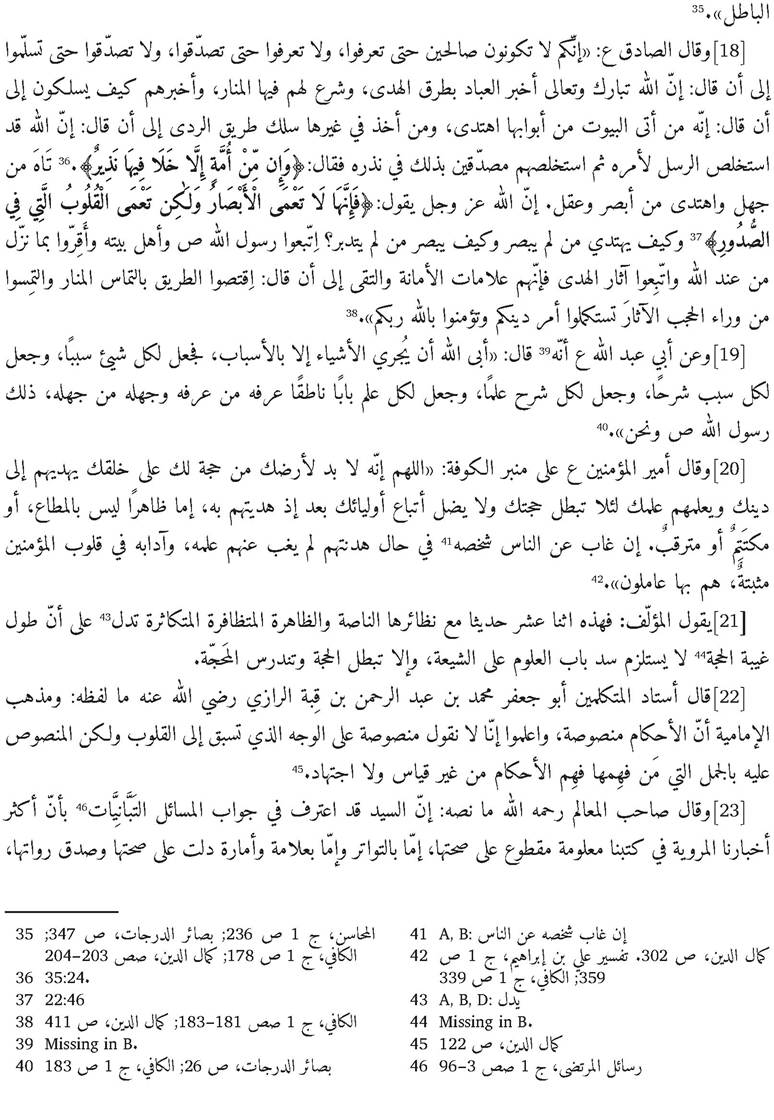
[18-19] The next set of reports reiterate the necessity of turning to the Imams for knowledge and the perils of ignoring their guidance. “Those who enter homes by their doors are guided, those who do not, fall into ruin...so follow God’s Messenger and his Household! Profess that which God reveals and follow the representatives of guidance for they are the signs of trust and security.”20 Al-Sadiq states, “God decrees that all things must have a cause. Each cause has an explanation. For every explanation there is a clear sign. For every sign there is a door that speaks. Those who know of this door, know it well; those who do not remain ignorant. We and God’s Messenger constitute that door.”21
[20] In a sermon attributed to 'Ali b. Abi Talib, he is believed to have said that humanity continues to benefit from God’s deputy and his guidance even in his absence. He states, “O Lord! Indeed, your earth must always have your hujja to all of humanity. One who guides all people to your religion and provides them with your teachings. In this way, their responsibility to obey you remains and they are not led astray after choosing faith. Indeed, you guide them with such a person. Sometimes he is manifest, but people refuse his guidance. At other times he is concealed and so people await his return. And if the Imam disappears altogether and they are secure from violence, then, at the very least, they still have access to his teachings and traditions. His faithful followers serve as repositories for such teachings and know them very well.”22
[21] Mirza Muhammad concludes that the occultation of the Imam, however long its length, does not bar the Shi'i community from accessing correct knowledge and certainty. Were this the case, his occultation would nullify God’s unequivocal proof in the world.
[22] Ibn Qiba al-Razi (d. before 317/929) states, “In the Imami [Twelver Shi'i] school, Islamic rulings (ahkam) are explicitly designated (mansusa) [by God]. It should be clarified, however, that we do not mean that every ruling is explicitly pronounced by the law-giver. Rather, that there are general principles that are explicitly specified. Whosoever understands these principles, will know rulings without resorting to analogical reasoning or personal judgment.”23
[23-24] Sahib al-Ma'alim further cites the opinion of al-Sharif al-Murtada that most reports preserved in well-known Twelver Shi'i hadith collections were, in fact, undoubtedly authentic.24 He is sure of this because such reports were either widely-transmitted in every generation (mut- awatir) or possessed another indication (amara) of their authenticity and the truthfulness of their transmitters. Thus, al-Murtada believed such hadith engendered certainty even in cases where they appear to possess only a single chain of transmission. Elsewhere, al-Murtada is asked directly, “If you reject the use of solitary reports (al-akhbar al-ahad), then what recourse would one have in resolving any legal (fiqh) matter?” He responds that the views of the Twelver Imams on most legal matters are necessarily known (bi-l-darura) through widely-transmitted reports. Those few legal matters that do not fall into this category are further backed by a consensus among Twelver Shi'a. In cases of contradictions, if one can ascertain that a particular opinion is the correct ruling, then one should take this course. Otherwise, one is free to choose between the available legal opinions.25
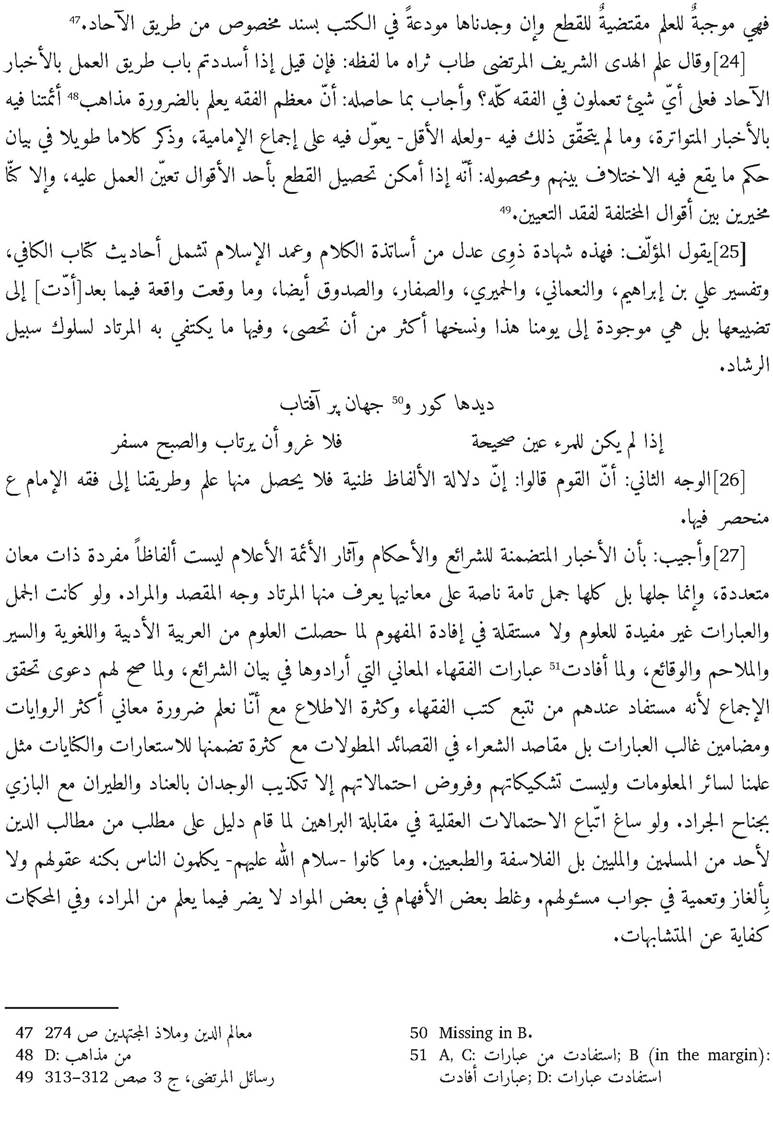
[25] Mirza Muhammad concludes his response by citing the titles of the Twelver Shi'i hadith collections from which he cites these twelve reports: al-Kafi, Tafsir ‘Alt b. Ibrahim and the works of al-Nu'mani (d.
360/971), al-Himyari (d. after 293/905 or 305/917), al-Saffar (d. 290/903) and al-Saduq (d. 381/991).[26] The Second Argument
Usulis claim that speech yields only uncertain knowledge. When we encounter such speech in statements attributed to the Twelver Imams, there remains doubt on whether our understanding of the statement reflects the appropriate ruling of the Imam on a legal matter.
[27] Mirza Muhammad responds that those reports which preserve the teachings of the Imams on legal and religious matters are neither rare, unique, nor vague and multivalent. Most, if not all of them, are clear statements. One who examines them will understand their intended meaning. If speech, in general, did not ever yield certainty, one would never be able to claim understanding of anything. There would be no coherence in the study of language, literature, law, or history. No jurist, for example, could ever discuss the concept of consensus (ijma‘) since it is predicated on one’s ability to read and understand legal discussions in different books written over many centuries.
Mirza Muhammad writes that scholars understand the meaning of the vast majority of reports that they encounter from the Imams. Similarly, scholars mostly understand classical Arabic poetry despite its complex use of symbolism, metaphor, and uncommon expressions. Usuli attempts to cast doubt on the epistemic value of speech itself is a poor attempt to refute the irrefutable. Were one to cast doubt on certainty on the basis of any conceivable possibility, despite clear evidence to the contrary, then nothing would ever be established in any discipline, be it religion, philosophy or science. Prophets and Imams addressed members of their societies according to their mental capacities. They did not speak in riddles. On occasion, there may be ambiguities (mutashabihat) or cases of misunderstanding, but they do not negate the certainty that unambiguous cases (muhkamat) yield. The majority of speech falls in the latter category.
Supporting his claim concerning the harmonious relation between Imams’ words and the understanding of their addressees, the author cites two reports.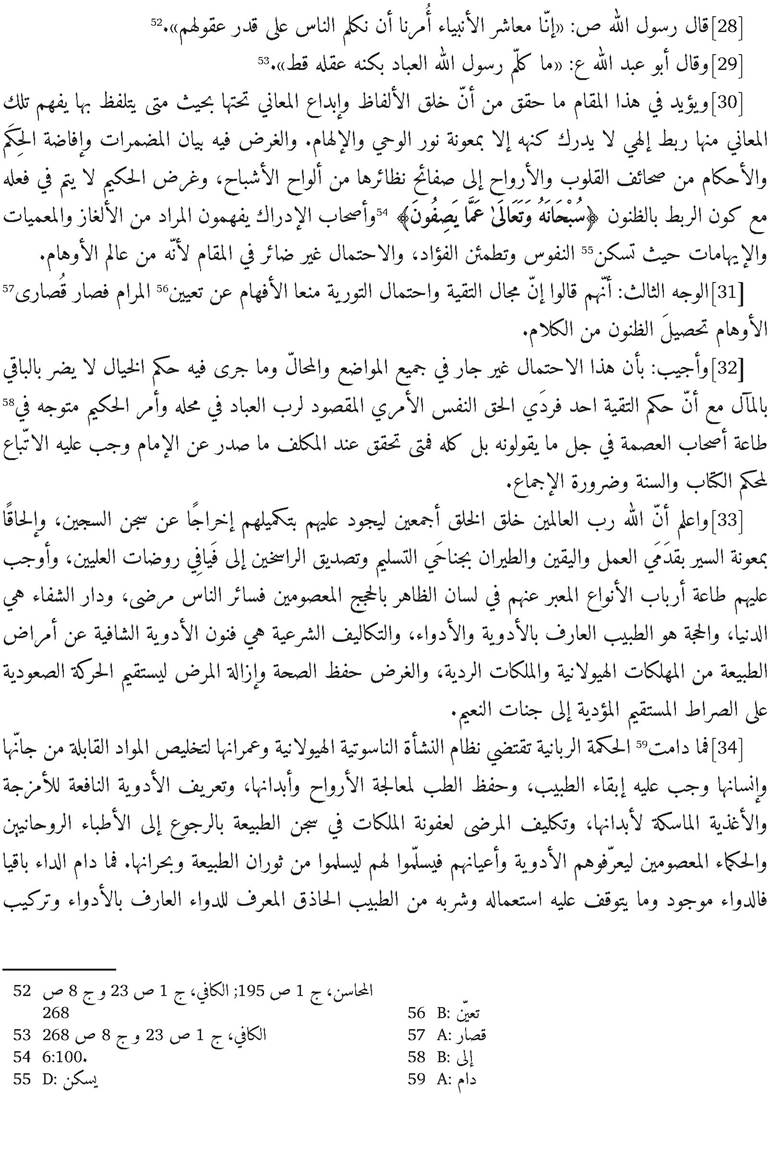
[28-29] God’s Messenger said, “God commanded us, as prophets, to address individuals according to their mental capacities.”26 Imam al-Sadiq also stated that the Prophet never addressed humanity using the full potential of his intellect.27 The implication is that had the Prophet attempted this, his community would have neither understood nor accepted his beliefs.
[30] Mirza Muhammad then makes a metaphysical and spiritual argument. He believes that words and their respective meanings are divinely linked. One understands the intended meaning of speech only by means of divine assistance, a type of inspiration or revelatory experience. In this way, the faithful come to understand divine commandments. This process cannot occur if uncertainty and speculation underpin it. Saintly scholars (ashab al-idrak) will even understand those statements that appear to be ambiguous, vague or riddles. It is God who endows them with certitude when they read such texts and offer interpretations.
[31] The Third Argument
Usulis argue that antagonism toward the family of 'Ali and Shi'ism led the Imams to dissimulate and use their discretion in sharing their religious beliefs. The possibility of such pressures affecting their statements prohibits us from having certainty in regards to the intended meaning of their speech. Therefore, the best that one’s intellect can grasp is the speculative meaning of the statements of the Imams reported in the hadith.
[32] Mirza Muhammad responds that such a possibility does not affect every statement pronounced by the Imams. It cannot be used as a reason to cast doubt on their speech on every topic either. Even in cases where the Imam makes a pronouncement in the state of dissimulation (taqiyya), obedience to such a command under those circumstances is, in fact, the correct ruling.
[33-36] Mirza Muhammad restates his argument in metaphysical and spiritual terms. The objective of humanity is to seek perfection, which is fulfilled by surrendering fully to the divine. This surrender occurs only when humans accept the teachings and follow the examples of infallible guides with access to revelation and wisdom from God. Humans are in need of these guides who serve as doctors for their spiritual ailments. The remedies that they offer are the teachings and commandments of the sacred law. God would not leave humanity without such a doctor or his remedies. People are in constant need of both. As long as this need for guidance exists, God must provide it. However, when a community turns on such a doctor and conspires to murder him, God may conceal this person while keeping his remedies and the wisdom that he can offer accessible to the community. God also empowers righteous disciples of this doctor to carefully preserve and disseminate his teachings far and wide. To fulfill this objective, disciples establish circles of learning and compose numerous books. Through these means, God averts any future objection from humans that they were unfairly left without guidance. God always provides a compelling argument or proof (hujja) to humanity in support of God’s religion. In this way, humans are fully aware when the paths that they choose are sinful or righteous. Mirza Muhammad cites a few verses of the Qur’an to support this doctrine.
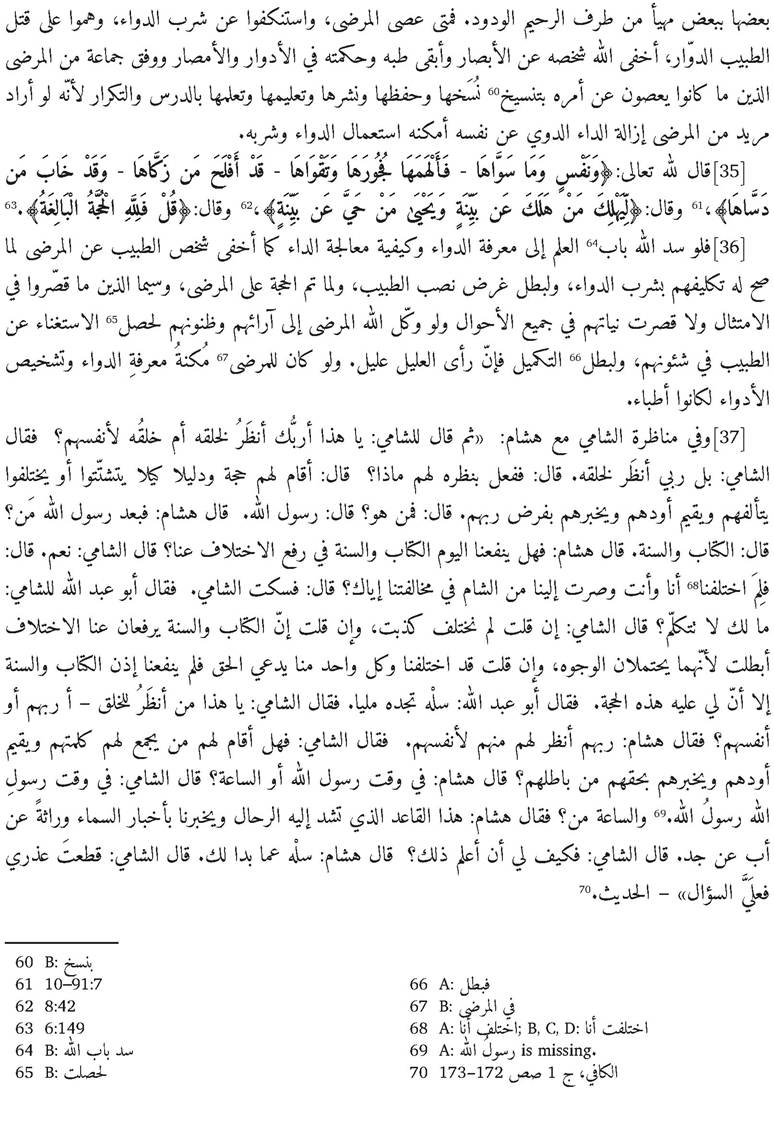
Were humans to lose access to the teachings of the prophets and Imams, then it would not make any sense for God to impose on them moral obligations (taklif). This would be akin to concealing the spiritual doctor and all his remedies with him. It would be unfair for God to expect people to know how and when to use the right remedies to heal themselves. God would also have no compelling evidence to support holding such people accountable or punishing them for failing to fulfil God’s expectations of them. It also does not make sense for God to expect the righteous among them, let alone those with spiritual maladies, to speculate or guess which remedies may help people. The opinion of the enfeebled is itself enfeebled. If the masses possessed the ability to identify and provide people with the correct remedies, they would be doctors.
[37] In a debate between Hisham b. al-Hakam (d. 179/795), the renowned companion of al- Sadiq and a certain Syrian, representing proto-Sunni doctrine, both agree that God, in his wisdom, knows the needs of humans and provides them with guidance. The Prophet served as God’s hujja. He served as God’s representative on earth, he taught people their responsibilities to God and aided those in need. The community obviously turned to the Prophet as their authority on religion. In this way, he prevented dissension in religious matters. When Hisham asks the Syrian who served as God’s hujja after the Prophet, the Syrian responds that the Qur’an and the Prophet’s example (sunna) fulfilled this function.
When Hisham asks whether the Qur’an and the Prophet’s example suffice in preventing dissension in the Muslim community, the Syrian responds in the affirmative. Hisham then forces him to reconsider this belief, “If this is the case, then why do you and I disagree with one another [as - what later came to be known - a Sunni and a Shi'a]? Why have you come here from Syria to debate me?” When the Syrian falls silent, Jafar al-Sadiq, who is observing the debate, asks, “Why don’t you respond?”
The Syrian says, “If I claim there is no disagreement between us, then this would be a lie. If I claim that the Qur’an and the Prophet’s example prevent people from such disagreements, then this would also be false, since they are multivalent and can be potentially interpreted in different ways. If I admit that we indeed disagree with one another and each of us claims to be right, then the Qur’an and the Prophet’s example have not succeeded in preventing dissension among us.” The Syrian then asks Hisham two key questions. First, whether he believes that there is a person who can authoritatively identify which Muslims are right from those who are wrong on religious matters after the Prophet. Second, if it is God who provides the community with such a person. Hisham answers both in the affirmative. The Prophet fulfilled such a function in his lifetime, while al-Sadiq is this person at the moment. Al-Sadiq does this by means of knowledge that was transmitted and inherited from grandfather to father to son.
The Syrian asks, “But how can I be sure of this?”
Hisham answers, “Ask him whatever you like.”
The Syrian says, “I no longer have any excuse not to. I will need to begin asking him questions.” Mirza Muhammad ends his citation of the report here, but in al-Kafi, the Syrian converts after al-Sadiq reveals his miraculous knowledge of everything that occurred on his trip.28
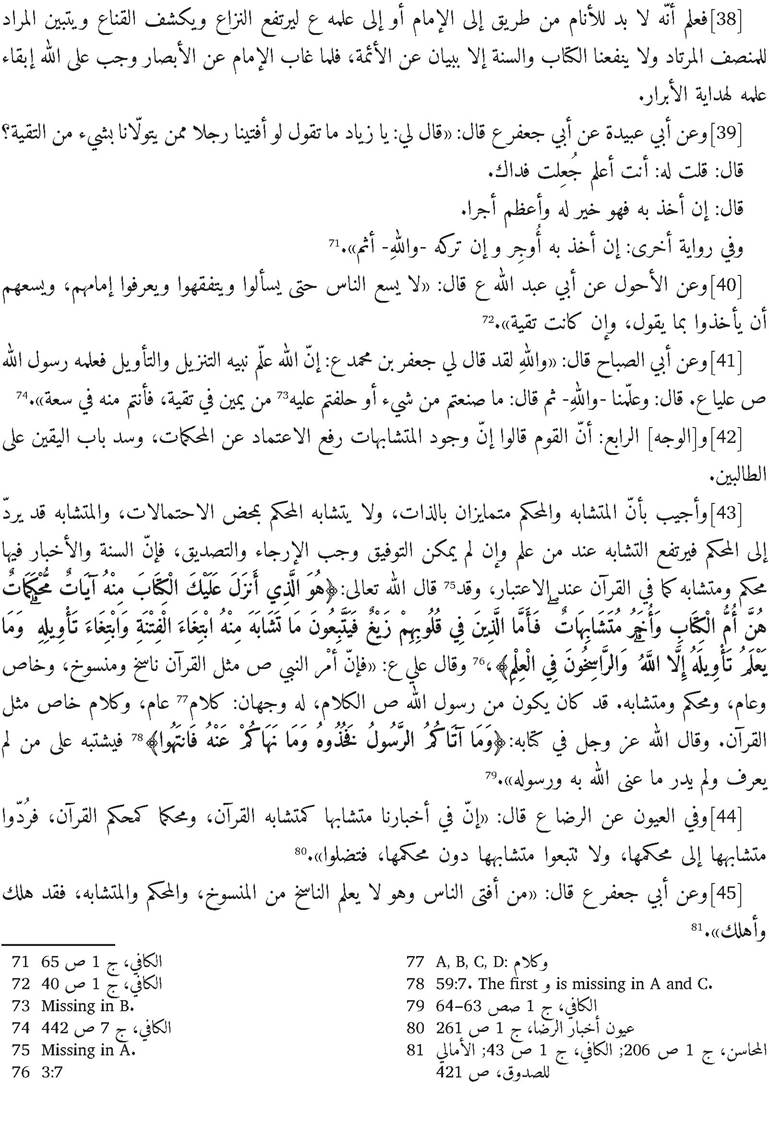
[38] Mirza Muhammad states that the above report clarifies the purpose of Imams. One must turn to the Imams or their teachings to avoid dissension, know one’s duties to God, and correctly understand the Qur’an and the Prophet’s example. One cannot truly benefit from either of these two sources of guidance without the Imams who authoritatively interpret them. In their absence, their hadith continue to provide such guidance.
[39-41] Returning to the subject of taqiyya, Mirza Muhammad cites three reports that indicate that when the Imam makes a pronouncement while dissimulating, his partisans are rewarded for obeying such a command. Al-Sadiq, for example, states, “If one follows such an instruction, there is good in it and he receives a greater reward.”29 In another report, he states, “One is rewarded if one obeys it and commits a sin if it is ignored.”30 In this way, Mirza Muhammad defuses the argument that obeying statements of the Imams potentially made while dissimulating may lead disciples to the wrong ruling. Those rulings, in fact, are the correct ones to follow in those circumstances.
[42] The Fourth Argument
Usulis argue that the continued presence of ambiguities undermines our ability to understand even the unambiguous reports of the Imams resulting in the closure of the gates of certainty.
[43] Mirza Muhammad responds that the ambiguous and unambiguous are easily distinguishable. One should apply unambiguous principles when encountering ambiguities to ensure compliance with sacred law. One can also compare ambiguous texts to unambiguous ones to interpret them correctly. If none of these methods work, then one should defer interpreting them since the Qur’an and the Prophet’s example can have ambiguities. 'Ali b. Abi Talib once stated that the Prophet’s example, very much like the Qur’an, includes commands that abrogate previous instructions. “They also include the general, the specific, the unambiguous, and the ambiguous. Some of the Prophet’s words were multivalent. His commands, like the Qur’an, included the universal and the contingent. The one without knowledge fails to determine the exact nature of God’s and his Messenger’s commands. Indeed, the Qur’an states, ‘Accept that which the Messenger provides you and refrain from what he forbids you.’”31
[44-45] Thus, the Imams encourage the faithful to follow those instructions that are unambiguous and to rely on them for guidance. Muhammad al-Baqir also warns those who do not know the Prophet’s abrogated instructions or how to differentiate the unambiguous from the ambiguous to refrain from providing the laity with their own legal opinions. Al-Baqir is referring to some of his contemporaries who were renowned as authorities in Islamic law and attracted followers.32
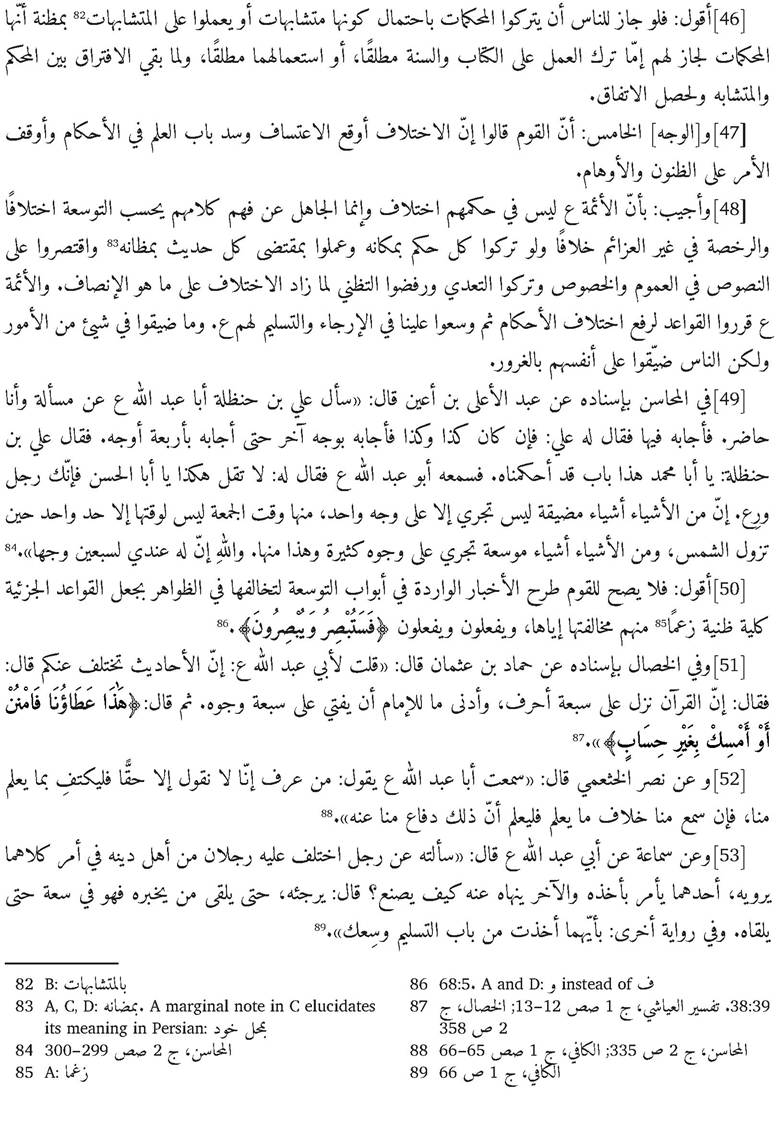
[46] If, on account of ambiguities, Mirza Muhammad summarises, the faithful were not required to comply with unambiguous commands, then this would ultimately lead them to abandon the Qur’an and the sunna altogether and there would remain no substantive difference between the two categories.
[47] The Fifth Argument
Usulis argue that the hadith literature that has reached us includes many contradictions. These contradictions have led to some misunderstanding and prevented the faithful from having certainty or truly knowing the rulings of God. Their knowledge, therefore, can be described as only speculative or uncertain.
[48] Mirza Muhammad responds that no contradictions exist in the rulings of the Imams. The Imams occasionally discuss accommodations that can be made for someone who cannot fulfil an obligation. In other cases, Muslims have a choice in how or when to fulfil obligations. Some without expertise may identify these secondary rulings as contradictions, but they do so in error. Moreover, the Imams have provided us with instructions and procedures that resolve these apparent contradictions. They also informed us of certain accommodations to assist us in fulfilling our duties to God, but people make the practice of religion more rigid and difficult for themselves.
[49] 'Ali b. Hanzala once asked al-Sadiq a legal question and after receiving the answer asked whether the ruling would change under different circumstances. When al-Sadiq answered in the affirmative, they ultimately discussed how the corresponding ruling would change under four different circumstances. Pleased with the exchange, 'Ali b. Hanzala then turned to a companion and said that he now fully understood the legal matter. When al-Sadiq heard him say this, he cautioned him against believing that and explained, “Some matters are absolute and have only one ruling...other matters can accommodate varying circumstances and conditions with greater flexibility. This is but one example. I could provide seventy different rulings for your legal question depending on the circumstances.”33
[50] Mirza Muhammad then turns to the Usulis reminding them that they should not discard hadith that discuss rulings for exceptional cases simply because they appear to contradict other reports discussing universal principles and normative practices.
[51-54] To support his claim that the reports of the Imams are not essentially contradictory as they might appear, Mirza Muhammad cites four reports. Al-Sadiq, in the first report, states that an imam can offer varying rulings on a subject just as verses of the Qur’an can be recited in more than one way.34 In the second report, the Imam is believed to have offered the following advice, “He who knows that we speak only the truth should trust what he knows about our teachings. If he later hears something that appears to contradict it, he should know that we made a strategic decision to protect him with such a statement.”35 Al-Sadiq appears to be referring to those instances where he or another Imam may have felt compelled to dissimulate. He explains that such dissimulation protects Shi'a from harm that would otherwise have befallen them in openly sharing their views. In the third report, al-Sadiq explains that when Shi'a encounter contradictory rulings from the Imams and are unsure of the appropriate command to follow, then they should defer making a decision until they are able to learn more information that can resolve the issue. In the meantime, it is acceptable for them to choose to abide by any of the rulings that they encounter.36
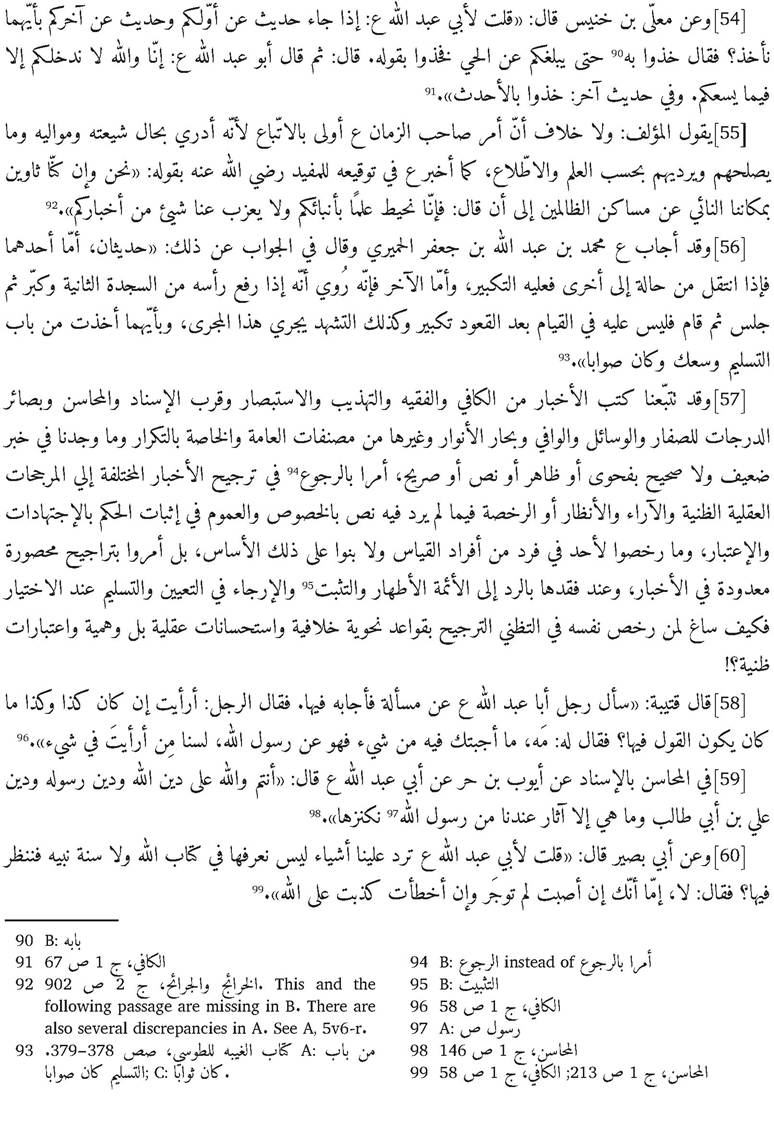
In the last report, Mu'alla b. Khunays asks al-Sadiq, “If I hear of a report from an earlier Imam and then hear another from the most recent one, which one should I follow?” Al-Sadiq responds, “Abide by what you know until you receive further instructions from the living Imam and then abide by the latter. In any case, rest assured that we would never instruct you to do anything God deems unlawful.”37
[55-56] Despite his occultation, Mirza Muhammad asserts, the twelfth Imam continues to guide his Shi'a in matters of religion, particularly that which concerns with contradictory reports. The author cites two rescripts from the twelfth Imam in which the latter assures his followers that even in his concealment he is aware of their affairs. The Imam also explains that in cases where they encounter conflicting reports about a ruling, they are free to choose either of the two commands.38
[57] Mirza Muhammad advances that the tools and techniques used by Usulis in their treatment of conflicting reports resemble Sunni methodologies which are unequivocally condemned by the Imams. None of the key Shi'i hadith collections he consulted, Mirza Muhammad argues, contain a single report from the Imams, authentic or weakly-attested, ever encouraging Shi'a to defer to their own independent judgments or use speculative tools such as analogical reasoning. In cases of ambiguity, they consistently encourage Shi'a to abide by one of their instructions transmitted in the hadith and to defer judgment on what is the correct ruling until clarification from the Imams can be sought. Mirza Muhammad asks how one can claim from all of this that the sacred law authorises individuals to speculate their own independent views on religious and legal matters? Reliance on one’s own linguistic analysis of scripture or personal preferences is unreliable and highly subjective. The use of such methods cannot be considered acceptable or lawful. This argument is buttressed by citing six reports of the Imams:
[58] In one report, al-Sadiq admonishes a disciple who asks him to speculate on a matter. He says, “Far from us are we to ever offer our own personal opinions. I only answer your questions with what I know from God’s Messenger.”39
[59] In another report he states, “By God, you are followers of the religion of God, his Messenger, and 'Ali b. Abi Talib. This religion is the Prophet’s legacy to us. We are only custodians who cherish and safeguard it.”40
[60] It is also reported that al-Sadiq explains that those who rely on their personal opinions in religious matters are never prosperous, whether they are right or wrong. God is the only source of all commandments in the sacred law. He does not reward a person who independently guesses the correct ruling. As for the person who is wrong, he is guilty of lying about God and what constitutes the ruling of God.41
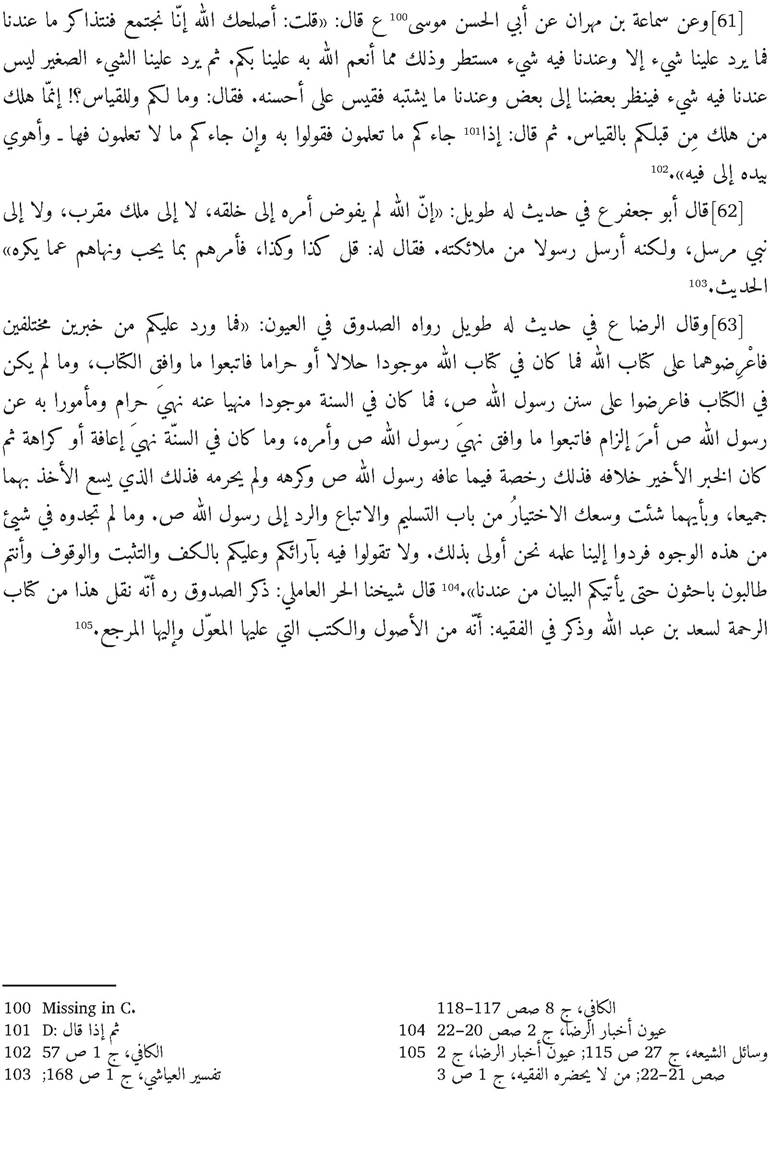
[61] In another report, Sama'a b. Mihran admits to Musa al-Kazim that sometimes he will rely on analogical reasoning (qiyas) to resolve minor issues in which there does not seem to be any instructions from the Imam. Al-Kazim warns against using any form of analogical reasoning, even on minor issues. If one knows the ruling on a matter because of a general principle or specific instruction that an Imam has taught, then one can abide by that instruction. Otherwise, he should refrain from giving any personal opinion.42
[62] Muhammad al-Baqir states in a long report that God never delegated legislative authority to an angel or prophet. No one but God may provide commandments and prohibitions in the sacred law.43
[63] In a long report that al-Saduq transmits from Sa'd b. 'Abdallah al-Ash'ari al-Qummi, 'All al-Rida, the eighth Twelver Imam, instructs his followers on how to deal with conflicting reports and novel questions. He reiterates that some matters are uncomplicated: one should respect the authority of the Qur’an and the Prophet in matters clearly identified as lawful or unlawful. In some cases the Prophet might express his disapproval of a thing in one report, but condone it in another. By tempering his disapproval with permission to engage in the activity, the Prophet is clarifying that the action is discouraged (makruh) rather than unlawful (haram). If one sees no instructions at all in regards to a subject, then one should refrain from offering any personal opinions, as noted in [61]. In those cases, al-Rida states, “Do not venture to offer your own personal opinion. It is your duty to remain steadfast to what you know to be true and to eschew any speculation. Withhold judgment and examine the subject until our teachings clarify the matter to you.”44 While al-Rida’s instructions seem to refer to a living imam’s intervention, Mirza Muhammad would likely support the belief that such clarification may also come from a scholar’s discovery of a text or realisation of its relevance.
More on the topic Editions Used:
- Reviewers for the First, Second, Third, Fourth, and Fifth Editions
- Detection, Investigation and Preparation
- Publisher’s Preface
- Bibliography
- Theories of the Violent Criminal
- Prefac
- CONTINUING THE IMPROVEMENT OF FORENSIC ASSESSMENTS
- The Chapters
- Bibliographic Essay
- Dedicatio
- THE CUNEIFORM CORPUS