Zaydi usul
In many ways, Zaydi usul writings run parallel to the vast majority of (classical) Sunni (and particularly Muttazili) works of usul al-fiqh. This has led some to (almost) characterise the early Zaydi works as Muttazili first and Zaydi second.[7] Some compositions are, perhaps, best described not as works of Zaydi usul but rather works of Muttazili usul composed by Zaydis.
Nonetheless, as the Zaydi tradition of usul al-fiqh established a corpus of works, a distinctive (and relatively stable) constellation of doctrines began to appear. There are doctrines which are not all obviously Shiti in origin. There is a general (but not unanimous) commitment to the doctrine known as taswib (i.e. kull mujtahid musib: all mujtahids are correct) in the classical Zaydi usul works - as opposed to the doctrine that only one of disputing mujtahids can be correct (al-haqq fi l-wahid) with the others mistaken (mukhti1, the position is known as takhti1a). The reason for this Zaydi commitment to taswib are nicely expressed in Sarim al-Din al-Wazir’s al-Fusul al-lu3lu3iyya where the pragmatism underpinning the general Zaydi commitment to taswib is explained:From the Four [Sunni] jurists, both taswib and takhti,a are reported. Both the opinion and the practice of our [i.e. Zaydi] early Imams indicate the taswib position - just as is the case with the later [Zaydi Imams]. It may have been the case that the statements of some of the [later Zaydi Imams] indicate takhti,a. This is the opinion of some of their followers, and on the basis of this, the Qasimiyya of Day- lam and the Nasiriyya of Jil accused each other of being mistaken IyukhattF bafiuhum bacdan) up until the time of al-Mahdi Abu cAbdallah b. al-Daci.
It then became clear to them that every mujtahid is correct. In the same way, most of the Yahyawiyya in Yemen declared anyone who opposed Yahya to be mistaken until the time of al-Mutawakkil Ahmad b. Sulayman.[8]Internal splits within the Zaydis had led to their being different Imams in different political domains. Doctrinally, the questions obviously emerged as to which of these contemporaneous Imams was the “true” Imam, and therefore which band of supporters were in the right, and which can be criticised (and even fought) for being wrong. These divisions - whether in the Caspian or in Yemen where the various Zaydi dynasties had established themselves - were undermining community cohesion. The solution, as it is presented here, was to first adopt the taswib doctrine, and then to argue that the choice of Imam was a matter of ijtihad. Since “all mujtahids are correct” the different groupings were able to recognise the value of their opponents’ positions, and thereby reduce community tension. Critically, the quote from Sarim al-Din indicates that the adoption of taswib was a political choice by the ruling Imams. That is, taswib was, in part, a doctrine adopted out political pragmatism and with regard to specific Zaydi political contexts. Of course, it was also held (for different reasons) by many other usul writers, but it is clear taswib’s political convenience was a factor in its adoption by the vast majority of Zaydi usul writers in the classical and late classical periods. By contrast, within the Shi'i traditions, the Twelver position has been overwhelmingly takhti,a, with the affirmation that there is only one correct opinion; this opinion is identical with God’s intention for humankind (murad Allah), and those holding incorrect opinions may be excused (macdhur) for their error and even rewarded for their efforts - they are, though, nonetheless wrong.
Taswib is a Zaydi doctrine shared with the wider usul tradition.
There is a more distinctively Zaydi doctrine in the commitment to the consensus of the descendants of the Prophet (ijmac al- citra, ijmac Ahl al-bayt) as a proof. This sits alongside wider community consensus in Zaydi works of usul, so the broadly Sunni doctrine of ijmac is incorporated and supplemented. The Twelver view that ijmac depends on the inclusion of the sinless Imam is roundly rejected, since, for Zaydis, the Imams are fallible mujtahids rather than Sinless Lawgivers. The doctrine of ijmac al-citra appears to have embedded itself in the Zaydi usul canon early in the Zaydi development of the field. It was entertained by some (non-Zaydi) Mu'tazilis before it was adopted in Zaydi usul works, and even then, some early Zaydi works do not discuss the doctrine in any detail at all. The evidence for ijmac al-citra being a proof lies, for Zaydis, in hadith reports (often drawn from a shared Sunni and Twelver Shi'i corpus) in which the descendants of the Prophet (as a collective) are described in glowing and protected terms.Another doctrine which illustrates the Zaydis’ Shi'i character is the doctrinal discussion of the legal authority of a recorded opinion of one of the Prophet’s Companions. This is discussed at length, of course, in Sunni works of usul; it is mentioned and rejected in Twelver works. In the Zaydi texts, there is a regular affirmation that one can accept the opinion of a Companion as included within the general category of “sunna”, and that their opinion can be relied upon in legal argumentation (mustanad). However, there are caveats. For example, for most jurists and hadith transmitters from the Sunni schools, all the Companions have high moral probity (cudul); for Zaydis, only those “who do not display transgressive behaviour (fisq), like those who killed al-wasi [i.e. 'Ali] and did not repent” are counted as has having high moral probity.[9] A further example can be found in the listing of the sources of law at the outset of any usul work.
It was not uncommon for the usual “four sources” (i.e. Qur’an, sunna, ijmac and qiyas) to be supplemented by additional sources, amongst which is the opinion of 'Ali (qawl al-wasi).[10] The opinion of a Companion of the Prophet (since they lived and worked alongside the Prophet himself, and they were themselves pious and trustworthy individuals) could be seen as evidence of the Prophet’s own opinion and actions. That there is a special position reserved for 'Ali’s opinion can be seen from the text edited in this collection (Chapter 7), where al-Mu’ayyadi states, “as for the was! ('Ali), his opinions have a particular probative force (hujjiyyat qawlihi). Some say [it has probative force] in matters where there can only be one correct answer; others say it has probative force absolutely [in all matters]; and yet others say that it doesn’t matter if you believe in taswib or in al-haqq fl l-wahid, it is absolutely authoritative on account of ['All’s] sinlessness (li-dalil al-cisma), [as proven by statements such as] ‘the truth is with 'Ali,... and others which are transmitted through multiple transmission chains with the same meaning”. For al-Mu’ayyadi, at least, 'Ali’s opinion appears to be a stronger proof within a legal argument than those of the other Companions on account of his special status within the Shi'i framework. A longer list of distinctively Shi'i (and specifically Zaydi) doctrines awaits a more detailed analysis of the Zaydi usul tradition. What is clear, though, is that in places the Zaydi writings of usul al-fiqh appear unexceptional when compared with other (non-Zaydi) discussions on the same topic - as one sees with discussions around qiyas (see the edition of the hashiyas on Sarim al-Din al-Wazir’s chapter on qiyas from al-Fusul al-lu,lu,iyya in Chapter 6); at other times, the doctrines are distinctively Shi'i, and sometimes specifically Zaydi in expression. It is in the latter, one might argue, that the Zaydi usul tradition creates its own space, separate from the Sunni/Mu'tazili context in which it appears to have had its origins.In terms of the internal Zaydi history of usul al-fiqh, the narrative begins with a description of Imam Zayd’s legal principles. For many Zaydi commentators, this is quite straightforward: Zayd’s legal pronouncements continue to have influence because they are recognised as based on (1) the Qur’an, (2) transmissions from the Prophet, and (3) transmissions from Imam 'Ali.[11] The textual record of Imam Zayd b. 'Ali’s legal positions is, in historical terms, problematic, and hence determining his supposed legal method (i.e. his usul) is a historical challenge.[12] Following Zayd’s death, though, the narrative is presented as a history of persecution of all who were associated with him, and in the next generation, those who were associated with the “school” he established. As one commentator put it, “most of the pupils of Imam Zayd and those members of the Prophet’s family (Ahl al-bayt) close to him were either killed alongside him, or fled, or were thrown into prison. For this reason, there are very few legal sources [from this period]...”.[13] This persecution prevents us knowing even the names of adherents, let alone their ideas. The emergence of a distinctive Zaydi self-identity is normally dated to the 3rd Hijri century (9th Century CE) with the emergence of significant scholar-Imams including the two well-known figures: al-Imam al-Qasim b. Ibrahim al-Rassi (d. 246/861) and al-Imam al-Hasan b. Yahya (d. 260/873). Some of this crop of scholars were the grandchildren and great-grandchildren of Imam Zayd himself; all were identified as descendants of Prophet through 'Ali, and therefore members of the “People of the House”. This connection between scholarly prowess and descent from 'Ali was to become a defining feature of the institutions of Zaydi theology and law. The later elaboration of the doctrine of the “scholar-Imam” who should be a warrior (mujahid), a learned jurist (mujtahid) and a skilled leader of the people (imam) has its roots in the archetypes developed in this period.
Though formal works of usul were yet to emerge, the surviving writings we have of al-Qasim b. Ibrahim reveal a recognition of the disputed nature of certain foundational legal principles, and therefore a legal reflectivity which later infused the discipline of usul al-fiqh. Though primarily a theologian, al-Rassi reportedly held that the consensus of the Family of the Prophet was a legal proof, and the opinions of 'Ali were authoritative in establishing legal positions. The extent to which these doctrines can be considered usul in its legal theoretical sense is debateable, but these doctrines do form some of the foundational usul doctrines of the later Zaydi tradition. In theological matters, the Zaydi engagement with Mu'tazili principles is now better known - thanks to a body of detailed textual work from the 1960s onwards.[14] This engagement inevitably had its effect on the emergence of Zaydi legal reflection, and (in time) on the composition of Zaydi works of usul al-fiqh. Politically, Zaydi imamates in Yemen and in the Caspian region (Daylam and then Tabaristan) were established, and works on usul topics are attributed to al-Rassi’s grandson, the Imam of the Yemeni imamate, Yahya al-Hadi ila l-Haqq (d. 298/911), particularly a treatise on qiyas (analogical reasoning). That treatise does not appear overly legal in its content, though it clearly has legal implications; the discussion begins with an examination of the differences of opinion amongst the community (αl-ummα). With a focus on knowledge as preserved by the “People of the [Prophet’s] House”, these differences are partly due to the community forgetting the doctrines laid down in the early period; more important as a cause, though, is scholars’ turning away from the knowledge of their forefathers, and turning to those outside this group for knowledge. In this context, qiyas is of two types: (1) invalid (bdtil) which is derived from sources other than the Qur’an, and is based purely on personal opinion; and (2) valid (sahih) which a scholar performs when he thinks over and considers a matter from the Book of God and the sunna of God’s Prophet. In this context, performing qiyas on something (qdsahu) is glossed as “he arranged it” (dabbarahu) and “he considered it (nazarahu). This latter process is, we learn, dependent on the knowledge the scholar uses in his contemplation being based on the “knowledge of their fathers and grandfathers (cilm dbd1ihim wa-ajdadihim)”.[15] Whilst these musings undoubtedly have legal import - and perhaps are based on the debate around analogical reasoning during al-Hadi’s time - they do not really constitute much more than a very general (perhaps cursory) discussion of qiyas. The treatise does, though, establish the emergence of legal theoretical reflection in Zaydi writings, and the importance of the heritage of the family of the Prophet as preservers of the proper interpretation of Qur’an and sunna. These positions were to establish themselves as fundamental Zaydi usul doctrines as the discipline became more systematised. In fiqh, the legal positions found in al-Hadi’s legal works - the Kitab al-muntakhab and Kitab al- ahkam - became the basis for Zaydi juristic thinking and probably legal practice also, giving rise to the dominance of the “Hadawi” school. The school was less compromising on fundamental Shi'i doctrines (including holding that the caliphates of Abu Bakr and 'Umar were illegitimate), and emphasised a distinct, Zaydi legal identity. There are references to works of Zaydi usul (such as al-Ibana of 'Ali b. Musa al-Banandashti) but these do not appear to have survived (or arguably, may not have been, stricto sensu, works of usul al-fiqh); they do, though, represent continued
Zaydi reflection on issues of legal theoretical import.
From the 9th century CE onwards, there were two main areas of Zaydi leadership: Yemen (legally dominated by the Hddawi school) and the Caspian region. Each had its own Zaydi imamate and separate systems of religious learning, and titles of usul works composed in both locations are recorded, and shorter treatises dealing with individual usul questions were also composed. Zaydi scholars, though, moved across the Abbasid caliphate, forging intellectual relationships with various schools in Baghdad, and working particularly closely with the Muttazila. A fused Zaydi-Muflazili trend emerged in this period’s literature. The surviving Zaydi works of usul (which might be better described as works of Muflazili usul by Zaydi authors) demonstrate the scholarly integration of Zaydis into the Muflazila school. In the Caspian, the work of the 11th century CE Imam Abu Talib Yahya b. al-Husayn al-Haruni al-Natiq bi-l-Haqq (d. 424/1033) signals the highpoint of Caspian Zaydi intellectual production. Al-Natiq bi-l-Haqq’s al-Mujzi fi usul al-fiqh, as has been discussed by others, is heavily influenced by Muflazili excursions into usul al-fiqh topics. In it, al-Natiq bi-l-Haqq reflects the usul doctrine of Abu tAbdallah al-Basri (d. 369/980), a Hanafi Muflazili of the school of Abu Hashim al-Jubba1i (d. 321/933). The Muttazili character of the work is so pronounced that modern editors[16] even published it thinking it was not a Zaydi work at all, but part of the oeuvre of Abu l-Husayn al-Basri (d. 436/1044, author of the famous Muttazili work of usul al-fiqh, al-Muctamad fi usul al-fiqh). That there is little distinctively Zaydi in al-Natiq bi-l-Haqq’s al-Mujzi has been noted;[17] however, al-Mujzi, along with al-Natiq bi-l-Haqq’s other usul work Jawamic al-adilla (a “khildf’ work examining disputed views on usul issues), marks the beginning of a developed Zaydi discipline of usul which, though certainly influenced by Muttazilism, grew beyond it into a distinctive tradition of legal theoretical scholarship.[18]
Generally speaking, Zaydi usul works after al-Mujzi, whilst broadly maintaining certain positions inherited from the Muttazili encounter, show a deep familiarity with Sunni usul works. We know from other references that the study of standard Sunni usul primers was integrated into numerous Zaydi madrasa curricula in subsequent centuries, particularly with the famous Mukhtasar al-muntahd of Ibn al-Hajib (d. 464/1248) and its numerous commentaries. Whilst the intellectual vibrancy of the Caspian Zaydis declined along with the political fortunes of the Imams in the area, the Zaydi imamate in Yemen created a more stable and long-lasting political and intellectual structure. In fiqh, as mentioned earlier, the Hadawi tradition became dominant, creating a doctrinal base for substantive legal issues. In terms of usul works, Yemeni production stepped up in the 6th/12th century. A number of important Zaydi usul works were composed in the late 6th/12th and early 7th/13th Centuries. The Imams of the Yemeni Zaydis were major authors of the period: al-Zdhir fi usul al-fiqh and al-Madkhal fi usul al-fiqh were composed by al-Imam Ahmad b. Sulayman, al-Mutawakkil tala Allah; Safwat al-ikhtiydr fi usul al-fiqh by Imam tAbdallah b. Hamza al-Mansur bi’llah was to become a major reference source. The former two works remain unedited; the latter has been transcribed and circulated on the internet, but apparently unpublished. The Safwat was, according to various sources, actually based on a text from the generation before al-Mansur, namely al-Fa1iq ft usul al-fiqh of Husam al-Din al-Hasan al- Rassas (d. 584/1188): a detailed comparison of the two texts might reveal the extent of the dependence between the former and the latter. The famous al-Qadi Ja'far al-Bahluli (d. 573/11779) composed both al-Taqrtb ft usul al-fiqh and al-Bayan ft usul al-fiqh. With these various works, the discipline of usul became firmly established within the Zaydi madrasa curriculum. The venture into usul was, undoubtedly, linked to the (much more extensive, and more extensively studied) Zaydi engagement with theology, particularly that of the various Mu'tazili schools. Zaydi scholars were taught by Mu'tazili masters and incorporated their argumentation into works of distinctively Zaydi theology; given theology’s close relationship with usul al-fiqh, it is not surprising that Zaydi usul had, in the early days at least, owed a specific debt to Mu'tazili legal theory.
After a slow start in the composition of usul compared to the other legal traditions, subsequent centuries saw a speedy rise in the composition of matn-style texts and commentaries. Extended monographs continued to be composed, but much intellectual effort went into the production of commentaries, supercommentaries and marginal glosses on primer-style texts. The first such matn subjected to extensive commentary was the Jawharat al-usul wa-tadhkirat al-fuhul of Ahmad b. Muhammad al-Rassas (d. 656/1258). The production of a matn for commentary in any discipline normally indicates a stable intellectual environment with a canon of doctrines which can be the subject of commentary and gloss in self-perpetuating pedagogic system. This appears to be true of the Zaydi production of mutun dealing with legal theory. Al-Rassas, a grandchild of the aforementioned Husam al-Din al-Rassas (and hence is often called “the grandson” - al-hafid), wrote his own commentary on the work, and this was followed by seven major commentaries, and many more glosses and minor commentaries over the next two centuries. In the 9th∕15th century, a new matn emerged as popular in the Yemeni context: the renowned Zaydi polymath scholar Ibn al-Murtada (i.e. Ahmad b. Yahya b. al-Murtada d. 840/1436, also known as al-Mahdi Ahmad) composes his Micyar al-cuqul ft Ilm al-usul. This becomes the next matn to be the subject of commentary.[19] The cycle of matn-commentary-supercommentary-gloss-matn goes through a number of overlapping iterations until the 11th/17th century with commentaries on the following base texts being the most often cited:
Jawharat al-usul wa-tadhkirat al-fuhul, Ahmad al-Rassas (d. 656/1258)
Miyar al-cuqul ft Hm al-usul, Ahmad b. Yahya Ibn al-Murtada (d. 840/1436)
Al-Fusul al-lu,hiiyya, Sarim al-Din Ibrahim al-Wazir (d. 914/1508)
Al-Kafil, Muhammad b. Yahya b. Muhammad Bahran (d. 957/1550)
Mirqat al-usul, al-Imam Mansur bi’llah al-Qasim (d. 1029/1620)
Ghayat al-su,ul ft cilm al-usul, al-Husayn b. al-Imam al-Qasim (d. 1050/1640)
Mughnt dhawt l-cuqul ft macrifat qawahd al-usul, 'Ali b. Salah al-Tabari (d. 1071/1660)
The time-scales of their popularity as base texts are shown in the table on page 15. The proliferation of base texts with commentary can be taken as a sign of ongoing debate and discussion amongst those writing usul. The repetitive, casuistic and arcane nature of the tradition’s cyclical pedagogy frustrated reform-minded scholars in the 18th and 19th centuries CE (most famously, Muhammad al-Shawkani, d. 1250/1834). It is clear, though, that the complexity of this later (“post-classical”) tradition reveals a highly skilled readership working within an elaborate (for some over-elaborate) intellectual framework.
In addition to the plethora of mutun, sharh and hashiya composed on usul works, there were a number of influential monographs which, though not attracting extensive commentary, also play a role in further establishing the central doctrines of Zaydi usul. Many of these remain unpublished. The major works referenced in the Zaydi bio-bibliographical tradition are nearly all Yemeni, amongst which are:
Al-Muqnic fl usul al-fiqh of al-Imam al-Daci Yahya b. al-Muhsin b. Abi l-Fawaris Mahfuz (d. 636/1238) - a descendent of al-Hadi ila l-Haqq. This appears to be a large book - 521 pages in the manuscript in Imam Zayd ibn Ali Cultural Foundation library.
Al-Hawi li-haqa,iq al-adilla al-fiqhiyya of Yahya b. Hamza al-Mujayyad (d. 745/1346), one of the many claimants to the imamate following the death of al-Mahdi Muhammad in 1328. Madelung described him as reflecting “a lack of sectarian zeal and an openness to Sunni learning”.[20] The work has been edited from the single surviving manuscript (thought lost) by Sadiq cAwwas as a PhD thesis at the Sanaca University (2012).
Qantarat al-wusul ila cilm al-usul of the Yemeni scholar, military commander and governor Salah b. Ahmad b. al-Mahdi al-Mujayyadi (d. c. 1044/1634), the section on ijmac of this work is published in Chapter 7 of this volume.
Mughni dhawi l-cuqul of cAli b. Salah al-Tabari (d. 1071/1660) who also wrote a major commentary on Ibn al-Murtada’s Micyar.
Irshad al-fuhul ila tahqiq al-haqq min Hm al-usul by Muhammad al-Shawkani (d. 1255/1839). This is, of course, by one of the best-known Zaydi authors, who moved so far from his Zaydi roots that he is hardly considered part of the tradition by contemporary authors. This work is, in effect, an account of different opinions on usul matters, and though Zaydi opinions are mentioned, they are not always supported.
The history, then, of Zaydi usul writing, at the current stage of research, encompasses a series of distinctive usul doctrines (ijmac al-citra, qawl al-wasi etc.), combined with positions in line with those found in much Sunni (particularly Muttazili) usul discussions. In literary terms, this admixture is reflected in early compositions, primarily amongst the Caspian Zaydis. In the 12th century CE, the centre of gravity of usul composition shifted to Yemen, and in usul follows many other areas of religious literary composition. This was symbolised by the transfer of large amounts of Zaydi literature from Iran to Yemen, and the invigoration of scholarship in the latter. The Caspian was not an intellectual desert, but, compared to Yemen, it shifted into decline. Whilst it was not until the Safavids gained power in Iran (from 1501 onwards) that the Caspian Zaydi communities eventually disappeared, their religious scholarship had declined well before this period, and the production of usul reflected this shift as well.
The two texts presented in this volume are editions of manuscript portions from what might be called the “middle” or “postclassical” period of Zaydi usul. The first Zaydi text is an edition of the chapter on qiyas from al-Fusul al-lu3lu3iyya by Sarim al-Din Ibrahim al-Wazir. The interest here is not the text of the Fusul which has been edited numerous times, but the marginal comments (shuruh, hawashι). In these, there is unpublished material which exemplifies the commentary culture in Zaydi usul referenced above. The Fusul was one of the major Zaydi mutun which attracted extensive commentaries and glosses, and this text, edited and summarised in Chapter 6, typifies the learning and scholarship of the period from al-Wazir onwards. The second Zaydi text is by a scholar active in the generation after al-Wazir, namely, Salah b. Ahmad b. al-Mahdi al-Mu3ayyadi. His Qantarat al-wusul ila cilm al-usul is a monograph on usul al-fiqh written in a highly condensed and referential style. It may have been an attempt to write a base text for commentary. If so, it was not successful, and remains in manuscript form: only one manuscript has been located, and is used in the edition portion presented here. The chapter on ijmac covers not only the standard usul discussions around consensus, but also the consensus of the family of the Prophet, the probative force of the opinion of a Companion, and specifically the opinion of the 'Ali (referred to as “the delegated successor” - al-wasι). Together they represent a snapshot of established Zaydi usul discussions on topics which are shared with the wider usul tradition, and on topics which are distinctively Zaydi. Together they demonstrate the challenges of reading Zaydi usul, much of the tradition which remains in manuscripts (many of which are challenging to read), and this may explain why the tradition has not yet been fully explored in the secondary literature on Zaydism to date.
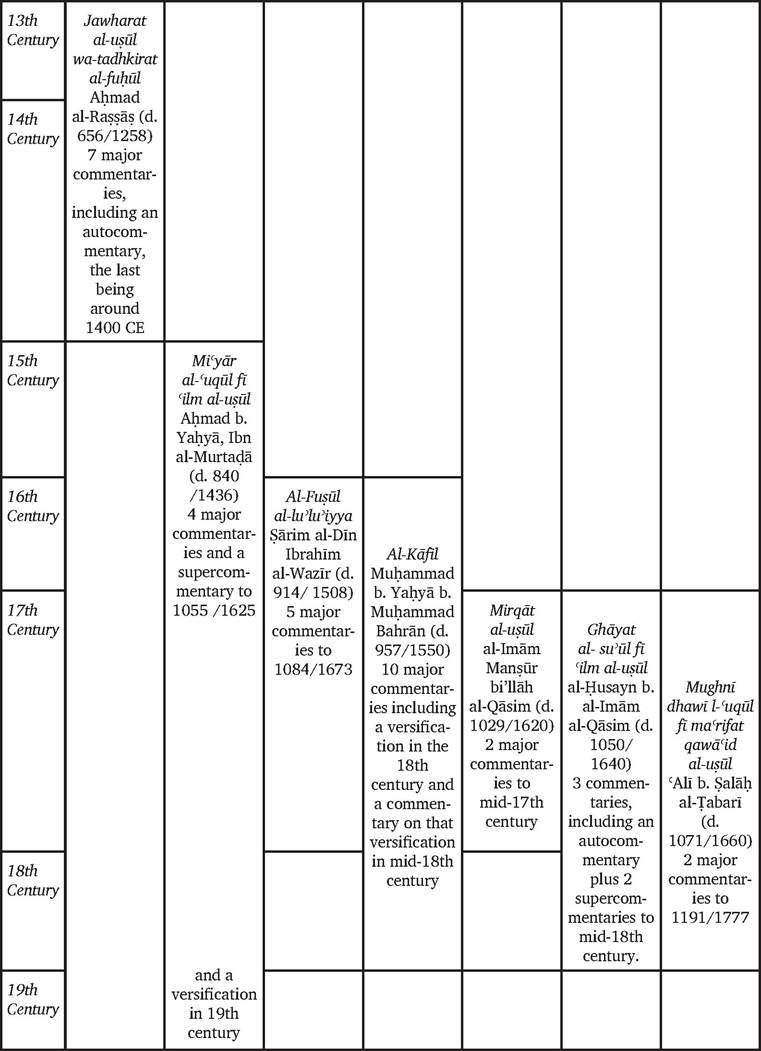
Table 1.1 Zaydi usul works from the 13th to 19th century
More on the topic Zaydi usul:
- Shiti usul, in general, has received little attention in scholarly discussions of Islamic legal theory. Whilst Twelver usul has gained some attention, there is almost no coverage of the Ismatili and Zaydi usul traditions.[1]
- Twelver usul
- IJTIHAD IN LEGAL THEORY (usul al-fiqh)
- Ismacili usul
- XII USUL AL-FIQH: BEYOND TRADITION1
- Qantarat al-wusul ila cilm al-usul of al-Mu’ayyadi (d. c. 1044/1634)
- Chapter 8 Why Early Muslims Divided into Sects? A Chapter from the Mukhtasar al-usul of cAli b. Muhammad b. al-Walid (d. 612/1215)1
- Chapter 1 Are Rulings of the Prophet Due to Ijtihad and Are all Mujtahids Always Correct? A Chapter from the Sharh. Zubdat al-usul of al-Mazandarani (d. 1081/1670)
- Rajani Kumail (ed.). Shiʿite Legal Theory: Sources and Commentaries. Edinburgh University Press,2023. — 352 p., 2023
- Introduction1