Definitions
Labour is defined by the presence of regular uterine contractions and the resultant cervical change. Induction of labour refers to the use of medications or mechanical methods to stimulate contractions in a patient who is not in labour with the goal of causing labour and vaginal delivery.
The initial step is usually cervical ripening, a process which increases the readiness of the cervix to undergo induction. The readiness of the cervix to respond to induction methods is generally calculated by the Bishop score (Table 36.2). This is a widely used calculation, which takes into account the consistency, effacement, position, and dilation of the cervix along with the fetal station. There are modifiers that can be applied to the Bishop score, the most common of which uses the substitution of effacement for cervical length in centimetres. This is what is typically referred to as the ‘modified Bishop score’. Additional modifiers are listed in Table 36.2. A Bishop score of 8 or greater is generally considered favourable for induction although various different cut-offs have been reported (between 5 and 8). A favourable Bishop score is also considered the point at which the likelihood of successful vaginal delivery is similarTable 36.1 Methods of labour induction advised in the Ten Teachers textbook between 1917 and 2011
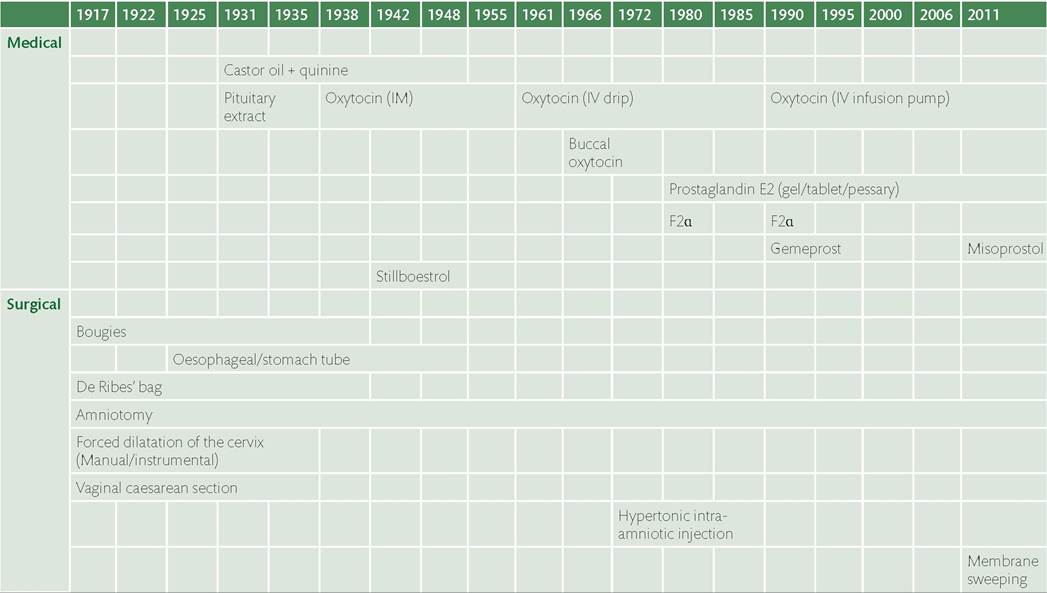
IM, intramuscular; IV, intravenous.
Bougie: a cylinder of celluloid or gum-elastic. Two or three are inserted through the cervix into the uterus under anaesthetic with vaginal packing to prevent expulsion. Vaginal caesarean section: under anaesthetic, the anterior vaginal wall and the anterior portion of the cervix are incised in the midline and the bladder pushed up. The membranes are ruptured and the baby is delivered through the resulting space.
Reproduced from Nabi HA, Aflaifel NB, Weeks AD. A hundred years of induction of labour methods. EurJ Obstet Gynecol Reprod Biol 2014 Aug;179:236-9. doi: 10.1016/ j.ejogrb.2014.03.045 with permission from Elsevier.
Table 36.2 Modified Bishop score
| Bishop score | Factor | ||||
| I Dilatation (cm) | I Cervical length (cm) | I Station | Cervical consistency | I Cervical position | |
| 0 | 1 | +1/2 | - | ||
Additional versions of the modified Bishop score add 1 additional point for every previous vaginal delivery or the presence of pre-eclampsia and 1 point is subtracted for nulliparity, postdate pregnancy, or the presence of PPROM.
to that when in spontaneous labour. Although initially developed only for multiparous women, this relationship is most profound in nulliparous women (7).
If a patient presents in spontaneous labour but requires the use of medication to increase the frequency or strength of contractions, this is referred to as augmentation of labour. This is generally used if there is inadequate cervical change.